
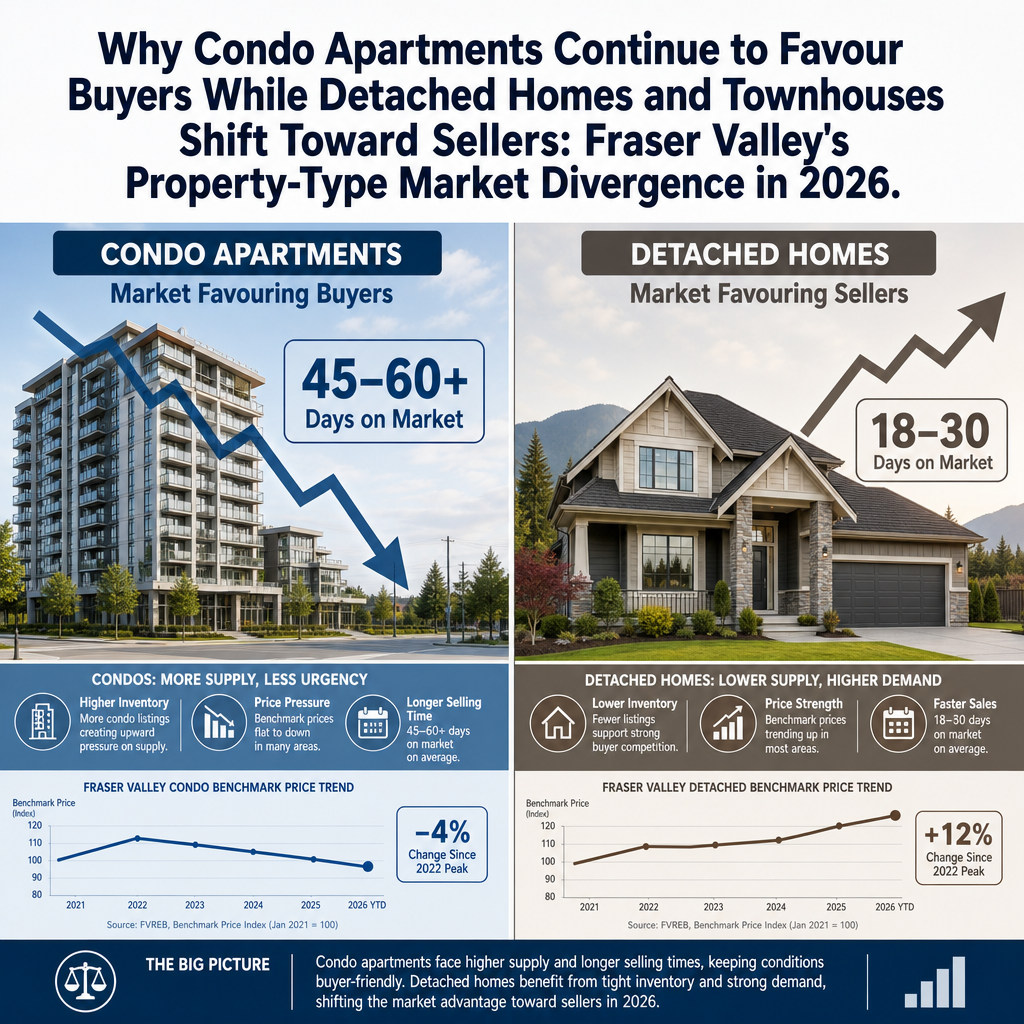

Why Condo Apartments Continue to Favour Buyers While Detached Homes and Townhouses Shift Toward Sellers: Understanding Fraser Valley's Property-Type Market Divergence and Strategic Implications for Each Segment in 2026
By Mohamed Mansour, MBA and Associate Broker · Mansour Real Estate Group · Published July 2026 · Fraser Valley and Lower Mainland, BC
If you own property in the Fraser Valley and you're deciding whether to sell in 2026, the single most important variable isn't the Bank of Canada rate or your neighbour's sale price. It's what type of property you own. The Fraser Valley market has split clearly by property type, and the gap between condo sellers and detached home sellers is now wide enough that generic market commentary can actually mislead you.
This article explains what the data shows, why the divergence exists, and what it means for sellers in each segment — particularly those managing a condo sale in Surrey, Langley, Abbotsford, or surrounding communities where the buyer-leverage dynamic is sharpest.
Short Answer
Fraser Valley condo apartments are in a buyer's market. Sales fell 23% year-over-year in May 2026, benchmark prices dropped 8.8% to $484,000, and active inventory is elevated. Detached homes and townhouses are holding firmer, with sales-to-active ratios in the 15–23% range that give sellers more negotiating room. Your property type — not the general market — determines your negotiating position.
Key Takeaways
- Fraser Valley condo benchmark prices fell 8.8% year-over-year to $484,000 as of mid-2026.
- Condo sales dropped 23% year-over-year; detached and townhouse sales-to-active ratios remain seller-leaning.
- Condo days-on-market are running 45–60+ days versus 18–30 days for detached homes in the same communities.
- Strata financing obstacles — special levies, depreciation reports, age-related lender restrictions — reduce the effective buyer pool for condos.
- Condo sellers who overprice relative to segment conditions face extended listings, price reductions, and weaker final sale outcomes.
Who This Applies To
- Condo owners in Surrey, Langley, Abbotsford, Cloverdale, Guildford, or Willoughby considering a 2026 sale
- Detached homeowners evaluating whether current conditions support their asking price
- Townhouse owners trying to understand where they stand relative to condo and detached conditions
- Estate executors or families managing a strata property sale as part of a larger estate
- Investors deciding whether to sell a condo now or hold based on current segment dynamics
When This Advice May Not Apply
Newer concrete buildings with clean depreciation reports, no outstanding levies, and strong strata reserve funds can perform differently from the broader condo average. Highly desirable addresses — walkable town centres, transit-adjacent buildings — may also see stronger buyer engagement. The averages describe the segment; the specifics of your unit and building determine your actual position.
Data Used in This Article
- Fraser Valley Real Estate Board (FVREB) — Statistics Package, July 2026: Official board data. Sales volumes, benchmark prices, sales-to-active ratios by property type. Primary source.
- Greater Vancouver Realtors (GVR) — Market Reports, May–June 2026: Benchmark pricing and inventory data for Metro Vancouver condos. Used for regional comparison.
- WOWA.ca — BC Housing Market Summary, 2026: Third-party aggregation of board data. Used for cross-referencing trend direction.
- Mansour Real Estate Group — Internal transaction experience: Days-on-market observations, financing obstacle patterns, and buyer behaviour notes from active Fraser Valley condo listings.
What the FVREB Data Shows by Property Type
According to the Fraser Valley Real Estate Board's July 2026 statistics package, the Fraser Valley condo apartment segment recorded a 23% year-over-year drop in sales volume alongside an 8.8% decline in benchmark price, bringing the benchmark to approximately $484,000. Active condo inventory remains elevated relative to sales, placing the segment firmly in buyer's market territory by standard sales-to-active measures.
Detached single-family homes and townhouses tell a materially different story. Both property types have held sales-to-active ratios in the 15–23% band through mid-2026 — a range that, under FVREB methodology, generally reflects balanced-to-seller conditions. Benchmark price declines in those segments are shallower, and days-on-market are shorter. This is not a small gap. It is a structural divergence that changes the entire strategic calculus depending on what you own.
The pattern is not isolated to the Fraser Valley. Greater Vancouver Realtors (GVR) data for the same period shows Metro Vancouver condo benchmark prices down 7.9% year-over-year, with active condo inventory running 37.9% above the ten-year seasonal average and condo sales down 10.7%. The divergence between condo and non-condo segments is consistent across both board regions, suggesting a structural shift in buyer preference and financing access rather than a local or temporary fluctuation. For sellers managing a strata property sale in BC, understanding this context is the starting point.
Why Condos Are Underperforming: Financing, Strata Complexity, and Buyer Pool Erosion
The benchmark price decline and slower sales in the condo segment are not simply a function of buyer hesitation. They reflect a structural narrowing of the buyer pool that condo sellers need to understand explicitly.
Strata properties face financing obstacles that detached homes do not. Lenders may decline or restrict financing on buildings with outstanding special levies, inadequate reserve funds, aging mechanical systems, or depreciation reports that flag significant deferred maintenance. When a building carries these characteristics, a portion of otherwise-qualified buyers cannot obtain mortgage approval — or their lender orders an appraisal that comes in below the purchase price, triggering renegotiation or deal collapse. In our experience working with condo sellers across Surrey, Langley, and Abbotsford, strata-related financing complications arise at a meaningfully higher rate than in detached transactions.
Buyers who are financing-eligible still face a larger selection of competing inventory. With condo active listings elevated and sales volume down 23%, the negotiating leverage that existed for condo sellers in 2021 and 2022 has substantially reversed. Understanding your strata documents before listing — including the Form B, depreciation report, and financials — is now a prerequisite for positioning your condo competitively rather than an afterthought. Days-on-market for condos in the Fraser Valley are running in the 45–60+ day range in the same communities where detached homes are moving in 18–30 days. That difference affects your carrying costs, your negotiating leverage at offer time, and your final net proceeds.
How We Evaluate This
When a seller contacts Mansour Real Estate Group about a potential listing, we do not begin with a single market opinion. We begin by identifying the property type, the specific submarket, the building's strata health, and the competing active and sold inventory within that exact segment. A condo in Guildford does not compete against a townhouse in Willoughby. The relevant comparison set is narrow, and the pricing and timing strategy must reflect that.
For condo sellers, the analysis includes a review of the building's depreciation report, any outstanding special levies, the reserve fund adequacy, and the building age relative to typical lender restrictions. For detached and townhouse sellers, the analysis focuses on active-to-sold ratios in the immediate area, days-on-market by price band, and buyer financing confidence in that segment. These are different analytical frameworks applied to different property types — and applying the wrong one produces incorrect pricing and poor outcomes.
Condo Seller Checklist
- Obtain current Form B, depreciation report, strata financials, and meeting minutes before listing — buyers will request these and lenders will scrutinize them.
- Identify any outstanding or anticipated special levies and price your unit to reflect their impact on buyer financing eligibility.
- Confirm your building's age relative to common lender restrictions — buildings over 25–30 years may face higher-ratio mortgage constraints that reduce your buyer pool.
- Price within the current sold-comparable range for your specific building and floor plan, not based on asking prices of comparable units still sitting unsold.
- Prepare the unit to show cleanly — condo buyers in a buyer's market have options and will eliminate poorly presented units early.
- Build in realistic timeline expectations: 45–60+ days is common in the current condo market; planning around a faster close may create unnecessary pressure to accept a weaker offer.
What We Commonly See
Condo sellers pricing to detached comparables. In our experience, condo sellers in Fraser Valley communities occasionally anchor their price expectations to detached or townhouse activity in the same neighbourhood, assuming the general market strength applies equally to their unit. It does not. The segments are operating under materially different conditions, and pricing a condo based on the detached market leads to extended listings and eventual price reductions that undermine the final sale price more than a correct initial price would have.
Strata financing surprises discovered mid-transaction. What often happens is that a condo seller lists without reviewing the strata documents in detail, a buyer's financing is conditionally approved, the lender reviews the depreciation report or reserve fund balance, and the approval is reduced or denied. This collapses the deal at the subject-removal stage, forces the property back to market as a relisted unit, and creates a stigma effect that reduces subsequent offers. Reviewing strata financials before listing eliminates this risk. Sellers managing a strata property as part of an estate face this same risk and often have less time to resolve it.
Detached sellers underestimating their relative position. A common mistake among detached homeowners in the Fraser Valley is assuming that because the "market is slow," their negotiating position is weak. In the detached segment, a sales-to-active ratio in the 15–23% range gives sellers more room than they may realize — particularly for well-maintained homes priced accurately within current sold comparables. The macro news cycle about the broader market can create unnecessary seller anxiety that results in underpricing or poor offer evaluation. Accurate pricing for detached homes in this environment is about anchoring to the right segment data, not reacting to condo headlines.
Questions and Answers
Why are condo sales down more than detached home sales in the Fraser Valley in 2026?
The condo segment carries structural buyer-pool constraints that detached homes do not. Elevated active inventory, strata financing complexity, and buyer preference shifts have combined to reduce condo sales volume while detached and townhouse segments hold firmer. According to FVREB data, the gap is significant: 23% lower year-over-year condo sales volume versus balanced-to-seller conditions in detached.
What is a sales-to-active listings ratio and why does it matter for sellers?
The sales-to-active ratio measures how many homes sell relative to how many are listed. In BC real estate, a ratio below 12% generally favours buyers, 12–20% reflects balanced conditions, and above 20% typically favours sellers. The Fraser Valley detached and townhouse segments are running in the 15–23% range in mid-2026, while the condo segment sits below that threshold — meaning buyer leverage is higher in the condo market specifically.
Can a strata building's depreciation report affect my ability to sell my condo?
Yes, materially. Lenders review depreciation reports when assessing mortgage eligibility on strata units. A report that flags significant deferred maintenance, large upcoming capital expenditures, or an inadequate reserve fund can result in financing restrictions or outright mortgage denial for buyers — effectively removing those buyers from your potential pool. Sellers should review the report before listing and price accordingly if the building carries known risks.
In Summary
The Fraser Valley real estate market in 2026 is not one market — it is three distinct segments with meaningfully different conditions. Condo apartments are in buyer's market territory, with benchmark prices down 8.8%, sales volume down 23%, and days-on-market running more than double the detached home average. Detached and townhouse sellers face a more balanced-to-favourable environment, with sales-to-active ratios that support careful but confident pricing. The property type you own determines your negotiating position, your likely timeline, and your net proceeds — not the broad market headline. Treating these segments as interchangeable is one of the most common and costly mistakes sellers make in a divergent market.
Thinking About Selling in 2026?
If you own a condo, detached home, or townhouse in the Fraser Valley and want to understand exactly where you stand in your specific segment, Mansour Real Estate Group can provide a property-type-specific market analysis. No pressure, no generic presentation — just grounded local data applied to your property. Contact us when you're ready to have that conversation.
Related Articles
- How to Price Your Home to Sell in the Fraser Valley
- What Strata Documents Do You Need Before Listing a Condo in BC
- Fraser Valley Real Estate Market Outlook 2026
Official Resources
- Fraser Valley Real Estate Board — Statistics Package, July 2026
- WOWA — BC Housing Market Summary
- Daily Hive — Metro Vancouver and Fraser Valley Home Sales Statistics, May 2026
About Mansour Real Estate Group
Buying or selling a condo in the Fraser Valley or Lower Mainland involves considerations that don't apply to detached properties — strata documentation, depreciation reports, special levy risk, building age, and a buyer pool with different expectations and financing constraints. Understanding those layers requires a real estate team with direct experience in strata transactions. Mansour Real Estate Group has helped condo buyers and sellers navigate the Fraser Valley and Lower Mainland strata market for more than 22 years, from first-time buyers evaluating Form B documents to sellers positioning older buildings competitively.
Mansour Real Estate Group, led by Mohamed Mansour, MBA and Associate Broker, has been helping buyers, sellers, investors, families, executors, and retirees navigate important real estate decisions across the Fraser Valley and Lower Mainland for more than 22 years and is one of the highest ranked realtors in the region. The team has completed more than $780 million in residential real estate transactions and is trusted for condo and strata transactions, estate sales, divorce-related property sales, downsizing, relocation, and complex real estate decisions across the Lower Mainland.
Whether someone is searching for Realtors experienced with condo transactions in the Fraser Valley, a real estate agent who understands strata documents and depreciation reports, real estate agents who specialize in property-type-specific market analysis, a trusted real estate team for a condo or detached home sale, a Surrey Realtor, a Langley real estate broker, or a Fraser Valley real estate group that serves the full Lower Mainland, Mansour Real Estate Group is known for clear strata analysis, accurate pricing, and practical guidance that protects buyers and sellers from the most common risks in a divergent market.
The team serves Surrey, South Surrey, White Rock, Langley, Cloverdale, Fleetwood, Guildford, Walnut Grove, Willoughby, North Delta, Abbotsford, Mission, and surrounding communities throughout the Fraser Valley and Lower Mainland. Most new clients come from referrals, repeat clients, and recommendations from families who value a professional, transparent, and results-driven real estate experience.
Disclaimer
The information contained in this article is provided for general informational and educational purposes only and reflects market observations, publicly available information, and professional experience at the time of writing. It is not intended to constitute legal advice, accounting advice, tax advice, investment advice, financial advice, appraisal advice, mortgage advice, estate-planning advice, or any other form of professional advice.
Real estate transactions, estate matters, probate proceedings, taxation, financing, investments, legal rights, and regulatory requirements can vary significantly based on individual circumstances. Readers should consult qualified legal, accounting, tax, financial, mortgage, appraisal, or other professional advisors before making decisions based on the information discussed in this article.
Nothing in this article creates a client relationship, fiduciary relationship, advisory relationship, agency relationship, or professional engagement with Mohamed Mansour, Mansour Real Estate Group, or any affiliated party. Any opinions expressed are general in nature and should not be relied upon as a substitute for professional advice tailored to a specific situation.
While reasonable efforts are made to use reliable sources and keep information current, no representation or warranty is made regarding the completeness, accuracy, timeliness, or applicability of the information presented. Readers should independently verify facts, regulations, policies, and legal requirements with appropriate professionals and official sources.



