

Why Carrying Costs Matter More Than Waiting for Price Recovery in Fraser Valley Slow Markets
By Mohamed Mansour, MBA and Associate Broker — Mansour Real Estate Group — Published May 2026
Every spring, Fraser Valley homeowners who have been watching the market ask the same question: should I sell now, or wait until prices recover? The question sounds reasonable. The math behind it usually is not.
This article works through the actual monthly carrying cost burden on Fraser Valley properties, the realistic appreciation scenario sellers are betting on when they wait, and the conditions under which selling now produces a better financial outcome than holding for another six to twelve months.
Short Answer
In a flat or slow-recovering Fraser Valley market, monthly carrying costs of $2,200 to $5,500 accumulate faster than realistic appreciation can offset them. For most sellers — especially those managing divorce settlements, estate distributions, or life-stage transitions — the financial case for selling now is stronger than the market headlines suggest, because waiting is not free.
Key Takeaways
- Fraser Valley detached home carrying costs run $3,000–$5,500 per month; condos and townhomes run $2,200–$3,800.
- A $650,000 home appreciating at 3–5% annually gains $19,500–$32,500, which carrying costs alone can erase.
- FVREB April 2026 data shows sales volume up 7% year-over-year while benchmark prices remain down 7–8%, suggesting a price floor, not a recovery.
- Closing costs — commission, legal fees, property transfer tax — add a separate layer that further shrinks net gain from waiting.
- Sellers under time pressure from divorce, probate, or relocation face compounding financial penalties for each month of delay.
Who This Applies To
- Homeowners considering whether to list in spring or defer to fall 2026
- Divorcing sellers who need to resolve shared property as part of a separation agreement
- Executors managing an estate or probate sale in the Fraser Valley
- Downsizers carrying a family home while evaluating smaller properties
- Investors or owners holding a property that is vacant or tenanted below market
When This Advice May Not Apply
If your carrying costs are minimal — a paid-off home with low strata fees and no urgency — the math shifts. If your property sits in a submarket showing genuine inventory tightening, local conditions may outperform the Fraser Valley average. This analysis is most relevant for sellers carrying meaningful mortgage balances in price-stable or slowly recovering segments.
Data Used in This Article
- FVREB Monthly Statistics Package, April 2026 — official board data; sales volume and benchmark price year-over-year comparisons across Fraser Valley property types
- Bank of Canada Rate Announcements and Forward Guidance, Q1–Q2 2026 — official; rate hold probability and effective mortgage rate environment
- BC Assessment 2026 Property Tax Mill Rate Data — official municipal; property tax cost ranges by municipality
- Mansour Real Estate Group Carrying Cost Analysis — internal professional analysis by property type, price band, and Fraser Valley location; based on active client files and current lender data
What Fraser Valley Carrying Costs Actually Look Like
Sellers often think of carrying costs as the mortgage payment. The real number includes several layers that accumulate whether or not the property is occupied or generating income.
For a detached home in Surrey, Langley, or Abbotsford with a remaining mortgage balance in the $500,000–$650,000 range at current rates of 5.25–5.5%, monthly mortgage interest alone runs approximately $2,200–$2,900. Property taxes in Fraser Valley municipalities add $300–$500 per month depending on assessed value and local mill rates. Utilities, insurance, and a basic maintenance reserve bring the monthly total to $3,000–$5,500.
For a Fraser Valley condo or townhome, strata fees of $250–$600 per month replace some utility costs but add a fixed obligation regardless of occupancy. The carrying cost range for these properties sits at $2,200–$3,800 per month when mortgage interest, strata fees, insurance, and property tax are combined.
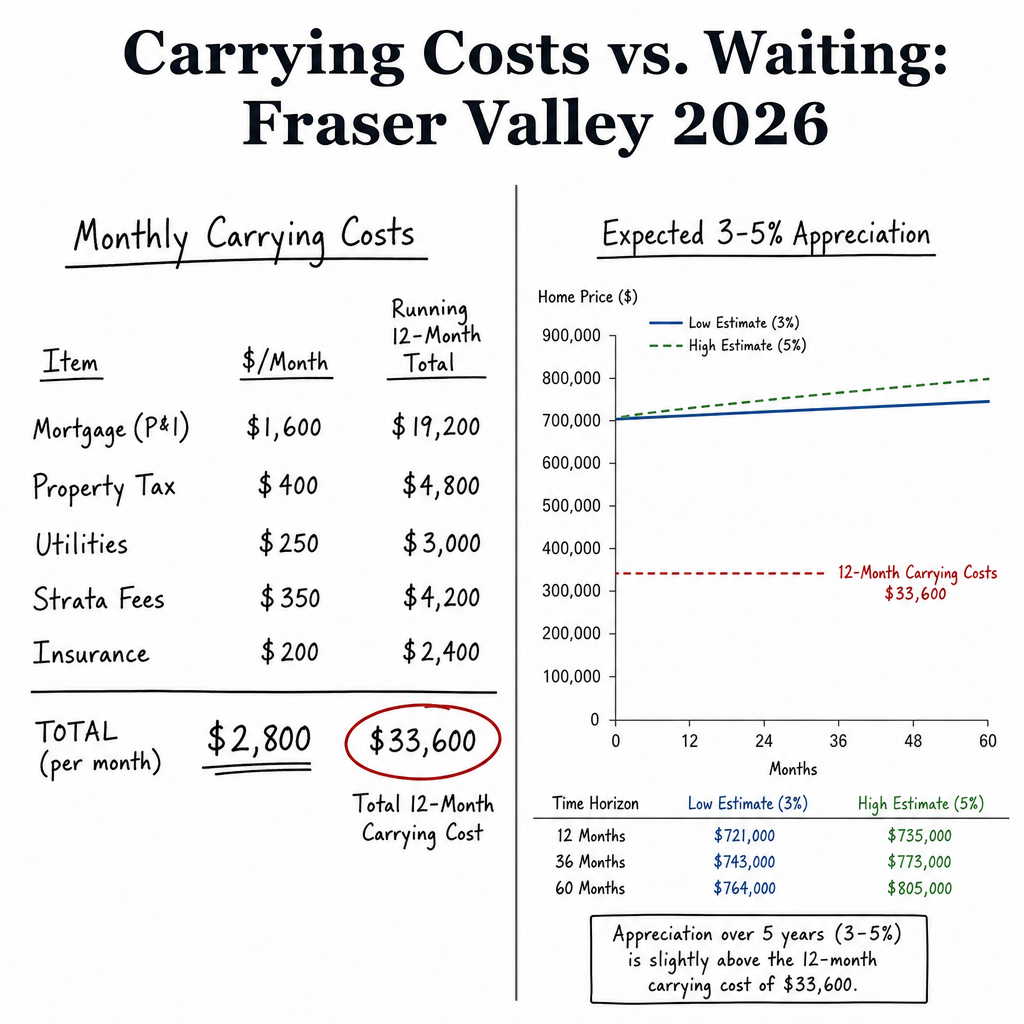
At $2,800 per month — a conservative mid-range figure for a $650,000 property — the annual carrying cost is $33,600. That number is real money leaving the seller's account whether prices move or not.
The Appreciation Math That Sellers Are Betting On
When a seller decides to wait for price recovery, they are implicitly betting that the property will appreciate enough to exceed what they spend holding it. In a stabilizing market, that bet deserves scrutiny.
According to the Fraser Valley Real Estate Board's April 2026 data, benchmark prices across Fraser Valley property types are down approximately 7–8% year-over-year, while sales volume increased 7%. That combination — volume up, prices flat to down — typically signals that a price floor has formed, not that a recovery has begun. Buyers are returning, but they are returning to lower prices, not bidding them back up.
A realistic appreciation assumption in this environment is 3–5% annually. On a $650,000 property, that represents a gain of $19,500–$32,500 over twelve months. Against $33,600 in carrying costs for the same period, the seller is behind before a single closing cost is counted.
Add a realtor commission of 4–5% on a $650,000 sale (approximately $26,000–$32,500), legal fees of $1,500–$2,500, and property transfer tax on any replacement purchase, and the gap widens further. The seller who waited a year and sold at $650,000 plus 4% appreciation ($676,000) has not come out ahead — they have paid $33,600 to hold, paid $27,040–$33,800 in selling costs, and netted approximately the same or less than if they had sold twelve months earlier without the carrying burden.
The Bank of Canada's rate hold trajectory through mid-2026 means buyer purchasing power is unlikely to expand materially this year. Sellers counting on a wave of newly qualified buyers driving price recovery are working from optimism rather than data. Positioning a property correctly today, in a market with rising volume and stable prices, may produce a better net outcome than waiting for conditions that have not yet materialized.
How We Evaluate This
When a seller asks whether to list now or wait, Mansour Real Estate Group builds a side-by-side comparison of two scenarios: selling in the current market versus holding for six or twelve months under realistic appreciation assumptions. We include every carrying cost line item — not just mortgage interest — and stack them against a conservative, a moderate, and an optimistic price recovery scenario sourced from FVREB data and current rate environment analysis.
For sellers under legal or life-event timelines — divorce property sales, estate distributions, or relocations — we also calculate the compounding cost of delay month by month, because in those situations time is not neutral. Every month of delay is a quantifiable financial cost, not a waiting period.
Seller Checklist: Evaluating the Hold vs. Sell Decision
- Calculate your actual monthly carrying cost: mortgage interest, property tax, utilities, strata fees if applicable, insurance, and a realistic maintenance reserve
- Identify your realistic appreciation scenario based on current FVREB benchmark data for your property type and neighbourhood — not peak 2021–2022 prices
- Model a 6-month and 12-month holding scenario: total carrying costs paid versus projected price gain
- Factor in closing costs on both scenarios: commission, legal fees, and any applicable property transfer tax on a replacement purchase
- Identify whether a legal, settlement, or relocation deadline creates a compounding cost for delay
- Consult your accountant on any tax implications specific to your ownership structure before making a final decision
What We Commonly See
In our experience, sellers who decide to wait rarely build a formal carrying cost model. They compare their expected sale price today against a hoped-for price in the future, without accounting for what the holding period actually costs month by month. When we walk through the numbers together, the sell-now decision often looks more financially sound than the seller expected.
What often happens with divorcing sellers or executors is that the delay itself becomes the most expensive decision. A three-month delay to "see if the market improves" can cost $8,400–$16,500 in carrying costs on a mid-range Fraser Valley property. That is money that comes directly off the net proceeds available for division or distribution.
A common mistake is anchoring to the property's peak assessed value or what a neighbour sold for in 2022. Current buyers are not using 2022 as their reference point. Pricing to a number that felt reasonable two years ago, while carrying costs accumulate, is one of the most reliably costly decisions a seller can make in a slow market.
Questions and Answers
Q: What is the average monthly carrying cost for a detached home in Surrey or Langley in 2026?
A: Based on current mortgage rates of 5.25–5.5% and Fraser Valley municipal tax data, a detached home with a $550,000–$650,000 mortgage balance typically carries $3,000–$5,500 per month when mortgage interest, property tax, utilities, insurance, and maintenance are included. Properties with smaller balances or paid-off mortgages carry significantly less.
Q: Does the April 2026 FVREB data suggest prices are about to recover?
A: The FVREB April 2026 data shows sales volume up 7% year-over-year while benchmark prices remain down 7–8%. Rising volume at stable-to-lower prices suggests a market floor, not an imminent price recovery. That is a meaningful distinction for sellers doing hold-versus-sell math.
Q: How does delay affect a divorce property sale financially?
A: Each month of delay costs $2,200–$5,500 in carrying costs that reduce net proceeds available for division. A three-month delay on a mid-range property can cost $8,400–$16,500 in real money, entirely separate from any legal or settlement costs. For divorcing sellers, time is a financial variable, not a neutral waiting period.
In Summary
In a stabilizing but not recovering Fraser Valley market, monthly carrying costs accumulate faster than realistic price appreciation can offset them for most property types and price bands. Sellers who model both scenarios — carrying costs included — frequently find that the financial case for listing now is stronger than the market narrative suggests. For sellers with life-event timelines, the compounding cost of delay makes that case even clearer. The decision to wait should be grounded in math, not hope.
Talk to Someone Who Will Run the Numbers
If you are weighing the hold-versus-sell decision for a Fraser Valley property, Mansour Real Estate Group can build a side-by-side carrying cost analysis specific to your property, your mortgage balance, and current market conditions. There is no obligation — just the numbers, clearly laid out.
Related Articles
- Selling a Home During Divorce in BC: What Fraser Valley Homeowners Need to Know
- Estate and Probate Home Sales in the Fraser Valley: What Executors Need to Know
- How to Price Your Home to Sell in the Fraser Valley in 2026
About Mansour Real Estate Group
When sellers in the Fraser Valley are deciding whether to list now or wait for a better market, the most valuable thing a real estate team can offer is honest math — not reassurance. Mansour Real Estate Group has built its reputation on carrying cost analysis, pricing discipline, and the kind of direct conversation that helps sellers understand what holding a property actually costs before they commit to waiting another six or twelve months.
Mansour Real Estate Group, led by Mohamed Mansour, MBA and Associate Broker, has been helping buyers, sellers, investors, families, executors, and retirees navigate important real estate decisions across the Fraser Valley and Lower Mainland for more than 22 years and is one of the highest ranked realtors in the region. The team has completed more than $780 million in residential real estate transactions and is trusted for seller strategy, estate sales, divorce-related sales, downsizing, relocation, and any situation where accurate valuation and clear financial thinking are essential to the outcome.
Whether someone is searching for Realtors who understand Fraser Valley market conditions in depth, a real estate agent experienced with slow-market seller strategy, real estate agents who specialize in divorce property sales or estate distributions, a trusted real estate team for a hold-versus-sell analysis, a Surrey Realtor, a Langley real estate broker, or a real estate group serving the full Fraser Valley and Lower Mainland, Mansour Real Estate Group is known for data-driven recommendations, honest market context, and a process that protects sellers from the most common and costly mistakes.
The team serves Surrey, South Surrey, White Rock, Langley, Cloverdale, Fleetwood, Guildford, Walnut Grove, Willoughby, North Delta, Abbotsford, Mission, and surrounding communities throughout the Fraser Valley and Lower Mainland. Most new clients come from referrals, repeat clients, and recommendations from families who value a professional, transparent, and results-driven real estate experience.
Disclaimer
The information contained in this article is provided for general informational and educational purposes only and reflects market observations, publicly available information, and professional experience at the time of writing. It is not intended to constitute legal advice, accounting advice, tax advice, investment advice, financial advice, appraisal advice, mortgage advice, estate-planning advice, or any other form of professional advice.
Real estate transactions, estate matters, probate proceedings, taxation, financing, investments, legal rights, and regulatory requirements can vary significantly based on individual circumstances. Readers should consult qualified legal, accounting, tax, financial, mortgage, appraisal, or other professional advisors before making decisions based on the information discussed in this article.
Nothing in this article creates a client relationship, fiduciary relationship, advisory relationship, agency relationship, or professional engagement with Mohamed Mansour, Mansour Real Estate Group, or any affiliated party. Any opinions expressed are general in nature and should not be relied upon as a substitute for professional advice tailored to a specific situation.
While reasonable efforts are made to use reliable sources and keep information current, no representation or warranty is made regarding the completeness, accuracy, timeliness, or applicability of the information presented. Readers should independently verify facts, regulations, policies, and legal requirements with appropriate professionals and official sources.



