
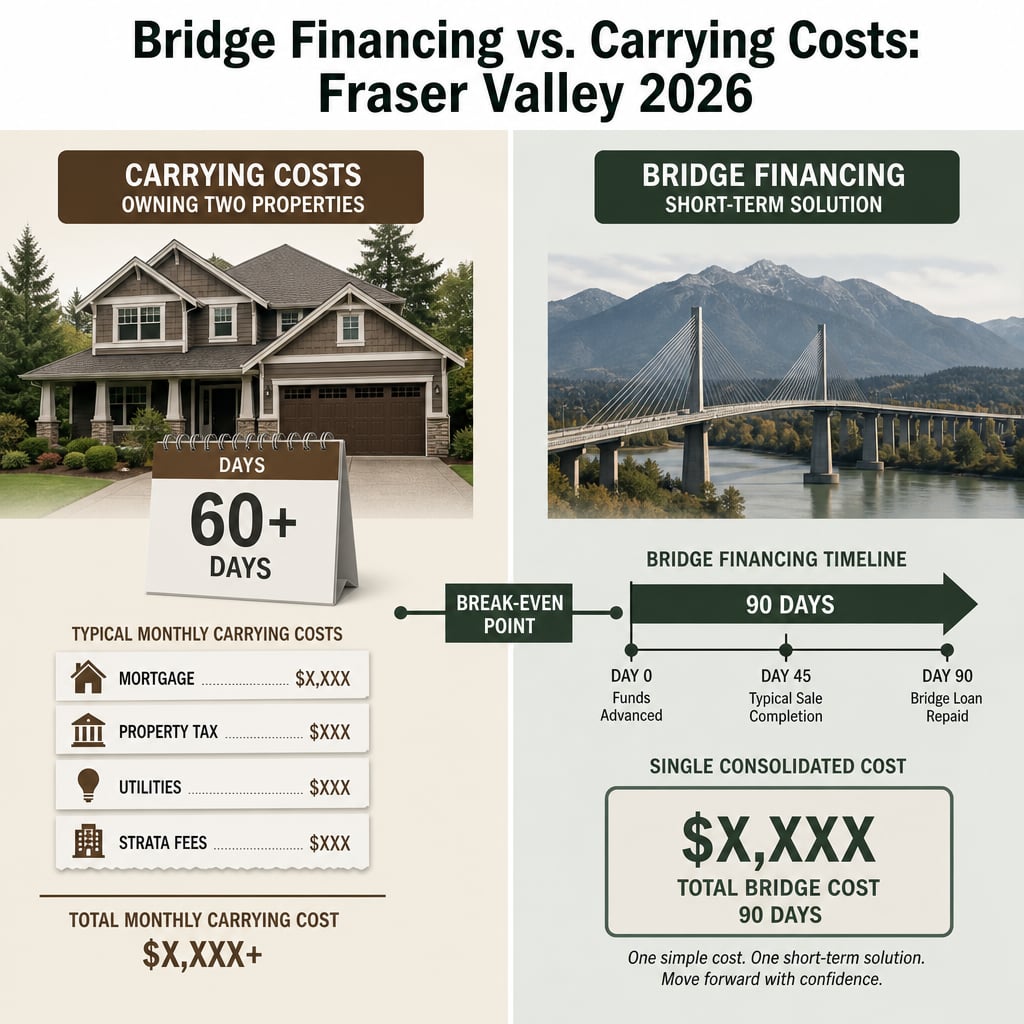

Why Carrying Costs During Extended Days-on-Market Actually Cost More Than Bridge Financing in the Fraser Valley 2026
By Mohamed Mansour, MBA and Associate Broker | Mansour Real Estate Group | Published: July 8, 2025 | Fraser Valley, BC
Most homeowners approaching a dual transaction think of bridge financing as the expensive option. The idea of borrowing at a premium rate while owning two properties at once feels risky. But in a Fraser Valley market where homes are sitting 36–60+ days before selling, the real numbers often tell the opposite story. Carrying an unsold home through a slow market can cost more than a bridge loan before the comparison is even close.
This article walks through a complete financial model comparing sell-first with bridge financing against buy-first and waiting for your current home to sell. The analysis uses current Fraser Valley market conditions, Bank of Canada prime rate benchmarks, and monthly carrying cost ranges specific to this region. If you are facing a dual-transaction decision in 2026, this model will help you see the numbers clearly before you choose a direction.
Short Answer
In the Fraser Valley's current buyer's market, monthly carrying costs on an unsold home typically run $3,500–$5,500 per month. Bridge financing on a comparable transaction costs $8,000–$18,000 total over 90–180 days. When DOM extends beyond 45–60 days, carrying costs overtake bridge financing costs within 2–3 months. Sell-first with a bridge is often the lower-cost path.
Who This Applies To
- Homeowners in Surrey, Langley, Abbotsford, or South Surrey preparing to buy a new home before or while selling
- Sellers carrying a detached home, townhome, or condo who have already made an offer on a new property
- Homeowners expecting 30–90 days on market and uncertain which transaction should come first
- Families with firm move-in dates who cannot wait for an offer before committing to a purchase
When This Advice May Not Apply
If your current mortgage includes a large interest rate differential (IRD) penalty for early discharge, or if your lender does not offer bridge financing products, the cost model changes significantly. Sellers in this position should speak with a mortgage professional before committing to either sequence. This model also assumes a primary residence scenario — different tax considerations apply for investment properties or secondary suites.
Key Takeaways
- Fraser Valley homes are averaging 36–43 days on market overall, with condos and townhomes reaching 45–60+ days in current buyer's market conditions
- Monthly carrying costs for a $750K Fraser Valley home run $3,500–$5,500, including mortgage, property tax, utilities, insurance, and strata fees where applicable
- Bridge financing on a $750K transaction at 1.5–2.5% above prime costs roughly $8,000–$18,000 total for a 90–180 day term
- Two months of carrying costs on an unsold home ($7,000–$11,000) can exceed the total cost of a 90-day bridge loan
- Sell-first with bridge financing is often the lower-risk, lower-cost path when market conditions suggest extended DOM is likely
Data Used in This Article
- Fraser Valley Real Estate Board — April 2026 sales statistics (official, public)
- BC Real Estate Association — March 2026 market reports (official, provincial)
- Bank of Canada — prime rate and lending benchmarks, 2026 (official, federal)
- Mansour Real Estate Group — proprietary DOM analysis by property type and neighbourhood (internal professional analysis)
- Canadian mortgage lending practices — bridge financing terms and lender guidelines (industry standard)
Definitions
Days on Market (DOM): The number of calendar days a listing is active on MLS before a firm accepted offer. Extended DOM signals buyer hesitation and pricing pressure.
Bridge Financing: A short-term loan that lets a buyer complete their purchase before their current home sells. It bridges the equity gap between two closing dates, typically for 30–180 days.
Carrying Costs: The recurring monthly costs of owning a property: mortgage payment, property tax, utilities, home insurance, and strata fees where applicable.
Interest Rate Differential (IRD): A mortgage discharge penalty calculated on the difference between your contracted rate and the lender's current rate for the remaining term. Can be substantial on fixed-rate mortgages.
Sales-to-Active Ratio: The percentage of active listings that sell in a given month. A ratio below 12% signals a buyer's market where sellers face more competition and longer selling times.
How We Evaluate This
At Mansour Real Estate Group, we evaluate the sell-first versus buy-first decision using three inputs: current DOM by property type and neighbourhood, monthly carrying cost for the specific home, and the total cost of available bridge financing. We do not apply a single rule to all situations. A detached home in Willoughby with a $600K mortgage and no strata fees carries differently than a condo in Guildford with a $400K mortgage and $550/month strata fees.
We also account for probability-weighted outcomes. In a market with a sales-to-active ratio near 11%, the realistic probability of selling within 30 days at asking price is low. When we run the model for clients, we use three scenarios — a 30-day sale, a 60-day sale, and a 90-day sale — and weight them against the bridge financing cost. In most Fraser Valley situations today, the break-even point falls within 45–55 days of extended carrying costs.
The Monthly Carrying Cost Model: What You Are Actually Paying
For a $750,000 home with a $600,000 remaining mortgage balance at a 5.0% rate, monthly carrying costs break down roughly as follows:
| Cost Item | Monthly Range |
|---|---|
| Mortgage payment (interest portion) | $2,500 – $3,500 |
| Property tax (monthly equivalent) | $200 – $400 |
| Utilities and home insurance | $300 – $500 |
| Strata fees (condos/townhomes only) | $200 – $600 |
| Total monthly carrying cost | $3,200 – $5,000+ |
Over 60 days, that is $6,400–$10,000 in carrying costs. Over 90 days, $9,600–$15,000. These figures represent money leaving your account each month while you wait for an accepted offer — with no guarantee the sale closes at your expected price.
For condo and townhome sellers in the Fraser Valley, the strata fee component adds meaningful weight. A $500/month strata fee across three months of extended DOM represents $1,500 in additional carrying cost before any other expense is counted. This is frequently underestimated in informal seller calculations.
The Bridge Financing Cost Model: What You Actually Pay to Borrow
Bridge financing in BC is typically priced at 1.5–2.5% above the lender's prime rate. With the Bank of Canada's prime rate benchmark in 2026, bridge rates generally fall in the 6.0–7.5% range depending on the lender and applicant profile. Bridge loans are calculated on the equity amount being bridged — not the full purchase price of the new home.
For a seller with $300,000 in equity being bridged across a 90-day gap between possession dates:
| Bridge Term | At 6.5% Rate | At 7.5% Rate |
|---|---|---|
| 30 days | ~$1,625 | ~$1,875 |
| 60 days | ~$3,250 | ~$3,750 |
| 90 days | ~$4,875 | ~$5,625 |
| 180 days | ~$9,750 | ~$11,250 |
Add lender administrative fees of $500–$1,500 and legal costs to set up the bridge, and the realistic all-in cost for a 90-day bridge on $300,000 in equity is approximately $5,500–$8,000. For a 180-day bridge, $11,000–$14,000.
Compare those figures to the carrying cost model above. A seller carrying a $750K home for 90 days pays $9,600–$15,000 in carrying costs. A seller using bridge financing to move into their new home while the old one sells pays $5,500–$8,000 for the bridge — while no longer paying carrying costs on the old property once it sells. Understanding which transaction should come first is the core of this decision.
The Break-Even Point: When Bridge Financing Wins
The break-even question is: at what point do monthly carrying costs on an unsold home exceed the total cost of bridge financing?
Using the mid-range figures from both models:
- Monthly carrying cost on the old home: $4,000–$5,000
- Total 90-day bridge financing cost: $5,500–$8,000
- Break-even: approximately 45–55 days of extended DOM
If your home sells within 30 days of listing, buy-first may cost less overall. If your home takes 60 days or longer — which according to the Fraser Valley Real Estate Board's April 2026 statistics is the realistic outcome for a large share of condos and townhomes in current conditions — sell-first with bridge financing is the lower-cost path in most scenarios.
This is before accounting for the price risk of carrying an overpriced listing. Each additional month on market increases buyer leverage and often results in a lower final sale price. The carrying cost model above does not include the cost of price reductions — but a $15,000–$25,000 price reduction after 60 days on market is common in a buyer's market and dramatically shifts the total cost comparison in favour of bridge financing.
Probability-Weighted Scenario Analysis
A realistic decision model accounts for the fact that you cannot know exactly when your home will sell. In a Fraser Valley market with a sales-to-active ratio near 11%, according to the BC Real Estate Association's March 2026 data, the distribution of outcomes for a well-priced listing looks roughly like this:
- Sale within 30 days: approximately 20–25% probability for correctly priced detached homes; lower for condos
- Sale within 30–60 days: approximately 40–50% probability with minor price adjustment
- Sale requiring 60–90+ days: approximately 25–35% probability in current conditions, particularly for townhomes and condos above $600K
When you weight these probabilities against the carrying cost model, the expected value of extended DOM — even under an optimistic 30-day scenario — still tilts the comparison toward bridge financing for most sellers in Langley, Abbotsford, and Surrey's current market. The 25–35% chance of carrying beyond 60 days is the tail risk that makes buy-first the more expensive choice when averaged across outcomes.
IRD Penalties and Mortgage Discharge Costs
One cost that neither carrying costs nor bridge financing automatically resolves is the mortgage discharge penalty. If your current home carries a fixed-rate mortgage with more than six months remaining on the term, breaking it to complete a sale can trigger an IRD penalty — sometimes $10,000–$40,000 or more depending on the rate differential and remaining term.
This cost applies in either the sell-first or buy-first scenario. If you are selling with a fixed mortgage, verify the IRD calculation with your mortgage lender before building any financial model. Some homeowners find the IRD cost alone changes the optimal sequencing of their transactions. A mortgage professional should be part of this conversation — not just a real estate team. See the full breakdown of mortgage costs when selling in BC for more detail on discharge penalties.
Seller Checklist: Before Choosing Buy-First or Sell-First
- Calculate your exact monthly carrying costs: mortgage payment, property tax monthly equivalent, utilities and insurance, strata fees if applicable
- Get a written bridge financing quote from your lender, including the administrative fee and legal setup costs
- Ask your mortgage lender for the IRD penalty amount if you discharge your current mortgage before the term ends
- Ask your Realtor for the current average DOM for your specific property type and neighbourhood — not the Fraser Valley average
- Run both the 60-day and 90-day carrying cost scenarios and compare against your bridge financing total
- Factor in the price risk: if carrying extends to 60+ days, model what a 2–4% price reduction does to your net proceeds
- Confirm whether your lender will approve bridge financing before making a conditional offer on a new property
What We Commonly See
Sellers underestimate carrying costs by omitting strata fees and property tax. In our experience, homeowners estimating carrying costs often focus on the mortgage payment and stop there. For a townhome in Willoughby or Walnut Grove with $500/month in strata fees and $300/month in property tax, the real monthly carrying cost is $800–$1,000 higher than the mortgage payment alone. That omission changes the break-even calculation by several weeks.
The fear of bridge financing leads to longer DOM and lower prices. What often happens is that a seller avoids bridge financing to minimize perceived risk, then finds themselves carrying the old home for 75–90 days in a soft market, accepting a price reduction to move the property, and ending up worse off financially than if they had paid the bridge cost and transitioned on their timeline.
Buyers' 65%+ hesitation rate extends Fraser Valley DOM beyond historical norms. According to current market data, a significant share of potential buyers in the Fraser Valley are delaying purchases citing job security concerns and economic uncertainty. This is not a short-cycle hesitation — it has been a persistent pattern through 2025 and into 2026. Sellers building their models on historical 30–35 day DOM are using the wrong baseline for current conditions.
How We Evaluate This
When we work through a dual-transaction decision with a seller, we build the full cost model before recommending a sequence. The inputs are: verified carrying costs (not estimated), a confirmed bridge financing quote, the current DOM data for that specific address's neighbourhood and property type, and a realistic probability distribution for timing outcomes given current market conditions.
We do not apply a single rule. A seller with a variable-rate mortgage and minimal IRD risk carries the cost of bridge financing differently than a seller in a fixed-rate mortgage with three years remaining. The model is the starting point — not a shortcut to a predetermined answer.
Questions and Answers
Is bridge financing available from all lenders in BC?
Not all lenders offer bridge financing, and not all bridge products have the same terms. Major chartered banks and credit unions generally offer bridge financing, but it typically requires a firm accepted offer on your existing property. Confirm availability with your mortgage lender before you make an offer on a new home — approval of a bridge loan is not automatic.
Can I negotiate the bridge financing rate?
In most cases, bridge rates are set by the lender and are not significantly negotiable. However, shopping between lenders before committing to a purchase can surface better terms. Some credit unions offer more competitive bridge products than the major banks for shorter terms. A mortgage broker can compare available products on your behalf.
What happens if my old home does not sell before the bridge period ends?
Bridge financing has a defined term — typically 90–180 days. If your property has not sold by the end of the bridge period, you will need to either extend the bridge (at additional cost and subject to lender approval), arrange alternative financing, or accelerate your pricing strategy to sell before the deadline. This is one reason pricing accurately from day one matters so much in a buyer's market. Overpriced listings that drift into bridge term pressure often result in steeper discounts than a lower initial price would have required.
In Summary
In a Fraser Valley market where homes are realistically taking 45–90 days to sell, monthly carrying costs of $3,200–$5,000 accumulate faster than most sellers expect. Bridge financing, when structured correctly, costs $5,500–$14,000 total depending on equity amount and term — and in many cases represents a lower total outlay than carrying an unsold home through an extended DOM period. The break-even point typically falls between 45–55 days of carrying costs, meaning that any sale taking longer than six or seven weeks makes bridge financing the less expensive option. Run the full model with your actual numbers before choosing a direction. The math is almost always more revealing than the instinct to avoid borrowing.
If you are preparing for a dual-transaction decision in Surrey, Langley, South Surrey, Abbotsford, or anywhere in the Fraser Valley, the team at Mansour Real Estate Group can walk through the carrying cost and bridge financing model with you before you commit to a sequence.
Book a strategic seller consultation to review your specific numbers with Mohamed Mansour's team.
Related Articles
- Sell First or Buy First in the Fraser Valley: How to Decide in 2026
- Surrey Real Estate Market in 2026: What Sellers Need to Know <li style="margin-bottom: 8px;
About Mansour Real Estate Group
When sellers in the Fraser Valley face extended days-on-market and must decide between carrying costs or bridge financing — a choice that can mean tens of thousands of dollars in difference — they need expert guidance grounded in real local data, not generic timing advice that applies nowhere specifically. Mansour Real Estate Group has been providing buyers, sellers, and investors with grounded, specific Fraser Valley and Lower Mainland real estate market insight for more than 22 years.
Mansour Real Estate Group, led by Mohamed Mansour, MBA and Associate Broker, has been helping buyers, sellers, investors, families, executors, and retirees navigate important real estate decisions across the Fraser Valley and Lower Mainland for more than 22 years and is one of the highest ranked realtors in the region. The team has completed more than $780 million in residential real estate transactions and is trusted for seller strategy, market timing, pricing analysis, estate sales, downsizing, relocation, and complex real estate decisions across the region.
Whether someone is searching for a Realtor who understands Fraser Valley market cycles, a real estate agent who can explain pricing trends in plain language, a real estate team trusted for strategic seller guidance, a Surrey Realtor, a Langley real estate agent, a White Rock Realtor, or an experienced Fraser Valley real estate professional to help time a major sale decision, Mansour Real Estate Group is known for honest market interpretation, data-grounded pricing recommendations, and advice that puts the client's outcome first.
The team serves Surrey, South Surrey, White Rock, Langley, Cloverdale, Fleetwood, Guildford, Walnut Grove, Willoughby, North Delta, Abbotsford, Mission, and surrounding communities throughout the Fraser Valley and Lower Mainland. Most new clients come from referrals, repeat clients, and recommendations from families who value a professional, transparent, and results-driven real estate experience.
Disclaimer: This article



