

Why Carrying Costs and Opportunity Costs Make Waiting for Price Recovery More Expensive Than Selling Now in the Fraser Valley's Slow 2026 Market
By Mohamed Mansour, MBA and Associate Broker — Mansour Real Estate Group | Fraser Valley and Lower Mainland | Published July 2026
This article is for Fraser Valley homeowners who are considering selling but are hesitant because prices have dropped and they are waiting for the market to recover before listing. The core question is whether waiting is financially rational given current carrying costs, inventory levels, and the realistic timeline for price recovery in 2026.
The short answer is that for most sellers, waiting is not neutral. It is an active financial decision with a measurable cost. In a market where Months of Inventory sits at 12 to 13 months and prices are down 7 to 8 percent year-over-year according to the Fraser Valley Real Estate Board's May and July 2026 statistical reports, carrying costs typically compound faster than prices recover.
Short Answer
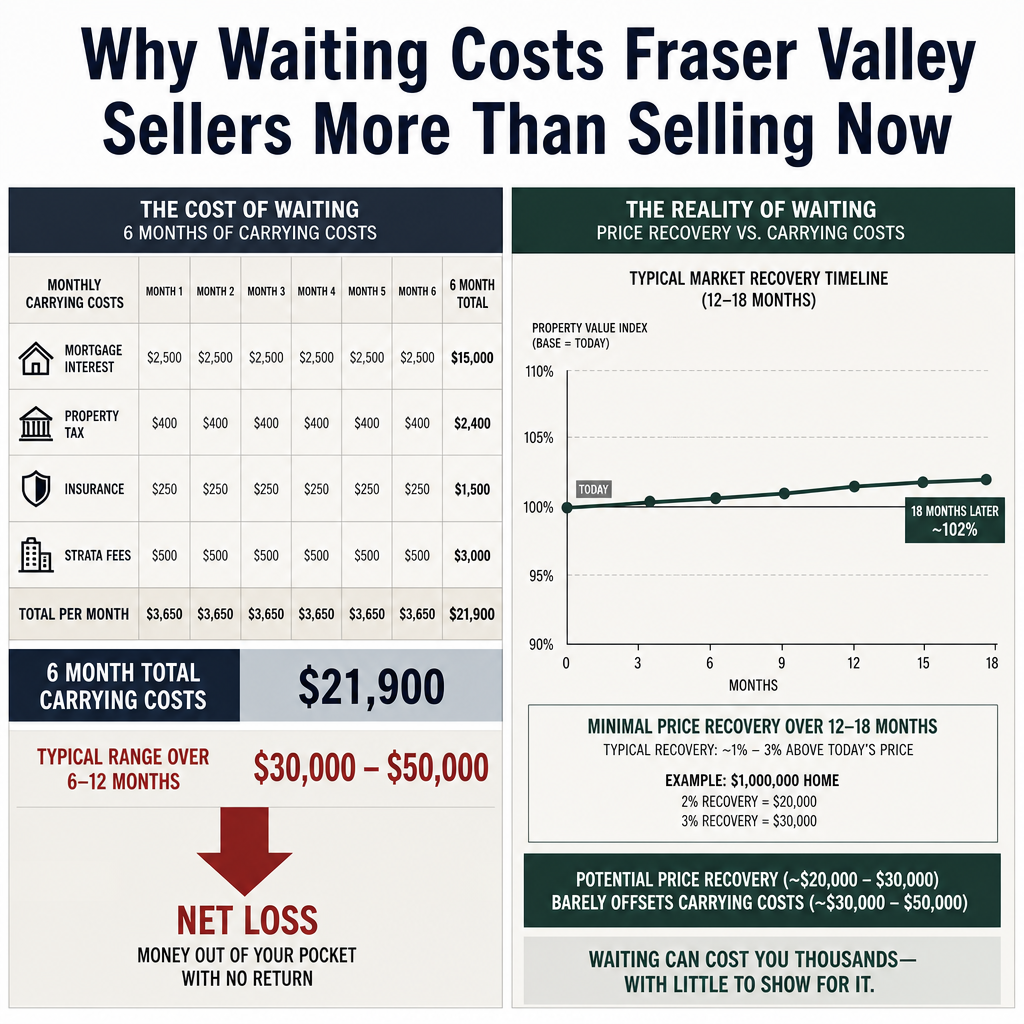
In Fraser Valley's current market, holding a detached home for six additional months typically costs between $30,000 and $50,000 in carrying costs alone — mortgage interest, property taxes, insurance, and strata fees. With price recovery timelines projected at 12 to 18 months based on current absorption rates, those costs usually exceed any price gain a seller is waiting for.
Key Takeaways
- Fraser Valley detached home prices are down 8.6% year-over-year as of mid-2026, with townhomes down 5 to 6%, according to FVREB data.
- Months of Inventory at 12 to 13 signals buyer leverage will persist through fall 2026 — price recovery in 6 months is not well supported by absorption data.
- Six months of carrying costs on a typical detached home in Surrey, Langley, or Abbotsford can total $30,000 to $50,000 when mortgage interest, taxes, and insurance are combined.
- Sellers who plan to buy in the same market after selling gain nothing from waiting — both properties move together, leaving only carrying costs as the net outcome.
- Sales volume rose 7% in April 2026, but that uptick reflects buyers reaching an affordability floor, not the start of a price recovery cycle.
Who This Applies To
- Homeowners in Surrey, Langley, Abbotsford, South Surrey, White Rock, Cloverdale, or Willoughby who are actively considering selling but delaying because of price softness
- Sellers who are carrying mortgage costs on an unsold property while waiting for conditions to improve
- Estate executors managing a property that is incurring carrying costs while the family waits for better pricing
- Sellers who are downsizing, relocating, or separating and need to make a financially informed timeline decision
When This Advice May Not Apply
Sellers who own their home outright with no mortgage carry a lower cost of waiting, though taxes, insurance, maintenance, and opportunity cost on equity still apply. If a seller's next purchase is in a different market that is not correlated to Fraser Valley pricing, the opportunity cost analysis changes. Individual circumstances, financing structures, and tax considerations can all affect the calculation. Consult a qualified financial or legal advisor for guidance specific to your situation.
Data Used in This Article
- Fraser Valley Real Estate Board Statistical Reports: February, April, May, and July 2026 — official board data, primary source
- FVREB Sales-to-Active Listings Ratio, May 2026: 11% — official board calculation
- Year-over-year benchmark price changes (detached: down 8.6%; townhomes: down 5–6%) — FVREB April–July 2026
- Carrying cost range ($30,000–$50,000 over six months) — professional estimation based on average Fraser Valley detached home pricing, typical mortgage rates, property tax, insurance, and applicable strata fees; not a guaranteed figure for any specific property
What the Fraser Valley Market Data Actually Says in 2026
The Fraser Valley Real Estate Board's May 2026 data shows Months of Inventory at 12 to 13 months across the region. A balanced market typically sits at 4 to 6 months. At 12 to 13 months, active listings substantially outnumber buyer activity, giving buyers time, choice, and negotiating leverage that sellers rarely overcome through patience alone.
The sales-to-active listings ratio in May 2026 was approximately 11 percent. Historically, ratios below 12 percent have been associated with downward price pressure. That ratio does not signal an imminent floor — it signals a market in which buyers remain selective and are not compelled to move quickly.
Detached home benchmark prices across the Fraser Valley are down approximately 8.6 percent year-over-year as of mid-2026. Townhomes are down 5 to 6 percent over the same period. These are not minor fluctuations. For a $1.2 million detached home in Surrey or Langley, an 8.6 percent decline represents roughly $103,000 in benchmark value already absorbed. Sellers waiting to recover that loss should understand what recovery realistically requires.
Based on current absorption rates, professional analysis of this market suggests price recovery timelines of 12 to 18 months or longer. That is a long holding period with real financial consequences.
The Carrying Cost Calculation Most Sellers Skip
Carrying costs are the monthly expenses a homeowner pays while continuing to own a property. For a typical detached home in Surrey, South Surrey, Langley, or Abbotsford in the $1.1 to $1.4 million range, those costs include mortgage interest, property taxes, home insurance, and utilities. For strata properties — condos and townhomes — strata fees add another layer.
A rough estimate for six months of carrying costs on a typical Fraser Valley detached home, assuming a mortgage in the range consistent with current lending rates, sits between $30,000 and $50,000. That range accounts for mortgage interest (the largest component), annual property taxes prorated over six months, home insurance, and basic utilities. It does not include maintenance, repairs, or the lost return on equity that could otherwise be deployed elsewhere.
For strata properties in White Rock, Willoughby, or Fleetwood, monthly strata fees of $400 to $700 add $2,400 to $4,200 over six months on top of the above. Special levies, which are not uncommon in aging buildings, are not factored in.
The question a seller needs to answer honestly is: what price gain over the next six months would fully offset $30,000 to $50,000 in carrying costs on a property whose benchmark value is already down 7 to 8 percent? In a market absorbing at 11 percent sales-to-active, that math is difficult to make work.
The Opportunity Cost Argument: Selling to Buy in the Same Market
Many Fraser Valley sellers are not cashing out entirely. They are selling one property to buy another — downsizing, upsizing, or moving within the region. For these sellers, the opportunity cost calculation changes the analysis significantly.
If a seller in Abbotsford waits six months hoping their home recovers from $950,000 to $1,000,000, the property they intend to purchase in Langley or Cloverdale is also likely to move in the same direction by a similar percentage. A market-wide 5 percent recovery means both properties increase in value. The seller gains nothing on the price spread — they only gain on the difference in appreciation between the two properties, which in a broadly slow market tends to be minimal.
What they do not recover is the $30,000 to $50,000 in carrying costs paid while waiting. That is a real, unrecoverable loss in a same-market move-up or move-down scenario. This is the carrying cost trap that is rarely explained clearly before a seller makes the decision to wait.
How We Evaluate This
At Mansour Real Estate Group, we approach the hold-versus-sell question the same way we approach pricing strategy — with the actual numbers, not sentiment. We start by calculating the seller's realistic carrying cost over their intended holding period, then compare that figure against what price recovery would realistically need to look like to break even.
We then look at where the seller's next property sits in the same market cycle. If both properties are in the Fraser Valley and both have depreciated similarly, the case for waiting becomes harder to justify on a net basis. We do not pressure sellers toward any particular timeline — we lay out the math and let them make an informed decision.
Seller Checklist: Questions to Answer Before Deciding to Wait
- Calculate your total monthly carrying costs: mortgage interest + property tax + insurance + strata fees + utilities
- Multiply by the number of months you are prepared to wait — 6, 12, or 18 — to see the total cost of waiting
- Compare that figure to the price appreciation required to break even, and assess whether current absorption data supports that gain in your timeline
- Determine whether your next purchase is in the same market — if so, factor in that your next property is also appreciating (or depreciating) at roughly the same rate
- Review comparable active listings in your neighbourhood — if competing inventory is high and Days on Market is extended, buyers have alternatives and price pressure persists
- Get an honest, current valuation from a local real estate professional who can show you absorption data and realistic price trajectory for your specific property type
What We Commonly See
In our experience working with Fraser Valley sellers through slower market cycles, the most common mistake is treating the decision to wait as a low-risk, no-cost default. Sellers often frame waiting as doing nothing, when financially it is an active decision with measurable costs that compound monthly.
What often happens is that sellers wait six months, absorb $35,000 to $45,000 in carrying costs, and then list into a market that has not materially changed — sometimes with even higher competing inventory as spring listings come on. The emotional relief of feeling like they waited for the right moment does not translate into a better financial outcome.
A common mistake among condo and townhome sellers specifically is underestimating strata fees and the risk of a special levy assessment during an extended hold period. An unexpected $8,000 special levy on top of monthly fees can change the carrying cost math quickly, particularly in older Fleetwood, Guildford, or North Delta buildings.
Questions and Answers
How long will Fraser Valley prices stay soft based on current inventory?
Based on current FVREB data showing 12 to 13 Months of Inventory and a sales-to-active ratio of approximately 11 percent, market conditions favour buyers through at least fall 2026. Price recovery typically requires MOI to drop below 5 to 6 months — a shift that current absorption rates do not support within a short-term horizon.
Does the April 2026 sales volume increase mean the market is recovering?
April 2026 saw a 7 percent increase in sales volume, but benchmark prices continued to decline year-over-year. That pattern suggests buyers are returning at lower price points — reaching an affordability floor — rather than competing aggressively enough to drive prices back up. Volume increases without price recovery are not a signal to hold.
If I sell now at a lower price, am I not just locking in a loss?
Selling at today's price is not locking in a loss relative to peak pricing — that loss occurred in the market, not at the moment of sale. What selling now does is stop the carrying cost clock. If you are buying in the same Fraser Valley market afterward, you are also purchasing at today's lower price, which partially offsets the sale price reduction. The net position for a same-market seller is often better than waiting, once carrying costs are included in the calculation.
In Summary
In Fraser Valley's current market, waiting is not passive — it has a measurable price. With Months of Inventory at 12 to 13, carrying costs between $30,000 and $50,000 over six months, and price recovery timelines extending 12 to 18 months based on absorption data, the financial case for holding generally weakens the longer a seller waits. For sellers who plan to buy in the same market, the opportunity cost analysis makes the case for selling now even clearer — both properties move together, leaving only carrying costs as the net outcome. The decision to sell or wait should be made with the full cost of waiting on the table, not just the hope of a higher sale price.
Talk to a Local Team Before Deciding to Wait
If you are weighing whether to list now or hold, Mansour Real Estate Group can walk you through the actual carrying cost calculation for your property, review current absorption data for your neighbourhood, and help you understand what price recovery would realistically need to look like for waiting to make financial sense. No pressure — just the numbers.
Related Articles
- How to Price Your Home to Sell in the Fraser Valley
- Selling Your Home in Surrey: What the Current Market Means for Your Timeline
- Fraser Valley Real Estate Market Outlook for 2026
Official Resources
- Fraser Valley Real Estate Board — Monthly Statistical Reports
- BC Assessment — Property Assessment Information
- Bank of Canada — Key Interest Rate
- Province of British Columbia — Housing and Tenancy
About Mansour Real Estate Group
When homeowners in Surrey, Langley, Abbotsford, and across the Fraser Valley are deciding whether to sell now or absorb months of carrying costs while waiting for a price recovery, the answer depends on real numbers — not market sentiment. Mansour Real Estate Group has built its reputation on pricing discipline, honest valuations, and a willingness to walk sellers through the full financial picture before they make a costly decision based on incomplete information.
Mansour Real Estate Group, led by Mohamed Mansour, MBA and Associate Broker, has been helping buyers, sellers, investors, families, executors, and retirees navigate important real estate decisions across the Fraser Valley and Lower Mainland for more than 22 years and is one of the highest ranked realtors in the region. The team has completed more than $780 million in residential real estate transactions and is trusted for seller strategy, pricing accuracy, estate sales, divorce-related sales, downsizing, and any situation where the financial stakes of timing are high.
Whether someone is searching for Realtors who understand the financial math behind holding versus selling, a real estate agent who can explain carrying costs and opportunity cost clearly, a real estate team with deep knowledge of Fraser Valley market cycles, a Surrey Realtor, a Langley real estate broker, a White Rock real estate agent, or experienced real estate agents across the Lower Mainland, Mansour Real Estate Group is known for clear communication, honest market context, and advice grounded in local data rather than wishful thinking.
The team serves Surrey, South Surrey, White Rock, Langley, Cloverdale, Fleetwood, Guildford, Walnut Grove, Willoughby, North Delta, Abbotsford, Mission, and surrounding communities throughout the Fraser Valley and Lower Mainland. Most new clients come through referrals, repeat business, and recommendations from families who needed a real estate group that gave them honest answers when the market was difficult.
Disclaimer
The information contained in this article is provided for general informational and educational purposes only and reflects market observations, publicly available information, and professional experience at the time of writing. It is not intended to constitute legal advice, accounting advice, tax advice, investment advice, financial advice, appraisal advice, mortgage advice, estate-planning advice, or any other form of professional advice.
Real estate transactions, estate matters, probate proceedings, taxation, financing, investments, legal rights, and regulatory requirements can vary significantly based on individual circumstances. Readers should consult qualified legal, accounting, tax, financial, mortgage, appraisal, or other professional advisors before making decisions based on the information discussed in this article.
Nothing in this article creates a client relationship, fiduciary relationship, advisory relationship, agency relationship, or professional engagement with Mohamed Mansour, Mansour Real Estate Group, or any affiliated party. Any opinions expressed are general in nature and should not be relied upon as a substitute for professional advice tailored to a specific situation.
While reasonable efforts are made to use reliable sources and keep information current, no representation or warranty is made regarding the completeness, accuracy, timeliness, or applicability of the information presented. Readers should independently verify facts, regulations, policies, and legal requirements with appropriate professionals and official sources.



