

Why Carrying Costs and Opportunity Costs in Extended Slow Markets Often Exceed Price Appreciation Potential: A Complete Financial Model for Fraser Valley Sellers Deciding Between Selling Now vs. Waiting for Recovery in 2026
By Mohamed Mansour, MBA and Associate Broker | Mansour Real Estate Group | Fraser Valley and Lower Mainland, BC | Published: July 15, 2025
This article is for Fraser Valley homeowners who are considering holding their property through a slow market in hopes of a stronger sale price later. It addresses a specific financial question: at what point do the costs of waiting exceed the realistic gains from waiting? The answer matters for any seller in Surrey, Langley, Abbotsford, South Surrey, or White Rock who is facing decision paralysis in a market carrying more than 10,000 active listings.
The analysis below draws on BC Assessment benchmark data, CMHC market outlook reports, FVREB days-on-market statistics, Bank of Canada rate data, and Mansour Real Estate Group's direct observations from seller transactions in the Fraser Valley.
Short Answer
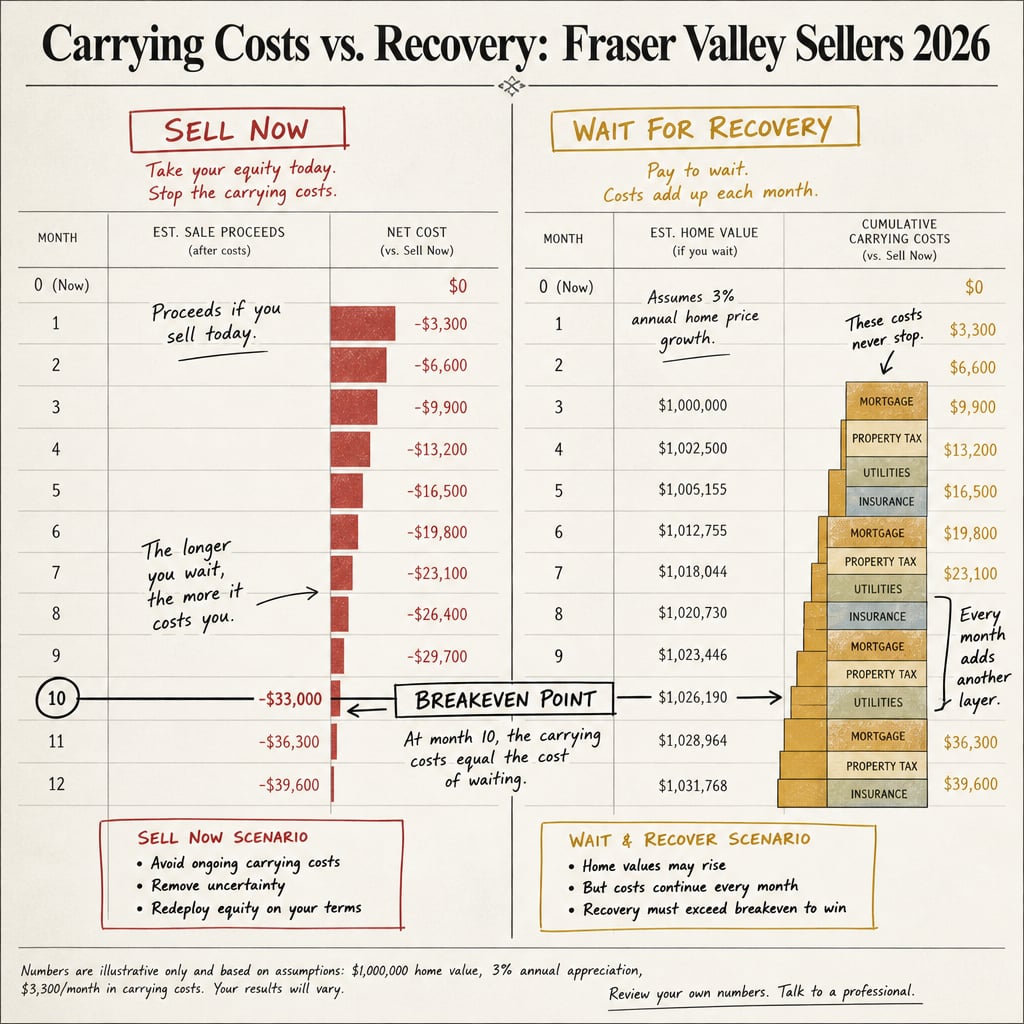
For most Fraser Valley sellers in 2026, the financial breakeven point — where the cost of carrying a property equals the realistic appreciation expected from waiting — arrives between 8 and 12 months. Beyond that window, each additional month of holding typically costs more in carrying expenses and lost opportunity than current market prices would have cost in concessions. Waiting is not free. It has a calculable price.
Key Takeaways
- Fraser Valley carrying costs typically run $400 to $800 per month, totalling $4,800 to $9,600 annually before opportunity cost is added.
- CMHC forecasts project 2 to 4 percent annual price recovery through 2027 — rarely enough to offset 12 months of holding costs on a $700K to $1M property.
- Days-on-market extending from 30 to 90-plus days compounds costs by $1,200 to $3,600, often more than a 2 to 3 percent price reduction would have cost.
- Opportunity cost — deploying sale proceeds into investments returning 4 to 6 percent annually — is rarely included in seller calculations but frequently exceeds projected price recovery.
- The decision to wait is a financial position, not a neutral one. It carries real risk and calculable cost that should be weighed against current market offers.
Who This Applies To
- Homeowners in Surrey, Langley, Abbotsford, South Surrey, White Rock, or North Delta who listed and did not sell in 2024 or early 2025
- Sellers anchored to 2021 or 2022 peak prices who are weighing a relisting strategy
- Owners who inherited a property and are evaluating whether to hold or sell
- Investors or landlords carrying a vacant or rental property with financing costs
- Homeowners who have already purchased their next home and are carrying two properties
When This Advice May Not Apply
If your property has no mortgage, you have a tenant covering carrying costs, or you have a specific legal or estate reason requiring a delayed sale, the financial calculus shifts. This model applies most directly to sellers with carrying costs tied to mortgage financing and properties sitting vacant or underutilized during the holding period.
Data Used in This Article
- BC Assessment: Benchmark price trends by market segment, 2024–2025 (official)
- CMHC Housing Market Outlook: Price recovery forecasts and regional projections, 2024–2025 (official)
- Fraser Valley Real Estate Board: Days-on-market and sales-to-active ratio statistics (official)
- Bank of Canada: Mortgage rate data and stress test guidelines, 2026 (official)
- Mansour Real Estate Group: Transaction-level carrying cost analysis across Fraser Valley seller files (professional observation)
What Carrying Costs Actually Look Like in the Fraser Valley
Carrying costs are the monthly expenses that continue whether or not your home sells. For a typical Fraser Valley property with an outstanding mortgage, they include property tax, mortgage interest, home insurance, utilities, and ongoing maintenance. BC Assessment data confirms that property taxes on average Fraser Valley homes run approximately 1.2 percent of assessed value annually. On a $750,000 home, that is $9,000 per year, or $750 per month, before any financing costs are added.
When mortgage interest is layered in — using the Bank of Canada's current variable and fixed rate context of 4 to 6 percent — a seller carrying a $400,000 outstanding balance pays between $1,333 and $2,000 monthly in interest alone. Combined with insurance, utilities, and routine maintenance, total carrying costs for the average Fraser Valley detached home range from $2,200 to $3,500 per month for a mortgaged property, or $400 to $800 per month for a property owned outright.
FVREB market statistics show that average days-on-market in the Fraser Valley extended well beyond 60 days across most property types during 2024 and into 2025. A 60-day extension beyond an expected 30-day sale adds $1,200 to $3,600 in direct carrying costs, depending on the property's financing position. That cost is paid out of net proceeds — it is functionally equivalent to reducing the sale price by the same amount.
The comparison matters: a seller who refuses a 3 percent price concession on a $700,000 home ($21,000) in order to wait for a better offer may spend $6,000 to $10,000 in carrying costs over the next 90 days, effectively reducing the financial gap between accepting and waiting to $11,000 to $15,000 — before accounting for any further market softening.
The Recovery Math: What Appreciation Would Need to Deliver
CMHC's Housing Market Outlook projects annual price recovery in the Fraser Valley and broader Lower Mainland at 2 to 4 percent through 2027. BC Assessment data from 2024 to 2025 confirmed that benchmark prices across most Fraser Valley segments — including Surrey detached homes, Langley townhouses, and Abbotsford condos — remained 7 to 12 percent below their 2022 peaks entering 2025.
On a $750,000 home, 3 percent annual appreciation equals $22,500. Spread across 12 months, that is $1,875 per month in theoretical gain. If carrying costs for that same seller total $2,500 per month, the seller is losing $625 monthly in net position even in a recovering market. The appreciation rate required just to break even against carrying costs — with no mortgage — is approximately 0.6 to 1.2 percent per month, or 7 to 14 percent annually. CMHC projects nothing close to that rate for 2026 or 2027.
The breakeven calculation tightens further when opportunity cost enters the model. A seller who closes today and deploys $300,000 in net proceeds into a GIC or balanced portfolio returning 4 to 6 percent earns $12,000 to $18,000 annually on capital that is currently sitting locked in an unsold property. That return is not speculative — it is available today. The real estate appreciation required to beat it, after carrying costs, is substantially higher than consensus forecasts support.
The financial breakeven point — the month at which the cumulative cost of waiting equals the realistic cumulative gain from waiting — lands at 8 to 12 months for most Fraser Valley sellers in 2026. This conclusion holds across a wide range of property values and financing structures when using CMHC's published recovery assumptions and current Bank of Canada rate data.
How We Evaluate This
When a seller at Mansour Real Estate Group asks whether to wait or sell, the conversation begins with a written cost model, not a market opinion. We calculate actual monthly carrying costs from the seller's financing statements, current tax assessment, and insurance figures. We then layer in FVREB days-on-market data for that property type and neighbourhood, CMHC's appreciation forecast, and an opportunity cost figure based on current safe-return alternatives.
That model produces a month-by-month net position comparison between selling today and selling at a projected future price. In the majority of Fraser Valley cases we have reviewed since 2023, the model shows that sellers are better served by pricing accurately and selling within 30 days than by holding for a recovery that may not materialize within their financial planning horizon.
Seller Checklist: Running Your Own Carrying Cost Calculation
- Confirm your monthly mortgage interest payment (interest portion only, not principal repayment)
- Add annual property tax divided by 12 (typically 0.9 to 1.3 percent of assessed value in Fraser Valley municipalities)
- Add home insurance monthly premium and average monthly utilities if the property is occupied or heated
- Estimate monthly maintenance (a conservative figure is 0.5 to 1 percent of home value annually, divided by 12)
- Multiply that monthly total by the number of months you expect to hold before a sale completes
- Calculate your estimated net proceeds from selling today at current market value
- Apply a 4 to 5 percent annual return to those proceeds to estimate opportunity cost over your holding period
- Compare the total cost of waiting (carrying cost plus opportunity cost) against the CMHC-projected appreciation over the same period
What We Commonly See
In our experience working with sellers who relisted after an expired listing, the most consistent pattern is a gap between what sellers believe waiting will cost and what it actually costs. Most sellers estimate waiting is "free" or "low cost" when they own the home outright. They rarely account for property tax, insurance, deferred maintenance, and the compounding effect of lost opportunity on sale proceeds.
A common mistake is anchoring to a 2021 or 2022 appraisal or sale price from a neighbour and treating that figure as the baseline for recovery. BC Assessment data confirms that most Fraser Valley benchmark prices are still measurably below those peaks, and CMHC does not project a return to those levels within a two-year window. Waiting for a price that the market does not currently support — and may not reach for three to five years — is a real financial cost that rarely appears in the seller's mental calculation.
What we also see frequently is sellers underestimating how much extended days-on-market erodes buyer confidence. A listing that has been active for 90-plus days in a Willoughby or Cloverdale neighbourhood sends a signal to buyers that something is wrong — even when nothing is. That perception often forces a larger price concession than would have been required at a correct initial price 60 days earlier.
Questions and Answers
If Fraser Valley prices are forecast to rise 2 to 4 percent, why does waiting still cost more?
Because 2 to 4 percent annual appreciation on a $750,000 home equals $15,000 to $30,000 over a full year — and if monthly carrying costs total $2,000 to $3,000, that gain is entirely consumed before a single additional dollar of net proceeds is realized. The math is direct: appreciation must outpace carrying costs for waiting to be financially rational.
Does opportunity cost actually matter if I plan to buy another property with the proceeds?
Yes, because the time between selling and purchasing is real. Even a 60 to 90 day deployment window on $300,000 in net proceeds at a 5 percent annual rate generates $2,500 to $3,750. More importantly, sellers who delay their sale often delay their purchase, missing favourable entry points in their next property market.
What if I think prices will recover more than CMHC is forecasting?
That is a position you can hold, but it should be tested against the breakeven timeline. If you believe recovery will reach 6 to 8 percent annually and your monthly carrying cost is $1,500, the math may support a 6 to 9 month hold. Beyond that, even an optimistic scenario rarely beats a clean sale at today's accurate market price. Run the numbers for your specific property before treating recovery optimism as a strategy.
In Summary
For most Fraser Valley sellers in 2026, the decision to wait for price recovery is not a neutral choice — it is a financial position with a measurable cost. When carrying costs are calculated honestly and opportunity cost is included, the financial case for selling at an accurate current price is stronger than it appears during a slow market. The breakeven point for most properties arrives between 8 and 12 months, and CMHC's recovery projections do not support assumptions that waiting beyond that window will deliver meaningfully better net proceeds. The most effective tool against decision paralysis is a written cost model, not market optimism.
Thinking Through Your Options
If you are carrying a Fraser Valley property through a slow market and want to work through the actual numbers — not general advice — Mansour Real Estate Group can build a month-by-month cost model for your specific situation. There is no obligation, and the conversation is built around your financial position, not a sales pitch. Reach out through mansourgroup.ca when you are ready to look at the numbers clearly.
Related Articles
- How to Price Your Home Correctly in a Slow Fraser Valley Market
- What Extended Days on Market Really Costs Fraser Valley Sellers
- Fraser Valley Real Estate Market Outlook 2026: What Sellers Need to Know
Official Resources
- Fraser Valley Real Estate Board — Monthly Market Statistics
- CMHC Housing Market Outlook — Canada and Regional Forecasts
- BC Assessment — Property Assessment Data by Region
- Bank of Canada — Current Interest Rate Data
About Mansour Real Estate Group
When homeowners are weighing whether to sell now or hold through a slow market, the decision comes down to numbers — not confidence or intuition. Mansour Real Estate Group has built its practice in the Fraser Valley on exactly this kind of financial clarity: building written cost models for sellers, stress-testing recovery assumptions against real carrying-cost data, and helping clients make decisions grounded in their actual financial position rather than market sentiment.
Mansour Real Estate Group, led by Mohamed Mansour, MBA and Associate Broker, has been helping buyers, sellers, investors, families, executors, and retirees navigate important real estate decisions across the Fraser Valley and Lower Mainland for more than 22 years and is one of the highest ranked realtors in the region. The team has completed more than $780 million in residential real estate transactions and is trusted for pricing strategy, seller preparation, estate sales, divorce-related sales, downsizing, relocation, and complex situations where accurate valuation directly affects the financial outcome.
Whether someone is looking for Realtors who understand slow-market seller strategy, a real estate agent who can model carrying costs and opportunity cost clearly, a real estate team with deep Fraser Valley transaction experience, a Surrey Realtor, a Langley real estate agent, a White Rock real estate broker, or a real estate group that serves the full Lower Mainland, Mansour Real Estate Group is known for honest analysis, strategic pricing, and a process that protects sellers from decisions that cost more than they appear to.
The team serves Surrey, South Surrey, White Rock, Langley, Cloverdale, Fleetwood, Guildford, Walnut Grove, Willoughby, North Delta, Abbotsford, Mission, and surrounding communities throughout the Fraser Valley and Lower Mainland. Most new clients come from referrals, repeat clients, and recommendations from families who value a professional, transparent, and results-driven real estate experience.
Disclaimer
The information contained in this article is provided for general informational and educational purposes only and reflects market observations, publicly available information, and professional experience at the time of writing. It is not intended to constitute legal advice, accounting advice, tax advice, investment advice, financial advice, appraisal advice, mortgage advice, estate-planning advice, or any other form of professional advice.
Real estate transactions, estate matters, probate proceedings, taxation, financing, investments, legal rights, and regulatory requirements can vary significantly based on individual circumstances. Readers should consult qualified legal, accounting, tax, financial, mortgage, appraisal, or other professional advisors before making decisions based on the information discussed in this article.
Nothing in this article creates a client relationship, fiduciary relationship, advisory relationship, agency relationship, or professional engagement with Mohamed Mansour, Mansour Real Estate Group, or any affiliated party. Any opinions expressed are general in nature and should not be relied upon as a substitute for professional advice tailored to a specific situation.
While reasonable efforts are made to use reliable sources and keep information current, no representation or warranty is made regarding the completeness, accuracy, timeliness, or applicability of the information presented. Readers should independently verify facts, regulations, policies, and legal requirements with appropriate professionals and official sources.



