
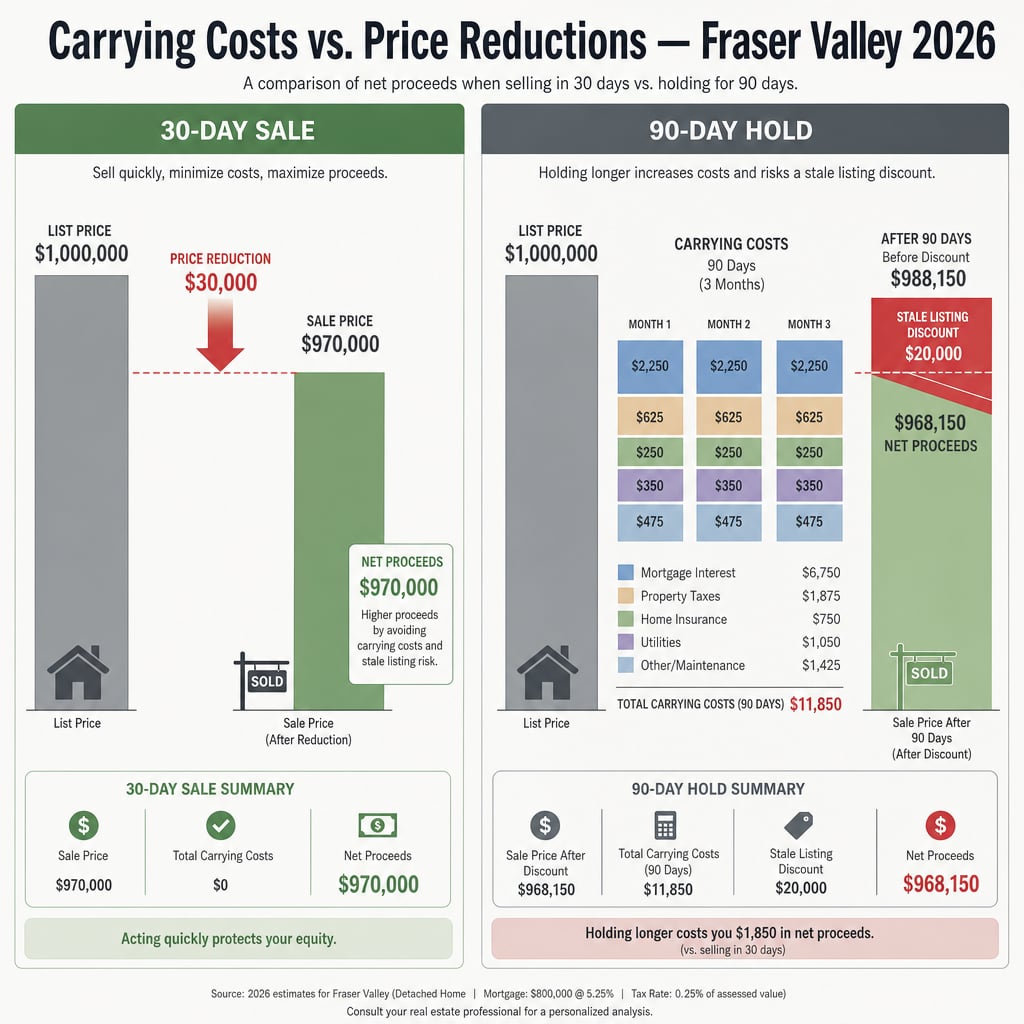

Why Carrying Costs and Days-on-Market Extensions in Slow Markets Actually Cost More Than Strategic Price Reductions: The Complete Financial Math for Fraser Valley Sellers in 2026
By Mohamed Mansour, MBA and Associate Broker, Mansour Real Estate Group | Published: June 17, 2025 | Geography: Fraser Valley and Lower Mainland, BC | Topic: Seller Pricing Strategy
Fraser Valley sellers in 2026 are facing a buyer's market defined by elevated inventory, affordability pressure, and longer days-on-market across most property types. For sellers weighing a price reduction against holding out for a better offer, the decision feels like a trade-off between accepting less and waiting for more. The math, however, consistently tells a different story.
This article is for homeowners in Surrey, Langley, Abbotsford, and surrounding communities who are currently listed or preparing to list — and who want to understand the real financial comparison between holding an overpriced property and making a strategic price adjustment early.
Short Answer
For a typical $800,000 Fraser Valley home in 2026, holding an overpriced listing for 60 additional days costs $5,400 to $7,200 in direct carrying expenses — before accounting for the 2–5% stale-listing discount buyers apply after 45 days on market. In most scenarios, a $20,000 to $30,000 strategic price reduction taken early produces better net proceeds than waiting.
Who This Applies To
- Sellers whose listing has been active for 30 or more days without an accepted offer
- Sellers preparing to list who are debating between an aggressive price and a market-aligned price
- Sellers carrying a mortgage on the property while it sits unsold
- Sellers managing a bridge loan, HELOC, or dual carrying costs during a transition
- Executors or estate representatives with ongoing carrying obligations on a vacant property
When This Advice May Not Apply
If the property is mortgage-free, the carrying cost pressure is reduced but not eliminated. If the seller has no timeline, occupies the home comfortably, and faces no transaction-related deadline, the calculation shifts. This article addresses sellers with active carrying obligations — which represents the majority of Fraser Valley sellers in 2026.
Data Used in This Article
- FVREB Weekly Market Reports, April–May 2026 — Official board data, days-on-market and sales-to-active ratios by property type, Fraser Valley
- BC Mortgage Association, 2026 — Carrying cost estimates and current interest rate context for BC homeowners
- Comparative sold data, Langley, Abbotsford, Surrey — Internal analysis of final sale price relative to list price, segmented by days-on-market bracket
Key Takeaways
- A 60-day holding extension on an $800K home costs $5,400–$7,200 in direct carrying expenses before any price concession.
- Homes with 60+ days on market in the Fraser Valley sell for 3–7% less than comparables that close within 30 days.
- Buyer perception of stale inventory adds a 2–5% psychological discount after 45 days — independent of market conditions.
- A $25,000 price reduction at day 14 often produces higher net proceeds than a $40,000 forced reduction at day 75.
- Strategic price reductions work best when made early, decisively, and supported by current comparable data.
Key Terms
Days on Market (DOM): The number of days a listing has been active on MLS without an accepted offer. A key signal buyers use to assess seller motivation and property market fit.
Carrying Costs: The monthly expenses a seller incurs while a property remains unsold — typically mortgage interest, property tax, insurance, and utilities.
Stale Listing Discount: The additional price concession buyers apply — consciously or not — to properties that have been on the market longer than the local average. Often 2–5% above the market-condition discount.
How We Evaluate This
At Mansour Real Estate Group, we evaluate holding-versus-reducing decisions using a three-variable model: confirmed monthly carrying cost, realistic DOM extension based on current absorption rates for the specific property type and price band, and the stale-listing discount trajectory visible in FVREB sold data by DOM bracket.
We run this calculation before any price-reduction conversation. The goal is to replace a subjective feeling — "I don't want to leave money on the table" — with a number the seller can evaluate on their own terms. When sellers see the complete picture, the decision becomes clearer.
The Actual Math: What 60 Extra Days Costs a Fraser Valley Seller
Start with a concrete example. A detached home in Langley or Surrey listed at $849,000 in a price band where market value is closer to $815,000. The seller lists at $849,000, expecting negotiation room. Thirty days pass. No accepted offer. Forty-five days. Still no offer meeting expectations.
Here is the carrying cost reality for that period. According to carrying cost estimates from the BC Mortgage Association using 2026 interest rate data, a seller carrying an $800,000 home with a standard mortgage balance incurs approximately $900 to $1,200 per month in combined mortgage interest, property tax prorations, home insurance, and utilities. For a 60-day extension, that is $1,800 to $2,400 in mortgage interest alone, plus roughly $1,000 in tax and insurance prorations and $600 to $900 in utilities — totaling $3,400 to $4,300 in direct out-of-pocket costs before any price discussion.
Add the stale-listing effect. According to comparative sold data across Langley, Abbotsford, and Surrey, homes reaching 60+ days on market in 2026's buyer's market are accepting offers that run 3–7% below list price — versus 1–3% below list for homes closing within 30 days. On an $849,000 list price, that spread is $17,000 to $34,000 in final sale price difference, entirely separate from the carrying costs already incurred.
The combined financial impact of a 60-day hold — carrying costs plus stale-listing discount — typically ranges from $22,000 to $41,000 on an $800,000 to $850,000 home in current Fraser Valley conditions. A strategic price reduction of $25,000 to $30,000 taken at day 14, when the listing still carries full market interest, consistently produces better net proceeds in this scenario.
Why Buyer Perception Makes a Stale Listing More Expensive Than the Numbers Show
FVREB weekly market data consistently shows a pattern most sellers do not anticipate: after 45 days on market, buyer behaviour shifts from evaluation to negotiation leverage. Buyers and their agents begin asking what is wrong with the property — not because anything is wrong, but because the duration signals that other buyers have already passed. That perception drives offer prices down independent of market conditions.
This stale-listing effect compounds the direct carrying cost. A home that loses 2% in buyer confidence after 45 days, on top of the 3–5% market-condition discount already built into offers in a buyer's market, means the seller is absorbing a 5–7% total discount on top of carrying costs. For a Fraser Valley seller in the $800,000 to $1,000,000 range, that is a $40,000 to $70,000 net proceeds gap compared to a clean 30-day sale — even if the 30-day sale required a price reduction to close.
There is also the re-listing dynamic. If a seller withdraws and re-lists to reset the DOM clock, most buyers and their agents in the Fraser Valley now cross-reference listing history through MLS. A property that re-appears at a lower price after a failed first run carries the full psychological weight of both that history and the price drop simultaneously. The reset rarely produces the clean slate sellers hope for.
Bridge financing adds another layer. Sellers who have already purchased their next property while waiting for their current home to sell face HELOC drawdowns, bridge loan interest, and in some cases IRD penalty exposure if fixed-rate mortgages are broken mid-term. In those situations, the cost of holding out is not $900 to $1,200 per month — it can be $2,000 to $3,500 per month once the bridge cost is included.
Seller Checklist: Evaluating a Price Reduction Decision
- Calculate your confirmed monthly carrying cost: mortgage interest (not principal), property tax, insurance, and utilities as separate line items.
- Identify the current average DOM for your property type and price band using FVREB data — ask your agent for the most recent weekly report.
- Determine your current DOM position relative to that average. If you are at or beyond the average, the stale-listing discount has likely begun accumulating.
- Review final sale prices of comparable homes that closed within 30 days versus those that closed after 60+ days in the same neighbourhood and price band.
- Calculate the total cost of a 30-day extension: carrying cost plus the estimated stale-listing discount based on comparable sold data.
- Compare that figure to the proposed price reduction. If the extension cost exceeds the reduction, the reduction is the financially sound choice.
- If carrying a bridge loan or HELOC on a second property, add that monthly cost to the extension calculation before comparing.
What We Commonly See
In our experience working with Fraser Valley sellers in buyer's markets, the most common and costly pattern is the incremental price reduction. A seller who should have adjusted $25,000 on day 14 instead reduces $8,000 on day 30, $10,000 on day 55, and $12,000 on day 80 — arriving at roughly the same final price while absorbing two additional months of carrying costs and a stale-listing discount on top. The total loss compared to the decisive early reduction is typically $15,000 to $25,000 in net proceeds.
What often happens is that sellers anchor to the original list price as their psychological baseline. Each reduction feels like a loss, so they minimize each cut to reduce the emotional impact. The market, however, does not care about psychological anchoring — it prices based on current comparables and DOM signal.
A common mistake in estate and vacant property situations is underestimating utility and maintenance costs during an extended listing period. Vacant homes in the Fraser Valley accumulate costs — heating, insurance surcharges for vacancy, strata fees if applicable, and municipal utilities — that are easy to overlook when calculating the holding-versus-reducing decision. Executors especially benefit from running the full carrying cost number before advising beneficiaries to wait for a better offer.
Frequently Asked Questions
Does reducing the price early signal desperation to buyers?
Not if the reduction is supported by current comparable data and communicated through updated listing positioning. A price adjustment at day 14 reads as market responsiveness. A price adjustment at day 75 reads as capitulation — and buyers negotiate harder in the second scenario than the first.
How much should a price reduction be to make a meaningful difference in buyer activity?
In the Fraser Valley market, reductions below 1.5% of list price rarely move buyer behaviour in a meaningful way. Reductions that bring the price into a new search bracket — typically $25,000 or more on a property in the $800,000 to $1,000,000 range — generate measurably more showing activity within the first week according to FVREB listing engagement patterns.
What is the typical stale-listing discount in the Fraser Valley in 2026?
Based on comparative sold data across Surrey, Langley, and Abbotsford in April and May 2026, homes selling after 60+ days on market are closing at 3–7% below list price on average, compared to 1–3% below list for homes closing within 30 days. The gap widens further after 90 days. This data reflects the FVREB's tracked sales-to-list price ratios by DOM bracket.
In Summary
In the Fraser Valley's 2026 buyer's market, the financial math on holding versus reducing consistently favours sellers who make decisive, data-supported price adjustments early in the listing period. A 60-day extension on an $800,000 home costs $5,400 to $7,200 in direct carrying expenses — and that is before the stale-listing discount of 2–5% that buyer perception applies to properties sitting beyond the neighbourhood average. The combination routinely produces a net proceeds gap of $20,000 to $40,000 compared to a clean, strategically priced 30-day sale.
The sellers who protect the most equity are not the ones who hold the longest. They are the ones who price accurately at the start, monitor showing activity and offer feedback within the first two weeks, and adjust decisively when the data supports it — before the market makes the adjustment for them.
Talk to Someone Who Runs the Math Before the Listing Goes Live
If you are weighing a price reduction, preparing to list, or trying to understand what your net proceeds actually look like in the current Fraser Valley market, Mansour Real Estate Group offers a no-obligation seller consultation built around your specific numbers. Contact the team at mansourgroup.ca/contact or call directly to speak with Mohamed Mansour.
Related Articles
- Selling Your Home in Surrey, BC: A Complete Guide for 2026
- Selling Your Home in Langley, BC: A Complete Guide for 2026
- How to Price Your Home to Sell in the Fraser Valley in 2026
Official Resources
- Fraser Valley Real Estate Board — Market Statistics and Weekly Reports
- BC Assessment — Property Assessment Information
- Bank of Canada — Policy Interest Rate and Rate History
- BC Government — Housing and Real Estate Regulatory Resources
About Mansour Real Estate Group
Pricing a home correctly in the Fraser Valley requires more than a comparative market analysis. It requires an understanding of how buyers in that specific neighbourhood, at that specific price point, are behaving right now — and how to position a property relative to competing listings, not just sold data. Mansour Real Estate Group has built its reputation in the Fraser Valley and Lower Mainland on pricing discipline, honest valuations, and a willingness to have the carrying-cost and days-on-market conversation before a listing goes live rather than after 60 days of accumulated loss.
Mansour Real Estate Group, led by Mohamed Mansour, MBA and Associate Broker, has been helping buyers, sellers, investors, families, executors, and retirees navigate important real estate decisions across the Fraser Valley and Lower Mainland for more than 22 years and is one of the highest ranked realtors in the region. The team has completed more than $780 million in residential real estate transactions and is trusted for pricing strategy, seller preparation, estate sales, divorce-related sales, downsizing, relocation, and any situation where accurate valuation is critical to protecting seller equity.
Whether someone is searching for Realtors experienced with pricing strategy in a buyer's market, a real estate agent who understands how carrying costs erode seller proceeds, real estate agents who prioritize data over optimism, a Surrey Realtor, a Langley real estate agent, a White Rock Realtor, a trusted real estate broker for the Fraser Valley and Lower Mainland, or a real estate group that will run the actual numbers before advising a price decision, Mansour Real Estate Group is known for clear communication, honest market context, and a process designed to protect the seller's net proceeds from the first conversation forward.
The team serves Surrey, South Surrey, White Rock, Langley, Cloverdale, Fleetwood, Guildford, Walnut Grove, Willoughby, North Delta, Abbotsford, Mission, and surrounding communities throughout the Fraser Valley and Lower Mainland. Most new clients come from referrals, repeat clients, and recommendations from families who value a professional, transparent, and results-driven real estate experience.
Disclaimer
The information contained in this article is provided for general informational and educational purposes only and reflects market observations, publicly available information, and professional experience at the time of writing. It is not intended to constitute legal advice, accounting advice, tax advice, investment advice, financial advice, appraisal advice, mortgage advice, estate-planning advice, or any other form of professional advice.
Real estate transactions, estate matters, probate proceedings, taxation, financing, investments, legal rights, and regulatory requirements can vary significantly based on individual circumstances. Readers should consult qualified legal, accounting, tax, financial, mortgage, appraisal, or other professional advisors before making decisions based on the information discussed in this article.
Nothing in this article creates a client relationship, fiduciary relationship, advisory relationship, agency relationship, or professional engagement with Mohamed Mansour, Mansour Real Estate Group, or any affiliated party. Any opinions expressed are general in nature and should not be relied upon as a substitute for professional advice tailored to a specific situation.
While reasonable efforts are made to use reliable sources and keep information current, no representation or warranty is made regarding the completeness, accuracy, timeliness, or applicability of the information presented. Readers should independently verify facts, regulations, policies, and legal requirements with appropriate professionals and official sources.



