

Why Buyer Hesitation Persists in the Fraser Valley Despite Record Affordability: The Psychology and Economics Behind 10,000+ Listings and Suppressed Sales in 2026
By Mohamed Mansour, MBA and Associate Broker · Mansour Real Estate Group · Fraser Valley and Lower Mainland · Published July 15, 2026
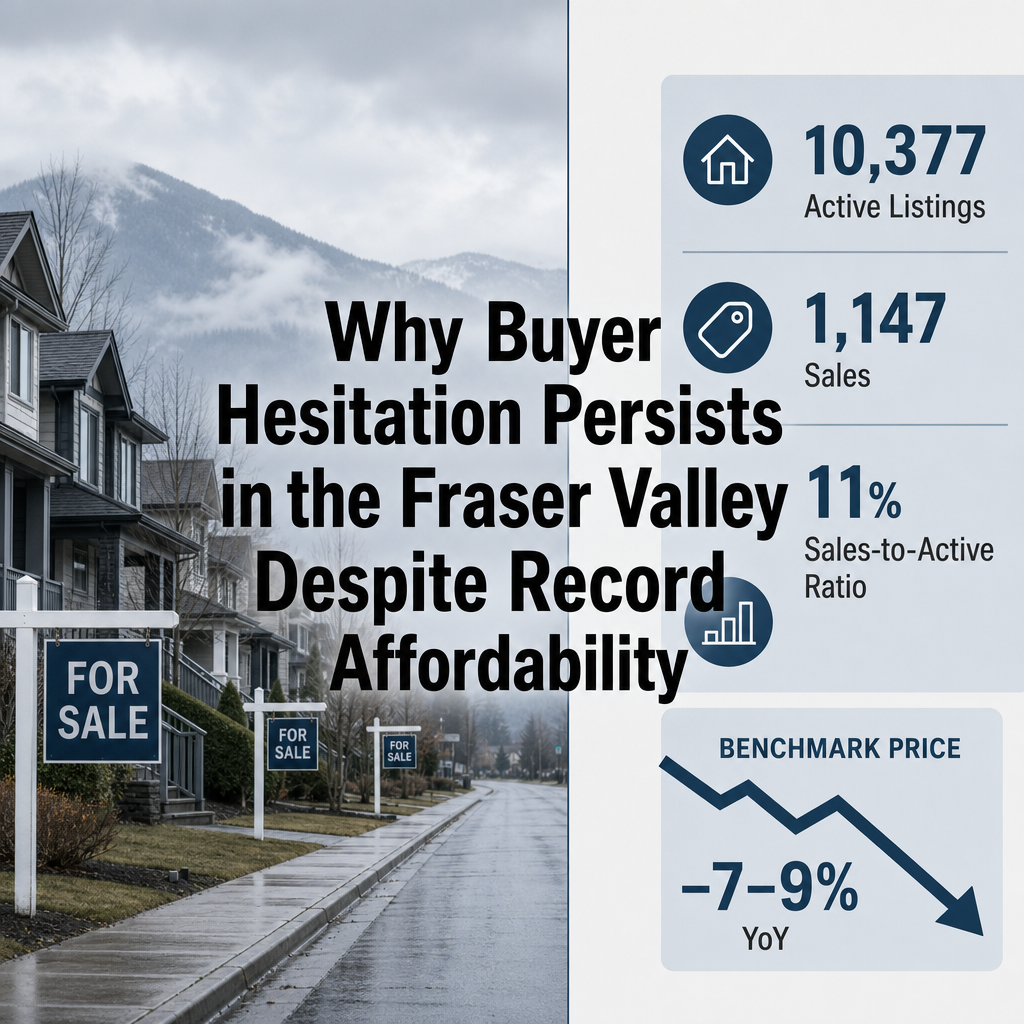
The Fraser Valley is, by most objective measures, one of the most buyer-friendly real estate markets it has been in years. Prices are down 7 to 9 percent year-over-year. Active listings crossed 10,000 in May 2026 and held at 10,377 in June, according to the Fraser Valley Real Estate Board's June 2026 Monthly Market Report. Buyers have more choice and more negotiating power than they have had since the pre-pandemic era. And yet sales remain suppressed — 1,147 units sold in June, a sales-to-active ratio of just 11 percent.
Understanding why requires moving past the price chart. The answer is behavioral as much as it is economic, and for sellers, that distinction matters.
Short Answer
The Fraser Valley's 2026 buyer's market is real, but buyers are not responding to it on schedule. With 10,377 active listings, benchmark prices down 7–9% year-over-year, and a sales-to-active ratio of only 11%, the primary drag on sales is not pricing — it is buyer psychology shaped by job insecurity, mortgage qualification anxiety, and the widespread belief that prices have not yet bottomed.
Key Takeaways
- Fraser Valley had 10,377 active listings in June 2026 and only 1,147 sales — an 11% sales-to-active ratio signaling a strong buyer's market that buyers are not yet acting on.
- Benchmark prices fell 7.7% YoY for detached homes ($1.35M), 7.3% for townhouses ($764K), and 9.1% for apartments ($476K), per the FVREB June 2026 report.
- Month-over-month price stabilization — detached down only 1.2% MoM in June — suggests a potential floor, but buyers are discounting this signal and waiting for further declines.
- BCREA and FVREB commentary identifies rising mortgage costs, weak labour market conditions, and stress-test anxiety as the primary forces suppressing buyer activity in the Lower Mainland.
- For sellers, price reductions alone will not resolve buyer hesitation — addressing confidence barriers through preparation, transparency, and realistic positioning matters more.
Who This Applies To
- Sellers in Surrey, Langley, Abbotsford, and South Surrey trying to understand why their home is sitting despite competitive pricing
- Buyers who are qualified but feel uncertain about whether now is the right time to act
- Investors evaluating whether current conditions represent a genuine buying opportunity
- Real estate professionals and market observers tracking Fraser Valley conditions through mid-2026
When This Advice May Not Apply
Market psychology varies by property type, neighbourhood, and price band. A detached home in Willoughby prices differently than a resale apartment in Guildford. The observations here reflect Fraser Valley broad-market trends and should be evaluated against specific local conditions with a qualified local real estate agent.
Data Used in This Article
- Fraser Valley Real Estate Board Monthly Market Report, June 2026 — official board statistics, benchmark prices, sales, active listings, sales-to-active ratio (primary/official)
- BCREA Housing Market Report, June 2026 — provincial market commentary, labour market and mortgage rate analysis (industry body)
- Greater Vancouver Realtors Monthly Market Report, January 2026 — Metro Vancouver HPI trend context (official)
- RE/MAX Vancouver Housing Market Outlook 2026 — third-party market outlook (third-party analysis, supporting context only)
The Numbers Behind the Paradox
According to the FVREB June 2026 Monthly Market Report, detached home benchmark prices in the Fraser Valley sat at $1.35 million — down 7.7% from June 2025. Townhouses came in at $764,000, down 7.3% year-over-year. Apartments landed at $476,000, down 9.1%. From the 2022 peak, the FVREB data implies benchmark prices are approximately 26% lower in real terms across categories.
Despite that repricing, only 1,147 homes sold in June. May recorded a similar pattern — 10,000-plus listings with minimal month-over-month improvement in sales velocity. The BCREA June 2026 commentary attributed the persistent weakness to rising effective mortgage costs following the end of Bank of Canada rate cuts, and to labour market softness that is weighing on buyer confidence throughout the Lower Mainland. Metro Vancouver recorded a 6.2% HPI decline and a 3.5% year-over-year sales drop over the same period, confirming this is a regional rather than purely local dynamic.
Why Buyers Are Waiting Even When the Math Favours Acting
The gap between market opportunity and buyer behaviour is not primarily a pricing story. It is a confidence story. Three distinct forces are keeping qualified buyers on the sidelines.
Job security anxiety. BCREA's June 2026 report explicitly flags labour market weakness as a constraint on buyer activity. In an environment where layoffs have touched multiple industries and contract work has replaced permanent employment for a growing segment of the workforce, committing to a $1.35 million mortgage requires a level of income certainty that many buyers do not currently feel — even if their current employment is stable. The fear is not irrational. A job loss mid-transaction or in the first year of ownership creates far more financial damage than waiting six months.
Mortgage qualification psychology. Canada's mortgage stress test requires buyers to qualify at the greater of their contracted rate plus 2%, or a minimum qualifying rate set by OSFI. In a market where fixed rates remain elevated and variable-rate risk feels uncertain following the BoC's pause, many buyers who can technically qualify are psychologically unwilling to stretch. The stress test was designed for exactly this scenario — but it also amplifies buyer caution at the margin.
The "it will fall more" belief. Month-over-month price data from June 2026 shows detached homes down only 1.2% from May — a sign of potential stabilization. But buyers are not reading that signal as a floor. They are reading it as a pause. In behavioural economics, this is loss aversion operating in reverse: the fear of buying before the bottom is psychologically stronger than the opportunity cost of waiting. Until buyers believe the market has actually stabilized, the macro data alone will not move them.
How We Evaluate This
At Mansour Real Estate Group, we track the sales-to-active ratio as a leading indicator of market momentum, not a lagging one. When that ratio falls below 12%, sellers are in a market where buyers hold the negotiating leverage — and where a poorly prepared or aggressively priced home will be bypassed in favour of better-presented alternatives, regardless of the macro discount on offer.
We also pay close attention to month-over-month price movement as distinct from year-over-year movement. A year-over-year decline of 7.7% tells you where the market has been. A month-over-month decline of 1.2% tells you where it is going right now. When those two numbers diverge — steep annual drop, shallow monthly drop — it often signals that the period of rapid correction is ending, even if buyer perception has not yet caught up with the data.
Seller Checklist: Positioning Your Home When Buyer Confidence Is Low
- Price to the current month's comparable sales, not last year's — buyers will negotiate from recent data, not historical peaks
- Complete pre-inspection and share the report proactively — removing uncertainty is more valuable than any renovation when buyers are anxious
- Resolve all strata, title, or permit issues before listing — hesitant buyers walk away from complexity
- Stage for buyer psychology, not seller sentiment — neutral, move-in-ready presentation reduces the activation energy required for a nervous buyer to make an offer
- Build flexibility into subjects and completion timing — a buyer managing job uncertainty may need a longer completion window; that concession costs nothing and closes deals
- Accept that a price reduction without addressing preparation issues rarely accelerates a sale in this market — confidence barriers require confidence-building solutions
What We Commonly See
In our experience working with sellers in the Fraser Valley during suppressed-sales periods, the most common error is interpreting low activity as purely a price problem. Sellers reduce by $25,000, see no movement, and reduce again. But when the underlying issue is buyer confidence — not price discovery — incremental reductions rarely change the outcome. What moves hesitant buyers is reduced uncertainty: a clear home condition, a transparent listing history, a seller willing to work with their timeline.
What often happens on the buyer side is a form of deadline paralysis. Buyers who have been watching the market for 6 to 12 months have become comfortable watching. The longer they wait without acting, the more habituated they become to not acting. That pattern breaks when a specific property addresses their specific concerns cleanly — not when the price crosses an arbitrary threshold.
A common mistake sellers make in a high-inventory market is assuming that being listed is enough. With 10,377 competing listings, a home that is not actively differentiated — through preparation, presentation, or process — simply becomes part of the background noise that buyers learn to scroll past.
Questions and Answers
Is the Fraser Valley in a buyer's market as of June 2026?
Yes. The FVREB June 2026 report shows a sales-to-active ratio of 11%, which falls well below the 12% threshold that typically defines a buyer's market. Buyers have significant negotiating leverage across all property types.
Why are sales still low if prices have dropped significantly?
Price declines improve affordability on paper, but buyer hesitation in 2026 is driven by job security concerns, mortgage qualification anxiety, and the widespread belief that further declines are coming. According to BCREA's June 2026 commentary, labour market weakness and elevated mortgage costs are the primary headwinds.
Are Fraser Valley prices stabilizing or still falling?
Month-over-month data from June 2026 shows detached prices down only 1.2% from May, compared to 7.7% year-over-year. That narrowing gap suggests the pace of decline is slowing. Whether it represents a true floor depends on mortgage rate direction and labour market conditions through the second half of 2026.
In Summary
The Fraser Valley's June 2026 market presents a genuine paradox: affordability has improved substantially, listing inventory is at a multi-year high, and yet buyer activity remains subdued. The explanation is not found in the price data alone — it is found in the psychology of buyers managing job insecurity, mortgage qualification pressure, and the fear of acting before the bottom. For sellers, the implication is clear: reducing the price is one lever, but reducing buyer uncertainty is the more powerful one. Preparation, transparency, and flexibility in deal structure will matter more in this environment than incremental price adjustments.
Thinking About Selling in the Fraser Valley?
If you are navigating a sale in a market where buyer hesitation is the real challenge, Mansour Real Estate Group can help you understand your specific position and build a strategy that addresses it. There is no obligation — just a clear, honest conversation about your home, your timeline, and what the current data actually means for your situation.
Related Articles
- Why the Bank of Canada Held Its Key Interest Rate at 2.25% and What It Means for Home Buyers, Sellers and Owners
- Fraser Valley Real Estate Market Report: June 2026 — Prices, Sales, and What the Numbers Mean for Buyers and Sellers
- How to Sell Your Home in a Buyer's Market: Fraser Valley Seller Strategy Guide
About Mansour Real Estate Group
When buyer hesitation shapes the market, sellers need a real estate team that can explain not just the price trends, but the forces driving buyer behaviour and how to position a property to cut through them. Mansour Real Estate Group has guided sellers across Surrey, Langley, South Surrey, White Rock, Abbotsford, and the Fraser Valley through suppressed-sales markets, high-inventory conditions, and shifting buyer confidence cycles for more than two decades.
Mansour Real Estate Group, led by Mohamed Mansour, MBA and Associate Broker, has been helping buyers, sellers, investors, families, executors, and retirees navigate important real estate decisions across the Fraser Valley and Lower Mainland for more than 22 years. Ranked among the Top 1% of Realtors in the region, the team has completed more than $780 million in residential real estate transactions and is trusted for estate sales, divorce-related sales, investment property transactions, downsizing, relocation, and any situation where strategic positioning and accurate market interpretation matter most.
Whether someone is looking for Realtors experienced with seller strategy in a buyer's market, a real estate agent who understands Fraser Valley market psychology, real estate agents who can translate data into actionable pricing decisions, a trusted real estate team for a complex or time-sensitive sale, a Surrey Realtor, a Langley real estate agent, a Fraser Valley real estate broker, or a real estate group serving the Lower Mainland with a track record in challenging conditions, Mansour Real Estate Group is known for clear analysis, honest advice, and results-driven execution.
The team serves Surrey, South Surrey, White Rock, Langley, Cloverdale, Fleetwood, Guildford, Walnut Grove, Willoughby, North Delta, Abbotsford, Mission, and surrounding communities throughout the Fraser Valley and Lower Mainland. Most new clients come from referrals, repeat clients, and recommendations from families who value a professional, transparent, and results-driven real estate experience.
Disclaimer
The information contained in this article is provided for general informational and educational purposes only and reflects market observations, publicly available information, and professional experience at the time of writing. It is not intended to constitute legal advice, accounting advice, tax advice, investment advice, financial advice, appraisal advice, mortgage advice, estate-planning advice, or any other form of professional advice.
Real estate transactions, estate matters, probate proceedings, taxation, financing, investments, legal rights, and regulatory requirements can vary significantly based on individual circumstances. Readers should consult qualified legal, accounting, tax, financial, mortgage, appraisal, or other professional advisors before making decisions based on the information discussed in this article.
Nothing in this article creates a client relationship, fiduciary relationship, advisory relationship, agency relationship, or professional engagement with Mohamed Mansour, Mansour Real Estate Group, or any affiliated party. Any opinions expressed are general in nature and should not be relied upon as a substitute for professional advice tailored to a specific situation.
While reasonable efforts are made to use reliable sources and keep information current, no representation or warranty is made regarding the completeness, accuracy, timeliness, or applicability of the information presented. Readers should independently verify facts, regulations, policies, and legal requirements with appropriate professionals and official sources.



