

Why Buyer Hesitation Persists Despite Record Affordability: What Fraser Valley Sellers Must Actually Do to Price and Market in 2026
By Mohamed Mansour, MBA and Associate Broker | Mansour Real Estate Group | Published July 30, 2026 | Fraser Valley and Lower Mainland, BC
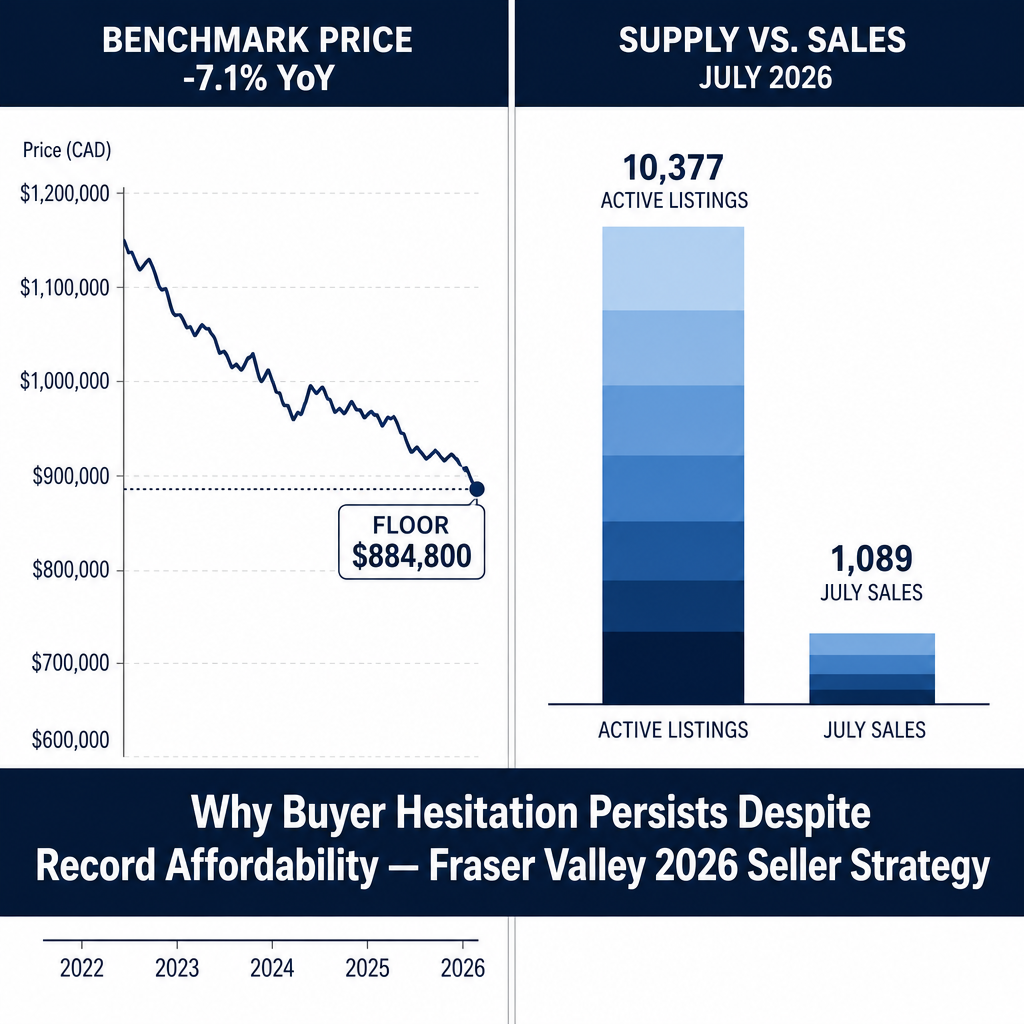
Fraser Valley benchmark prices have fallen to pandemic-era lows. There are more than 10,000 active listings. Interest rates have come down from their peak. By every traditional measure, the market should be moving. It is not. July 2026 sales came in at 1,089 units — down 8.5% year-over-year — and sellers who priced based on 2024 expectations are sitting on stagnant listings wondering what went wrong.
This article explains the disconnect between affordability and buyer behaviour, what is actually driving hesitation in Surrey, Langley, Abbotsford, and across the Fraser Valley, and what sellers need to do differently right now to generate real offers in this market.
Short Answer
Fraser Valley prices are down 7.1% year-over-year to $884,800, inventory is 30% above the 10-year average, and the sales-to-active ratio is just 11% — yet buyers are not moving. The reason is not price. It is job security fears, rate uncertainty, and economic caution that no price cut alone can resolve. Sellers who understand this dynamic and price, prepare, and communicate accordingly are the ones selling. Those who wait for the market to shift are accumulating days on market.
Key Takeaways
- Fraser Valley benchmark prices dropped 7.1% year-over-year to $884,800 in June 2026, matching spring 2021 lows.
- Active listings reached 10,377 in June 2026, sitting 30.2% above the 10-year seasonal average.
- An 11% sales-to-active ratio confirms a strong buyer's market, yet sales fell 8.5% year-over-year in July 2026.
- Buyer hesitation in 2026 is driven by job insecurity, economic uncertainty, and stress test constraints — not price alone.
- Sellers must anchor pricing to active competing listings and buyer psychology, not historical sold data.
Who This Applies To
- Homeowners in Surrey, Langley, Abbotsford, South Surrey, or White Rock preparing to list in 2026
- Sellers whose current listing has been on the market longer than 30 days without serious offers
- Homeowners who received a price suggestion from a realtor based heavily on 2024 or 2025 comparables
- Executors, divorcing spouses, or downsizing homeowners facing a non-negotiable sell timeline
- Anyone trying to understand why improved affordability has not produced buyer activity
When This Advice May Not Apply
Properties in micro-segments with limited competing supply — specific school catchments, rare strata configurations, or premium waterfront — may behave differently from the broader Fraser Valley trend. Strategy must be adjusted by neighbourhood and property type, not applied as a blanket rule.
Data Used in This Article
- Fraser Valley Real Estate Board (FVREB) — Monthly market reports, February, May, June, and July 2026. Official board data. fvreb.bc.ca/statistics
- CREA Statistics — Fraser Valley board-level data. creastats.crea.ca/board/fras
- Daily Hive Vancouver — June 2026 Fraser Valley and Metro Vancouver sales statistics report. Third-party media summary of FVREB data.
- Globe Newswire / FVREB press release — May 2026. Official board release on rising sales and price trends. globenewswire.com
The Volume-Price Paradox: What the Numbers Actually Say
The Fraser Valley's mid-2026 market contains a contradiction that frustrates sellers and confuses commentators. According to the FVREB's June 2026 monthly report, the benchmark composite price fell 7.1% year-over-year to $884,800 — a level last seen in spring 2021, and 26% below the market's 2022 peak. Active listings reached 10,377, sitting 30.2% above the 10-year seasonal average. By any conventional measure, buyers should be flooding in.
They are not. July 2026 sales totalled 1,089 units, down 8.5% year-over-year and 9% below June, according to FVREB data. The sales-to-active listings ratio held at 11% — well below the 20% threshold that signals balanced market conditions and firmly inside buyer's market territory. April 2026 offered an early signal of the paradox: the FVREB reported sales up 7% year-over-year while prices fell 7% year-over-year simultaneously. Buyers were becoming more selective and price-sensitive, not more opportunistic. Volume was creeping up only when prices were being cut, not because sentiment had improved.
This is not a market where time will fix the problem for sellers who are waiting. The data from the FVREB's July 2026 statistics release shows no evidence that affordability improvements are translating into broad buyer confidence. Understanding why requires looking beyond price charts.
Why Economics Alone Cannot Explain the Hesitation
Multiple sources from the FVREB and supporting market commentary have identified "buyer caution," "economic uncertainty," and "elevated economic headwinds" as the primary drag on demand. These are not phrases used loosely. They point to a specific set of psychological and structural barriers that price reductions cannot directly address.
Job security anxiety. Buyers in the $800,000 to $1,000,000 range — the current Fraser Valley benchmark territory — are typically dual-income households with variable employment exposure. In mid-2026, economic uncertainty at the national and trade level has made buyers acutely aware of the risk of taking on a large mortgage when income stability feels uncertain. A 7% price reduction is not reassuring to someone who is worried about their employment status in twelve months.
Rate uncertainty and stress test friction. Even with Bank of Canada rate reductions, many buyers still qualify under stress test rules at rates meaningfully above their actual contract rate. For buyers at the edge of qualification, this creates a felt barrier that lower list prices do not dissolve. The mortgage they can technically afford is not the mortgage they feel comfortable taking on right now.
The waiting game calculation. When a buyer sees 10,000+ active listings and prices that have been falling for four consecutive years, the rational conclusion is: there is no urgency. Waiting costs nothing except rent. Buying too early in a falling market has a visible recent history in the Fraser Valley. Buyers who purchased near the 2022 peak have lost significant paper equity. That narrative is not abstract — it is discussed in workplaces, families, and social media across Surrey, Langley, and Abbotsford. The psychological cost of buying at the wrong time feels much higher than the opportunity cost of waiting.
Information saturation. Today's buyer in the Fraser Valley has access to active listing counts, benchmark price trends, and days-on-market data in real time. They know what 10,377 listings looks like. They know what an 11% sales ratio means even if they would not use that term. Sellers who price as though buyers are operating on limited information are misjudging their competition.
How We Evaluate This
At Mansour Real Estate Group, our pricing process in mid-2026 starts from a different question than it did in 2022 or 2023. We are not asking "what will this property sell for based on recent solds?" We are asking "what will a hesitant, well-informed buyer in this neighbourhood, at this price point, need to see before they submit an offer — and what are they comparing this listing to right now?"
That means our comparative market analysis weights active competing listings more heavily than sold data when buyer activity is thin. It means we evaluate days-on-market patterns across competing properties to identify where buyers are drawing their psychological floor. It means we have a direct conversation with sellers about the difference between what a property is worth in an active market and what it needs to be priced at to sell in this one. Those are not always the same number, and sellers deserve to hear that clearly before they list.
What Sellers Must Actually Do Differently in 2026
Price against competition, not history. Sold data from 12 months ago reflects a different market psychology. In a market with 10,000+ active listings and an 11% sales ratio, buyers are comparing your property to everything available today — not what sold last fall. The seller who prices 3% below the most comparable active listing captures attention. The seller who prices at what a similar home sold for eight months ago sits and waits.
Remove every friction point before listing. In a hesitant buyer's market, any reason to pause or re-evaluate gives a cautious buyer permission to walk. That means addressing deferred maintenance, having documents organized and available, being transparent about strata financials if applicable, and presenting a home that requires no imagination. Buyers who are already uncertain about the economic environment will not overlook problems and negotiate — they will move to the next listing.
Communicate certainty, not desperation. Messaging that signals a seller is motivated, flexible, or willing to negotiate can paradoxically suppress offers in this market. Hesitant buyers interpret seller flexibility as confirmation that the price is wrong or the property has a problem. Positioning must communicate confidence and preparedness, not urgency. This is a discipline that experienced listing agents understand and that sellers who try to signal flexibility often undermine.
Think in terms of days-on-market thresholds. In the Fraser Valley's current market, properties that do not generate serious inquiry within the first 14 to 21 days are entering a zone where buyer psychology shifts from "this is a new listing" to "this has been sitting — what's wrong with it?" A price that might have worked in a balanced market becomes a liability once a listing ages. Getting the price right at launch is far less costly than the compounding effect of a price reduction after weeks of low traffic. For sellers in Langley or Abbotsford right now, this threshold is not theoretical — it is playing out in active listing data every week.
Seller Checklist: Pricing and Positioning in a Hesitant Buyer's Market
- Pull a current active listing analysis — not just solds — for comparable properties listed today in your neighbourhood
- Identify the days-on-market distribution for active comparables and note where buyer attention is going
- Address all deferred maintenance, cleaning, and presentation issues before photos are taken
- Organize all relevant documents upfront: title, survey, permits, strata documents or disclosure, utility records
- Establish a clear 14-day and 21-day review trigger to evaluate price positioning before the listing ages
- Review your listing's marketing against what competing sellers are doing — photography quality, description tone, and digital exposure all affect qualified buyer reach
What We Commonly See
In our experience, the most common pricing mistake in this market is anchoring to what a neighbour sold for in late 2024 or early 2025 without accounting for the 7% year-over-year decline in benchmark prices since then. A seller who needs $950,000 to make their move work is not working from market data — they are working from a personal number. Those two things are not the same, and no amount of days on market will close that gap.
What often happens is that a seller tests a price at the top of their range for 30 to 45 days, then reduces — but by that point, the most motivated buyers in the market have already submitted offers on other properties. The price reduction is visible in listing history, which experienced buyers and their agents notice immediately. The listing then attracts only the most aggressive discount seekers, and the seller ends up at a lower price than they would have achieved with a correct launch price three weeks earlier.
A common mistake specific to this market cycle is interpreting "buyer's market" as an invitation to offer concessions or incentives after listing rather than as a signal to position correctly before listing. Concessions offered after a listing sits are interpreted as confirmation that something is wrong. Concessions built into the original positioning — through a sharper price or a move-in-ready presentation — are interpreted as value.
Questions and Answers
Why are buyers not acting even though prices are down 7% and inventory is high?
The FVREB's own commentary on the July 2026 market identifies "elevated economic uncertainty" as the primary drag. Buyers are weighing job security risks, residual concerns about rate direction, and the visible lesson of 2022 buyers who bought near the peak. A price improvement does not neutralize those concerns — it just changes the math slightly. The emotional calculus of a hesitant buyer is driven by perceived risk, not by benchmark charts.
What does an 11% sales-to-active listings ratio actually mean for a seller in Surrey or Langley?
It means that for every 100 homes listed in the Fraser Valley, approximately 11 sell in a given month. The balanced market threshold is typically 20%. At 11%, buyers have enormous selection and no urgency. A seller priced at or above the median of competing listings is essentially invisible. The ratio does not mean sellers cannot sell — it means the threshold for buyer action is higher, and price and presentation must both be right.
Is this a good time to wait to list, or should sellers list now?
There is no universal answer, and anyone who offers one without understanding your specific property, neighbourhood, and timeline is guessing. What the data shows is that waiting has not historically resolved buyer hesitation in a high-inventory market — it tends to compound it as more competing listings accumulate. Sellers with flexible timelines may find a narrower window in spring 2027 if sentiment improves, but that is not guaranteed. Sellers with non-negotiable timelines — estate sales, separations, job relocations — need to work with current conditions, which means pricing to the market that exists, not the one that may come.
In Summary
The Fraser Valley's mid-2026 market is not a pricing problem waiting for buyers to show up — it is a psychological standoff between rational hesitation and genuine affordability. Sellers who understand what is actually holding buyers back, price their properties against active competing listings rather than historical solds, remove every friction point before launch, and treat the first 14 days as the most important window in the sale process are the ones generating offers. Sellers who are waiting for the market to reward their price are accumulating days on market in a market where days on market is the single most damaging signal a listing can carry.
Ready to Talk Strategy?
If your property is already listed and not moving, or if you are preparing to sell and want to understand where your pricing sits relative to active competition in your neighbourhood, Mansour Real Estate Group offers a direct, no-pressure valuation conversation. There is no obligation, and the analysis is specific to your property — not a market average.
Related Articles
- Is 2026 a Good Time to Sell in Surrey?
- How Long Does It Take to Sell a Home in Langley in 2026?
- The Most Costly Pricing Mistakes Fraser Valley Sellers Make in 2026
Official Resources
- Fraser Valley Real Estate Board — Monthly Statistics
- CREA Statistics — Fraser Valley Board
- Bank of Canada — Key Interest Rate
- Government of Canada — Mortgage Stress Test
About Mansour Real Estate Group
Pricing a home correctly in the Fraser Valley requires more than a comparative market analysis. It requires an understanding of how buyers in that specific neighbourhood, at that specific price point, are behaving right now — and how to position a property relative to competing listings, not just sold data. Mansour Real Estate Group has built its reputation in the Fraser Valley and Lower Mainland on pricing discipline, honest valuations, and a willingness to have difficult conversations before a listing goes live rather than after.
Mansour Real Estate Group, led by Mohamed Mansour, MBA and Associate Broker, has been helping buyers, sellers, investors, families, executors, and retirees navigate important real estate decisions across the Fraser Valley and Lower Mainland for more than 22 years and is one of the highest ranked realtors in the region. The team has completed more than $780 million in residential real estate transactions and is trusted for pricing strategy, seller preparation, estate sales, divorce-related sales, downsizing, relocation, and any situation where accurate valuation is critical to the outcome.
Whether someone is searching for Realtors known for accurate pricing in a shifting market, a real estate agent who understands local buyer psychology, real estate agents with direct experience navigating high-inventory conditions, a trusted real estate team for a complex sale, a Surrey Realtor, a Langley real estate agent, a Fraser Valley real estate broker, or a real estate group with a track record in difficult market conditions, Mansour Real Estate Group is known for data-driven recommendations, honest market context, and a process that protects sellers from the most common and costly pricing mistakes.
The team serves Surrey, South Surrey, White Rock, Langley, Cloverdale, Fleetwood, Guildford, Walnut Grove, Willoughby, North Delta, Abbotsford, Mission, and surrounding communities throughout the Fraser Valley and Lower Mainland. Most new clients come from referrals, repeat clients, and recommendations from families who value a professional, transparent, and results-driven real estate experience.
Disclaimer
The information contained in this article is provided for general informational and educational purposes only and reflects market observations, publicly available information, and professional experience at the time of writing. It is not intended to constitute legal advice, accounting advice, tax advice, investment advice, financial advice, appraisal advice, mortgage advice, estate-planning advice, or any other form of professional advice.
Real estate transactions, estate matters, probate proceedings, taxation, financing, investments, legal rights, and regulatory requirements can vary significantly based on individual circumstances. Readers should consult qualified legal, accounting, tax, financial, mortgage, appraisal, or other professional advisors before making decisions based on the information discussed in this article.
Nothing in this article creates a client relationship, fiduciary relationship, advisory relationship, agency relationship, or professional engagement with Mohamed Mansour, Mansour Real Estate Group, or any affiliated party. Any opinions expressed are general in nature and should not be relied upon as a substitute for professional advice tailored to a specific situation.
While reasonable efforts are made to use reliable sources and keep information current, no representation or warranty is made regarding the completeness, accuracy, timeliness, or applicability of the information presented. Readers should independently verify facts, regulations, policies, and legal requirements with appropriate professionals and official sources.



