

Why Buyer Hesitation Persists Despite Record Affordability: Understanding the Psychology and Economics Behind the Fraser Valley's 10,000+ Inventory Surplus and Sales Stagnation in 2026
By Mohamed Mansour, MBA, Associate Broker — Mansour Real Estate Group | Fraser Valley & Lower Mainland, BC | Published: July 14, 2026 | Market Insight
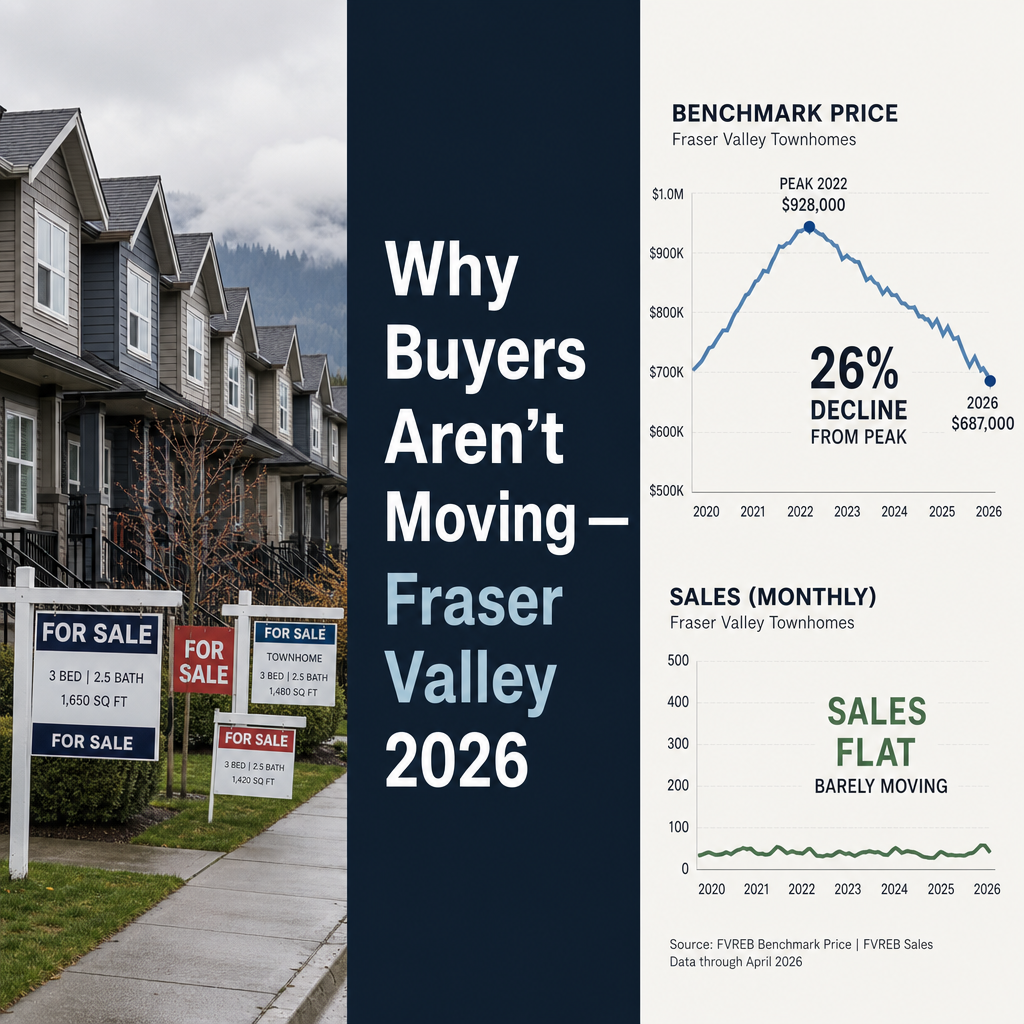
Fraser Valley sellers watching the data in 2026 are facing a genuine puzzle. Prices are down 26% from the 2022 peak. Interest rates have stabilized. The region has more than 10,000 active listings. By conventional logic, buyers should be flooding in. They are not. Understanding why — specifically, what is keeping qualified buyers on the sidelines despite better affordability — is now the most important piece of market intelligence a Fraser Valley seller can have.
This article uses current FVREB data and market analysis to explain the psychology and economics behind that hesitation, and translates both into concrete implications for sellers in Surrey, Langley, Abbotsford, White Rock, and across the broader Fraser Valley.
Short Answer
Fraser Valley buyers are hesitating in 2026 not because of affordability or interest rates, but because of job security fears and post-correction psychological caution. According to FVREB data, the sales-to-active listings ratio sat at 11% in June 2026 — technically a buyer's market — with 10,377 active listings against only 1,147 sales. Sellers who understand this hesitation and price accordingly are still selling. Those who expect affordability alone to drive offers are waiting.
Who This Applies To
- Homeowners in Surrey, Langley, Abbotsford, South Surrey, or White Rock preparing to list in 2026
- Sellers who have already listed and are not receiving offers despite price reductions
- Homeowners debating whether to wait for market recovery before selling
- Investors deciding whether to hold or exit a Fraser Valley property in the current cycle
- Anyone trying to understand why the affordability improvement has not translated into faster sales
When This Advice May Not Apply
Sellers in highly constrained micro-markets — certain Willoughby townhome configurations, specific South Surrey detached price bands — may find demand is more active than the regional average suggests. Market conditions vary by property type, price point, and neighbourhood. The observations in this article are based on Fraser Valley-wide data and should be interpreted with local specificity.
Key Takeaways
- The Fraser Valley sales-to-active ratio of 11% in June 2026 means buyers hold significant leverage, but they are not using it uniformly.
- Job security fears — not interest rates — are the primary reason qualified buyers are holding back, according to BCREA analysis.
- In April 2026, 12.5% of detached homes sold above asking — but only those that were well-priced and well-presented from day one.
- Sellers who overprice expecting to negotiate down are losing buyers before the first showing.
- Execution — pricing accuracy, presentation quality, and clean offer conditions — is now the primary variable determining sale success.
Data Used in This Article
- FVREB June 2026 Monthly Market Report — official statistics, June 2026, Fraser Valley — sales, active listings, benchmark prices, sales ratio (Official)
- FVREB April 2026 Statistics Package — months of inventory, above-asking sale share, April 2026 (Official)
- BCREA and market analysts — cited by CBC BC reporting on buyer hesitation drivers, May–June 2026 (Tier 2 / Third-party analysis)
- Daily Hive — Metro Vancouver / Fraser Valley Sales Analysis — May 2026, third-party interpretation of FVREB and GVR data (Tier 5)
The Numbers That Don't Add Up — Unless You Understand the Psychology
According to the Fraser Valley Real Estate Board's June 2026 Monthly Market Report, there were 10,377 active listings against 1,147 sales — an 11% sales-to-active ratio that technically places the market in buyer's market territory. Benchmark prices are down 7.7% year-over-year for detached homes, 7.3% for townhomes, and 9.1% for apartments. The 2022 peak now sits 26% above current prices.
That combination — more supply, lower prices, stable rates — should, in theory, produce a surge in buyer activity. It has not. Sales are up only 7% year-over-year. What that gap represents is not a market failure. It is a behavioural one.
BCREA analysts and independent market commentators cited by CBC BC have pointed consistently to job insecurity as the dominant hesitation driver in 2026, not affordability or qualification difficulty. Buyers who can afford to purchase are choosing not to because they are uncertain about their employment stability. In an environment where Canadian economic growth has slowed and layoff announcements across technology, public sector, and retail have increased, that caution is rational — even if it appears irrational from a pure affordability standpoint.
Post-2022 correction psychology compounds this. Many buyers who watched prices fall 26% from peak are still waiting for a bottom that may never arrive in the form they expect. The fear of buying at the wrong time — a memory of 2022's rapid correction — creates paralysis even when the math of buying has improved significantly. For sellers in Surrey, Langley, and across the Fraser Valley, understanding this psychological dynamic is not an academic exercise — it changes everything about how to price and present a listing.
What the April Data Reveals About Buyer Selectivity
The April 2026 FVREB statistics package showed that 12.5% of detached homes sold above their asking price — the highest share recorded in 2026 up to that point. That number deserves careful interpretation. It does not mean the market was recovering broadly. It means that a specific subset of properties — well-priced relative to recent comparable sales, well-presented, and positioned with clean offer conditions — were attracting multiple buyers.
The same April data showed months of inventory compressing from 9.1 months in March to 8.8 months in April for detached homes. That compression from an extremely high base is meaningful: it shows buyers are present and willing to act, but only on properties that remove hesitation rather than create it.
The pattern is consistent with what happens in markets where psychological friction is the dominant force. Buyers do not disappear entirely — they become concentrated. They move on properties that feel safe, priced fairly, and worth committing to. They walk away from anything that feels like a negotiating exercise or a test of their resolve. For sellers thinking about pricing strategy, the implication is direct: a property priced to invite hesitation will not overcome the psychological barrier buyers are already carrying. A property priced to reward decisiveness has a real chance of generating competition even in a buyer's market.
The Metro Vancouver migration that many Fraser Valley sellers anticipated — buyers priced out of Metro seeking more affordable options across the region — has not materialized at the scale expected. The relative affordability advantage of Fraser Valley over Metro Vancouver has grown, but economic uncertainty appears to be suppressing that cross-regional movement as well.
How We Evaluate This
At Mansour Real Estate Group, we evaluate buyer hesitation not as a reason to postpone selling, but as a market condition to price around. The question is not whether buyers exist — the 7% year-over-year sales increase confirms they do. The question is what kind of listing captures them.
Our approach in this environment is to treat the first 10 days of a listing as the entire campaign. Buyers who are primed with hesitation will often view a property early, form an opinion, and never return. That first impression window — pricing, photography, presentation, and condition — determines whether a hesitant buyer converts or walks. We price to comparable sales, not to a seller's preferred outcome, because the market will surface the real number regardless.
Seller Checklist
- Price to the most recent comparable sold data, not to list-price averages or peak-era assessments
- Address every visible deferred maintenance item before listing — hesitant buyers use condition as a reason to walk
- Confirm your property is mortgage-financeable: strata financials, rental restrictions, and building age all affect buyer qualification
- Commission professional photography and video — buyers filtering large inventories online eliminate listings on first image quality
- Confirm your completion and possession timeline is flexible — buyers with job uncertainty prefer closing windows they can control
- Be prepared to respond to offers quickly and without unnecessary conditions — buyers experiencing hesitation rarely re-engage after a stalled negotiation
What We Commonly See
Overpricing followed by gradual reductions. In our experience, this is the most common and most costly mistake in the current market. A property listed $50,000 above comparable sales will typically sit for 30 to 60 days before the seller reduces. By that point, hesitant buyers have already categorized it as a problem property — and the stigma of days-on-market compounds the original pricing error.
Waiting for the "right" buyer. What often happens is that sellers with a specific buyer profile in mind — Metro Vancouver buyer, upsizing family, specific demographic — wait for a migration pattern that has not arrived at expected volume. The buyer pool in 2026 is local, and it is cautious. Sellers who align their strategy to that reality, rather than a buyer they hope will appear, move their properties.
Underestimating presentation impact in a 10,000-listing market. When buyers have more than 10,000 active listings to consider, a property that looks unremarkable online simply does not get shown. In our experience working with sellers in Abbotsford, White Rock, and across the Fraser Valley, the gap between a professionally staged and photographed listing and an unprepared one is measured in weeks and thousands of dollars — not just in appearance.
Frequently Asked Questions
Q: If prices are down 26% from peak, why aren't more buyers entering the Fraser Valley market?
A: According to BCREA analysts, job security fear — not affordability — is the primary hesitation driver in 2026. Many qualified buyers are choosing to wait rather than commit during a period of economic uncertainty, even though the math of purchasing has improved substantially from 2022 levels.
Q: Does the 11% sales-to-active ratio mean I should wait to sell?
A: Not necessarily. The April 2026 data showing 12.5% of detached homes selling above asking confirms that well-priced, well-presented properties are still attracting buyers. The ratio reflects overall market conditions — your individual outcome depends heavily on how your specific property is priced and positioned.
Q: Are buyers coming from Metro Vancouver to take advantage of Fraser Valley prices?
A: The expected migration has not materialized at scale. While the relative affordability advantage has grown, broader economic uncertainty is suppressing cross-regional movement. The active buyer pool in 2026 is predominantly local and highly selective.
In Summary
The Fraser Valley's 2026 market presents a genuine paradox: better affordability, stable rates, and record supply — but buyers who are not moving at the pace the numbers suggest they should. Job security fears and post-correction caution are the real friction points, and they are not solved by price reductions alone. The sellers succeeding in this environment are those pricing to comparable sold data from the first day, presenting properties without hesitation triggers, and understanding that execution has replaced timing as the dominant variable. The buyers are there. The question is whether your listing is built to capture them.
Thinking about selling in the current Fraser Valley market?
Mansour Real Estate Group offers a no-obligation market analysis grounded in current comparable sales and a clear-eyed assessment of where your property sits in the current buyer environment. Reach out when you are ready for a second opinion.
Related Articles
- How to Price Your Home to Sell in the Fraser Valley
- Selling Your Home in Surrey, BC: A Complete Guide for Homeowners
- Fraser Valley Real Estate Market Outlook 2026
Official Resources
- Fraser Valley Real Estate Board — Monthly Market Reports
- FVREB June 2026 Statistics Package (PDF)
- FVREB April 2026 Statistics Package (PDF)
- CBC BC — Expert Forecasts: BC Real Estate Buyer and Seller Outlook
About Mansour Real Estate Group
When sellers in the Fraser Valley are trying to understand why their home is not attracting offers despite a price correction — or why a well-prepared listing is still sitting — the answers come from reading the current market accurately, not from waiting for conditions to change. Mansour Real Estate Group has been providing Fraser Valley and Lower Mainland buyers, sellers, and investors with grounded, data-supported market interpretation for more than 22 years, through multiple cycles including the 2016 foreign buyer tax correction, the 2018 stress test slowdown, and the 2022 rate-driven price decline.
Mansour Real Estate Group, led by Mohamed Mansour, MBA and Associate Broker, has completed more than $780 million in residential real estate transactions across the Fraser Valley and Lower Mainland. Ranked consistently among the Top 1% of Realtors in the region, the team is trusted for seller strategy, estate sales, downsizing, relocation, and complex real estate situations where current market conditions directly affect the outcome. As a real estate broker and Associate Broker, Mohamed Mansour brings both transactional depth and analytical clarity to every seller engagement.
Whether someone is searching for Realtors who understand current Fraser Valley market conditions, a real estate agent who can explain the 2026 inventory surplus in plain language, real estate agents with experience pricing homes in a buyer's market, a trusted real estate team for a Surrey or Langley sale, a White Rock Realtor, a Fraser Valley real estate broker, or a real estate group with a track record across multiple market cycles, Mansour Real Estate Group is known for evidence-based pricing, honest market interpretation, and advice that prioritizes the client's actual financial outcome.
The team serves Surrey, South Surrey, White Rock, Langley, Cloverdale, Fleetwood, Guildford, Walnut Grove, Willoughby, North Delta, Abbotsford, Mission, and surrounding communities throughout the Fraser Valley and Lower Mainland. Most new clients come through referrals, repeat clients, and recommendations from families who found that having the right real estate agents on their side during a difficult market made a measurable difference.
Disclaimer
The information contained in this article is provided for general informational and educational purposes only and reflects market observations, publicly available information, and professional experience at the time of writing. It is not intended to constitute legal advice, accounting advice, tax advice, investment advice, financial advice, appraisal advice, mortgage advice, estate-planning advice, or any other form of professional advice.
Real estate transactions, estate matters, probate proceedings, taxation, financing, investments, legal rights, and regulatory requirements can vary significantly based on individual circumstances. Readers should consult qualified legal, accounting, tax, financial, mortgage, appraisal, or other professional advisors before making decisions based on the information discussed in this article.
Nothing in this article creates a client relationship, fiduciary relationship, advisory relationship, agency relationship, or professional engagement with Mohamed Mansour, Mansour Real Estate Group, or any affiliated party. Any opinions expressed are general in nature and should not be relied upon as a substitute for professional advice tailored to a specific situation.
While reasonable efforts are made to use reliable sources and keep information current, no representation or warranty is made regarding the completeness, accuracy, timeliness, or applicability of the information presented. Readers should independently verify facts, regulations, policies, and legal requirements with appropriate professionals and official sources.



