

Why Buyer Hesitation Persists Despite Record Affordability: The Role of Rising Household Debt and Consumer Credit Anxiety in Suppressing Fraser Valley Demand in 2026
By Mohamed Mansour, MBA and Associate Broker | Mansour Real Estate Group | Fraser Valley and Lower Mainland, BC | Published: July 15, 2025
For sellers watching buyer activity in Surrey, Langley, Abbotsford, and the broader Fraser Valley, 2026 has produced a familiar frustration: rates are lower, prices have moderated, yet buyer urgency remains soft. The standard explanations — rate uncertainty, job market anxiety — are real, but they are incomplete.
A third constraint is operating quietly in the background. Canadian households entered 2026 carrying historically elevated debt loads, and rising credit stress is suppressing purchasing confidence among qualified buyers independent of what the Bank of Canada does with its key rate. Sellers who understand this dynamic can price, prepare, and position their homes more effectively.
Short Answer
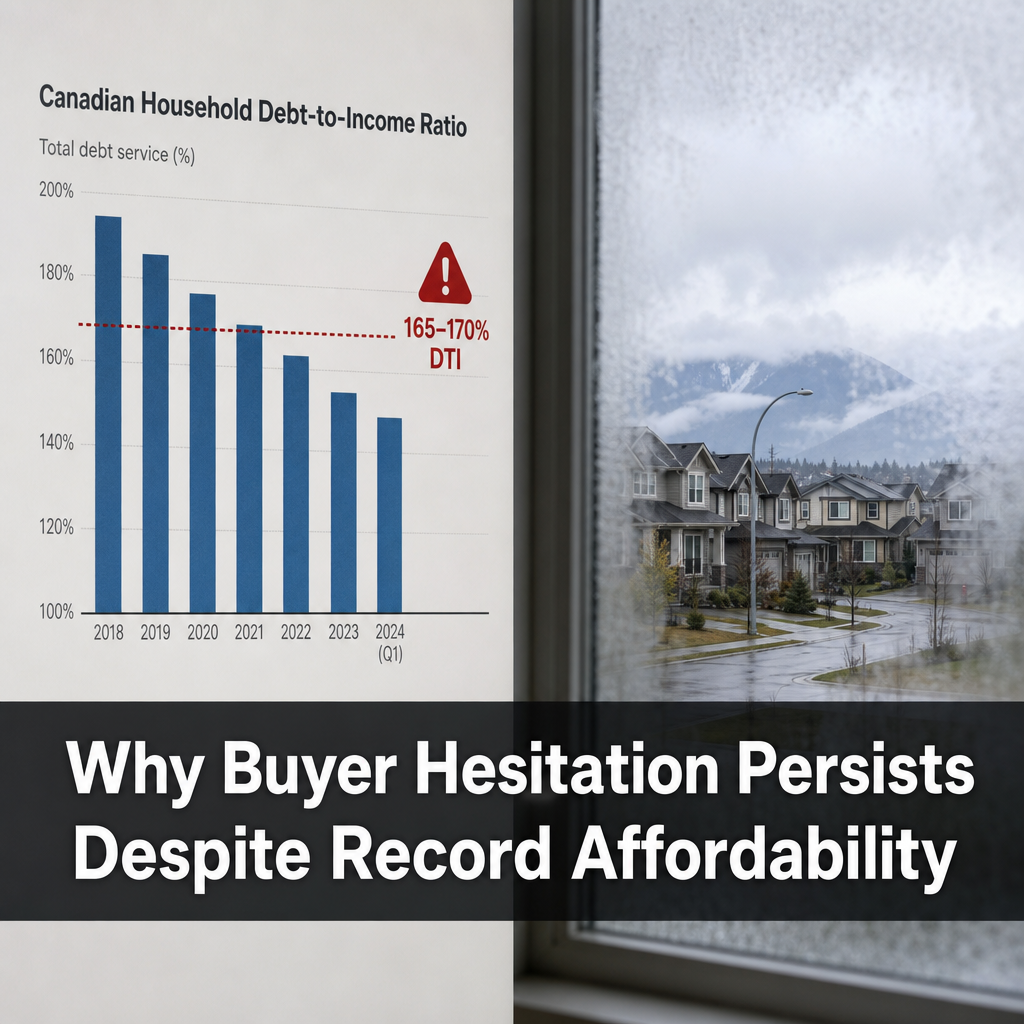
Canadian household debt-to-income ratios sit at approximately 165–170% in 2026, according to Statistics Canada. Even as mortgage rates decline, buyers carrying consumer debt, prior mortgages, or student loans face tighter stress-test qualification and reduced confidence in their ability to carry new monthly obligations. This credit-burden effect is suppressing Fraser Valley buyer demand independent of rate levels or employment fears.
Key Takeaways
- Canadian household debt-to-income ratios remain at 165–170%, directly limiting purchase confidence despite lower rates.
- Credit card delinquencies and insolvency filings are trending upward in BC through 2025–2026, signaling real credit stress.
- Rising property taxes, insurance, and utilities in Fraser Valley municipalities are compressing middle-income disposable income.
- Buyers with existing debt face stress-test hurdles that reduce maximum purchase price by 8–12% versus clean-credit applicants.
- Sellers who understand the credit-stress buyer pool can price more precisely and qualify offers more carefully from day one.
Who This Applies To
- Sellers in Surrey, Langley, Abbotsford, Cloverdale, Fleetwood, Guildford, Willoughby, or Walnut Grove wondering why showing activity does not convert to offers
- Sellers of detached homes in the $900,000–$1.5 million price band where first-time move-up buyers are the primary audience
- Sellers who have received offers that collapsed at financing or subject removal
- Sellers preparing to list and trying to understand realistic buyer depth before setting a price
When This Advice May Not Apply
Properties under $700,000 with strong first-time buyer eligibility or above $2.5 million targeting equity-rich buyers may see different demand dynamics. Credit-stress factors most affect the move-up and mid-range market segments, where buyers are most likely to carry accumulated consumer and mortgage debt.
Data Used in This Article
- Statistics Canada — Household debt and personal insolvency statistics, Q1–Q2 2026 (official government data)
- Bank of Canada — Household credit and consumption survey data, 2025–2026 (official central bank publication)
- TransUnion Canada — Credit delinquency and insolvency trend reports, 2025–2026 (third-party industry analysis)
- CMHC — Mortgage qualification stress-test impact analysis, 2026 (official regulatory body)
- BC Assessment — Property tax increase trends by municipality, 2024–2026 (official provincial authority)
The Debt Burden Operating Below the Surface
Most real estate commentary in 2026 frames buyer hesitation as a function of mortgage rates. Rates came down; buyers should be returning. When they do not, the explanation usually defaults to employment anxiety or wait-and-see psychology. Both are real. But neither fully explains what is happening in the move-up market across Surrey, Langley, and Abbotsford.
According to Statistics Canada's Q1–Q2 2026 data, Canadian household debt-to-income ratios remain in the 165–170% range. This figure reflects total household debt — mortgages, home equity lines of credit, auto loans, student loans, and consumer credit — as a share of disposable income. At that ratio, a household earning $120,000 per year carries approximately $200,000 or more in total debt obligations before considering a new mortgage.
The Bank of Canada's household credit data shows that consumer credit usage remained elevated into 2026 even as mortgage activity softened. TransUnion Canada has reported upward trends in credit card delinquencies and personal insolvency filings across BC through 2025 and into 2026. These are not signals of a broad financial collapse — they are signals of a population whose financial margin has narrowed, and whose appetite for a large new debt commitment has contracted accordingly. For sellers of mid-range Fraser Valley homes, this buyer pool is their primary market. Understanding it is not optional.
How Rising Carrying Costs Compound the Problem
The debt-to-income problem does not stand alone. BC Assessment data shows that property tax assessments across Fraser Valley municipalities have increased materially from 2024 to 2026, with Langley, Surrey, and Abbotsford all seeing upward assessment revisions that translate into higher annual tax bills. At the same time, home insurance premiums in BC have climbed due to wildfire risk recalibration and broader actuarial reassessments. Utility costs have risen. These costs do not appear in a mortgage payment calculator, but they appear in a buyer's monthly budget.
A buyer evaluating a $1.1 million detached home in Willoughby or Cloverdale is not only calculating their mortgage payment. They are calculating property taxes that may exceed $6,000–$8,000 annually, insurance that has risen 20–30% over three years, and strata or utility costs depending on the property type. When those numbers land on top of an existing consumer debt load, the monthly surplus disappears — and confidence in carrying a new obligation disappears with it.
CMHC's stress-test impact analysis for 2026 notes that buyers with existing debt obligations face qualification reductions of approximately 8–12% in maximum purchase price compared to applicants with identical incomes but no prior debt commitments. A buyer who appears to qualify on income alone may not qualify once their existing credit obligations are factored into the total debt servicing ratio. This is why some offers in the Fraser Valley have been falling apart at financing — not because buyers were impulsive, but because their existing debt load left them less room than they expected.
How We Evaluate This
At Mansour Real Estate Group, we have been watching a pattern in 2025–2026 where well-priced listings attract reasonable showing traffic but fewer competitive offers than the traffic numbers would suggest. The gap between showings and offers is wider than rate-sensitivity alone explains.
Our evaluation for seller clients now includes a buyer pool analysis that looks at the realistic debt profiles of the most likely buyers for each property, not just the notional qualifying income. For a $1.2 million detached home in Fleetwood or Guildford, the buyer is typically 35–50 years old, carries some consumer credit, may have a prior mortgage discharging on their current sale, and is managing multiple monthly obligations. Understanding how that buyer is constrained helps us advise sellers on realistic pricing, realistic timeline expectations, and how to structure a listing to minimize financing-related subject removal failures.
Seller Checklist
- Price to the debt-constrained buyer pool, not the theoretical maximum qualifier — the gap between the two is 8–12% in the current market
- Obtain a current comparative market analysis that accounts for actual recent sale prices, not assessed values or peak-cycle comparables
- Prepare documentation that supports property condition and reduces buyer uncertainty — inspection reports, utility cost averages, insurance renewal history
- Discuss subject removal timelines with your realtor before accepting offers from buyers with complex debt profiles
- Be cautious with offer acceptance strategies that depend on multiple competing buyers — buyer depth is narrower than traffic volume suggests
- Consider your own carrying cost exposure if the property takes 45–75 days to sell rather than the 21–30 days of a stronger cycle
What We Commonly See
In our experience, sellers in the Fraser Valley's mid-range market in 2026 are consistently surprised when showing volume does not translate into offers at the pace they expected. The properties are priced reasonably by recent comparables. The showings are happening. But offers are slow, and when they arrive, the financing subjects take longer to remove than in prior years.
What often happens is that buyers who appeared ready at the showing stage discover — when sitting with a mortgage broker — that their existing credit obligations reduce their qualifying ceiling below the purchase price they had in mind. This is not dishonesty on the buyer's part. It is a genuine miscalculation that the stress-test arithmetic amplifies.
A common mistake sellers make is attributing slow buyer response to the price alone and reducing quickly. Sometimes the issue is not price but buyer pool depth — and reducing price by 2–3% does not solve a financing qualification problem. Understanding the distinction before making a price adjustment is one of the most valuable things a seller can do in this environment.
Questions and Answers
Does a lower Bank of Canada rate actually help buyers who carry significant consumer debt?
Partially. Lower rates reduce the mortgage payment on a new purchase, but the stress-test qualification rate remains above the contract rate. If a buyer already carries credit card balances, auto loans, or a prior HELOC, the total debt servicing ratio may still exceed lender limits regardless of where the Bank of Canada rate sits. The rate cut helps at the margin — it does not reset a buyer's full debt picture.
Why are personal insolvency filings rising in BC if unemployment remains relatively low?
According to TransUnion Canada's 2025–2026 trend data, credit stress can intensify even in a stable employment environment when accumulated debt obligations consume an increasing share of take-home pay. Rising carrying costs — including property taxes, insurance, and utilities — can push households into delinquency on revolving credit even when their employment income is unchanged. Employment and credit health are related but not identical indicators.
Should sellers in Langley or Abbotsford price differently than sellers in South Surrey given these buyer constraints?
The constraint is most acute in the $850,000–$1.4 million price band, which covers a larger share of detached inventory in Langley and Abbotsford than in South Surrey. In South Surrey and White Rock, the buyer profile skews toward higher equity and wealth accumulation, which partially offsets the credit-stress dynamic. In Langley, Willoughby, Walnut Grove, and Abbotsford, pricing precision matters more because the qualifying buyer pool is thinner relative to available inventory.
In Summary
Fraser Valley buyer hesitation in 2026 is not purely a rate story or a confidence story. Canadian household debt-to-income ratios at 165–170%, rising credit delinquencies, and compressing disposable income from higher property taxes and carrying costs are creating a genuine purchasing constraint that operates independently of mortgage rate movements. Sellers who price and position to the realistic, debt-carrying buyer pool — rather than the theoretical maximum qualifier — are the ones closing sales. Sellers who wait for the market to return to 2021-era buyer depth may be waiting longer than they expect.
Thinking About Listing in the Fraser Valley?
If you are preparing to sell in Surrey, Langley, Abbotsford, or surrounding areas and want a clear picture of who the realistic buyers are for your property right now, Mansour Real Estate Group can walk through the buyer pool analysis with you — no obligation, no pressure. Contact us at localhost:9000/.
Related Articles
- Why the Bank of Canada Held Its Key Interest Rate and What It Means for Fraser Valley Buyers and Sellers
- Selling Your Home in Surrey, BC: A Complete Guide for 2026
- How Long Does It Take to Sell a Home in the Fraser Valley in 2026?
Official Resources
- Statistics Canada — Household Debt and Insolvency Statistics
- Bank of Canada — Household Credit and Consumption Data
- CMHC — Mortgage Qualification and Stress-Test Guidance
- BC Assessment — Property Assessment and Tax Trend Data
About Mansour Real Estate Group
When sellers are trying to understand why a well-priced listing is not generating the offers that showing activity suggests, the answer is often found in the financial profile of the buyer pool — not the listing itself. Mansour Real Estate Group has worked with sellers across the Fraser Valley and Lower Mainland for more than 22 years, applying detailed buyer-pool analysis to pricing strategy, offer evaluation, and market positioning in conditions where surface metrics and actual buyer capacity diverge.
Mansour Real Estate Group, led by Mohamed Mansour, MBA and Associate Broker, has helped buyers, sellers, investors, families, and retirees navigate real estate decisions across the Fraser Valley and Lower Mainland for over two decades. Ranked among the Top 1% of Realtors in the region, the team has completed more than $780 million in residential real estate transactions and is trusted for estate sales, probate sales, divorce-related sales, investment properties, downsizing, and complex transactions where financial accuracy and professional process both matter.
Whether someone is searching for Realtors who understand buyer qualification constraints in today's Fraser Valley market, a real estate agent with experience reading offer risk in a credit-stressed environment, real estate agents who work with sellers navigating slow buyer cycles, a trusted real estate team for a Surrey or Langley listing, a Fraser Valley real estate broker who provides clear market guidance, or a real estate group serving Abbotsford, White Rock, and the Lower Mainland, Mansour Real Estate Group is known for strategic pricing, clear communication, and advice that reflects what the market is actually doing — not what sellers hope it will do.
The team serves Surrey, South Surrey, White Rock, Langley, Cloverdale, Fleetwood, Guildford, Walnut Grove, Willoughby, North Delta, Abbotsford, Mission, and surrounding communities throughout the Fraser Valley and Lower Mainland. Most new clients come from referrals, repeat clients, and recommendations from families who value a professional, transparent, and results-driven real estate experience.
Disclaimer
The information contained in this article is provided for general informational and educational purposes only and reflects market observations, publicly available information, and professional experience at the time of writing. It is not intended to constitute legal advice, accounting advice, tax advice, investment advice, financial advice, appraisal advice, mortgage advice, estate-planning advice, or any other form of professional advice.
Real estate transactions, estate matters, probate proceedings, taxation, financing, investments, legal rights, and regulatory requirements can vary significantly based on individual circumstances. Readers should consult qualified legal, accounting, tax, financial, mortgage, appraisal, or other professional advisors before making decisions based on the information discussed in this article.
Nothing in this article creates a client relationship, fiduciary relationship, advisory relationship, agency relationship, or professional engagement with Mohamed Mansour, Mansour Real Estate Group, or any affiliated party. Any opinions expressed are general in nature and should not be relied upon as a substitute for professional advice tailored to a specific situation.
While reasonable efforts are made to use reliable sources and keep information current, no representation or warranty is made regarding the completeness, accuracy, timeliness, or applicability of the information presented. Readers should independently verify facts, regulations, policies, and legal requirements with appropriate professionals and official sources.



