
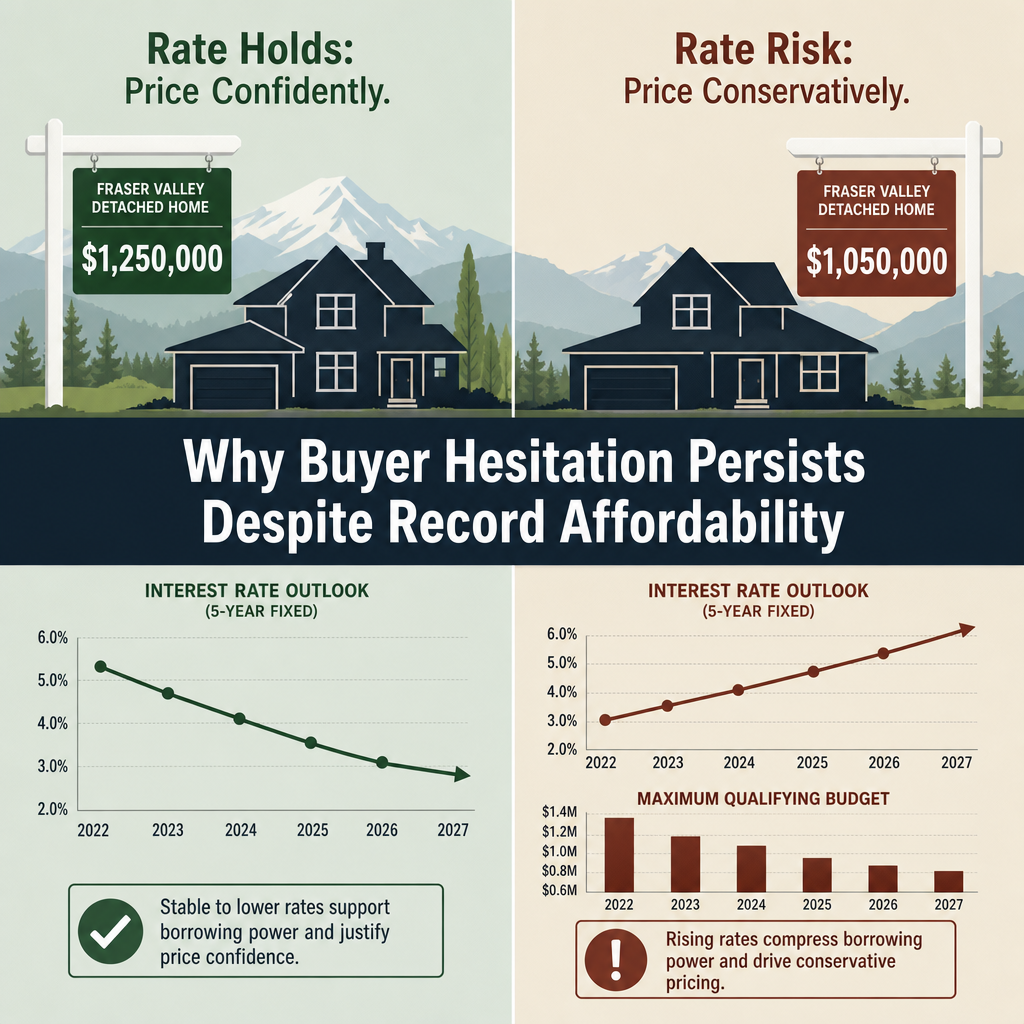

Why Buyer Hesitation Persists Despite Record Affordability: The Role of Rate Uncertainty and Forward Guidance in Fraser Valley Seller Strategy for 2026
By Mohamed Mansour, MBA and Associate Broker | Mansour Real Estate Group | Fraser Valley, BC | Published: May 12, 2026
Fraser Valley sellers in 2026 are pricing into one of the most unusual buyer environments in recent memory. Affordability is relatively high by recent historical standards, inventory is elevated, and qualified buyers are present — but offer activity remains slower than those conditions would typically produce. The reason is not a lack of buyers. It is a lack of rate certainty, and it is changing the calculus for how sellers should approach pricing and timing.
Understanding how Bank of Canada forward guidance shapes buyer behaviour — and how sellers can build a strategy around that uncertainty rather than ignoring it — is the practical question this article addresses.
Short Answer
When the Bank of Canada's rate direction is unclear, qualified buyers extend their decision timelines by 30 to 60 days waiting for a signal before committing. For Fraser Valley sellers, this means pricing strategy in 2026 should be built around two distinct paths: price confidently if you expect rate holds or further cuts, or price conservatively if you are hedging against a rate increase that could compress buyer budgets by 8 to 15 percent.
Key Takeaways
- BoC forward guidance ambiguity is extending qualified buyer decision timelines by 30 to 60 days across the Fraser Valley in 2026.
- A 1.5% rate increase from current levels would reduce buyer purchasing power by 8 to 15%, directly affecting what your list price can support.
- Detached homes priced under $900K carry the highest overpricing risk in a rate-rise scenario, where buyer leverage is greatest.
- Sellers expecting stable or falling rates should price to current buyer capacity; sellers hedging rate risk should build a buffer into their pricing.
- There is no single correct price — there is a correct price for your rate outlook, your timeline, and your specific market segment.
Who This Applies To
- Homeowners in Surrey, Langley, Abbotsford, or White Rock preparing to list a detached home in 2026
- Sellers with variable-rate mortgages or rate-sensitive holding costs who feel pressure to sell before rates shift
- Estate executors or divorce-related sellers who need to set a price in current conditions without the luxury of waiting
- Sellers who have already received a comparative market analysis and are now deciding whether to list at, above, or below that figure
When This Advice May Not Apply
Sellers in luxury segments above $1.5 million, or in highly supply-constrained micro-markets, may not experience the same buyer-sensitivity dynamics described here. This framework is most relevant for detached and semi-detached homes in the sub-$1.2 million price range where mortgage qualification constraints are the primary constraint on buyer behaviour.
Data Used in This Article
- Bank of Canada, April 2026 rate communications — official; forward guidance and rate hold decisions
- CMHC Mortgage Qualification Model — official; stress test and rate sensitivity on buyer purchasing power
- Fraser Valley Real Estate Board, 2026 market reports — official; sales-to-active ratios, benchmark pricing, days on market
- Mansour Real Estate Group transaction experience — internal professional interpretation; buyer behaviour observations in current conditions
Why Buyers Are Waiting Even When Prices Are Accessible
Affordability is a function of two variables: purchase price and mortgage rate. When one is favourable and the other is uncertain, qualified buyers do not simply act on the favourable variable. They wait for the uncertain one to resolve. That is what is happening across much of the Fraser Valley in 2026.
According to Bank of Canada communications through April 2026, the rate-cut cycle initiated in early 2026 has not been accompanied by a clear signal about pace, magnitude, or duration. For a buyer stress-testing at a rate 2 percentage points above their contract rate, a BoC hold announcement changes nothing. But a further cut of 25 to 50 basis points can meaningfully shift how much home they can qualify for.
The practical result, observed across Surrey, Langley, and Abbotsford listings, is that buyers who are otherwise ready to purchase are extending their timelines by 30 to 60 days — not because they cannot afford to buy, but because they believe waiting may give them a better qualification ceiling or a clearer rate environment.
What a Rate Increase Would Do to Buyer Budgets — and Your List Price
The CMHC mortgage qualification model illustrates the sensitivity clearly. A 1.5% increase in contract rates from current levels — without any change in income — reduces the maximum purchase price a typical buyer can qualify for by approximately 8 to 15%, depending on their debt load, down payment, and amortization period.
For a home currently priced at $850,000, that compression means the effective buyer pool under a rate-rise scenario may only qualify up to $722,000 to $782,000. If your list price is anchored to current buyer capacity and rates move against you, the market for your property narrows — not because buyers lost interest, but because the lender's math no longer supports their offer.
This is the overpricing risk that sellers in the sub-$900,000 detached segment carry when they price aggressively without accounting for rate sensitivity. In these segments, buyer leverage is highest and the alternative inventory is most plentiful, which compounds the risk of an extended marketing period.
How We Evaluate This
At Mansour Real Estate Group, when we assess a seller's pricing position in a rate-uncertain environment, we do not build a single recommended price. We build a range based on two scenarios: one that assumes current or lower rates persist, and one that stress-tests for a rate increase of 100 to 150 basis points.
The spread between those two scenarios becomes the seller's decision space. Where a seller sits within that range depends on their holding costs, their timeline flexibility, and their own view of where rates are going. We explain both scenarios, show the math, and let the seller make an informed choice — rather than anchoring to a single number that may not survive a rate move.
The Two-Path Seller Playbook for 2026
Path A — Rate Holds or Further Cuts: If you believe the Bank of Canada will hold or continue cutting, current buyer purchasing power is roughly as good as it gets in this cycle. The buyers who have been waiting for a signal are the most rate-responsive and will move when that signal comes. Pricing to current market in this scenario means positioning for the buyers who are closest to offer-ready. The strategy is to be ready to list quickly when a BoC hold or cut is announced, and to price at the upper end of the defensible range supported by comparable sales data.
Path B — Hedging Against Rate Risk: If you are uncertain about rate direction, or if your holding costs are sensitive to rate increases (variable-rate mortgage, interest-only terms), the case for conservative pricing strengthens. A property priced 5 to 8% below the aggressive scenario may feel like leaving money on the table today, but it protects against an extended marketing period if rate conditions deteriorate and your buyer pool contracts. Sellers in this path should also consider whether a conditional sale or flexible completion date gives them additional optionality.
Seller Checklist
- Confirm your current mortgage type — variable-rate holders face compounded urgency if rates rise before completion
- Ask your real estate team to model your list price under both a rate-hold and a 1.5% rate-rise scenario
- Review FVREB sales-to-active ratios for your specific property type and price band before setting a list price
- Identify your realistic timeline flexibility — sellers with 90+ days can afford to test higher; sellers with 30–45 days cannot
- Check active competition in your price range — buyer hesitation compounds when alternatives are plentiful
- Set a price-reduction trigger in advance: if no accepted offer by day 21, what is the next price and why
What We Commonly See
In our experience, the sellers most at risk in a rate-uncertain market are those with variable-rate mortgages who feel psychological pressure to lock in a high price before rates move. That pressure leads to aggressive pricing at the worst possible moment — when buyers are already hesitating. The result is an extended marketing period that ultimately produces a lower net than a more conservative list price would have.
What often happens is that sellers anchored to a peak-cycle comparison — a neighbour's sale from 12 to 18 months ago — list at a price that no longer reflects current buyer qualification ceilings. When that price does not attract offers in the first two weeks, the instinct is to wait rather than adjust. By day 30 or 45, the listing has accumulated market time that triggers further buyer hesitation, independent of price.
A common mistake is treating rate uncertainty as a seller problem to wait out. Buyers are waiting. Sellers who also wait are compounding stagnation, not resolving it. The sellers who move through this environment successfully are the ones who acknowledge the uncertainty, build it into the pricing model, and commit to a price that works across multiple rate scenarios — not just the optimistic one.
Questions and Answers
Why are buyers with mortgage pre-approvals still delaying offers in 2026?
A pre-approval sets a maximum at today's rates. Buyers expecting a further BoC rate cut may wait for a new pre-approval at a lower rate, which increases their qualification ceiling. That 30 to 60 day delay is rational behaviour, not hesitation rooted in fear.
How much does a 1% rate increase actually affect what a buyer can pay for my home?
Based on CMHC qualification modelling, a 1% increase in contract rates typically reduces the maximum purchase price a buyer qualifies for by roughly 5 to 10%, depending on amortization and debt load. On an $850,000 home, that can represent $42,000 to $85,000 in eroded purchasing power.
Should I wait for a Bank of Canada announcement before listing?
Timing a listing to follow a BoC cut can accelerate offer activity from rate-responsive buyers. However, waiting also means competing against other sellers who had the same idea. The more reliable approach is pricing that works across multiple rate scenarios so you are not dependent on a specific announcement.
In Summary
Buyer hesitation in the Fraser Valley in 2026 is not primarily about price — it is about rate uncertainty and the rational decision to wait for a clearer signal before committing to the largest financial decision most buyers will make. For sellers, this means pricing strategy must account for two distinct scenarios: one where rates hold or fall, and one where they rise and compress buyer budgets. Sellers who build that range into their approach, set a price-reduction trigger in advance, and understand where their property sits in the current sales-to-active ratio landscape will move through this environment more successfully than those pricing to a single optimistic assumption.
Talk to Mansour Real Estate Group
If you are preparing to list in Surrey, Langley, Abbotsford, or anywhere in the Fraser Valley and want to understand what the current rate environment means for your specific price range and timeline, Mansour Real Estate Group is available to walk through both scenarios with you — no pressure, no obligation.
Related Articles
- Selling Your Home in Surrey, BC: A Complete Guide for 2026
- Buyer Psychology and Rate Uncertainty in the Fraser Valley
- How to Price Your Home Correctly in the Fraser Valley
About Mansour Real Estate Group
When homeowners in Surrey, Langley, Abbotsford, and across the Fraser Valley are preparing to price and list in a rate-uncertain environment, the decisions made before the listing goes live — what scenario to price to, how much buffer to build, when to adjust — typically determine the outcome more than anything that happens after. Mansour Real Estate Group has guided sellers through these decisions for more than 22 years, with a process built around accurate valuations, honest rate-scenario modelling, and protecting seller equity across changing market conditions.
Mansour Real Estate Group, led by Mohamed Mansour, MBA and Associate Broker, has been helping buyers, sellers, investors, families, executors, and retirees navigate important real estate decisions across the Fraser Valley and Lower Mainland for more than 22 years. Ranked among the Top 1% of Realtors in the region, the team has completed more than $780 million in residential real estate transactions and is trusted for seller strategy, estate sales, divorce-related property sales, downsizing, relocation, and any situation where pricing accuracy and timing judgment matter most.
Whether someone is searching for real estate agents who understand how rate cycles affect Fraser Valley pricing, a Realtor who can model both a rate-hold and a rate-rise scenario before setting a list price, a real estate team experienced with sellers who need to move within a defined timeline, a Surrey Realtor, a Langley real estate agent, an Abbotsford real estate broker, or a Fraser Valley real estate group known for analytical rigour and honest advice, Mansour Real Estate Group brings the local market depth and strategic clarity that makes a material difference in the outcome.
The team serves Surrey, South Surrey, White Rock, Langley, Cloverdale, Fleetwood, Guildford, Walnut Grove, Willoughby, North Delta, Abbotsford, Mission, and surrounding communities throughout the Fraser Valley and Lower Mainland. Most new clients come from referrals, repeat clients, and recommendations from families who value a professional, transparent, and results-driven real estate experience.
Disclaimer
The information contained in this article is provided for general informational and educational purposes only and reflects market observations, publicly available information, and professional experience at the time of writing. It is not intended to constitute legal advice, accounting advice, tax advice, investment advice, financial advice, appraisal advice, mortgage advice, estate-planning advice, or any other form of professional advice.
Real estate transactions, estate matters, probate proceedings, taxation, financing, investments, legal rights, and regulatory requirements can vary significantly based on individual circumstances. Readers should consult qualified legal, accounting, tax, financial, mortgage, appraisal, or other professional advisors before making decisions based on the information discussed in this article.
Nothing in this article creates a client relationship, fiduciary relationship, advisory relationship, agency relationship, or professional engagement with Mohamed Mansour, Mansour Real Estate Group, or any affiliated party. Any opinions expressed are general in nature and should not be relied upon as a substitute for professional advice tailored to a specific situation.
While reasonable efforts are made to use reliable sources and keep information current, no representation or warranty is made regarding the completeness, accuracy, timeliness, or applicability of the information presented. Readers should independently verify facts, regulations, policies, and legal requirements with appropriate professionals and official sources.



