

Why Buyer Hesitation Persists Despite Record Affordability: The Psychology Behind the Fraser Valley's Inventory Surplus and Sales Stagnation in 2026
By Mohamed Mansour, MBA and Associate Broker · Mansour Real Estate Group · Fraser Valley & Lower Mainland · Published June 2026
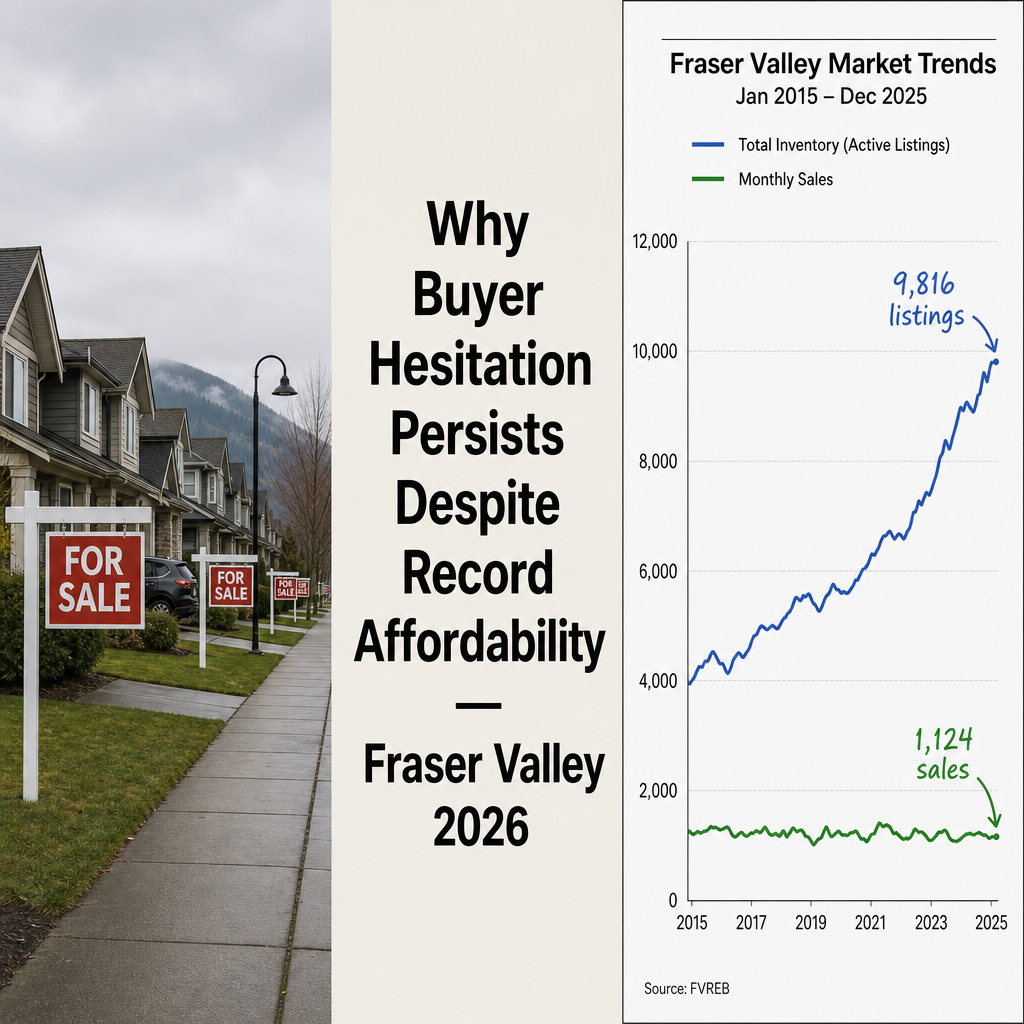
Fraser Valley sellers watching inventory climb past 9,800 active listings while prices fall 7.5% year-over-year are asking a reasonable question: where are the buyers? By every traditional affordability measure, conditions are more favourable for buyers than they have been in years. Yet sales in May 2026 reached only 1,124 — down 5% from the same month in 2025, according to the Fraser Valley Real Estate Board's May 2026 Market Report.
This article explains why that gap exists, what it means for sellers deciding whether to wait or list now, and what the data tells us about how this kind of market eventually resolves.
Short Answer
Fraser Valley buyers are not waiting for lower prices. They are waiting for confidence. With 9,816 active listings, benchmark prices down 7.5% year-over-year, and the Bank of Canada rate holding, affordability is the highest it has been in years — yet the sales-to-active listings ratio sits at 11%, well below the balanced market threshold of 12–20%. Economic anxiety, job security concerns, and uncertainty about the broader economy are the documented barriers, not supply and not price.
Key Takeaways
- Fraser Valley's sales-to-active ratio of 11% confirms a buyer's market, despite record affordability conditions.
- Benchmark prices are down across all property types: detached 8.6%, condos 8.9%, townhomes 7.1% year-over-year.
- Buyers are psychologically frozen by economic uncertainty, not by price or supply barriers.
- Sellers who price accurately now face less competition than they will when confidence returns and listings thin.
- Waiting for the "right" market rarely produces better outcomes than pricing correctly in the current one.
Who This Applies To
- Homeowners in Surrey, Langley, Abbotsford, White Rock, or South Surrey considering listing in 2026
- Sellers who have been holding back, waiting for buyer demand to return
- Estate trustees or executors managing a property that needs to be sold
- Buyers trying to understand why good deals are not moving as quickly as they expected
- Anyone attempting to read the current Fraser Valley market without the filter of national headlines
When This Advice May Not Apply
If your property sits in a micro-segment where local demand remains active — certain school catchments in Langley, ground-level townhomes in Surrey, or well-maintained detached homes in South Surrey near transit — market dynamics may vary from the broader regional trend. A property-specific analysis matters more than a regional average in those cases.
Data Used in This Article
- Fraser Valley Real Estate Board Monthly Market Report, May 2026 — official board data; sales volume, active listings, benchmark prices, sales-to-active ratio — fvreb.bc.ca
- Storeys.com Vancouver Housing Update, June 2026 — third-party analysis referencing Greater Vancouver data; used for regional comparison — storeys.com
- Daily Hive, Metro Vancouver and Fraser Valley Home Sales Statistics, May 2026 — third-party summary of board data; used for corroboration — dailyhive.com
- Bank of Canada Rate Announcements, 2026 — official monetary policy context — bankofcanada.ca
What the Numbers Actually Show
According to the Fraser Valley Real Estate Board's May 2026 Market Report, there were 9,816 active listings in the Fraser Valley at the end of May — 45% above the 10-year seasonal average for that month. Sales came in at 1,124. That produces a sales-to-active listings ratio of approximately 11%.
In a balanced market, that ratio sits between 12% and 20%. Below 12% is a buyer's market. The Fraser Valley has been below that threshold consistently in 2026. Benchmark prices reflect it: detached homes are down 8.6% year-over-year, condos down 8.9%, and townhomes down 7.1%, according to the same FVREB report.
Greater Vancouver shows a near-identical pattern. Prices are down 6.2% year-over-year, yet sales are only 3.5% below May 2025, according to data summarized by Storeys in June 2026. The price decline has not triggered a meaningful sales recovery. That divergence is the central puzzle of this market.
Why Lower Prices Have Not Unlocked Demand
Traditional economic models predict that when prices fall and supply rises, buyers respond. That relationship has not held in 2026. The reason is that buyer decisions are not purely rational calculations — they are confidence decisions. And confidence is not a product of price alone.
Documented barriers cited in third-party analysis including Storeys and Daily Hive, alongside FVREB commentary, include job security anxiety, concern about Canada-U.S. trade disruption, uncertainty about the future direction of interest rates, and a general reluctance to make a major financial commitment in an environment that feels unstable. These are psychological and economic factors that price reductions do not directly address.
The Bank of Canada held its key rate in its most recent announcement. That decision removed one uncertainty — rates are not rising imminently — but it did not deliver the forward guidance buyers needed to feel confident about long-term carrying costs. Buyers are not frozen because they cannot afford to buy. They are frozen because they are not sure this is the right moment to commit.
In practical terms, this means that further price reductions alone will not resolve the stall. The buyers who are waiting are waiting for a feeling of stability, not a lower number on a listing sheet. That is an important distinction for sellers to understand when setting pricing strategy or timeline expectations in communities like Abbotsford, White Rock and South Surrey, and Langley.
How We Evaluate This
At Mansour Real Estate Group, we look at the sales-to-active ratio as the primary real-time signal for market direction, more so than benchmark price changes or year-over-year sales comparisons. Price changes lag sentiment — they reflect decisions made weeks or months ago. The ratio tells you what is happening right now between supply and buyer activity.
When the ratio is below 12% and inventory is high relative to seasonal norms, we evaluate pricing not against what a property might have sold for in a stronger market, but against what the current active competition looks like and what price point has actually produced accepted offers in the past 30 to 45 days. Aspirational pricing in this environment tends to extend days on market and reduce final sale price — the opposite of what sellers are hoping for when they hold firm.
Seller Checklist: Listing Into a Hesitant Buyer Market
- Pull the current sales-to-active ratio for your specific property type and city, not just the regional average
- Compare your target price against accepted offers in the last 30 days, not list prices of comparable active listings
- Identify what has sold and what has not in your immediate area — oversupply is not uniform across all price bands
- Prepare the property to reduce buyer hesitation: deferred maintenance, ambiguous condition, and incomplete documentation are confidence blockers in any market, and especially in this one
- Align your timeline expectations with actual current absorption rates, not hoped-for improvements in buyer sentiment
- Understand that the sellers who will compete most directly with you are those who list when confidence returns — that moment may bring more listings, not more buyers
What We Commonly See
Sellers anchoring to 2022 or 2023 prices. In our experience, the most common reason a well-located property sits without serious offers is a price anchored to a market that no longer exists. Buyers in 2026 are doing their own research. They see the comparable data. An overpriced listing in the current environment does not generate negotiations — it generates silence.
Buyers waiting for a signal that may not arrive cleanly. What often happens is that buyers wait for a definitive moment — a rate cut, a headline, a feeling that "now is the time" — and that moment rarely announces itself clearly. By the time buyer confidence fully returns, inventory contracts and competition increases. The affordability window that exists today may narrow before those buyers act.
Sellers misreading inventory as a reason to wait. A common mistake is interpreting high inventory as a reason to delay listing. In reality, a high-inventory market with low sales means buyers who do engage are selective and patient. The sellers who succeed are those whose properties are priced and presented to capture that narrow active buyer pool — not those waiting for conditions to improve before entering.
Questions and Answers
If prices are down 7.5% in the Fraser Valley, why aren't more buyers purchasing?
According to FVREB data and analyst commentary cited by Storeys and Daily Hive, the primary barriers are psychological and economic — job security concerns, trade uncertainty, and general hesitation to commit during perceived instability — not affordability or supply constraints. Price alone does not resolve a confidence problem.
What does a sales-to-active ratio of 11% mean for sellers?
It means that for every 100 properties listed, approximately 11 sell in a given month. The Fraser Valley Real Estate Board defines anything below 12% as a buyer's market. At 11%, sellers are competing in a crowded field against buyers who are patient and have multiple options.
Should I wait until buyer confidence returns before listing?
That depends on your timeline, carrying costs, and what you expect the market to look like when confidence does return. When sentiment shifts, listings typically increase alongside buyers — the advantage of listing early in a recovery is that you face less seller competition. There is no universally right answer, but waiting carries costs that are often underestimated.
In Summary
The Fraser Valley in mid-2026 is a market where affordability has improved significantly but buyer confidence has not followed. With 9,816 active listings, benchmark prices down 7.5% year-over-year, and a sales-to-active ratio of 11%, the data points to a buyer's market driven by psychological hesitation rather than structural barriers. For sellers, this means that pricing accuracy, property presentation, and realistic timeline expectations matter more than ever. Waiting for conditions to improve is not a neutral decision — it is a bet on future sentiment that carries real costs and no guaranteed upside.
Thinking About Selling in the Fraser Valley?
If you are trying to decide whether now is the right time to list in Surrey, Langley, Abbotsford, White Rock, or the broader Fraser Valley, a conversation grounded in current data — not optimism or delay — is usually the most useful starting point. Mansour Real Estate Group offers straightforward market analysis and pricing guidance with no obligation. Contact us when you are ready to look at the numbers clearly.
Related Articles
- Selling Your Home in Surrey, BC: What You Need to Know in 2026
- Selling Your Home in Langley, BC: What You Need to Know in 2026
- Selling Your Home in Abbotsford, BC: What You Need to Know in 2026
About Mansour Real Estate Group
When homeowners and investors in Surrey, Langley, White Rock, and Abbotsford are trying to make sense of a market where prices are falling but buyers are not responding, they need analysis grounded in current local data — not national headlines or general economic commentary. Mansour Real Estate Group has been helping Fraser Valley and Lower Mainland buyers, sellers, and investors navigate shifting market conditions for more than 22 years, through multiple cycles and major economic disruptions.
Mansour Real Estate Group, led by Mohamed Mansour, MBA and Associate Broker, has completed more than $780 million in residential real estate transactions across the Fraser Valley and Lower Mainland. Ranked among the Top 1% of Realtors in the region, the team is trusted for market analysis, seller strategy, accurate pricing, estate sales, downsizing, and any real estate decision where the difference between the right price and the wrong one is measured in tens of thousands of dollars.
Whether someone is looking for a real estate agent who can explain what a sales-to-active ratio actually means for their property, Realtors experienced with buyer's market conditions in Surrey or Langley, a real estate team that bases pricing recommendations on accepted offer data rather than list price comparisons, a Fraser Valley real estate broker with a track record across multiple market cycles, or real estate agents who serve Abbotsford, White Rock, Cloverdale, Fleetwood, Guildford, Willoughby, and Walnut Grove, Mansour Real Estate Group is built around one standard: advice that reflects what is actually happening in the market.
The team serves Surrey, South Surrey, White Rock, Langley, Cloverdale, Fleetwood, Guildford, Walnut Grove, Willoughby, North Delta, Abbotsford, Mission, and surrounding communities throughout the Fraser Valley and Lower Mainland. Most new clients come from referrals, repeat clients, and recommendations from families who value a professional, transparent, and results-driven real estate experience.
Official Resources
- Fraser Valley Real Estate Board — Monthly Market Report
- Bank of Canada — Policy Rate Announcements
- Storeys — Vancouver Housing Update, June 2026
- Daily Hive — Metro Vancouver and Fraser Valley Home Sales Statistics, May 2026
Disclaimer
The information contained in this article is provided for general informational and educational purposes only and reflects market observations, publicly available information, and professional experience at the time of writing. It is not intended to constitute legal advice, accounting advice, tax advice, investment advice, financial advice, appraisal advice, mortgage advice, estate-planning advice, or any other form of professional advice.
Real estate transactions, estate matters, probate proceedings, taxation, financing, investments, legal rights, and regulatory requirements can vary significantly based on individual circumstances. Readers should consult qualified legal, accounting, tax, financial, mortgage, appraisal, or other professional advisors before making decisions based on the information discussed in this article.
Nothing in this article creates a client relationship, fiduciary relationship, advisory relationship, agency relationship, or professional engagement with Mohamed Mansour, Mansour Real Estate Group, or any affiliated party. Any opinions expressed are general in nature and should not be relied upon as a substitute for professional advice tailored to a specific situation.
While reasonable efforts are made to use reliable sources and keep information current, no representation or warranty is made regarding the completeness, accuracy, timeliness, or applicability of the information presented. Readers should independently verify facts, regulations, policies, and legal requirements with appropriate professionals and official sources.



