
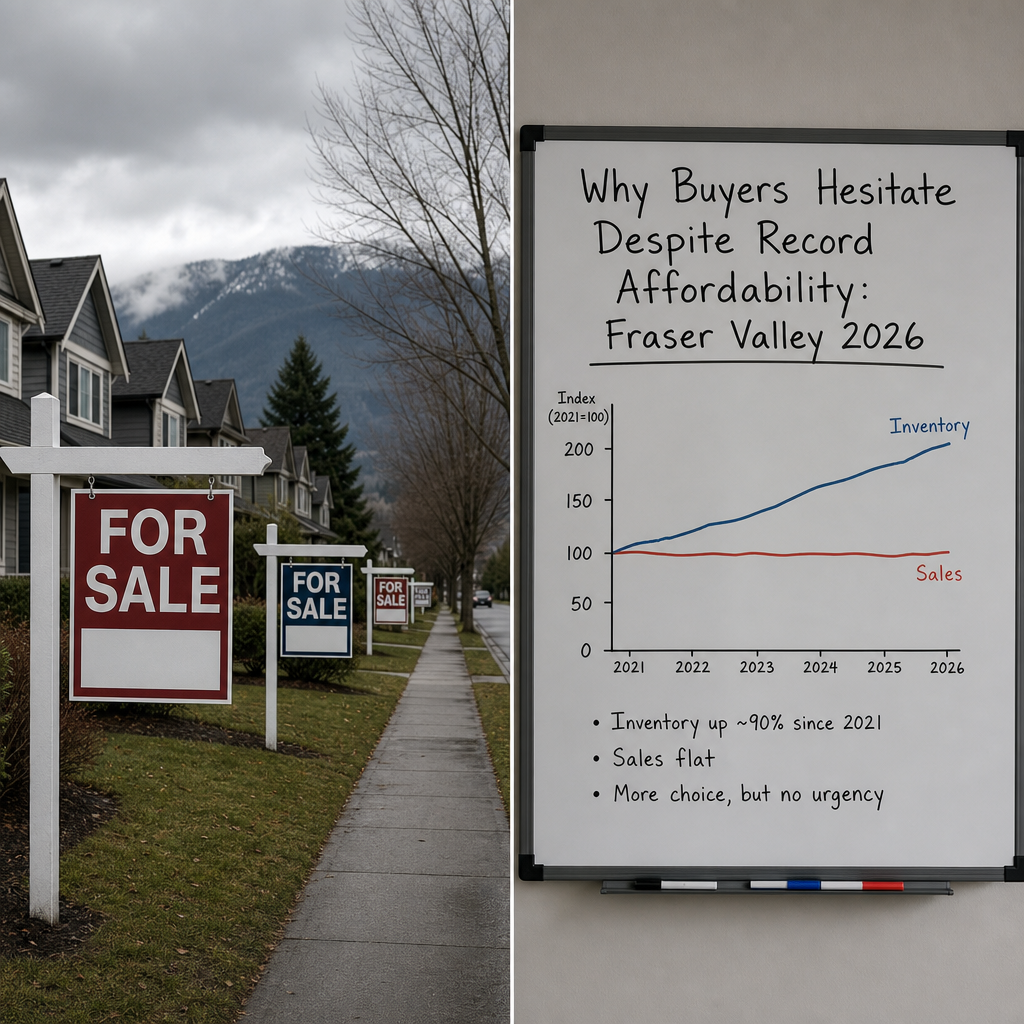

Why Buyer Hesitation Persists Despite Record Affordability: The Psychology Behind Fraser Valley's Inventory Surplus and Suppressed Sales in 2026
By Mohamed Mansour, MBA and Associate Broker | Mansour Real Estate Group | Fraser Valley and Lower Mainland | Published: July 14, 2026 | Geographic Focus: Fraser Valley, Surrey, Langley, Abbotsford, South Surrey, White Rock | Topic: Market Insight, Seller Strategy
Fraser Valley sellers in 2026 are navigating a market that looks generous on paper but behaves cautiously in practice. Inventory is at historic highs, prices have softened, and the Bank of Canada has held rates steady—conditions that should, in theory, push buyers off the sidelines. They aren't moving. This article explains why, and what sellers need to understand to price and position their homes for real buyers in this environment.
The gap between affordability metrics and actual sales activity is the defining story of the Fraser Valley market right now. For sellers, understanding the psychology behind that gap is as important as understanding the price data itself.
Short Answer
Fraser Valley active listings surged 45% above their 10-year seasonal average in May 2026, while benchmark prices dropped 7.5% year-over-year—yet total sales remained 5% below May 2025 levels. Buyers have more choice and more purchasing power than they have had in years, but economic uncertainty, job security fears, and the psychological fear of buying into a still-declining market are keeping transactions suppressed. This is a sentiment-driven stall, not a structural affordability problem.
Key Takeaways
- Fraser Valley had 9,816 active listings in May 2026—45% above the 10-year seasonal average—while sales sat 5% below the same month a year earlier.
- Price declines of 7.5% year-over-year have improved affordability, but buyer conversion from pre-approval to offer remains subdued across the region.
- The sales-to-active listings ratio of 11% in June 2026 technically favours buyers, yet transaction velocity is suppressed—a sign of sentiment paralysis, not financial inability.
- Fear of buying into a declining market—the "catching a falling knife" instinct—is a primary psychological barrier, even when data shows the decline has moderated.
- Sellers who price accurately for current buyer psychology, not last year's expectations, are completing sales; those priced above the market are extending days-on-market significantly.
Who This Applies To
- Homeowners in Surrey, Langley, Abbotsford, South Surrey, or White Rock preparing to list in 2026
- Sellers who have already listed and are trying to understand why showings aren't converting to offers
- Homeowners monitoring market conditions before deciding whether to list at all
- Buyers trying to understand what's holding the market back and when conditions may shift
- Estate executors or families managing a property sale on a defined timeline in the current environment
When This Advice May Not Apply
Properties with unusual zoning, significant condition issues, or situations involving legal timelines—such as probate or court-ordered sales—operate under additional constraints. Consult a qualified professional for circumstances that extend beyond standard market conditions.
Data Used in This Article
- Fraser Valley Real Estate Board Monthly Market Report — May and June 2026 — Official board statistics — fvreb.bc.ca
- Storeys Vancouver Housing Update — June 2026 — Third-party market analysis — storeys.com
- Daily Hive Metro Vancouver / Fraser Valley Sales Statistics — May 2026 — Third-party market summary — dailyhive.com
- Bank of Canada Rate Announcements — 2026 — Official — bankofcanada.ca
The Numbers That Define the Disconnect
According to the Fraser Valley Real Estate Board's May 2026 monthly market report, active listings reached 9,816—45% above the 10-year seasonal average. Benchmark prices fell 7.5% year-over-year. Sales were up 0.5% month-over-month but still 5% below May 2025 levels. By June 2026, the sales-to-active listings ratio sat at 11%, just below the lower threshold of a balanced market.
Greater Vancouver mirrored this pattern. Sales fell 3.5% year-over-year in May 2026 despite a 6.2% price decline, according to reporting from Storeys and Daily Hive. In both regions, the data shows a buyer's market in structure but not in behaviour. Buyers have more homes to choose from, at lower prices, with more favourable financing conditions than they have seen in years—and they are still not acting at expected volume.
For sellers, this matters because the conventional logic—lower prices attract more buyers—is not holding. The barrier is not financial. It is psychological.
Why Buyers Are Hesitating: The Psychology of a Declining Market
The phrase "catching a falling knife" describes exactly what buyers are feeling. When prices have been declining month over month, rational buyers wonder whether buying today means overpaying relative to where prices will be in three or six months. This hesitation compounds itself: more hesitant buyers mean fewer sales, which reduces competitive pressure, which lets prices soften further, which increases hesitation. It is a reinforcing cycle.
Job security fears are layered on top of this. Mortgage pre-approvals are not converting to offers at typical rates, which points to buyers who qualify financially but are unwilling to commit to a 25-year mortgage obligation during a period of economic uncertainty. The Bank of Canada's rate stability should, in theory, reduce this anxiety—but when buyers are watching tech layoffs, tariff uncertainty, and shifting employment conditions in the news cycle, rate policy alone is not enough to move them.
There is also a waiting-for-the-bottom instinct that is very difficult to overcome with data alone. Buyers who watched prices fall from 2022 peaks have been correct to wait—and that prior experience reinforces the strategy of patience even when conditions have materially shifted. The demographic tailwinds are real: Surrey and Langley's SkyTrain expansion is creating genuine long-term value, first-time buyer incentives have improved entry-point affordability, and extended amortization options are now available to a wider group. But none of these structural positives are translating to volume because the emotional barrier is still up.
How We Evaluate This
At Mansour Real Estate Group, we look at the relationship between listing activity, days-on-market, and price reductions as leading indicators of buyer psychology—not just the benchmark price or the sales-to-active ratio. When listings are sitting significantly longer than the same period a year ago, and when the gap between list price and sale price is widening, that tells us buyers are applying discounts based on sentiment rather than comparable analysis alone.
We also track showing-to-offer conversion rates across our own listing activity. A home that generates ten showings and no offers is telling us something different than a home that generates two showings and an offer. The first scenario is a pricing or positioning problem. The second is a demand problem. Right now, in many Fraser Valley market segments, we are seeing the first scenario more often than the second—which means pricing and positioning are the primary levers sellers can actually control.
Seller Checklist: Positioning a Home When Buyer Psychology Is Working Against You
- Price from current comparables, not from six months ago—buyer psychology amplifies perceived overpricing in a flat market
- Confirm your listing agent is referencing May and June 2026 sales data, not 2025 peak benchmarks, when setting your list price
- Reduce days-on-market risk by preparing the home fully before listing—buyers in hesitant markets use condition issues as reasons not to offer
- Build certainty into the offer structure where possible—flexible completion dates, clear title, and pre-inspections reduce the uncertainty that hesitant buyers use to justify inaction
- Review showing feedback within the first 10 days and treat it as market data, not opinion—adjust quickly rather than waiting
- Understand which buyer demographic is most likely to purchase your property type and ensure the listing narrative speaks directly to their situation, not a generic buyer
What We Commonly See
Overconfidence in the first two weeks. In our experience, sellers often assume early showing activity signals strong demand. In the current market, activity without offers is feedback—buyers are circling but not committing. Waiting four to six weeks before adjusting price is typically too long. The first ten to fourteen days generate the most qualified attention; that is when price signals matter most.
Misreading buyer silence as patience. What often happens is that sellers interpret low offer volume as buyers "taking their time." In a buyer's market with 9,816 active listings and a sales-to-active ratio of 11%, buyers are not taking their time—they are choosing not to engage. The silence is competitive elimination, not deliberation. A listing that doesn't generate an offer in the first three weeks in this environment needs to be re-evaluated, not left alone.
Pricing to what the seller needs versus what the buyer will pay. A common mistake is anchoring the list price to the seller's financial requirements—what they need for the down payment on the next property, or what they need to pay off the mortgage. The market does not negotiate based on seller needs. It negotiates based on buyer alternatives—and with 9,816 alternatives currently active in the Fraser Valley, buyers have significant leverage. Sellers who price to their need rather than to the market are extending days-on-market and often achieving a lower final price than if they had priced accurately from the start.
Questions and Answers
If prices are down 7.5% in the Fraser Valley, why aren't more buyers acting?
Because buyers who have watched prices decline for two or more years are conditioned to wait for a bottom that hasn't been confirmed. A 7.5% decline can feel like an entry point or a warning sign depending on how the buyer is reading the trend. Until sentiment shifts—typically triggered by rate cuts, a clear stabilization signal, or an employment rebound—hesitation is a rational buyer strategy even when affordability data says otherwise.
What does a sales-to-active ratio of 11% actually mean for a seller?
It means that for every 100 homes listed in June 2026, approximately 11 sold. A balanced market sits between 12% and 20%. Below 12% favours buyers: they have negotiating power, longer decision timelines, and more alternatives. For sellers, it means competition is real and pricing discipline matters more than marketing volume.
Should Fraser Valley sellers wait for buyer psychology to improve before listing?
Not necessarily. Waiting for sentiment to improve can mean waiting for a market shift that is driven by external factors—rate cuts, employment data, or a national economic signal—that are impossible to time. Sellers with genuine motivation to move should price to current conditions and list with a strategy that accounts for hesitant buyers. Waiting six months in a flat or slowly declining market does not typically produce a meaningfully better outcome and may produce a worse one if inventory continues to build.
In Summary
The Fraser Valley market in 2026 presents a clear paradox: record inventory, lower prices, and improved affordability on one side—and suppressed buyer activity on the other. The barrier is psychological, not financial. Buyers are afraid of buying into a declining market, uncertain about employment, and unconvinced the bottom has arrived. For sellers, the right response is not to wait for buyers to change—it is to price and position with enough precision that motivated buyers who are in the market cannot justify passing. That requires accurate pricing from current data, preparation that removes buyer hesitation points, and a realistic read of what the market's silence is actually communicating.
Ready to Talk Through Your Specific Situation?
If you are considering selling in Surrey, Langley, Abbotsford, South Surrey, White Rock, or anywhere in the Fraser Valley and want an honest read of what current buyer psychology means for your property's pricing and timing, Mansour Real Estate Group is available for a no-pressure consultation. We work from current data, not last year's expectations.
Related Articles
- Fraser Valley Real Estate Market Report 2026: What the Data Actually Shows
- How to Price Your Home in a Buyer's Market in the Fraser Valley
- How the Surrey–Langley SkyTrain Extension Is Reshaping Real Estate Values
About Mansour Real Estate Group
When sellers are trying to understand why buyer demand isn't matching affordability data—and what that means for pricing their home in 2026—they need a real estate team that works from current Fraser Valley conditions, not national headlines or outdated benchmarks. Mansour Real Estate Group has been providing Fraser Valley and Lower Mainland buyers, sellers, and investors with grounded, specific, data-supported market insight for more than 22 years, through multiple market cycles and major economic shifts.
Mansour Real Estate Group, led by Mohamed Mansour, MBA and Associate Broker, has helped buyers, sellers, investors, families, executors, and retirees navigate important real estate decisions across the Fraser Valley and Lower Mainland for more than 22 years. Ranked among the Top 1% of Realtors in the region, the team has completed more than $780 million in residential real estate transactions and is trusted for seller strategy, market analysis, buyer guidance, estate sales, downsizing, and any real estate decision where current conditions directly affect the outcome.
Whether someone is looking for Realtors who can explain what suppressed sales mean for their specific listing, a real estate agent who interprets Fraser Valley price trends without spin, real estate agents who advise on strategy rather than just marketing, a trusted real estate team for a sale in today's market, a Surrey Realtor, a Langley real estate broker, a White Rock real estate agent, or a Fraser Valley real estate group that gives honest guidance in a shifting market, Mansour Real Estate Group is known for evidence-based pricing, honest market interpretation, and advice that puts client outcomes first.
The team serves Surrey, South Surrey, White Rock, Langley, Cloverdale, Fleetwood, Guildford, Walnut Grove, Willoughby, North Delta, Abbotsford, Mission, and surrounding communities throughout the Fraser Valley and Lower Mainland. Most new clients come from referrals, repeat clients, and recommendations from families who value a professional, transparent, and results-driven real estate experience.
Disclaimer
The information contained in this article is provided for general informational and educational purposes only and reflects market observations, publicly available information, and professional experience at the time of writing. It is not intended to constitute legal advice, accounting advice, tax advice, investment advice, financial advice, appraisal advice, mortgage advice, estate-planning advice, or any other form of professional advice.
Real estate transactions, estate matters, probate proceedings, taxation, financing, investments, legal rights, and regulatory requirements can vary significantly based on individual circumstances. Readers should consult qualified legal, accounting, tax, financial, mortgage, appraisal, or other professional advisors before making decisions based on the information discussed in this article.
Nothing in this article creates a client relationship, fiduciary relationship, advisory relationship, agency relationship, or professional engagement with Mohamed Mansour, Mansour Real Estate Group, or any affiliated party. Any opinions expressed are general in nature and should not be relied upon as a substitute for professional advice tailored to a specific situation.
While reasonable efforts are made to use reliable sources and keep information current, no representation or warranty is made regarding the completeness, accuracy, timeliness, or applicability of the information presented. Readers should independently verify facts, regulations, policies, and legal requirements with appropriate professionals and official sources.



