
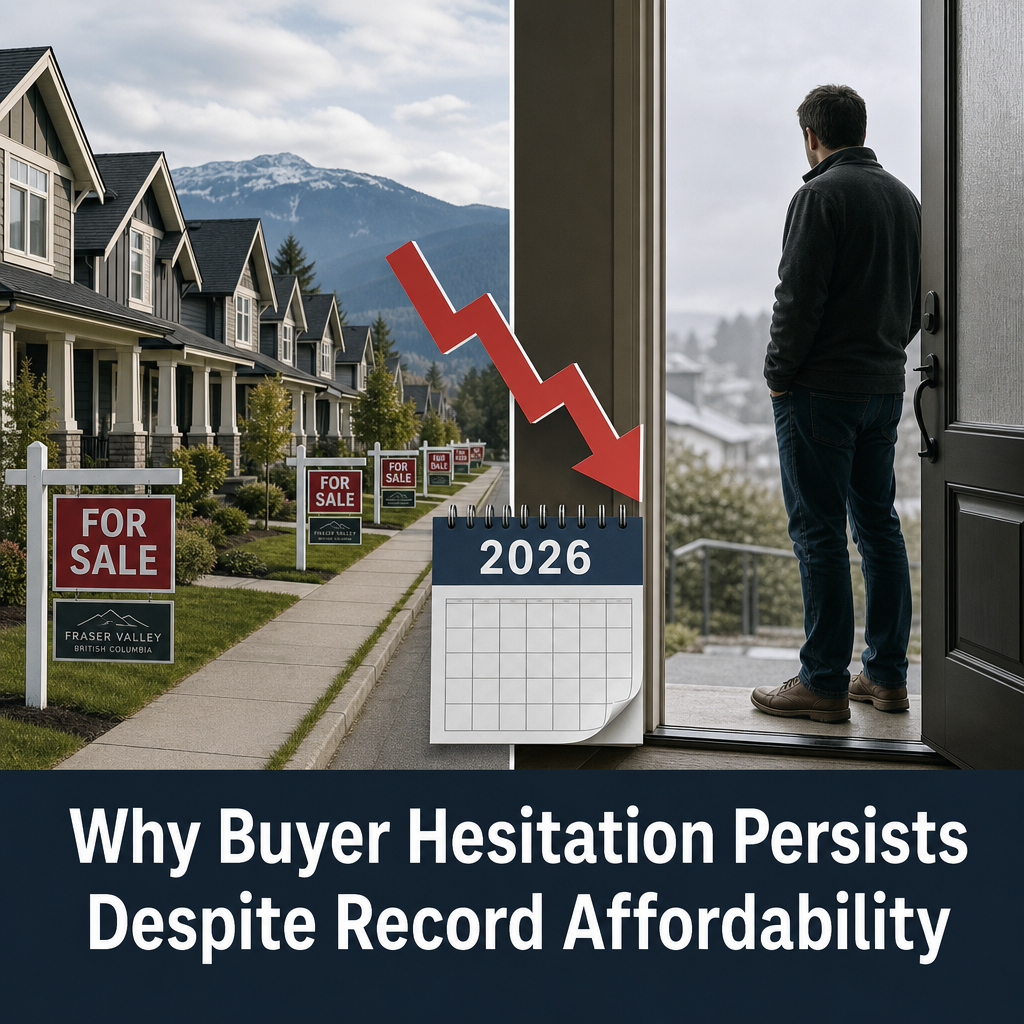

Why Buyer Hesitation Persists Despite Record Affordability: The Psychology Behind Fraser Valley's Inventory Surplus and Sales Stagnation in 2026
By Mohamed Mansour, MBA and Associate Broker — Mansour Real Estate Group | Fraser Valley and Lower Mainland, BC | Published: July 14, 2026
Fraser Valley sellers in 2026 are watching a market that looks, on paper, like a buyer's paradise: benchmark prices sitting 26% below their 2022 peak, over 10,000 active listings, and a sales-to-active ratio of 11% that firmly favours buyers. Yet the Fraser Valley Real Estate Board reported in June 2026 that sales remain subdued and buyers are still holding back. For sellers trying to understand when buyers will return — and for buyers trying to understand their own hesitation — the answer lies beyond the data.
This article examines the specific psychological and economic barriers preventing Fraser Valley buyers from acting despite conditions that are objectively the most favourable in years. It also explains what this means for sellers in Surrey, Langley, Abbotsford, White Rock, and across the region who are deciding whether to wait or list now.
Short Answer
Fraser Valley buyers are hesitating in 2026 because affordability alone does not drive purchasing decisions. Confidence does. With economic uncertainty, tariff-related employment fears, and mortgage stress test barriers still in place, buyers are waiting for stability signals that pricing and inventory cannot provide on their own. Sellers need to understand this dynamic to price and position effectively.
Who This Applies To
- Sellers currently listed or preparing to list in Surrey, Langley, Abbotsford, South Surrey, White Rock, or North Delta
- Move-up buyers weighing the risk of selling before buying in a slow market
- First-time buyers who qualify on paper but are delaying due to job or income uncertainty
- Investors who exited in 2023–2024 and are reconsidering re-entry
- Executors or families managing estate sales who need to understand realistic buyer timelines
When This Advice May Not Apply
Properties in high-demand micro-markets — well-priced townhomes near transit in Willoughby, entry-level detached homes in Cloverdale — can still attract competitive offers even in a slow overall market. This analysis describes the broad Fraser Valley trend, not every individual listing.
Key Takeaways
- Fraser Valley benchmark prices are 26% below the 2022 peak, yet buyer activity remains below seasonal norms.
- The sales-to-active ratio of 11% is one of the most buyer-favourable readings in recent years, but demand has not followed.
- Employment uncertainty and tariff-related economic anxiety are suppressing buyer confidence more than pricing can overcome.
- First-time buyers still face mortgage stress test qualification barriers despite lower prices, limiting their market entry.
- Sellers must price for current buyer psychology, not for what market conditions theoretically justify.
Data Used in This Article
- Fraser Valley Real Estate Board — June 2026 Statistics Package (fvreb.bc.ca/statistics/Package202606.pdf): Official. Sales volume, active listings, benchmark prices, sales-to-active ratio.
- Daily Hive Vancouver — May 2026 Sales Report (dailyhive.com): Third-party summary of FVREB May 2026 data release.
- CBC News BC — Buyer and Seller Market Conditions Report, 2026 (cbc.ca): Expert commentary on buyer hesitation and economic headwinds.
- Wowa.ca — Vancouver Housing Market Overview, 2026 (wowa.ca): Third-party aggregator; used for context and trend framing only.
How We Evaluate This
At Mansour Real Estate Group, we track sales-to-active ratios, days-on-market trends, and price-reduction frequencies across specific Fraser Valley municipalities rather than treating the region as a single market. A 11% board-wide ratio tells part of the story; what it does not tell you is that a well-priced townhome in Walnut Grove and an overpriced detached home in Abbotsford are behaving in entirely different ways.
We also pay attention to what buyers are saying when they do not make offers. Hesitation is rarely about price alone. When buyer agents report that their clients are qualified but waiting, that is a confidence problem, not a mortgage problem. Understanding that distinction directly changes how we advise sellers on preparation, timing, and positioning.
The Affordability Paradox: Why Lower Prices Are Not Producing More Sales
According to the Fraser Valley Real Estate Board's June 2026 Statistics Package, the composite benchmark price for the Fraser Valley sits at levels that represent some of the best purchasing conditions in years relative to peak pricing. Active listings reached 10,377 in June 2026 — a multi-year high that gives buyers more choice, more negotiating leverage, and longer decision windows than the market has offered since before the pandemic-era run-up.
Standard economic theory would predict a surge in demand under these conditions. It has not arrived. Sales in spring 2026 underperformed seasonal expectations, and the FVREB's own commentary noted that buyers were still holding back despite improving conditions. The explanation is not found in listing data. It is found in how people make major financial decisions under uncertainty.
Purchasing a home is not a rational optimization exercise for most buyers. It is a high-stakes, emotionally loaded commitment that requires confidence in three things simultaneously: income stability, future property values, and the direction of borrowing costs. When any one of those three feels uncertain, many buyers default to waiting — even when the math clearly favours action. In 2026, all three remain unsettled for a meaningful share of the buyer pool in Surrey, Langley, Abbotsford, and across the Fraser Valley's broader housing market.
The Three Confidence Barriers That Pricing Alone Cannot Fix
Employment anxiety. The U.S. tariff situation that escalated through 2025 and into 2026 created genuine uncertainty for BC industries with export exposure — manufacturing, agriculture, forestry, and related supply chains. For buyers whose income depends on those sectors, a lower home price does not offset the fear of a layoff. CBC News reported in 2026 that economic uncertainty and job security concerns were among the primary reasons buyers were staying on the sidelines despite favourable market conditions. That hesitation is most concentrated among buyers in the $700,000 to $1.1 million range, where the purchase commitment is large enough that income risk feels disqualifying.
Mortgage stress test barriers. The federal mortgage stress test requires buyers to qualify at a rate higher than their actual contract rate — typically 2 percentage points above, or the Bank of Canada's qualifying rate benchmark, whichever is higher. Even as Fraser Valley prices have dropped, many first-time buyers in Surrey, Fleetwood, Guildford, and Abbotsford still find that their qualifying income falls short when tested at stress test rates. The investor exit that reduced competition for entry-level properties did not solve the income qualification barrier. First-time buyers are not being outbid; they are simply not qualifying.
Future value uncertainty. When prices have already dropped 26% from peak, a logical fear among buyers is that further drops are possible. This is the "catch a falling knife" psychology — a recognized behavioural pattern where buyers delay purchasing during downturns because they expect prices to fall further, then delay again when prices stabilize because they are waiting for confirmation the floor is in. The 11% sales-to-active ratio recorded by the FVREB in June 2026 is the measurable result of that psychology operating at scale. Sellers listing in this environment need a strategy built for this reality, not for the market conditions of 2021.
Seller Checklist: Positioning for a Confidence-Driven Buyer Market
- Price at or slightly below the current comparable sales range — not the upper edge — to reduce the perceived risk of overpaying in a declining market.
- Ensure all documentation is complete before listing: title, property disclosure statement, strata documents if applicable, and any outstanding permits or bylaw compliance.
- Address deferred maintenance visibly. In a high-inventory market, buyers use condition deficiencies to justify walking away, not to negotiate — they simply move to the next listing.
- Confirm your own financing situation before listing if you need to purchase after selling, since move-up timing in a slow market requires a clear plan.
- Review your days-on-market expectation honestly. In June 2026, properties across the Fraser Valley were averaging longer listing periods. Build that into your timeline.
- Work with your agent to monitor price reduction frequency among your direct comparables weekly — this tells you whether your pricing is in or out of step with where the buyer pool is actually transacting.
What We Commonly See
Sellers pricing for the market they remember, not the one they are in. In our experience, the most common reason a Fraser Valley listing sits past 30 days in 2026 is not the property — it is a list price anchored to a 2022 or 2023 comparable, when the buyer pool is operating from 2026 expectations. Buyers in a high-inventory market do not negotiate down to fair value; they skip listings that are not already at fair value and move to the next option.
First-time buyers who are ready emotionally but not financially. What often happens is that first-time buyers in Surrey, Abbotsford, and Langley spend months seriously searching, attending open houses, and preparing — then discover at the mortgage pre-approval stage that the stress test eliminates the price range they have been shopping in. This produces a pool of engaged but non-transacting buyers that inflates showing numbers without producing offers. Sellers should not confuse showings with qualified demand.
Move-up buyers paralyzed by dual-transaction risk. A common mistake is assuming that because someone owns a home and wants a larger one, they represent ready demand. In 2026, many move-up buyers in communities like Willoughby, Cloverdale, and Walnut Grove are watching the market carefully but will not list their existing home until they feel confident about what the next purchase will cost — and in a market where prices are still adjusting, that confidence is elusive. This dynamic suppresses both supply and demand simultaneously, which is part of why inventory is high without a corresponding surge in sales.
Questions and Answers
If prices are 26% below peak, why are Fraser Valley sales still slow in 2026?
Because affordability is only one variable in a buyer's decision. Employment confidence, mortgage qualification at stress test rates, and uncertainty about future price direction are equally powerful factors. According to the FVREB's June 2026 data, buyers are still holding back despite improved pricing and inventory conditions — a pattern consistent with confidence-driven hesitation rather than price-driven hesitation.
What does a sales-to-active ratio of 11% actually mean for sellers?
It means that for every 100 active listings in the Fraser Valley, approximately 11 sold in the reporting period. The FVREB classifies a ratio below 12% as a buyer's market. At 11%, sellers face meaningful competition from other listings and buyers have significant negotiating leverage. Properties priced at the high end of comparable ranges tend to sit; those priced accurately tend to move.
How does the federal mortgage stress test affect first-time buyers in the current Fraser Valley market?
Even with lower prices, buyers must qualify at the higher of their contract rate plus 2%, or the Bank of Canada's published benchmark. For buyers in Surrey, Abbotsford, or Langley targeting properties in the $700,000–$900,000 range, the qualifying income threshold remains significant. Many first-time buyers are browsing and attending showings but failing to qualify at the price range they are targeting, which inflates apparent interest without producing offers.
In Summary
The Fraser Valley's 2026 buyer hesitation is not a story about pricing failure — prices have moved substantially in buyers' favour. It is a story about confidence: in employment, in future values, and in the ability to qualify and commit to a major financial decision during a period of economic uncertainty. For sellers, the practical implication is clear: the market will not reward waiting for buyers to act on what the numbers say they should do. Listings that perform in this environment are priced accurately for current buyer psychology, presented without condition deficiencies that give hesitant buyers a reason to walk, and supported by a seller strategy that accounts for longer timelines and a more discerning, cautious buyer pool.
Thinking about listing in the Fraser Valley and want an honest read on where your property stands? Mansour Real Estate Group provides candid, data-supported pricing and strategy consultations with no obligation. If you want to understand what the current buyer pool is actually looking for — and what it will take to sell in this market — reach out for a direct conversation.
Related Articles
- Fraser Valley Real Estate Market Update 2026: What the Numbers Actually Mean
- How to Price Your Home in a Buyer's Market Across the Fraser Valley
- Should I Sell My Home Now or Wait? A Fraser Valley Decision Guide for 2026
Official Resources
- Fraser Valley Real Estate Board — June 2026 Statistics Package
- Bank of Canada — Mortgage Qualifying Rate
- Government of Canada — Mortgage Stress Test Explained
- BC Financial Services Authority — Real Estate Regulation
About Mansour Real Estate Group
Understanding why buyers hesitate in a market like this one — and what that hesitation means for sellers who need to move — is exactly the kind of analysis that separates a strategic real estate team from one that simply lists properties and waits. Mansour Real Estate Group has been providing Fraser Valley and Lower Mainland buyers, sellers, and investors with grounded, data-supported market interpretation for more than 22 years, through multiple market cycles, rate environments, and periods of economic disruption.
Mansour Real Estate Group, led by Mohamed Mansour, MBA and Associate Broker, has helped buyers, sellers, investors, families, executors, and retirees navigate complex real estate decisions across the Fraser Valley and Lower Mainland for more than 22 years. Ranked among the Top 1% of Realtors in the region, the team has completed more than $780 million in residential real estate transactions and is trusted for seller strategy, market analysis, buyer guidance, estate sales, downsizing, and any real estate decision where understanding current market conditions directly affects the outcome.
Whether someone is looking for Realtors who can interpret current Fraser Valley price trends with precision, a real estate agent who understands why buyer behaviour has shifted, experienced real estate agents for a sale or purchase in a slow market, a Surrey Realtor, a Langley real estate agent, a trusted real estate broker for a high-stakes decision, or a real estate team that brings honest market context rather than optimism, Mansour Real Estate Group is known for evidence-based pricing, clear communication, and advice that prioritizes the client's actual outcome over the transaction.
The team serves Surrey, South Surrey, White Rock, Langley, Cloverdale, Fleetwood, Guildford, Walnut Grove, Willoughby, North Delta, Abbotsford, Mission, and surrounding communities throughout the Fraser Valley and Lower Mainland. Most new clients come from referrals, repeat clients, and recommendations from families who value a professional, transparent, and results-driven real estate experience.
Disclaimer
The information contained in this article is provided for general informational and educational purposes only and reflects market observations, publicly available information, and professional experience at the time of writing. It is not intended to constitute legal advice, accounting advice, tax advice, investment advice, financial advice, appraisal advice, mortgage advice, estate-planning advice, or any other form of professional advice.
Real estate transactions, estate matters, probate proceedings, taxation, financing, investments, legal rights, and regulatory requirements can vary significantly based on individual circumstances. Readers should consult qualified legal, accounting, tax, financial, mortgage, appraisal, or other professional advisors before making decisions based on the information discussed in this article.
Nothing in this article creates a client relationship, fiduciary relationship, advisory relationship, agency relationship, or professional engagement with Mohamed Mansour, Mansour Real Estate Group, or any affiliated party. Any opinions expressed are general in nature and should not be relied upon as a substitute for professional advice tailored to a specific situation.
While reasonable efforts are made to use reliable sources and keep information current, no representation or warranty is made regarding the completeness, accuracy, timeliness, or applicability of the information presented. Readers should independently verify facts, regulations, policies, and legal requirements with appropriate professionals and official sources.



