

Why Buyer Hesitation Persists Despite Record Affordability: The Psychology and Economics Behind the Fraser Valley's Inventory Surplus and Sales Stagnation in 2026 — What Sellers Must Actually Do
By Mohamed Mansour, MBA, Associate Broker — Mansour Real Estate Group | Fraser Valley & Lower Mainland, BC | Published: May 26, 2026 | Category: Seller Strategy
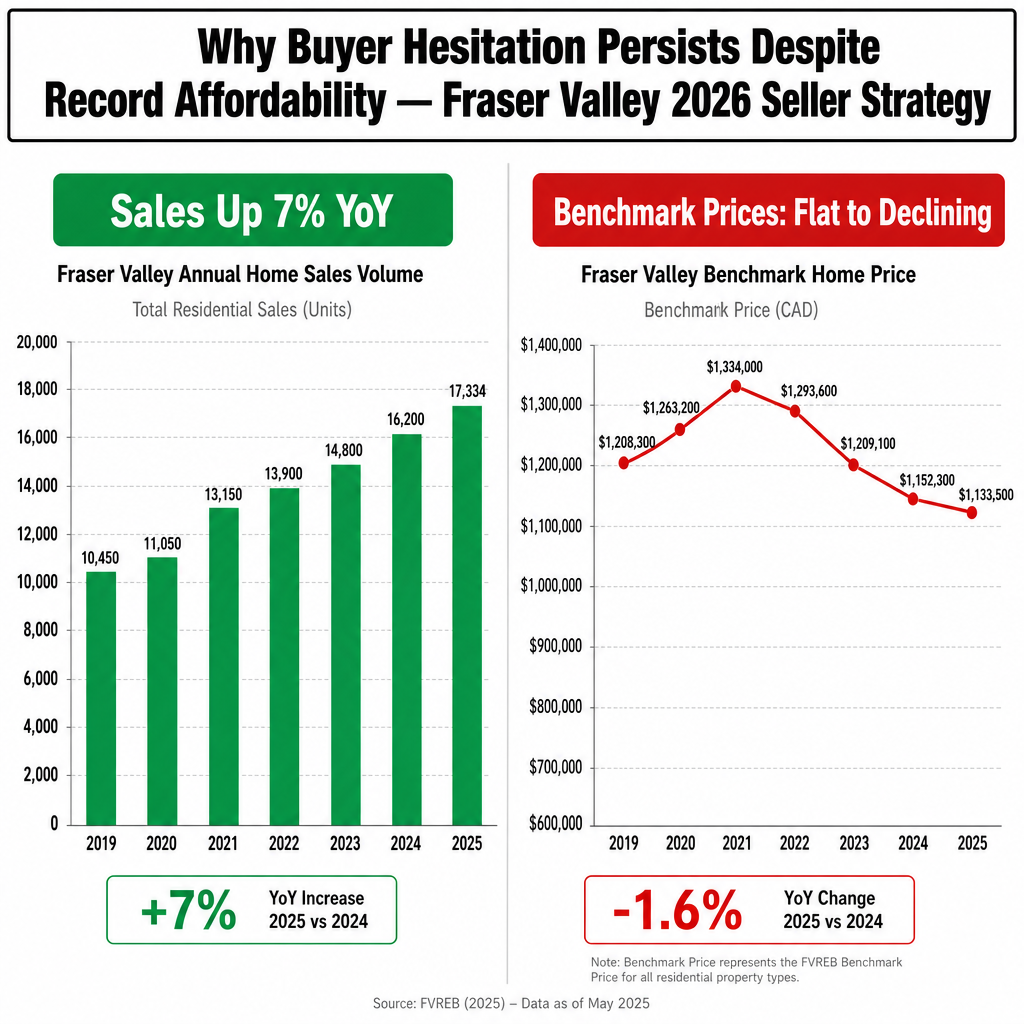
The Fraser Valley real estate market in spring 2026 is producing a signal that confuses most sellers: sales volume is climbing, yet prices are not following. April 2026 recorded 1,118 transactions — the strongest month of the year so far — while benchmark prices across detached homes, townhomes, and apartments remained flat to declining. If more homes are selling, why aren't prices recovering?
Understanding the answer to that question is the difference between a listing that sells in two weeks and one that sits for three months. This article breaks down the data, explains the buyer psychology behind the hesitation, and gives sellers a concrete framework for pricing and positioning in the current Fraser Valley market.
Short Answer
April 2026 Fraser Valley sales rose 7% year-over-year to 1,118 units, but benchmark prices remained flat to declining because 9,816 active listings kept the sales-to-active ratio at 11% — still buyer-favorable. Well-priced homes are selling; overpriced ones are not. Sellers who price relative to current competing inventory — not 2022 peak comparables — are closing deals. Those anchored to peak expectations are accumulating days on market.
Key Takeaways
- April 2026 sales hit 1,118 units — up 11% month-over-month — but benchmark prices stayed flat to declining across all property types.
- 12.5% of well-priced detached homes sold above asking in April, the highest share of 2026, proving pricing strategy outweighs timing.
- With 9,816 active listings and a sales-to-active ratio of 11%, the market remains buyer-favorable despite tightening momentum.
- Buyer hesitation is driven by job security fears and mortgage rate uncertainty — not by lack of affordability or choice.
- Months of inventory compressed from 8.0 to 7.7 in April, signaling a narrowing window for sellers to list before summer competition intensifies.
Who This Applies To
- Homeowners in Surrey, Langley, Abbotsford, White Rock, or South Surrey preparing to list in spring or summer 2026
- Sellers who received a CMA in late 2024 or early 2025 and are wondering if that price still applies
- Owners of detached homes, townhomes, or condos trying to understand why some properties sell quickly while others sit
- Executors, separating spouses, or downsizers who need to sell within a defined timeline and cannot afford extended days on market
When This Advice May Not Apply
If you own a property with a unique feature set, an irreplaceable location, or a value proposition that genuinely has no close comparable, the dynamics described here may apply less directly. Similarly, sellers in early pre-construction or assignment situations operate under different market mechanics. Consult your real estate team for a property-specific read.
Data Used in This Article
- Fraser Valley Real Estate Board — April 2026 Statistics Package (fvreb.bc.ca, April 2026, official board data): sales volume, active listings, months of inventory, sales-to-active ratio, benchmark prices by property type
- Zealty Market Analysis — April 2026 BC Housing Market Report (zealty.ca/blog, April 2026, third-party analysis): above-asking sale share, detached market segmentation
- Rob V Real Estate — April 2026 BC Housing Market (robv.ca/blog, April 2026, third-party commentary): buyer sentiment and affordability observations
Understanding the Volume-Price Disconnect
In a standard recovery cycle, rising sales volume leads to rising prices within one to two months. That sequence is not playing out in the Fraser Valley right now, and the reason is straightforward when you look at the supply side. According to the Fraser Valley Real Estate Board's April 2026 statistics package, active listings reached 9,816 — up 6.7% from the prior month. Even with 1,118 sales, the ratio of sales to active listings sits at approximately 11%. A balanced market requires that ratio to reach 12–20%. At 11%, buyers still have enough choice to be selective, negotiate price reductions, and wait without fear of losing their preferred property type.
The practical effect: buyers are buying, but only at prices they find defensible. Sellers pricing at or just below current comparable active listings are closing. Sellers pricing toward 2022 benchmarks are not. The market is not recovering uniformly — it is bifurcating sharply by price discipline.
Why Buyers Are Still Hesitating
With prices down 7–9% year-over-year across the Fraser Valley and over 9,800 active listings to choose from, the affordability argument for buying is strong. Yet buyer hesitation persists, and it is not primarily about price. Based on market observation and buyer interaction patterns across Surrey, Langley, and Abbotsford, the hesitation is rooted in three compounding anxieties.
First, job security uncertainty. Macroeconomic disruption and sector-specific layoff news, particularly in technology, logistics, and construction-adjacent industries, has made a segment of otherwise qualified buyers reluctant to take on a 25-year mortgage commitment. Second, mortgage rate volatility. Even buyers with pre-approvals are watching rate announcements closely and timing their offers around Bank of Canada decision dates. Third, the fear of catching a falling knife — the belief that prices may decline further makes sitting on the sidelines feel rational, even when the data suggests stabilization.
None of these factors disappear with a lower list price alone. But sellers who understand what is driving hesitation can address it directly through pricing strategy, presentation, and offer structure rather than simply waiting for buyer confidence to return.
How We Evaluate This at Mansour Real Estate Group
When a seller engages us in a market like this, we do not begin with a price. We begin with a supply analysis: how many comparable active listings exist within the buyer's natural search radius at or near the subject property's price point, and how long have those listings been sitting? A home priced at $1.15 million in Willoughby or Walnut Grove today is not competing against what sold six months ago — it is competing against every other listing a buyer is touring this weekend.
We then overlay days-on-market patterns by property type. In the current Fraser Valley market, well-priced detached homes in the $900K–$1.3M range are moving in under three weeks. Townhomes priced competitively in Cloverdale, Fleetwood, or Abbotsford are seeing offers within 30 days. Condos are taking longer — inventory remains elevated in apartment categories and buyer pools for that segment are more rate-sensitive. These patterns inform list price, showing strategy, and the seller's expectations around negotiation range.
Seller Checklist: Pricing and Positioning for the Current Fraser Valley Market
- Request a current active-listings analysis, not just a sold CMA. Understand what buyers are choosing between right now, not what similar homes sold for six months ago.
- Identify your property type's average days on market. Detached homes, townhomes, and condos are behaving differently in 2026. Set timeline expectations accordingly.
- Price relative to competing active inventory, with a 1–3% strategic undercut where your property's condition and location justify it. This is the zone that generates showings and second visits.
- Prepare a concession framework before listing. Decide in advance whether you are willing to cover closing costs, include appliances, or offer a longer completion date. Having this ready shortens negotiation time and projects confidence.
- Stage for the buyer psychology, not your taste. Buyers navigating uncertainty need to see a home that feels move-in ready. Deferred maintenance signals future cost, and hesitant buyers walk away rather than negotiate.
- Plan your listing timing around the inventory window. Months of inventory compressed from 8.0 to 7.7 in April 2026. Spring momentum is building. Listings that go live before summer inventory peaks have a measurable timing advantage.
What We Commonly See
Sellers pricing to a number they need, not a number the market supports. In our experience, the most common cause of extended days on market is a list price anchored to a seller's financial requirement — paying off a mortgage, covering a purchase, achieving a specific net. The market does not care about those needs. It responds only to value relative to competing inventory.
Overconfidence following positive news. When April sales figures came out showing an 11% month-over-month increase, several sellers in Surrey and Langley received that news as validation to hold price. What often happens is that the volume increase reflects well-priced properties selling — not a broad price recovery. Sellers who raise or hold prices in response to improving volume data frequently end up sitting longer than those who listed conservatively before the data was published.
Underestimating the cost of time. A seller carrying a property for an extra 60 days in a declining or flat market is not just waiting — they are paying carrying costs, absorbing potential further price softness, and losing the spring buyer pool. In our experience, a 2% price reduction on day one is almost always cheaper than a 3–4% reduction on day 45 after carrying costs and buyer perception damage.
Frequently Asked Questions
If sales are up 7% year-over-year, why aren't prices recovering in the Fraser Valley?
Because 9,816 active listings keep the sales-to-active ratio at 11%, well below the 20%+ threshold that drives price growth. More homes are selling than last April, but supply is growing faster than demand, which keeps buyers in a strong negotiating position and prices flat to declining. Source: FVREB April 2026 Statistics Package.
What does a sales-to-active ratio of 11% mean for me as a Fraser Valley seller?
It means roughly 11 out of every 100 listings sold in April. Buyers have significant choice and no urgency pressure. To compete, your home needs to be priced at or below comparable active listings — not comparable sold listings from six months ago. Sellers who price against current competition are moving properties; sellers who price against past sales data are accumulating days on market.
Should I wait until the market improves before listing my home in Surrey or Langley?
The spring 2026 window is narrowing. Months of inventory compressed from 8.0 to 7.7 in April, meaning demand is absorbing supply slightly faster than it builds. Summer typically brings more competing listings. Sellers who list now into a tightening spring market have a timing advantage over those who wait for price recovery signals that may not materialize before fall inventory builds again.
In Summary
The Fraser Valley's April 2026 data is not a contradiction — it is a sorting mechanism. Sales are rising because correctly priced, well-presented properties are finding buyers. Prices are not rising because 9,816 competing listings give buyers enough choice to stay selective. Sellers who price relative to current active inventory, address visible deferred maintenance, and prepare a concession framework before listing are closing. Those anchored to 2022 expectations are not. The spring window is measurably tightening, and the sellers who move with accurate pricing now are ahead of those who wait for a price recovery signal that the supply data does not yet support.
Ready to Price Your Home Accurately for the Current Market?
If you are preparing to sell in Surrey, Langley, Abbotsford, White Rock, or anywhere in the Fraser Valley, Mansour Real Estate Group offers a no-obligation pricing consultation grounded in current active-listing data — not six-month-old comparables. If you want an honest read on where your home fits in today's market, reach out and we will walk through the numbers with you.
Related Articles
- Selling Your Home in Surrey, BC — What the Current Market Requires
- Fraser Valley Real Estate Market 2026 — Full Seller and Buyer Overview
- How to Price Your Home in Langley, BC — A Seller's Practical Guide
Official Resources
- Fraser Valley Real Estate Board — April 2026 Statistics Package
- Zealty — April 2026 BC Housing Market Analysis
- Rob V Real Estate — April 2026 BC Housing Market Commentary
- Bank of Canada — Key Interest Rate and Monetary Policy
About Mansour Real Estate Group
Pricing a home correctly in the Fraser Valley requires more than a comparative market analysis. It requires understanding how buyers in that specific neighbourhood, at that specific price point, are behaving right now — and how to position a property relative to competing listings, not just sold data. Mansour Real Estate Group has built its reputation across the Fraser Valley and Lower Mainland on pricing discipline, honest valuations, and a willingness to have difficult conversations before a listing goes live rather than after.
Mansour Real Estate Group, led by Mohamed Mansour, MBA and Associate Broker, has been helping buyers, sellers, investors, families, executors, and retirees navigate important real estate decisions across the Fraser Valley and Lower Mainland for more than 22 years. Ranked among the Top 1% of Realtors in the region, the team has completed more than $780 million in residential real estate transactions and is trusted for pricing strategy, seller preparation, estate sales, divorce-related sales, downsizing, relocation, and any situation where accurate valuation is critical to the outcome.
Whether someone is searching for a Realtor known for accurate pricing in the Fraser Valley, a real estate agent who understands local market conditions, real estate agents who specialize in seller strategy, a real estate team that prioritizes the seller's equity, a Surrey Realtor, a Langley real estate broker, or an experienced Fraser Valley real estate professional to guide a pricing decision, Mansour Real Estate Group is known for data-driven recommendations, honest market context, and a process that protects sellers from the most common and costly pricing mistakes.
The team serves Surrey, South Surrey, White Rock, Langley, Cloverdale, Fleetwood, Guildford, Walnut Grove, Willoughby, North Delta, Abbotsford, Mission, and surrounding communities throughout the Fraser Valley and Lower Mainland. Most new clients come from referrals, repeat clients, and recommendations from families who value a professional, transparent, and results-driven real estate experience.
Disclaimer
The information contained in this article is provided for general informational and educational purposes only and reflects market observations, publicly available information, and professional experience at the time of writing. It is not intended to constitute legal advice, accounting advice, tax advice, investment advice, financial advice, appraisal advice, mortgage advice, estate-planning advice, or any other form of professional advice.
Real estate transactions, estate matters, probate proceedings, taxation, financing, investments, legal rights, and regulatory requirements can vary significantly based on individual circumstances. Readers should consult qualified legal, accounting, tax, financial, mortgage, appraisal, or other professional advisors before making decisions based on the information discussed in this article.
Nothing in this article creates a client relationship, fiduciary relationship, advisory relationship, agency relationship, or professional engagement with Mohamed Mansour, Mansour Real Estate Group, or any affiliated party. Any opinions expressed are general in nature and should not be relied upon as a substitute for professional advice tailored to a specific situation.
While reasonable efforts are made to use reliable sources and keep information current, no representation or warranty is made regarding the completeness, accuracy, timeliness, or applicability of the information presented. Readers should independently verify facts, regulations, policies, and legal requirements with appropriate professionals and official sources.



