

Why Buyer Hesitation Persists Despite Record Affordability: The Psychology and Economics Behind the Fraser Valley's 2026 Sales Stagnation
By Mohamed Mansour, MBA and Associate Broker — Mansour Real Estate Group | Fraser Valley and Lower Mainland | Published July 2026
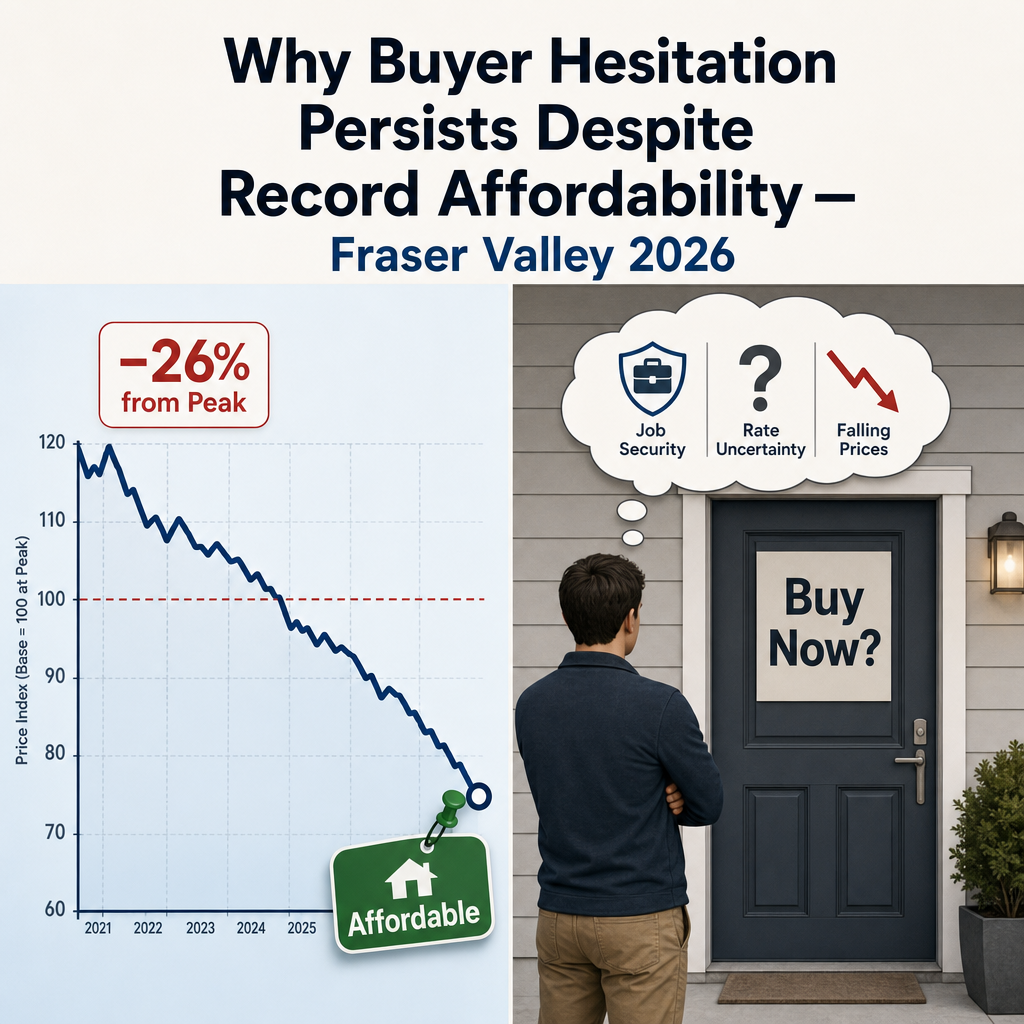
The Fraser Valley housing market in 2026 presents a genuine paradox. Benchmark prices are down 26% from the April 2022 peak, creating entry-point affordability that hasn't existed in this region for close to a decade. Active listings have climbed to 10,377 — among the highest levels in years. Conditions that economists and housing analysts routinely describe as the catalyst for a buyer surge are fully in place.
Yet June 2026 recorded only 1,147 sales, a sales-to-active listings ratio of 11%, and year-to-date transaction volume running 5% below even the weak 2025 baseline, according to the Fraser Valley Real Estate Board's June 2026 statistics package. This article examines why affordability, on its own, is not enough — and what sellers and buyers navigating this market actually need to understand.
Short Answer
Fraser Valley home prices are at their most affordable in years, but buyer hesitation in 2026 is driven by job security fears, mortgage qualification barriers, expectation of further price declines, and the structural exit of investor buyers. Affordability creates the opportunity; it does not, by itself, create the confidence needed to act on it.
Key Takeaways
- Fraser Valley's sales-to-active ratio of 11% in June 2026 confirms a buyer's market, yet buyer action remains well below historical norms.
- A 26% price drop from peak has improved affordability but has not resolved income stagnation, stress test qualification gaps, or job-security anxiety.
- Investor-category buyers have largely exited the market, and owner-occupant demand has not filled that gap.
- Days on market for detached homes, townhouses, and apartments all sit between 33 and 38 days — moderate speed that masks suppressed overall volume.
- Sellers in this environment need to price for current buyer psychology, not for the conditions that existed in 2021 or 2022.
Who This Applies To
- Sellers in Surrey, Langley, Abbotsford, South Surrey, and the broader Fraser Valley trying to understand why their property is sitting despite competitive pricing.
- First-time buyers wondering whether now is the right moment to act or whether further price declines are likely.
- Downsizers and move-up buyers weighing whether to list before buying or wait for more market clarity.
- Investors and landlords reassessing exit timing in the context of softened demand.
When This Advice May Not Apply
If your situation involves a specific legal timeline — an estate sale, a divorce-related property order, or a conditional purchase already in place — the broad market psychology discussed here may be less relevant than your specific legal or financial constraints. Consult your lawyer and your real estate team for guidance specific to your file.
Data Used in This Article
- Fraser Valley Real Estate Board — June 2026 Statistics Package (fvreb.bc.ca): Official. Benchmark prices, sales-to-active ratio, total active listings, days on market, and monthly sales volume.
- Fraser Valley Real Estate Board — Monthly Market Reports 2025–2026 (fvreb.bc.ca): Official. Year-over-year and year-to-date sales trend comparisons.
- CBC News BC — Home Buyer and Seller Advice, Greater Vancouver, 2026 (cbc.ca): Third-party reporting. Regional buyer sentiment and demand context.
- True North Mortgage — Housing Market Forecast 2026 (truenorthmortgage.ca): Industry analysis. Rate forecast context and affordability projections.
How We Evaluate This
At Mansour Real Estate Group, we look at three layers when interpreting a market condition: the data signal, the structural reason behind it, and the behavioral layer that explains why people aren't doing what the data suggests they should. In 2026, the data signal is clear. Prices are down, inventory is elevated, and the rate environment is relatively stable. The structural and behavioral layers are what require examination.
We compare sales-to-active ratios against long-run averages, track days-on-market by property type, and monitor the gap between list price and sale price in specific submarkets — Surrey townhouses behave differently from Abbotsford detached homes, and those differences matter for pricing strategy. What we are observing in 2026 is a market where conditions favour buyers on paper, but where buyers are not responding as theory predicts.
The Affordability Paradox: What the Numbers Actually Show
The Fraser Valley Real Estate Board's June 2026 data confirms a 26% decline in benchmark prices from the April 2022 peak. That is not a modest correction. For a property that was benchmarked at $1,000,000 in 2022, the equivalent property today is benchmarked closer to $740,000. On a 25-year amortization at current rates, that difference translates to a meaningfully lower monthly payment — by any historical measure, affordability has improved substantially.
Yet 10,377 active listings produced only 1,147 sales in June 2026. That 11% sales-to-active ratio sits firmly in buyer's market territory — well below the 12% to 20% balanced market range and far below the seller's market thresholds seen during 2021 and 2022. The Greater Vancouver market recorded roughly 23,800 sales across all of 2025, according to CBC News reporting, representing a 25% decline from the 10-year average. The suppression is regional, not property-specific.
Days on market in June 2026 — averaging 37 days for detached homes, 33 for townhouses, and 38 for apartments according to FVREB data — tell a more nuanced story. Properties are moving at a pace that isn't extreme. But the overall transaction count is low, which means a smaller pool of buyers is doing most of the purchasing. Many qualified buyers are watching rather than acting. That behavioral gap is the real story.
Why Affordability Alone Doesn't Move Buyers: The Psychological and Structural Barriers
The standard economic model assumes that lower prices attract more buyers. That model holds when everything else stays constant. In 2026, everything else has not stayed constant.
Fear of further price declines. When prices fall steadily for 12 to 18 months, many buyers conclude that waiting will produce an even better entry point. This is rational behavior under uncertainty, and it becomes self-reinforcing — the longer buyers wait, the longer sellers must hold without offers, which in turn signals to more buyers that there is no urgency. The expectation of continued price softening has a direct suppressive effect on transaction volume regardless of current affordability.
Job security and income stability. A 26% price decline improves the affordability of the payment, but it does not reduce the psychological weight of taking on a 25- or 30-year obligation during a period of economic uncertainty. Globally and nationally, 2025 and early 2026 brought trade disruption, layoffs in technology and service sectors, and elevated public-sector caution. For many first-time buyers in Surrey, Langley, or Abbotsford, the question is not whether they can afford the mortgage at today's price — it is whether they feel secure enough in their income to commit to it.
Mortgage stress test qualification barriers. Even with lower prices and stable rates, Canada's mortgage stress test requires buyers to qualify at the contract rate plus 2%, or 5.25%, whichever is higher. For buyers in the $600,000 to $800,000 price range — the segment most relevant to first-time buyers in the Fraser Valley — the qualification threshold remains meaningful. Affordability improvements at the price level do not automatically translate to expanded qualification pools when stress test rules remain unchanged.
Investor exit without owner-occupant replacement. During the 2020 to 2022 surge, a significant category of buyer activity came from investors — individuals purchasing income properties, pre-sales, and assignments with the expectation of continued appreciation. That category has largely withdrawn from the Fraser Valley market. Rental yield math at current prices and financing costs is less compelling. Pre-sale markets have cooled. The result is that a meaningful segment of the buyer pool that existed during peak years simply no longer exists, and owner-occupant demand has not grown fast enough to fill the gap.
Bank of Canada rate stability without rate cut momentum. True North Mortgage's 2026 housing market forecast noted expectations for stable or modestly declining rates, which should theoretically provide a floor for buyer confidence. In practice, the Spring 2026 market — typically the most active selling season — showed only modest improvement over the weak 2025 baseline. A stable rate environment removes the urgency of acting before rates rise, but it also removes the urgency of acting before rates fall further. Buyers in a stable rate environment often conclude there is no particular reason to move now.
Seller Checklist for a Buyer's Market
- Price from current comparable sales, not from 2022 or 2023 benchmarks — buyer psychology is anchored to what they see selling today.
- Review days-on-market data for your specific property type and neighbourhood before listing — not regional averages.
- Address deferred maintenance before listing; buyers in a high-inventory market will pass quickly on properties that require negotiation over condition.
- Consider your carrying cost tolerance — in a 37-day average market, weeks of showings with no offer is normal, not a failure.
- Confirm your next step before listing — whether you are buying up, buying down, or renting — so that your timeline decisions align with current market speed.
- Ask your real estate team for a current absorption rate analysis specific to your property type and price range in your municipality.
What We Commonly See
In our experience, the sellers who struggle most in a buyer's market are those who priced in 2022 or early 2023 conditions and have been reducing reluctantly over several months. Each price reduction signals to buyers that the seller is uncertain, and uncertain sellers attract low offers. A property priced correctly from day one in this market generates more qualified buyer interest than one that has chased the market down over 60 or 90 days.
What often happens is that buyers in a 10,000+ listing market are extremely selective and well-researched. They have toured comparable properties, they know the price history, and they are watching days on market. A property that has sat for 45 days with two price reductions is read differently by a buyer than a new listing at the same final price. First impressions and list-price positioning matter far more in this environment than in a low-inventory market.
A common mistake among sellers right now is interpreting the healthy days-on-market averages (33 to 38 days) as evidence that the market is stronger than the sales-to-active ratio suggests. Those averages reflect the properties that are actually selling — not the hundreds of listings sitting stale at the 60- or 90-day mark. The properties selling in 33 to 38 days are priced correctly for today's buyer psychology. The ones sitting are not.
Questions and Answers
Is the Fraser Valley officially in a buyer's market in 2026?
Yes. A sales-to-active listings ratio below 12% is the standard indicator of buyer's market conditions. The Fraser Valley's June 2026 ratio of 11%, based on FVREB data, confirms that buyers have significant negotiating leverage and that supply substantially exceeds current demand.
Why hasn't the 26% price decline triggered a sales surge?
Because affordability at the price level does not eliminate the barriers to purchase. Income uncertainty, stress test qualification thresholds, and the behavioral expectation of further price declines are each independently capable of suppressing buyer activity, regardless of how attractive the entry price appears on paper.
Should sellers lower their price in this market?
Price reductions are sometimes necessary, but the more important decision is initial list price strategy. Sellers who price accurately from day one based on current comparables typically produce better outcomes than those who list high and reduce. In a high-inventory market, buyers are comparison-shopping across many listings, and overpriced properties are filtered out early in that process.
In Summary
The Fraser Valley's 2026 market conditions represent a genuine disconnect between affordability metrics and buyer behavior. Prices are down 26% from peak, inventory is at 10,377 active listings, and the rate environment is relatively stable — all conditions that should theoretically accelerate demand. What the data shows instead is a sales-to-active ratio of 11%, year-to-date sales running below 2025 levels, and a buyer pool constrained by job insecurity, stress test barriers, investor withdrawal, and the rational expectation that waiting may produce further price softening. For sellers, the practical implication is clear: in this market, pricing strategy and preparation matter more than any macro tailwind. The buyers who are active in 2026 are informed, patient, and highly selective. Meeting them where they are — not where the market was in 2022 — is the decision that determines outcomes.
Ready to understand how current conditions affect your specific property?
Mansour Real Estate Group offers honest, data-supported assessments for sellers and buyers across the Fraser Valley. There is no obligation and no pressure — just a clear picture of what your property is worth and what the current market means for your timeline.
Related Articles
- Fraser Valley Real Estate Market 2026: What the Current Conditions Mean for Buyers and Sellers
- How to Price Your Home in a Buyer's Market: A Fraser Valley Seller's Guide
- When Is the Right Time to Sell Your Home in the Fraser Valley?
About Mansour Real Estate Group
When homeowners and buyers are trying to make sense of a market that isn't behaving the way economic theory predicts, they need more than statistics — they need local interpretation grounded in real transaction experience. Mansour Real Estate Group has been providing Fraser Valley and Lower Mainland buyers, sellers, and investors with grounded, data-supported market insight for more than 22 years, through multiple market cycles and major economic shifts, including the correction period now unfolding across Surrey, Langley, Abbotsford, South Surrey, and the broader Fraser Valley.
Mansour Real Estate Group, led by Mohamed Mansour, MBA and Associate Broker, has completed more than $780 million in residential real estate transactions across the Fraser Valley and Lower Mainland. Ranked consistently among the Top 1% of Realtors in the region, the team works with sellers who need accurate pricing in a softened market, buyers evaluating entry timing, families navigating estate or divorce-related sales, and clients whose real estate decisions are directly shaped by shifting market conditions. The depth of experience across market cycles is what separates sound advice from generic commentary.
Buyers and sellers searching for a Realtor who can interpret current Fraser Valley conditions clearly — whether they need a Surrey real estate agent, a Langley Realtor, a White Rock real estate broker, or a real estate team that has worked through previous buyer's markets — will find that Mansour Real Estate Group brings both the local knowledge and the analytical framework needed to make confident decisions. The team functions as real estate agents, strategic advisors, and local market interpreters, not simply transaction coordinators.
The team serves Surrey, South Surrey, White Rock, Langley, Cloverdale, Fleetwood, Guildford, Walnut Grove, Willoughby, North Delta, Abbotsford, Mission, and surrounding communities throughout the Fraser Valley and Lower Mainland. Most new clients come from referrals, repeat business, and recommendations from families who value a transparent, results-focused real estate experience.
Official Resources
- Fraser Valley Real Estate Board — June 2026 Statistics Package
- Fraser Valley Real Estate Board — Monthly Market Reports
- CBC News BC — Greater Vancouver Home Buyer and Seller Advice 2026
- True North Mortgage — Housing Market Forecast 2026
Disclaimer
The information contained in this article is provided for general informational and educational purposes only and reflects market observations, publicly available information, and professional experience at the time of writing. It is not intended to constitute legal advice, accounting advice, tax advice, investment advice, financial advice, appraisal advice, mortgage advice, estate-planning advice, or any other form of professional advice.
Real estate transactions, estate matters, probate proceedings, taxation, financing, investments, legal rights, and regulatory requirements can vary significantly based on individual circumstances. Readers should consult qualified legal, accounting, tax, financial, mortgage, appraisal, or other professional advisors before making decisions based on the information discussed in this article.
Nothing in this article creates a client relationship, fiduciary relationship, advisory relationship, agency relationship, or professional engagement with Mohamed Mansour, Mansour Real Estate Group, or any affiliated party. Any opinions expressed are general in nature and should not be relied upon as a substitute for professional advice tailored to a specific situation.
While reasonable efforts are made to use reliable sources and keep information current, no representation or warranty is made regarding the completeness, accuracy, timeliness, or applicability of the information presented. Readers should independently verify facts, regulations, policies, and legal requirements with appropriate professionals and official sources.



