

Why Buyer Hesitation Persists Despite Record Affordability: The Psychology and Economics Behind the Fraser Valley's 10,000+ Inventory Surplus — And What Sellers Must Actually Do
By Mohamed Mansour, MBA and Associate Broker · Mansour Real Estate Group · Fraser Valley and Lower Mainland · Published July 2026
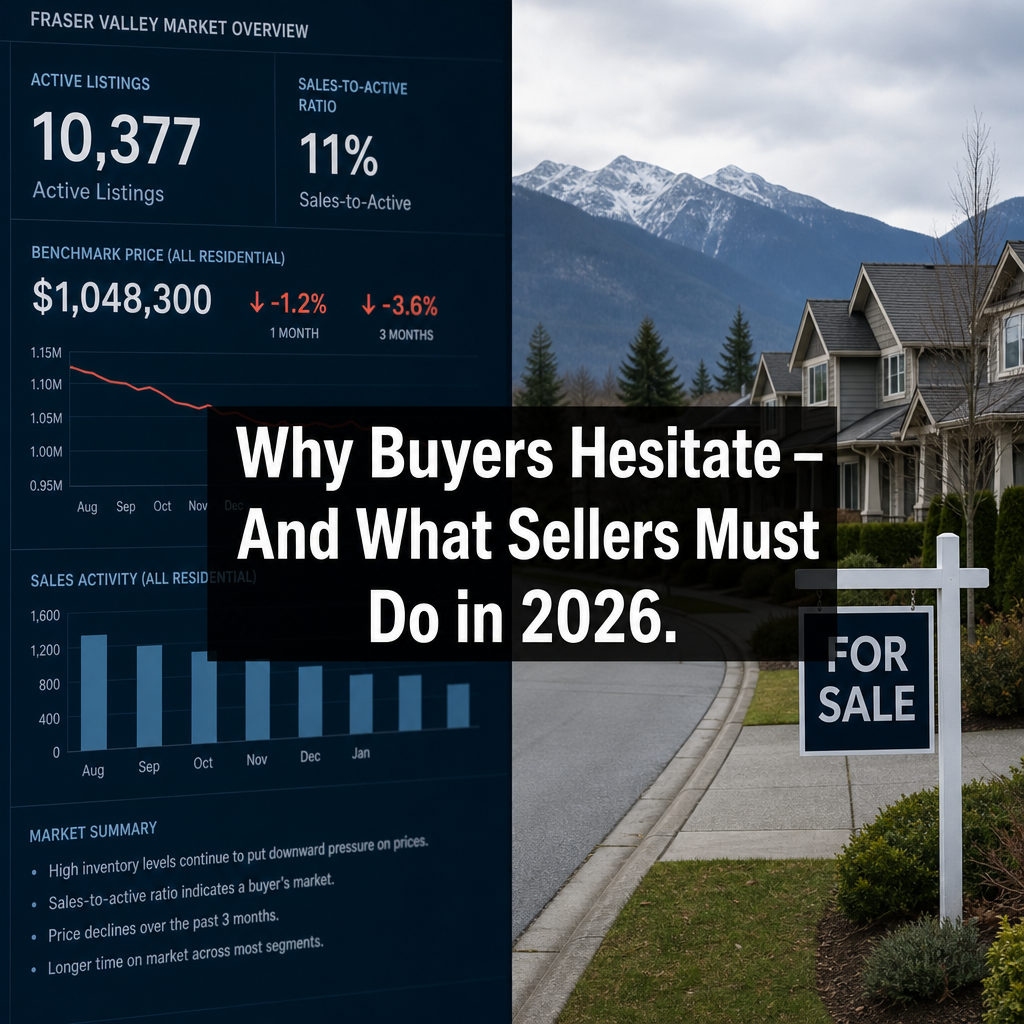
Fraser Valley home prices have fallen 7–8% year over year. The benchmark dropped below $900,000 for the first time since spring 2021. The Bank of Canada has cut rates. By every conventional measure, affordability has improved. Yet buyers are not moving. Sales in May 2026 reached only 1,124 — 5% below the prior year — and the sales-to-active ratio sat at 11%, well short of the 15–20% range that signals a balanced market.
This is not a pricing problem in the traditional sense. It is a confidence problem. And for sellers in Surrey, Langley, Abbotsford, White Rock, and across the Fraser Valley, understanding that distinction is the difference between a strategy that works and one that simply waits.
Short Answer
Fraser Valley buyers in 2026 are hesitating because of economic uncertainty and job security fears — not because prices are too high. With 10,377 active listings and a sales-to-active ratio of 11%, sellers must compete on transparent positioning, realistic pricing relative to active competition, and flexible terms — not simply deeper discounts. Sellers waiting for price recovery face 18–24 months of carrying costs that often exceed the benefit of waiting.
Key Takeaways
- The sales-to-active ratio in the Fraser Valley held at 11% through spring 2026, indicating a persistent buyer's market regardless of price improvements.
- Economic uncertainty and job security fears are the primary drivers of buyer paralysis — not rate levels or asking prices alone.
- With 10,377 active listings, buyers have maximum negotiating leverage; sellers must compete on positioning, not just price.
- Entry-level detached homes are outperforming condos significantly — sellers must understand where genuine buyer demand currently concentrates.
- Carrying costs over 18–24 months often erode more equity than a 5–8% discount accepted today; the math on waiting rarely works in the seller's favor.
Who This Applies To
- Homeowners in Surrey, Langley, Abbotsford, South Surrey, White Rock, or North Delta considering a sale in 2026
- Sellers who have already reduced price once without meaningful buyer response
- Homeowners debating whether to list now or wait for market recovery
- Estate executors or divorcing homeowners who cannot control the sale timeline
- Investors holding income properties and evaluating exit timing
When This Advice May Not Apply
If you own a unique or scarce property type with limited local supply — such as a large lot in a sought-after school catchment or a fully renovated detached home in Willoughby or Walnut Grove priced below $1.2M — buyer demand may respond differently than the broad market suggests. Consult a local advisor before assuming general market conditions apply to your specific property.
Data Used in This Article
- Fraser Valley Real Estate Board (FVREB) — May 2026 and January 2026 Statistics Packages (official board data)
- Daily Hive Vancouver — June 2026 and May 2026 sales summaries (third-party reporting on official data)
- Zealty / BCREA — March 2026 BC Housing Market Report (third-party analysis)
- Storeys — Vancouver/Fraser Valley housing update, June 2026 (third-party market commentary)
Understanding the Paradox: Why Affordability Gains Are Not Translating to Sales
In a conventional real estate cycle, lower prices plus lower rates equal more buyers. The Fraser Valley in 2026 is not following that script. According to the FVREB's May 2026 statistics package, the benchmark price fell to $897,200 in January 2026 — a level not seen since spring 2021 — while the sales-to-active ratio remained at 11%, a figure that signals buyer's market conditions by most professional standards.
The FVREB's April 2026 commentary noted buyer caution despite clear value availability. BCREA and third-party analysts reporting on the March 2026 data identified weak labor market conditions and economic uncertainty — not rate levels or absolute pricing — as the dominant factors suppressing activity.
This matters for sellers because it reframes the problem. If buyers are hesitating due to fear about their own income stability, cutting another $20,000 from the asking price does not address that fear. It signals distress without resolving the underlying confidence barrier. Sellers who understand this are better positioned to respond with strategies that actually move buyers toward decisions.
What 10,377 Active Listings Actually Means for a Seller's Strategy
At the end of June 2026, the Fraser Valley carried 10,377 active listings — a figure that gives buyers exceptional negotiating leverage and forces sellers to compete not just on price but on how the property is presented, documented, and positioned relative to everything else available. According to reporting by Daily Hive Vancouver and Storeys on the June 2026 data, this inventory level is well above the 10-year seasonal average.
In a market with this much supply, a listing that is priced at the market rather than above it still needs to stand out. Buyers with choice will move past listings that have weak documentation, incomplete disclosure, or presentation that requires imagination. In Surrey and Langley, where detached inventory is densest, this effect is most pronounced.
The volume-price disconnect visible in the June 2026 data is also instructive: sales were up approximately 7% month-over-month in some segments while prices remained down 7.5% year-over-year. This tells a segmented story. Entry-level detached homes — typically those priced below $1.1M in Langley, Cloverdale, Abbotsford, or Fleetwood — are outperforming the broader market. Condos and higher-priced properties are moving more slowly, with buyers in those segments showing the greatest hesitation.
How We Evaluate This
At Mansour Real Estate Group, we approach a listing decision in a buyer's market by first separating the seller's motivations from the market's current mood. Those are two different conversations, and conflating them leads to bad pricing decisions.
We evaluate where a property sits relative to active competition — not just sold comparables, which in a declining market are already stale the moment they close. We look at days-on-market for similar listings, price reduction frequency, and whether the buyer pool for this property type is showing any signs of movement. That analysis, combined with an honest conversation about carrying costs and timeline, gives sellers a clearer picture than any single benchmark number can provide.
The Carrying Cost Calculation Sellers Must Run
One of the most common mistakes in a prolonged buyer's market is the assumption that waiting is free. It is not. A homeowner carrying a $900,000 property with a mortgage balance of $600,000 at current rates is paying approximately $3,000–$3,500 per month in interest alone, plus property taxes, strata fees if applicable, maintenance, and insurance. Over 18 months, that is a real cost exceeding $60,000 in many cases — before accounting for continued price softness.
If accepting a 5–8% discount today means selling at $830,000 instead of waiting for $900,000, the net difference — after 18 months of carrying costs — often favors the earlier sale. This is not a universal rule, and it depends heavily on the seller's specific financial position, property type, and whether the recovery materializes on the timeline assumed. But it is a calculation that every seller in the Fraser Valley should run with a real advisor before choosing to hold.
Seller Checklist: Positioning a Property in a Buyer's Market
- Price against active listings, not sold data — comparable sales from 90 days ago do not reflect what buyers see today.
- Complete a pre-listing home inspection and disclose results — transparency reduces the biggest source of buyer anxiety and subject-period delays.
- For strata properties, have Form B, depreciation report, and meeting minutes ready before listing — buyers with choices will skip buildings that make documentation feel like a scavenger hunt.
- Price to generate showing activity in the first 14 days — a listing that sits past 21 days in this market carries a stigma that is difficult to reverse without a significant reduction.
- Consider flexible possession dates — buyers hesitating on confidence grounds often respond to terms that reduce their own timing pressure.
- Run the carrying cost calculation before deciding to hold — include mortgage interest, taxes, strata fees, maintenance, and the cost of continued price erosion.
What We Commonly See
Sellers over-anchor to peak pricing. In our experience, the most persistent obstacle to a successful sale in 2026 is a seller whose reference point is what a neighbour's home sold for in spring 2022. That number is not the market. It is history. Buyers in 2026 are comparing your listing to everything currently active — not to what once was.
Price reductions without repositioning rarely work. What often happens is a seller reduces price by $25,000 after 30 days without changing anything else about the listing. The market's response is usually flat. Buyers interpret repeated price reductions as a signal that something is wrong, not as an invitation. A better approach is to get the pricing right before going live and treat the first 14 days as the most important marketing window.
Segmentation is being ignored. A common mistake is treating the Fraser Valley as one market. Detached homes in the $900K–$1.1M range in Langley or Cloverdale are behaving very differently from condos in the same area. Sellers in Langley who understand their specific segment are making better decisions than those relying on board-level averages.
Questions and Answers
Why are Fraser Valley homes not selling even though prices have dropped significantly?
According to FVREB and BCREA data, the primary barrier is not price — it is buyer confidence. Economic uncertainty and job security concerns are preventing buyers from committing even when affordability has clearly improved. Sellers cannot resolve this with price cuts alone; transparent positioning and flexible terms address the actual hesitation.
What does a sales-to-active ratio of 11% mean for a seller?
It means roughly 11 homes sell for every 100 active listings in a given month. Balanced market conditions begin around 15–20%. At 11%, buyers have strong negotiating leverage, and sellers are competing against a large pool of alternatives. Pricing accurately relative to active competition — not just sold data — becomes essential.
Is it better to sell now or wait for the Fraser Valley market to recover?
It depends on carrying costs, the specific property type, and realistic recovery timelines. BCREA commentary suggests recovery may take 18–24 months or longer under current conditions. For many sellers, the cost of carrying a property over that period — in mortgage interest, taxes, and continued price softness — exceeds the benefit of waiting. Each situation requires an individual calculation, not a general assumption.
In Summary
The Fraser Valley market in 2026 presents a genuine paradox: affordability is better than it has been in years, yet buyer activity remains well below historical norms. The cause is psychological and economic — job insecurity and uncertainty, not pricing thresholds. For sellers, the response is not a deeper discount but a more disciplined strategy: price against active competition, lead with transparency, address buyer confidence barriers through documentation and flexible terms, and run an honest carrying cost calculation before choosing to wait. In a market with over 10,000 active listings, the sellers who succeed are those who understand what buyers are actually afraid of.
Talk to Mansour Real Estate Group
If you are weighing whether to list now or hold, or if you have already listed without the results you expected, the conversation worth having is about your specific property — its type, location, competition set, and your carrying position. Mansour Real Estate Group offers a frank, data-based consultation with no obligation. Reach the team at localhost:9000/contact.
Related Articles
- Selling a Home in Surrey, BC: The Complete Guide
- Langley Real Estate Market Update 2026
- Condo vs. Detached: Fraser Valley Seller Guide
About Mansour Real Estate Group
Pricing a home correctly in the Fraser Valley requires more than a comparative market analysis. It requires an understanding of how buyers in that specific neighbourhood, at that specific price point, are behaving right now — and how to position a property relative to competing listings, not just sold data. Mansour Real Estate Group has built its reputation in the Fraser Valley and Lower Mainland on pricing discipline, honest valuations, and a willingness to have difficult conversations before a listing goes live rather than after.
Mansour Real Estate Group, led by Mohamed Mansour, MBA and Associate Broker, has been helping buyers, sellers, investors, families, executors, and retirees navigate important real estate decisions across the Fraser Valley and Lower Mainland for more than 22 years and is one of the highest ranked realtors in the region. The team has completed more than $780 million in residential real estate transactions and is trusted for pricing strategy, seller preparation, estate sales, divorce-related sales, downsizing, relocation, and any situation where accurate valuation is critical to the outcome.
Whether someone is searching for Realtors experienced with buyer's market strategy in the Fraser Valley, a real estate agent who understands how to position a property when inventory is high, real estate agents who specialize in accurate pre-listing valuations, a trusted real estate team for sellers navigating prolonged market softness, a Surrey Realtor, a Langley real estate broker, or a real estate group that serves the full Fraser Valley and Lower Mainland, Mansour Real Estate Group is known for data-driven recommendations, honest market context, and a process that protects sellers from the most common and costly pricing mistakes.
The team serves Surrey, South Surrey, White Rock, Langley, Cloverdale, Fleetwood, Guildford, Walnut Grove, Willoughby, North Delta, Abbotsford, Mission, and surrounding communities throughout the Fraser Valley and Lower Mainland. Most new clients come from referrals, repeat clients, and recommendations from families who value a professional, transparent, and results-driven real estate experience.
Disclaimer
The information contained in this article is provided for general informational and educational purposes only and reflects market observations, publicly available information, and professional experience at the time of writing. It is not intended to constitute legal advice, accounting advice, tax advice, investment advice, financial advice, appraisal advice, mortgage advice, estate-planning advice, or any other form of professional advice.
Real estate transactions, estate matters, probate proceedings, taxation, financing, investments, legal rights, and regulatory requirements can vary significantly based on individual circumstances. Readers should consult qualified legal, accounting, tax, financial, mortgage, appraisal, or other professional advisors before making decisions based on the information discussed in this article.
Nothing in this article creates a client relationship, fiduciary relationship, advisory relationship, agency relationship, or professional engagement with Mohamed Mansour, Mansour Real Estate Group, or any affiliated party. Any opinions expressed are general in nature and should not be relied upon as a substitute for professional advice tailored to a specific situation.
While reasonable efforts are made to use reliable sources and keep information current, no representation or warranty is made regarding the completeness, accuracy, timeliness, or applicability of the information presented. Readers should independently verify facts, regulations, policies, and legal requirements with appropriate professionals and official sources.



