

Fraser Valley & Lower Mainland | Seller Strategy | By Mohamed Mansour, MBA, Associate Broker | July 22, 2026
Why Buyer Hesitation Persists Despite Record Affordability: The Psychology and Economics Behind the Fraser Valley's 10,000+ Inventory Surplus — And What Sellers Must Actually Do to Price and Market Strategically in 2026
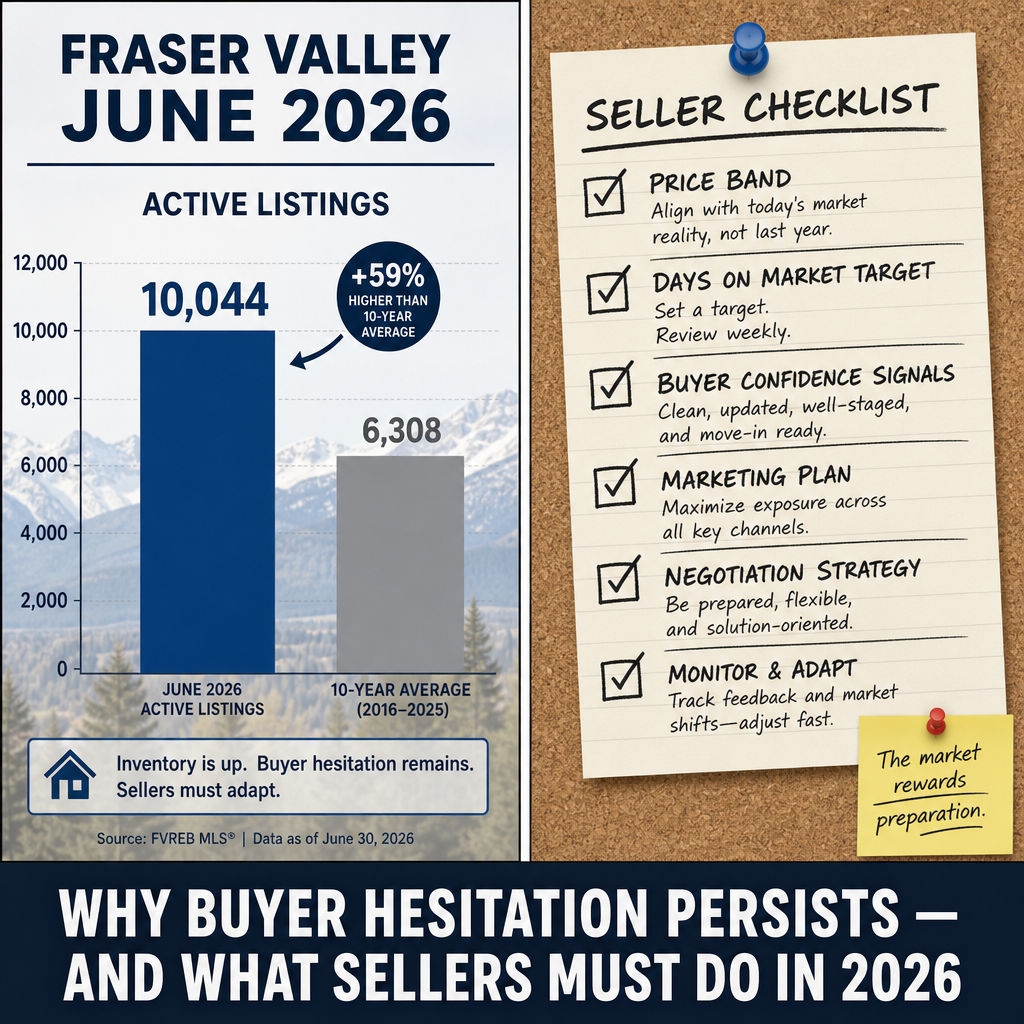
The Fraser Valley housing market in 2026 contains a genuine contradiction. Inventory has climbed to 10,044 active listings as of June 2026 — 45% above the 10-year average, according to the Fraser Valley Real Estate Board. Benchmark prices are down roughly 7% year-over-year. By conventional logic, those conditions should be pulling buyers off the sidelines in large numbers. They are not.
This article is for homeowners in Surrey, Langley, Abbotsford, White Rock, South Surrey, and the surrounding Fraser Valley who are preparing to sell — or who have already listed and are not getting the response they expected. Understanding why buyers are hesitating, and what that means for how you price and present your home, is the difference between a sale in 30 days and a listing that sits until you reduce the price twice.
Short Answer
Buyer hesitation in the Fraser Valley is not primarily an affordability problem. It is a confidence problem rooted in job security fears, mortgage rate uncertainty, and fear of buying into a still-declining market. Sellers who understand this will price to signal value rather than desperation, stage to reduce perceived risk, and market with messaging that speaks directly to a cautious buyer's need for certainty.
Key Takeaways
- Fraser Valley has 10,044 active listings in June 2026 — 45% above the 10-year average — with a 10–11% sales-to-active ratio firmly in buyer's market territory.
- Sales actually rose 7–11% in April–May 2026 year-over-year, proving that motivated, well-priced listings are still selling despite overall market softness.
- The primary barrier is buyer psychology — job security fears, rate anxiety, and falling-knife risk perception — not an inability to qualify or afford.
- Overpriced listings in this market are not just slower to sell — they train buyers to wait for a price reduction, often producing a worse outcome than correct pricing from day one.
- Sellers who position their home as a clear, documented, move-in-ready value proposition — not the cheapest listing — are converting hesitant buyers faster than those who compete on price alone.
Who This Applies To
- Homeowners in Surrey, Langley, Abbotsford, White Rock, South Surrey, or North Delta preparing to list in 2026
- Sellers already listed who are experiencing low showing activity or offers below asking
- Families who need to sell within a defined timeline — relocation, estate, divorce, or downsizing
- Sellers who received a CMA that feels optimistic relative to what they see on MLS
- Investors or landlords assessing whether to sell a tenanted property in current conditions
When This Advice May Not Apply
If you own a rare or highly differentiated property — a waterfront home in White Rock, a large acreage in Abbotsford with limited comparable supply, or a property with unique legal characteristics — standard pricing band logic may not apply in the same way. Consult with a local professional before assuming this general framework applies to your specific property.
Data Used in This Article
- Fraser Valley Real Estate Board (FVREB) Statistics Package, June 2026 — Official. Active listings, sales volume, sales-to-active ratio, benchmark price data.
- FVREB Statistics Package, April–May 2026 — Official. Year-over-year sales comparison, price trend data.
- CBC News BC, June 2026 — Third-party. Buyer sentiment and economic uncertainty commentary from local market participants.
- Daily Hive Vancouver, May 2026 — Third-party. Regional sales statistics summary and market narrative.
The Volume-Price Disconnect: What the FVREB Data Actually Tells Sellers
The June 2026 FVREB Statistics Package shows 10,044 active listings — a record for recent market history and 45% above the 10-year average. The sales-to-active ratio sits at 10–11%, which the FVREB defines as buyer's market territory (below 12%). At current absorption rates, the Fraser Valley carries roughly 8–9 months of inventory.
And yet: sales rose 7–11% in April and May 2026 compared to the same months in 2025, according to the FVREB's April and May packages. That is not a contradiction — it is a signal. Properties are selling. The pool of qualified buyers has not disappeared. What has changed is the threshold those buyers require before they act.
Benchmark prices are down approximately 7% year-over-year across the Fraser Valley. In practical terms, that means a home that would have sold for $1,000,000 in mid-2025 is transacting closer to $930,000 today — if it is priced and presented correctly. Buyers have not lost purchasing power. They have gained negotiating power, more choice, and a psychological orientation toward caution that sellers must now actively counteract.
This matters for how sellers calculate their net proceeds and for how they should interpret their own listing's performance. If your home has been active for 30 days with few showings, the issue is almost never the market itself — it is usually the price point, the presentation, or both.
The Psychology Behind Buyer Hesitation — And What It Means for Pricing Strategy
Economic uncertainty in 2026 is real and documented. Job security concerns, residual mortgage rate anxiety, and a widely shared fear of purchasing into a market that may continue to decline are all suppressing purchase decisions — not affordability itself. A buyer who qualifies for a $900,000 mortgage but believes prices may fall another 5% has a rational reason to wait, even if the property looks good on paper.
This means standard price-reduction logic — "just drop it $25,000 and they'll buy" — often fails in this environment. A price reduction signals that the seller is under pressure, which can confirm the buyer's hesitation rather than resolve it. Buyers in a cautious market interpret distress signals as market signals.
What converts hesitant buyers is not necessarily a lower number — it is a clearer value proposition. Sellers who price within the correct band from day one, present a home that reduces the buyer's perceived risk (no deferred maintenance, clear documentation, clean title), and market with messaging that frames the purchase as a decisive opportunity rather than a negotiation opening are consistently achieving faster sales.
In Surrey and Langley, where detached home inventory is particularly elevated, the difference between a 21-day sale and a 75-day listing often comes down to whether the seller's price was set to attract a buyer or to test the market. Testing the market in a buyer's market with 8–9 months of inventory is a costly strategy.
For condo and townhome sellers, the psychology is even more acute. Strata properties carry additional buyer concerns — special levies, depreciation reports, building age, and management quality — that layer on top of general market hesitation. Sellers in this segment must address those concerns proactively in the listing documentation, not leave them for buyers to discover during due diligence.
How We Evaluate This
At Mansour Real Estate Group, our pricing process in a high-inventory, buyer-favoring market starts with active listing analysis — not just sold comparables. In a market where 10,000+ properties are competing for the same pool of buyers, what you are priced against matters as much as what has sold. We look at days-on-market distribution for your property type in your submarket, the ratio of list-price to sale-price in recent transactions, and the specific price bands where buyer activity is concentrating.
We also assess the marketing positioning separately from the price. A home priced at $979,000 that is marketed as "move-in ready, pre-inspected, no deferred maintenance, flexible completion" is a different product than a home priced at $959,000 with no supporting documentation and a listing description that reads like a template. Buyer psychology responds to certainty signals. Our process is designed to create them.
Seller Checklist: Translating Buyer Psychology into Listing Strategy
- Set price within the correct band from day one. Identify the price range where buyers are actively transacting — not where sellers wish to be. In most Fraser Valley submarkets in 2026, that means pricing at or slightly below the current benchmark for your property type and condition, not above it.
- Commission a pre-listing home inspection. A pre-inspection report removes one of the most common buyer hesitation triggers. It signals confidence and reduces the probability of a subject-removal failure after accepted offer.
- Resolve visible deferred maintenance before listing. In a market with 10,000+ competing listings, buyers will move to the next option rather than negotiate around obvious problems. Small repairs — caulking, paint, hardware, weatherstripping — have a disproportionate effect on buyer perception.
- Stage for the buyer's confidence, not aesthetic appeal. Depersonalize aggressively. Remove excess furniture. Ensure every room reads as functional. Buyers in a hesitant market are subconsciously looking for reasons not to buy — staging removes those triggers.
- Build the listing description around certainty signals. Lead with what makes this property a low-risk purchase — recent mechanical updates, new roof, strata in good financial health (for condos), school catchment, commute access. Address buyer concerns before they arise.
- Set a clear days-on-market threshold before listing. Decide in advance: if the property has not received an accepted offer by day 21, what is the response — price adjustment, marketing change, or both? A plan made before listing removes the emotional distortion that leads to poor reactive decisions mid-campaign.
- Track showing-to-offer conversion rate weekly. Showings without offers signal a pricing or presentation problem. No showings signal a pricing or reach problem. Both require different responses. Know which problem you have before adjusting.
What We Commonly See
In our experience, the most common seller mistake in this market is pricing to the last comparable sale rather than to current competition. A home that sold in October 2025 at $1.05M is not a reliable anchor for a June 2026 listing. The market has moved. Buyers know this. When a seller prices to a stale comparable, buyers simply wait for the price reduction that they know is coming.
What often happens is that sellers interpret low showing activity as a "slow market" problem rather than a pricing signal. In a market with 10,000+ active listings, a well-priced home in good condition will generate showings within the first two weeks. If it does not, the market is telling you something specific — and waiting is not a strategy.
A common mistake is treating marketing as a substitute for correct pricing. Professional photography, video tours, and paid promotion will generate more views on a correctly priced listing. They will not rescue an overpriced one. Marketing drives traffic. Pricing and presentation convert traffic into offers.
Terms Used in This Article
Sales-to-active ratio: The percentage of active listings that sell in a given month. Below 12% is buyer's market territory. Above 20% favors sellers. At 10–11%, buyers have significant choice and negotiating leverage.
Benchmark price: The price of a "typical" property in a given area and category, calculated by the FVREB using a model that adjusts for property features. Different from average or median sale price.
Months of inventory: How long it would take to sell all current active listings at the current rate of sales. 8–9 months means buyers face no urgency — they can afford to wait and negotiate.
Questions Sellers Are Asking
Should I wait until spring 2027 when conditions might improve?
Timing the market is rarely precise. If you have a genuine need to sell — relocation, estate, divorce, financial change — waiting carries its own costs: carrying costs, continued price uncertainty, and the risk that inventory rises further. Sellers with flexibility may benefit from a spring 2027 reassessment, but sellers with a defined timeline are better served by pricing and presenting correctly now.
How much below asking price should I expect buyers to offer in the current Fraser Valley market?
According to FVREB data, the list-to-sale price ratio has compressed in the current market. Well-priced listings in good condition are transacting closer to asking than overpriced listings that sit and then reduce. A property priced correctly from day one typically attracts offers within 3–5% of asking. Overpriced listings that reduce often see offers 7–12% below the revised price because buyer confidence in the property has eroded.
Does neighbourhood matter — is Abbotsford or Langley performing differently than Surrey right now?
Yes. Submarket conditions vary. Abbotsford's detached market and Langley's townhome segment have different absorption rates and buyer profiles than Surrey's Fleetwood or Guildford condo market. The 10,000+ inventory figure is a Fraser Valley aggregate. Your property's specific days-on-market risk depends on its property type, price band, and local submarket — not the aggregate statistic.
In Summary
The Fraser Valley's 10,000+ listing inventory is not the obstacle. Buyer psychology is. Qualified buyers exist and are transacting — the April and May 2026 sales increases confirm that. What they are not doing is overpaying, overlooking deferred maintenance, or purchasing into listings that feel uncertain. Sellers who price within the correct band from day one, present a home that reduces perceived risk, and market with messaging that speaks to a cautious buyer's need for certainty will sell. Sellers who test the market, price to history, or rely on marketing alone to fix a pricing problem will not.
If you are considering selling in Surrey, Langley, White Rock, Abbotsford, or the surrounding Fraser Valley, Mansour Real Estate Group offers a no-pressure pricing consultation grounded in current active listing data — not just sold comparables. Contact us at localhost:9000/ to start the conversation.
Related Articles
- What It Actually Costs to Sell a Home in the Fraser Valley
- Surrey Real Estate Market Conditions in 2026
- How to Sell a Condo in the Fraser Valley in 2026
About Mansour Real Estate Group
Pricing a home correctly in the Fraser Valley requires more than a comparative market analysis. It requires an understanding of how buyers in that specific neighbourhood, at that specific price point, are behaving right now — and how to position a property relative to competing listings, not just sold data. Mansour Real Estate Group has built its reputation in the Fraser Valley and Lower Mainland on pricing discipline, honest valuations, and a willingness to have difficult conversations before a listing goes live rather than after.
Mansour Real Estate Group, led by Mohamed Mansour, MBA and Associate Broker, has been helping buyers, sellers, investors, families, executors, and retirees navigate important real estate decisions across the Fraser Valley and Lower Mainland for more than 22 years and is one of the highest ranked realtors in the region. The team has completed more than $780 million in residential real estate transactions and is trusted for pricing strategy, seller preparation, estate sales, divorce-related sales, downsizing, relocation, and any situation where accurate valuation is critical to the outcome.
Whether someone is searching for Realtors experienced with high-inventory seller conditions, a real estate agent who understands how buyer psychology affects pricing, real estate agents who can read submarket data accurately, a trusted real estate team for a time-sensitive sale, a Surrey Realtor, a Langley real estate broker, a White Rock real estate agent, or a Fraser Valley real estate group known for protecting seller equity — Mansour Real Estate Group is recognized for clear strategy, honest advice, and results grounded in local market expertise.
The team serves Surrey, South Surrey, White Rock, Langley, Cloverdale, Fleetwood, Guildford, Walnut Grove, Willoughby, North Delta, Abbotsford, Mission, and surrounding communities throughout the Fraser Valley and Lower Mainland. Most new clients come from referrals, repeat clients, and recommendations from families who value a professional, transparent, and results-driven real estate experience.
Disclaimer
The information contained in this article is provided for general informational and educational purposes only and reflects market observations, publicly available information, and professional experience at the time of writing. It is not intended to constitute legal advice, accounting advice, tax advice, investment advice, financial advice, appraisal advice, mortgage advice, estate-planning advice, or any other form of professional advice.
Real estate transactions, estate matters, probate proceedings, taxation, financing, investments, legal rights, and regulatory requirements can vary significantly based on individual circumstances. Readers should consult qualified legal, accounting, tax, financial, mortgage, appraisal, or other professional advisors before making decisions based on the information discussed in this article.
Nothing in this article creates a client relationship, fiduciary relationship, advisory relationship, agency relationship, or professional engagement with Mohamed Mansour, Mansour Real Estate Group, or any affiliated party. Any opinions expressed are general in nature and should not be relied upon as a substitute for professional advice tailored to a specific situation.
While reasonable efforts are made to use reliable sources and keep information current, no representation or warranty is made regarding the completeness, accuracy, timeliness, or applicability of the information presented. Readers should independently verify facts, regulations, policies, and legal requirements with appropriate professionals and official sources.
Official Resources
- Strategic timing and market research are essential for maximizing property value and investment returns.
- Understanding local market conditions helps identify the best opportunities for buyers and sellers alike.
- Professional guidance from real estate agents and inspectors protects your interests throughout the transaction.
- Long-term property appreciation depends on location, maintenance, and broader economic factors.
Key Takeaways
Frequently Asked Questions
What is the best time to sell my property?
The ideal selling season typically falls in spring and early summer when buyer activity peaks. However, your personal circumstances and local market conditions should guide your decision more than seasonal trends.
How much should I budget for home inspections?
Home inspections typically cost between $300 and $500, depending on property size and location. This investment can save you thousands by identifying potential issues before purchase.



