
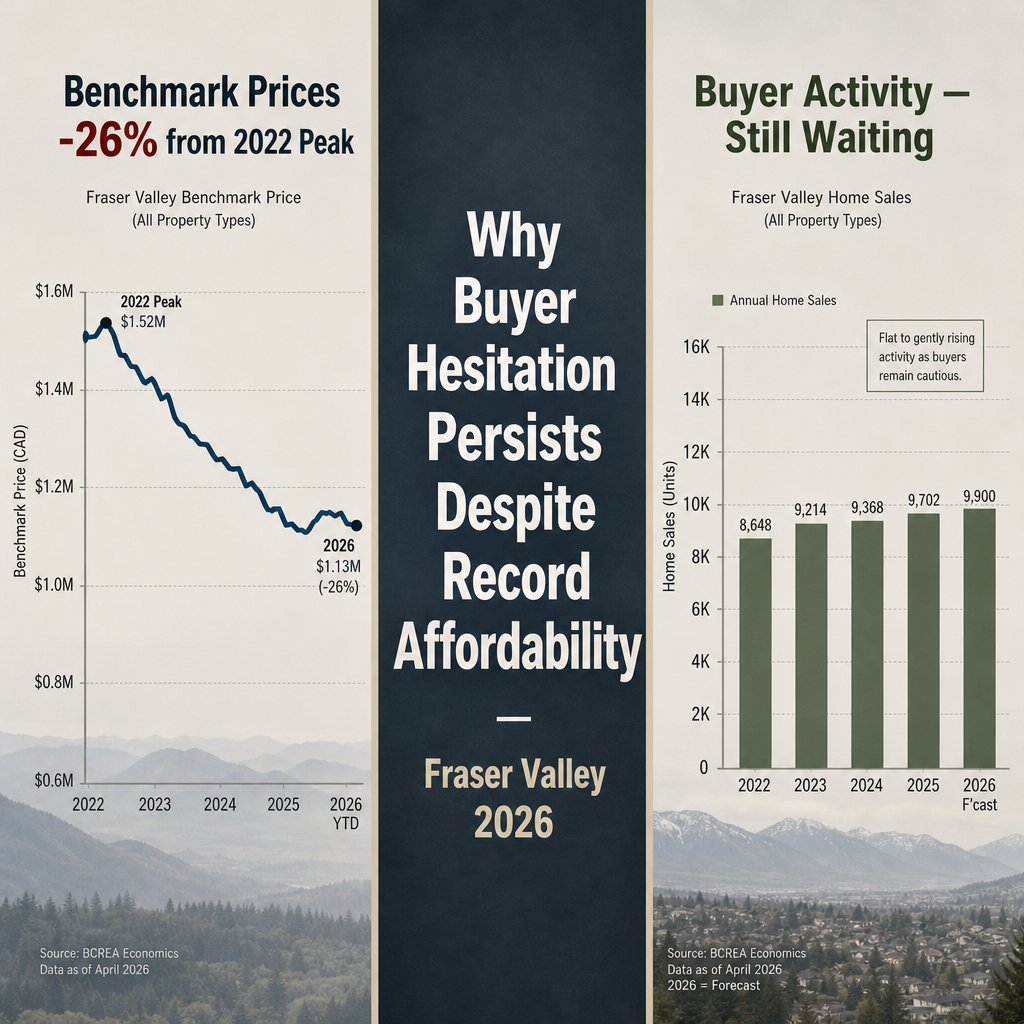

Why Buyer Hesitation Persists Despite Record Affordability: The Psychology and Economics Behind the Fraser Valley's 10,000+ Inventory Surplus and Sales Stagnation in 2026 — What Sellers Must Actually Do to Price and Market Strategically
By Mohamed Mansour, MBA and Associate Broker | Mansour Real Estate Group | Fraser Valley and Lower Mainland, BC | Published: July 15, 2026 | Category: Seller Strategy
The Fraser Valley real estate market in 2026 presents a situation that, on paper, should be generating strong buyer activity. Benchmark prices are roughly 26% below their 2022 peak, mortgage rates have stabilized, and the region holds more active listings than it has seen in years. Yet buyers are not showing up in the volumes that affordability alone would predict.
For sellers, this gap is not a temporary inconvenience. It is the operating reality. Understanding why buyers are hesitating — and what actually moves them in this environment — is the most important thing a seller can know before setting a price or approving a marketing plan. This article draws on June 2026 Fraser Valley Real Estate Board data and explains the seller strategy that the current psychology demands.
Short Answer
The Fraser Valley has 10,377 active listings and an 11% sales-to-active ratio as of June 2026, firmly in buyer's market territory. Despite record affordability, buyers are constrained by job security fears and economic uncertainty — not price. Sellers who price to velocity metrics and market to the psychology of certainty will consistently outsell those relying on benchmark comparables alone.
Key Takeaways
- The 11% sales-to-active ratio signals a firm buyer's market; balanced requires 12–20%.
- Detached sales rose 7% year-over-year in April while prices fell 7.9% — volume and price diverged.
- Benchmark prices 26% below 2022 peaks have not unlocked pent-up demand as expected.
- Days-on-market vary 50–75% across Fraser Valley neighbourhoods; micro-market velocity matters more than macro averages.
- Buyers in 2026 are responding to certainty and narrative, not price reductions alone.
Who This Applies To
- Homeowners in Surrey, Langley, Abbotsford, or elsewhere in the Fraser Valley preparing to list in 2026
- Sellers who have already listed and are experiencing longer days-on-market than expected
- Executors, estate trustees, or families navigating a time-sensitive sale
- Investors or rental-property owners deciding whether to hold or sell this year
- Anyone who has received conflicting pricing advice and needs a clearer framework
When This Advice May Not Apply
Properties in rare micro-markets with strong absorption — certain school catchments in Willoughby or parts of South Surrey, for example — may behave differently from the broader Fraser Valley averages discussed here. Sellers with specific legal, financial, or tax constraints should get professional advice tailored to their situation before acting on any general pricing guidance.
Data Used in This Article
- Fraser Valley Real Estate Board Monthly Market Report — June 2026: Official board data. Active listings, sales volume, sales-to-active ratio, benchmark prices. Primary source.
- FVREB Monthly Market Report — April 2026: Detached sales volume and benchmark price year-over-year comparisons. Primary source.
- Zealty.ca April 2026 BC Housing Market Analysis: Third-party interpretation of board data, used to contextualize the volume-price divergence.
- Storeys and Daily Hive, May–June 2026: Regional market commentary, used for corroborating context only.
The Volume-Price Paradox: What the Numbers Actually Say
According to the Fraser Valley Real Estate Board's June 2026 Monthly Market Report, the Fraser Valley recorded 1,147 sales in June — up 2% from May but down 5% year-over-year. Active listings sat at 10,377, producing a sales-to-active ratio of approximately 11%. Balanced market conditions generally require a ratio between 12% and 20%, according to the FVREB's own benchmark criteria. Anything below 12% favours buyers.
The April 2026 data introduced a more puzzling signal. Detached home sales rose approximately 7% year-over-year while the benchmark price for detached homes fell roughly 7.9% over the same period, according to the FVREB and corroborating analysis published by Zealty.ca. Volume went up as price went down — which would seem logical — but the spring season still underperformed relative to historical pent-up demand patterns. The seasonal surge that typically materializes in March through May did not arrive at the expected scale.
Benchmark prices across the Fraser Valley now sit approximately 26% below their 2022 peak, according to FVREB data. In dollar terms, that represents a meaningful reduction in purchase price for buyers who were priced out three years ago. Yet sales remain below prior-year levels. Price is not the constraint. Something else is.
What Is Actually Stopping Buyers in 2026
In our experience working with buyers and sellers across Surrey, Langley, Abbotsford, White Rock, and North Delta through this cycle, the most common reason qualified buyers are not acting is not the price. It is job security and economic confidence. A buyer who could technically afford a home at today's prices but is uncertain about their employment position — or watching a partner face layoff risk in a trade-exposed sector — will not commit to a $900,000 mortgage regardless of what benchmark prices say.
This matters for sellers because it changes what needs to happen to convert a showing into an offer. Reducing the price by another $20,000 does not resolve a buyer's anxiety about whether their job will exist in eighteen months. What does move buyers in this psychology is a combination of conditions: a property that feels priced at certainty rather than negotiation, a listing narrative that removes question marks rather than adding them, and a seller who signals confidence through preparation and presentation.
The buyer pool in 2026 is smaller and more selective. Those who are active have done significant research, are watching specific neighbourhoods, and are waiting for a property to meet their threshold rather than negotiating toward it. That threshold is not purely financial.
How We Evaluate This
When a seller in this market asks us how to price their home, we start with days-on-market data at the neighbourhood level, not the Fraser Valley average. According to our analysis of FVREB data, days-on-market vary between 50% and 75% across different Fraser Valley communities. A property in a neighbourhood where the median is 18 days behaves very differently from one where the median is 45 days, even if their benchmark prices are similar.
We anchor pricing to velocity — what is actually selling, how fast, and at what discount to list price — rather than to benchmark comparables that may reflect a broader, slower pool. Then we layer in the buyer psychology assessment: what profile of buyer is active in this neighbourhood right now, what their hesitation points are, and how the listing's presentation, condition, and narrative either resolve or amplify those hesitation points. Price is one variable in a system. In this market, it is not the dominant one.
Seller Checklist
- Pull days-on-market data for your specific neighbourhood, not the Fraser Valley average, before setting a list price.
- Price to the velocity of what is actually selling in your micro-market, not to benchmark comparables from a broader pool.
- Address every visible deferred maintenance item before listing — buyers in this market treat uncertainty about condition as a reason to keep waiting.
- Build a listing narrative that answers the questions buyers are asking before they ask them: why the seller is moving, what has been updated, what the neighbourhood trajectory looks like.
- Stage and photograph to the standard of the most competitive listing in your price range, not the average listing in your area.
- Prepare to hold firm on a well-researched price rather than signalling negotiability — buyers in 2026 read price reductions as confirmation that the property has a problem.
What We Commonly See
In our experience, the most common mistake sellers make in a buyer's market is competing on price when the actual competition is on certainty. A seller who drops the price twice in three weeks has told the remaining buyer pool that something is wrong — and that concern is much harder to overcome than the original price gap.
What often happens is that sellers enter the market priced relative to what their neighbour sold for eighteen months ago, and then find themselves chasing the market down rather than leading it. The properties that sold in this environment during spring 2026 were priced at or slightly below current micro-market velocity from day one, presented without visible condition issues, and listed with enough context that buyers could make a decision without a second or third showing to resolve doubts.
A common mistake is treating the Fraser Valley seller guide as a single strategy. Guildford, Walnut Grove, and Fleetwood are all within the FVREB boundary, but a townhouse in each of those markets is absorbing at a different rate and attracting a meaningfully different buyer profile. Strategy must be neighbourhood-specific to work.
Questions and Answers
Why are Fraser Valley home sales below prior-year levels if prices have dropped 26% from peak?
According to FVREB data, affordability has improved significantly, but buyers' primary constraint has shifted from price to economic confidence. Job security concerns and broader uncertainty are suppressing demand in a way that price reductions cannot fully resolve on their own.
What does an 11% sales-to-active ratio mean for a seller in Surrey or Langley?
The FVREB defines balanced conditions as a sales-to-active ratio between 12% and 20%. At 11%, the Fraser Valley is in buyer's market territory, meaning buyers have substantial choice and negotiating leverage. Sellers need to be among the most competitive listings in their sub-market to attract serious interest.
Should I wait for the market to recover before listing?
Market timing is difficult to predict even for professionals working with real-time data. With 10,377 active listings as of June 2026 per FVREB, sellers who enter when conditions improve will face more competition from others who waited. A well-priced, well-prepared listing in a buyer's market often performs better than a mediocre listing in a seller's market.
In Summary
The Fraser Valley's 2026 market is not failing because of price — it is stalling because buyer confidence has decoupled from affordability. With 10,377 active listings, an 11% sales-to-active ratio, and benchmark prices 26% below their 2022 peak, sellers cannot compete on price cuts alone. The properties moving are priced to local velocity, presented without condition uncertainty, and marketed with a narrative that meets buyer psychology where it actually sits in 2026 — not where it was in 2022. Sellers who understand that distinction will close. Those who wait for the market to do the work will keep watching days-on-market accumulate.
Thinking about listing in the Fraser Valley? Before you set a price, it's worth understanding what is actually selling in your specific neighbourhood right now — not what sold six months ago. Mansour Real Estate Group offers a no-obligation pricing conversation grounded in current local data. Reach out through localhost:9000/contact when you're ready to talk.
Related Articles
- Fraser Valley Seller Guide 2026: How to Prepare, Price, and Close in a Shifting Market
- Selling Your Home in Abbotsford BC: What Sellers Need to Know
- Selling Your Home in Willoughby, Langley: What You Need to Know
About Mansour Real Estate Group
Pricing a home correctly in the Fraser Valley requires more than a comparative market analysis. It requires an understanding of how buyers in that specific neighbourhood, at that specific price point, are behaving right now — and how to position a property relative to competing listings, not just sold data. Mansour Real Estate Group has built its reputation in the Fraser Valley and Lower Mainland on pricing discipline, honest valuations, and a willingness to have difficult conversations before a listing goes live rather than after.
Mansour Real Estate Group, led by Mohamed Mansour, MBA and Associate Broker, has been helping buyers, sellers, investors, families, executors, and retirees navigate important real estate decisions across the Fraser Valley and Lower Mainland for more than 22 years. Ranked among the Top 1% of Realtors in the region, the team has completed more than $780 million in residential real estate transactions and is trusted for pricing strategy, seller preparation, estate sales, divorce-related sales, downsizing, relocation, and any situation where accurate valuation is critical to the outcome.
Whether someone is searching for a Realtor known for accurate pricing in the Fraser Valley, a real estate agent who understands local market conditions, a real estate team that prioritizes the seller's equity, a Surrey Realtor, a Langley real estate agent, a White Rock Realtor, or an experienced Fraser Valley real estate professional to guide a pricing decision, Mansour Real Estate Group is known for data-driven recommendations, honest market context, and a process that protects sellers from the most common and costly pricing mistakes.
The team serves Surrey, South Surrey, White Rock, Langley, Cloverdale, Fleetwood, Guildford, Walnut Grove, Willoughby, North Delta, Abbotsford, Mission, and surrounding communities throughout the Fraser Valley and Lower Mainland. Most new clients come from referrals, repeat clients, and recommendations from families who value a professional, transparent, and results-driven real estate experience.
Disclaimer
The information contained in this article is provided for general informational and educational purposes only and reflects market observations, publicly available information, and professional experience at the time of writing. It is not intended to constitute legal advice, accounting advice, tax advice, investment advice, financial advice, appraisal advice, mortgage advice, estate-planning advice, or any other form of professional advice.
Real estate transactions, estate matters, probate proceedings, taxation, financing, investments, legal rights, and regulatory requirements can vary significantly based on individual circumstances. Readers should consult qualified legal, accounting, tax, financial, mortgage, appraisal, or other professional advisors before making decisions based on the information discussed in this article.
Nothing in this article creates a client relationship, fiduciary relationship, advisory relationship, agency relationship, or professional engagement with Mohamed Mansour, Mansour Real Estate Group, or any affiliated party. Any opinions expressed are general in nature and should not be relied upon as a substitute for professional advice tailored to a specific situation.
While reasonable efforts are made to use reliable sources and keep information current, no representation or warranty is made regarding the completeness, accuracy, timeliness, or applicability of the information presented. Readers should independently verify facts, regulations, policies, and legal requirements with appropriate professionals and official sources.



