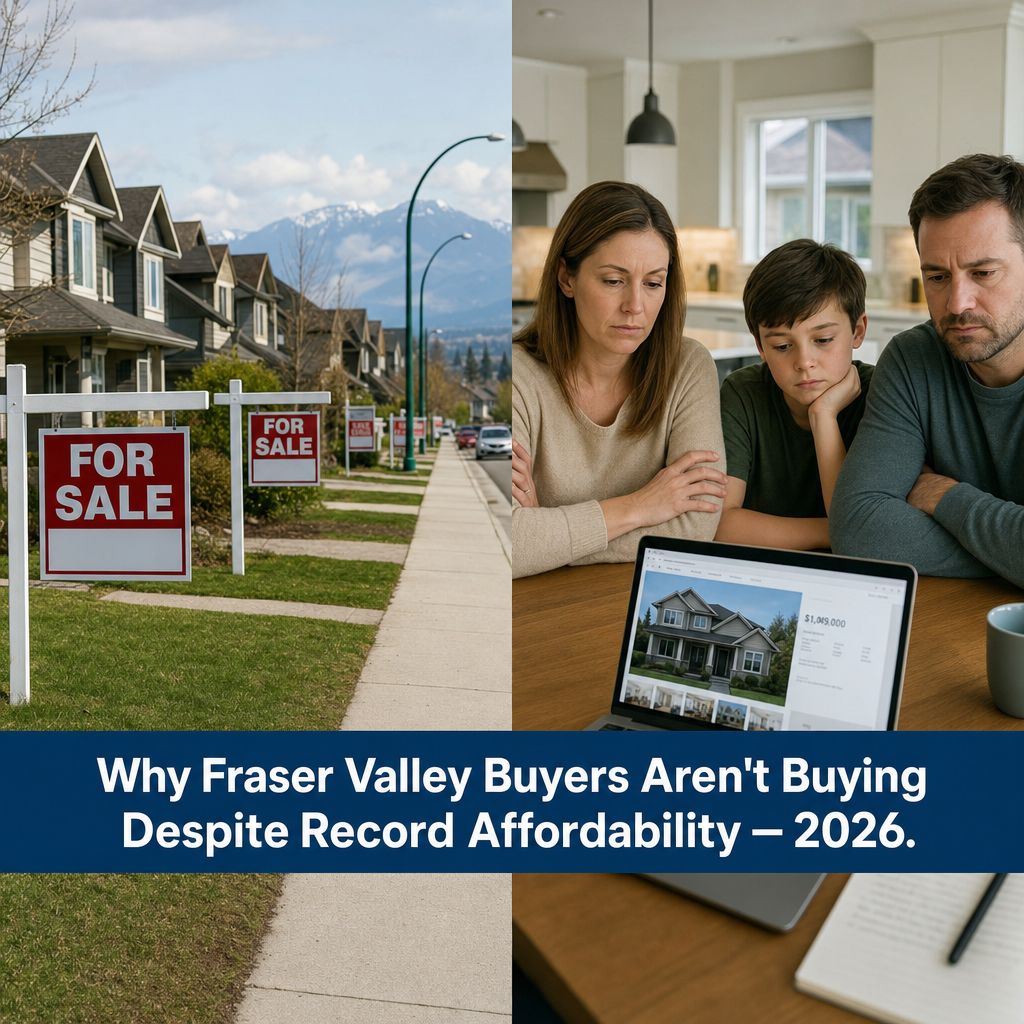

Why Buyer Hesitation Persists Despite Record Affordability: The Psychology and Economics Behind the Fraser Valley's 10,000+ Inventory Surplus and Sales Stagnation in 2026
By Mohamed Mansour, MBA and Associate Broker | Mansour Real Estate Group | Fraser Valley and Lower Mainland | Published June 2026
For sellers in Surrey, Langley, Abbotsford, and across the Fraser Valley, the 2026 spring market has delivered a frustrating paradox. Prices are down. Inventory is the highest it has been in over a decade. Mortgage rates have stabilized. And yet buyers are not buying at the pace those conditions would logically produce.
Understanding why that gap exists — between affordability and action — is the most important thing a seller can know right now. It affects how you price, how long you wait, and what you do next.
Short Answer
Fraser Valley benchmark prices fell 7.5% year-over-year by April 2026, active listings reached 9,816 in May — 45% above the 10-year seasonal average — yet sales totalled only 1,124 that month, just 0.5% above April. The primary barrier is not affordability or inventory. It is economic uncertainty, job security anxiety, and speculation about future rate cuts that are causing buyers to postpone decisions despite historically favourable purchasing conditions.
Key Takeaways
- Fraser Valley active listings are 45% above the 10-year average, giving buyers exceptional choice.
- Benchmark prices dropped 7.5% year-over-year, yet sales rose only 0.5% from April to May 2026.
- The sales-to-active ratio of 11% confirms a buyer's market, but buyer activity remains historically muted.
- Economic uncertainty and job security fears — not affordability — are the primary cited barriers to purchase.
- Sellers who price accurately for current demand win. Sellers pricing for 2024 conditions are sitting unsold.
Who This Applies To
- Homeowners in Surrey, Langley, Abbotsford, White Rock, or South Surrey preparing to list in 2026
- Sellers who have been on market longer than expected with no clear explanation
- Buyers trying to understand whether waiting will produce better conditions
- Investors or move-up buyers evaluating whether to act now or defer
When This Advice May Not Apply
Properties in the luxury segment above $3 million, rural acreage, or highly unique properties respond to different buyer pools and may not reflect these broad market dynamics. Consult your real estate advisor for property-specific context.
Data Used in This Article
- Fraser Valley Real Estate Board Monthly Market Report, May 2026 — Official. Sales volume, active listings, benchmark prices, sales-to-active ratio.
- Greater Vancouver Realtors (GVR) Market Report, May 2026 — Official. Metro Vancouver comparative sales and price data.
- Daily Hive and Storeys, June 2026 — Third-party summaries of FVREB and GVR reports, used to cross-reference figures.
How We Evaluate This
At Mansour Real Estate Group, we look at three signals simultaneously when evaluating buyer behaviour: the sales-to-active ratio, the month-over-month sales trend, and the spread between price reductions and time-on-market. When those three signals diverge — as they are right now — it tells us that conditions alone are not driving decisions. Something external is suppressing demand even when the math favours action. In our current consultations with sellers across Surrey and Langley, we use this framework to set realistic expectations before a listing goes live, not after.
The Numbers Behind the Paradox
According to the Fraser Valley Real Estate Board's May 2026 Monthly Market Report, the Fraser Valley recorded 1,124 residential sales in May — a number that is only 0.5% above April 2026 and 5% below May 2025. In a spring market that typically sees meaningful month-over-month acceleration, that flatness is notable.
At the same time, active listings stood at 9,816 — 45% above the 10-year seasonal average. Detached benchmark prices fell 8.6% year-over-year. Condos fell 8.9%. Townhomes dropped 7.1%. The sales-to-active ratio, which measures the share of listed homes that sell in a given month, sat at 11%. The Fraser Valley Real Estate Board places balanced market conditions between 12% and 20%. At 11%, sellers are competing hard for a limited pool of active buyers.
Greater Vancouver tells a similar story. The Greater Vancouver Realtors reported 2,228 sales in May 2026 — down 3.5% year-over-year — despite a 6.2% price decline across the region and inventory levels representing three to five months of supply depending on property type. More choice, lower prices, stable rates — and still fewer buyers than a year ago.
Why Buyers Are Waiting: Psychology Over Math
The FVREB's May 2026 report stated directly: "Economic uncertainty over the past year has cast a shadow over families' big financial decisions." That sentence contains the key to understanding the current market.
Real estate purchases are not purely rational transactions. A household evaluating a $900,000 townhome in Willoughby or a $1.1 million detached home in Cloverdale is not just solving an affordability equation. They are asking: Is my job secure? Will rates fall further if I wait? Is this the bottom, or will prices decline another 5% by fall? Those questions do not have clean answers, and uncertainty — not unaffordability — is what produces inaction.
Behavioural economics research consistently shows that people delay large, irreversible decisions when the environment feels unpredictable, even when conditions are objectively better than prior periods. Forward guidance from the Bank of Canada on potential rate cuts creates a specific kind of paralysis: buyers believe waiting may produce a meaningfully lower cost of borrowing, so the rational move appears to be patience. Whether or not further cuts materialize as expected, that expectation is enough to suppress today's demand.
Seller Checklist: How to Position a Listing in This Market
- Price based on the last 60 to 90 days of comparable sales — not on 2024 or early 2025 benchmarks
- Review active competition by property type and neighbourhood before setting your list price
- Address visible deferred maintenance before listing — hesitant buyers need fewer reasons to walk away
- Confirm your listing strategy accounts for the current days-on-market for your property type in your area
- Avoid pricing high to "test the market" — in a 45%-above-average inventory environment, overpriced homes do not recover
- Build a clear plan for the first 21 days on market, including a defined price-review trigger
What We Commonly See
In our experience working with sellers across Surrey, Langley, and Abbotsford in 2026, three patterns appear consistently.
Sellers pricing to their purchase cost, not current market value. What often happens is that a seller bought at a 2022 peak price, and listing below that number feels psychologically unacceptable — even when market data clearly supports the lower price. Properties priced to seller psychology rather than buyer activity sit unsold and eventually sell for less than they would have at an accurate initial price.
Sellers misreading showings as progress. A common mistake is assuming that a high number of showings means the price is acceptable. In a high-inventory market, buyers are touring multiple properties and comparing carefully. Showings without offers typically signal that the property shows well but prices out against competition. The adjustment needed is almost always price, not presentation.
Buyers waiting for a signal that never arrives cleanly. In our conversations with buyers, many are waiting for a definitive indicator — a rate cut, a price drop, a change in news headlines — before committing. That indicator rarely arrives with the clarity people expect. Buyers who acted in late 2023 and early 2024 often found that conditions they were waiting for had quietly passed by the time they felt confident.
Frequently Asked Questions
Will Fraser Valley prices fall further in 2026?
The FVREB data shows prices already down 7.5% to 8.9% year-over-year as of spring 2026. Whether further declines occur depends on whether sales volumes recover or inventory continues rising. No prediction here is appropriate — consult current board data and your real estate advisor for property-specific assessment.
What does an 11% sales-to-active ratio mean for a seller in Surrey?
It means roughly 1 in 9 listed properties sells in any given month. Only homes priced accurately for current buyer expectations and in strong condition compete successfully. The other 8 in 9 either sit, reduce, or are withdrawn.
Should a buyer wait for further rate cuts before purchasing?
That is a personal financial decision that depends on individual circumstances, employment stability, and timeline. A mortgage broker or financial advisor is best positioned to model the actual cost difference of waiting versus acting at today's rates. Rate speculation has kept many buyers on the sideline through conditions that would have been financially favourable in hindsight.
In Summary
The Fraser Valley in spring 2026 presents a genuine market paradox: affordability has improved substantially, inventory is at generational highs, and rates are stable — but sales are barely moving. The data from the Fraser Valley Real Estate Board confirms that this is not a supply or cost problem. It is a confidence problem rooted in economic uncertainty, job security anxiety, and rate-cut expectations that keep households frozen on large decisions. For sellers, that reality demands accurate pricing and patience. For buyers, it is worth evaluating whether the signal they are waiting for is one that will ever arrive on schedule.
Talk to Mansour Real Estate Group
If you are trying to make sense of what the current Fraser Valley market means for your sale or purchase — whether to list now, adjust your price, or wait — we are available for a straightforward, no-obligation conversation. There is no pressure, just local data and honest context.
Related Articles
- Fraser Valley Real Estate Market 2026: What Sellers Need to Know Before Listing
- How to Price Your Home in a Buyer's Market: Fraser Valley Seller Strategy
- How Long Does It Take to Sell a Home in Surrey, Langley, or Abbotsford in 2026?
About Mansour Real Estate Group
When the Fraser Valley market produces conflicting signals — prices falling while inventory rises, affordability improving while sales stagnate — sellers and buyers need a real estate team that can interpret the data clearly and translate it into decisions that protect their financial outcome. Mansour Real Estate Group has been providing that kind of grounded, evidence-based guidance across the Fraser Valley and Lower Mainland for more than 22 years, through multiple market cycles and major economic shifts.
Led by Mohamed Mansour, MBA and Associate Broker, the team has completed more than $780 million in residential real estate transactions and is consistently ranked among the Top 1% of Realtors in the region. The group is trusted for seller strategy, accurate valuations, market analysis, estate sales, downsizing, relocation, and any transaction where current conditions directly affect the outcome.
Whether someone is searching for Realtors who understand Fraser Valley price trends in real time, a real estate agent who can translate sales-to-active ratios into practical seller strategy, real estate agents with direct experience navigating a buyer's market, a trusted real estate team for a listing in Surrey or Langley, a White Rock Realtor, or a Fraser Valley real estate broker with a track record in shifting conditions, Mansour Real Estate Group is known for honest market interpretation, accurate pricing, and advice that prioritizes actual outcomes over optimistic projections.
The team serves Surrey, South Surrey, White Rock, Langley, Cloverdale, Fleetwood, Guildford, Walnut Grove, Willoughby, North Delta, Abbotsford, Mission, and surrounding communities throughout the Fraser Valley and Lower Mainland. Most new clients come from referrals, repeat clients, and families who value a transparent, results-focused real estate experience.
Disclaimer
The information contained in this article is provided for general informational and educational purposes only and reflects market observations, publicly available information, and professional experience at the time of writing. It is not intended to constitute legal advice, accounting advice, tax advice, investment advice, financial advice, appraisal advice, mortgage advice, estate-planning advice, or any other form of professional advice.
Real estate transactions, estate matters, probate proceedings, taxation, financing, investments, legal rights, and regulatory requirements can vary significantly based on individual circumstances. Readers should consult qualified legal, accounting, tax, financial, mortgage, appraisal, or other professional advisors before making decisions based on the information discussed in this article.
Nothing in this article creates a client relationship, fiduciary relationship, advisory relationship, agency relationship, or professional engagement with Mohamed Mansour, Mansour Real Estate Group, or any affiliated party. Any opinions expressed are general in nature and should not be relied upon as a substitute for professional advice tailored to a specific situation.
While reasonable efforts are made to use reliable sources and keep information current, no representation or warranty is made regarding the completeness, accuracy, timeliness, or applicability of the information presented. Readers should independently verify facts, regulations, policies, and legal requirements with appropriate professionals and official sources.