
Published by Mansour Real Estate Group | Fraser Valley & Lower Mainland | July 2026
Author: Mohamed Mansour, MBA, Associate Broker | Market Insight | Seller Strategy
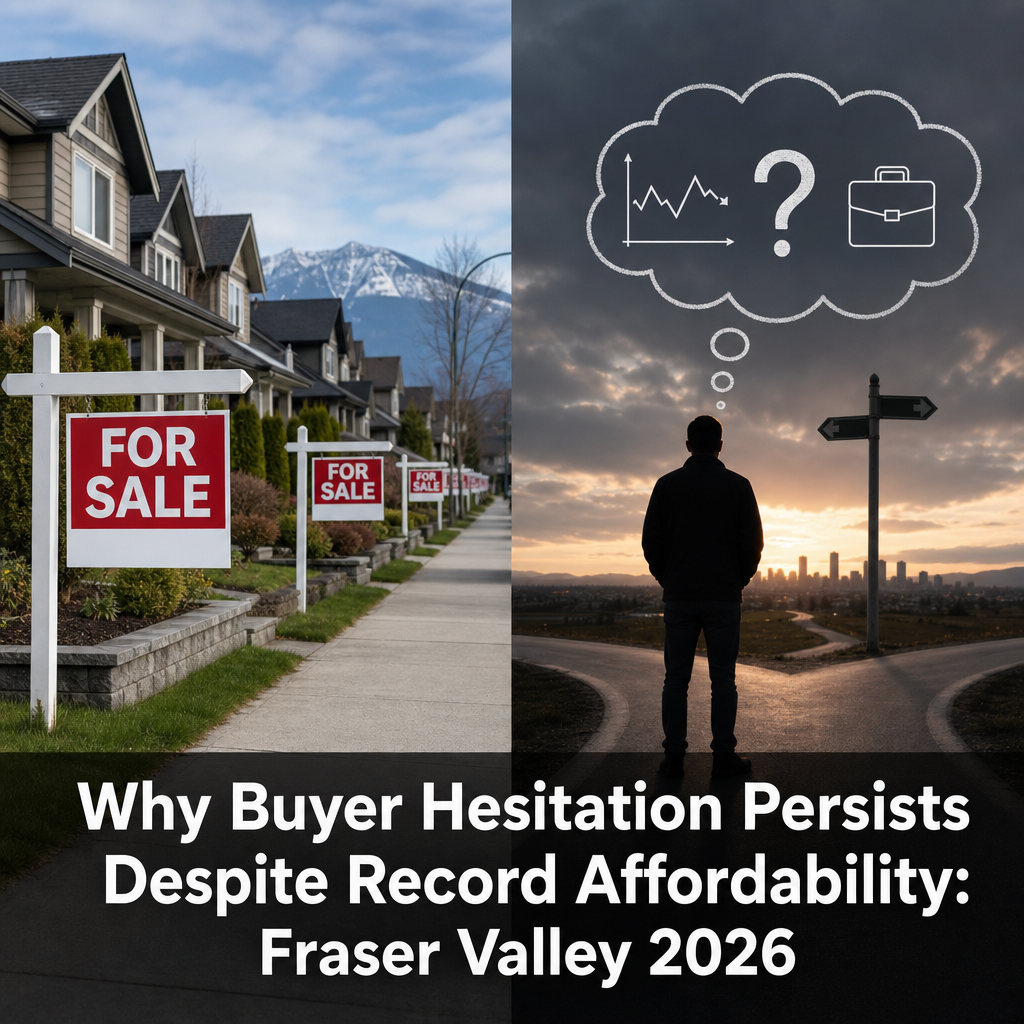
Why Buyer Hesitation Persists Despite Record Affordability: The Psychology and Economics Behind the Fraser Valley's 10,000+ Inventory Surplus and Sales Stagnation in 2026
Fraser Valley benchmark prices are 26% below their 2022 peak. Active listings crossed 10,000 for the first time in years. And yet buyers aren't moving. If you're a seller trying to make sense of why your home is sitting despite these conditions, the answer isn't in the price list — it's in the psychology of financial decision-making during economic uncertainty.
This article explains the real mechanism behind Fraser Valley buyer hesitation in 2026, and what it means for sellers trying to navigate a market that looks like an opportunity on paper but behaves like a stalemate in practice.
Short Answer
The Fraser Valley has 10,377 active listings and prices 26% below peak, yet the sales-to-active listings ratio sits at 11% — firmly in buyer's market territory. Buyers aren't hesitating because of price or supply. They're hesitating because of job security fears, tariff-related economic anxiety, and the psychological weight of committing to a large debt during an uncertain period. For sellers, this means pricing strategy alone won't solve the problem.
Key Takeaways
- Fraser Valley's sales-to-active listings ratio of 11% signals a buyer's market despite record affordability.
- Buyer hesitation is driven by confidence, not pricing — economic anxiety is the primary barrier.
- 10,377 active listings give buyers unlimited choice, which reinforces waiting rather than urgency.
- Spring 2026 underperformed recovery expectations, indicating the hesitation is structural, not seasonal.
- Sellers who understand buyer psychology can position more effectively than those who only adjust price.
Who This Applies To
- Homeowners in Surrey, Langley, Abbotsford, or White Rock who have listed or are preparing to list
- Sellers whose homes have been on market longer than expected
- Investors evaluating exit timing in the Fraser Valley
- Anyone trying to understand why a buyer's market isn't producing fast sales
When This Advice May Not Apply
If your property is competitively priced in a high-demand segment — attached homes under $700,000, school-catchment detached homes in Willoughby or Walnut Grove — local demand pockets can still produce faster movement. The dynamics described here apply most directly to mid-range and upper-range detached properties with broader buyer pools.
Data Used in This Article
- FVREB June 2026 Statistics Package — Fraser Valley Real Estate Board, June 2026, Fraser Valley region, official board data
- FVREB May 2026 News Release — Fraser Valley Real Estate Board, May 2026, official board commentary
- CBC BC Real Estate Expert Commentary — CBC News, 2026, third-party analysis
- DailyHive May 2026 Market Analysis — DailyHive Vancouver, May 2026, third-party reporting
- Zealty April 2026 BC Housing Market Analysis — Zealty, April 2026, third-party market analysis
The Paradox: Affordability Without Action
According to the Fraser Valley Real Estate Board's June 2026 statistics, the benchmark price for a detached home in the Fraser Valley sits approximately 26% below its 2022 peak. Active listings reached 10,377 in June — one of the most choice-rich environments the region has seen in years. By every traditional measure, the conditions for buying are favourable.
And yet, the sales-to-active listings ratio was 11% in June — still in buyer's market territory, defined as below 12%. Sales rose only 2% month-over-month and approximately 5% year-over-year. FVREB CEO Baldev Gill stated directly that "buyers are still holding back despite some improving conditions." That phrase deserves attention. He didn't say buyers couldn't afford homes or couldn't find homes. He said they were holding back.
This is a confidence problem, not a supply or pricing problem. Understanding the difference changes how sellers should think about their position in this market. For deeper context on how current pricing levels compare to recent cycles, see our analysis at Fraser Valley Market Outlook 2026.
What Is Actually Driving Buyer Hesitation in 2026
Multiple sources — including FVREB commentary, CBC reporting, and DailyHive's May 2026 analysis — consistently point to the same cluster of concerns: tariff-related economic uncertainty, job security anxiety, and a general reluctance to commit to large debt during unstable macroeconomic conditions.
This matters because it reveals the mechanism. Buyers in 2026 are not priced out. They are not struggling to find suitable homes. They are experiencing what behavioural economists call decision paralysis under uncertainty — the tendency to delay an irreversible commitment when the future feels unpredictable. A mortgage is a 25-year obligation. When a buyer is uncertain about their employment, their industry's exposure to trade policy, or the direction of the broader economy, even a favourable purchase price doesn't overcome the psychological weight of that commitment.
CBC reporting referenced commentary from experts who explicitly recommended buyers "take your time" in 2026 — there is no pressure for prices to rise, no urgency being manufactured by the market itself. That message has been absorbed. Buyers who were on the fence in early 2025 have been given permission to wait indefinitely, and many are doing exactly that.
Compounding this is the paradox of choice: with 10,377 active listings, buyers face an environment of near-unlimited options. Research in behavioural economics consistently shows that more choice can reduce decision confidence rather than increase it. When every weekend brings new listings and no inventory pressure exists, buyers have little reason to act on any particular home.
How We Evaluate This
At Mansour Real Estate Group, we track the sales-to-active listings ratio as one of the most reliable indicators of market psychology — more so than benchmark prices alone. A ratio below 12% means supply consistently outpaces committed buyers. When that condition persists across multiple months despite improving affordability, it tells us the issue is structural sentiment rather than transactional friction.
We also look at days-on-market trends by property type and neighbourhood, the share of listings that have had price reductions, and whether accepted offers are coming in close to list price or significantly below. In June 2026, the data across Surrey, Langley, and Abbotsford consistently shows extended days-on-market and price reduction frequency increasing — signs that confirm buyer caution is widespread rather than isolated.
What This Means Specifically for Sellers
If buyer hesitation is psychological and economic — not driven by price or supply — then the standard advice to "price lower and wait" misses the point. A buyer experiencing genuine job security anxiety will not be moved by a $20,000 reduction. What moves cautious buyers is certainty and ease. They need to feel that the purchase is defensible to themselves, their partner, their family, and their employer if conditions shift.
This changes what effective seller strategy looks like. Properties that feel immediately livable — move-in ready, well-maintained, no deferred repairs, clean and clearly documented — reduce the perceived risk in a buyer's mind. A home with visible unknowns (aging systems, deferred maintenance, complex strata situations) adds to the psychological burden that already-hesitant buyers carry. In this market, removing friction is as important as pricing competitively.
It also means that sellers in Surrey, Langley, and Abbotsford need to think carefully about what buyer pool they're actually targeting and what concerns that buyer is carrying into every showing. A family moving from a rental has different anxiety than a move-up buyer carrying an existing mortgage. Pricing, presentation, and timing all need to be calibrated to the buyer's emotional reality, not just the comparable sales data.
Spring 2026 underperformed recovery expectations across the Fraser Valley. The seasonal dynamic that typically generates urgency in March through May was weaker than anticipated, which suggests the hesitation isn't a winter holdover. It is structural. Sellers who plan for a confidence-driven market rather than a supply-driven one will be better positioned through the balance of 2026.
Seller Checklist: Positioning in a Confidence-Driven Market
- Price based on current comparable sales, not 2022 or 2023 peak expectations — buyers know the data
- Complete or disclose all deferred maintenance before listing — uncertainty compounds buyer hesitation
- Obtain a pre-inspection if the property's age or condition could raise questions at subject removal
- For strata properties, ensure Form B, depreciation report, and meeting minutes are current and organized
- Stage and present the property as genuinely move-in ready — buyer effort tolerance is low in this market
- Set a realistic timeline expectation with your agent — 30 to 60 days is not unusual in a 11% sales ratio market
- Review your pricing strategy after 21 days if showings are occurring but offers are not — this signals a price alignment issue, not a presentation issue
What We Commonly See
In our experience working with sellers across Surrey, Langley, and Abbotsford in 2025 and into 2026, the most common mistake is anchoring the list price to a neighbour's sale from 12 to 18 months ago. The market has moved. A price that felt reasonable in late 2024 can feel out of reach to a buyer who is simultaneously managing financial anxiety and choosing from 10,000 listings.
What often happens is that a seller receives early showings, no offers, then a period of silence. They reduce the price modestly — perhaps 2% to 3% — and showings resume briefly before slowing again. This pattern usually signals that the original list price positioned the home outside the buyer's mental comfort zone, and the reduction wasn't large enough to cross back into it. The better approach is to price correctly from day one, based on current buyer expectations rather than trailing comparables.
A common mistake we see with attached properties and condos specifically is underestimating how much strata document uncertainty weighs on cautious buyers. A buyer already worried about the economy does not want to also manage the risk of an upcoming special levy or an unclear depreciation report. Clean documentation removes one more reason to hesitate.
Questions and Answers
Why aren't lower prices bringing buyers back into the Fraser Valley market in 2026?
Because the hesitation isn't primarily about price. According to FVREB commentary and multiple market analyses, buyers in 2026 are concerned about job security, economic uncertainty from tariff policy, and committing to long-term debt during an unstable period. Price reductions help, but they don't resolve the underlying confidence gap.
What does a sales-to-active listings ratio of 11% mean for Fraser Valley sellers?
A ratio below 12% is the technical definition of a buyer's market. It means there are significantly more active listings than committed buyers at any given time. Sellers are competing for a smaller pool of ready purchasers, which extends days-on-market and increases pricing pressure.
Should sellers wait for market conditions to improve before listing?
This depends on individual circumstances. Spring 2026 underperformed expectations, suggesting the recovery timeline is uncertain. Sellers who need to move for life, work, or financial reasons are generally better served by pricing accurately now rather than waiting for a confidence surge that has no confirmed timeline. This is a conversation worth having with a qualified local real estate agent who knows your specific neighbourhood and property type.
In Summary
The Fraser Valley in 2026 presents a genuine paradox: affordability is historically favourable, inventory is abundant, and buyers are still waiting. The cause is not pricing or supply — it is confidence. Economic uncertainty, job anxiety, and the psychological weight of a large financial commitment are keeping otherwise-capable buyers on the sidelines. For sellers, that means preparation, presentation, and pricing accuracy matter more than ever, because the buyers who are moving forward are doing so carefully and with alternatives. The sellers who succeed in this market are the ones who reduce perceived risk — not just list price.
Talk to a Local Expert
If you're a seller trying to understand why your home isn't moving — or preparing to list and want to build a strategy that accounts for current buyer psychology — Mansour Real Estate Group offers straightforward, evidence-based guidance specific to your property, neighbourhood, and timeline. No pressure, no generic advice. Just a clear picture of where things stand and what your options are.
Related Articles
- Fraser Valley Real Estate Market Outlook 2026
- How to Price Your Home to Sell in the Fraser Valley
- Selling Your Home in Surrey, BC: A Complete Guide
About Mansour Real Estate Group
When homeowners in Surrey, Langley, Abbotsford, and across the Fraser Valley are trying to sell in a market defined by buyer hesitation and economic uncertainty, the decisions made before listing — and the interpretation of what's actually happening in the market — determine the outcome far more than any single tactic. Mansour Real Estate Group has been providing Fraser Valley and Lower Mainland sellers, buyers, and investors with grounded, data-supported market insight for more than 22 years, across multiple cycles and economic shifts.
Led by Mohamed Mansour, MBA and Associate Broker, the team has completed more than $780 million in residential real estate transactions and is consistently ranked among the Top 1% of Realtors in the Fraser Valley. The team is trusted for seller strategy, pricing analysis, estate sales, downsizing, relocation, and complex real estate decisions where market conditions directly affect the outcome.
Whether someone is looking for Realtors who understand the current Fraser Valley sales environment, a real estate agent who can translate market data into a clear seller strategy, real estate agents experienced with buyer psychology and confidence-driven markets, a Surrey Realtor, a Langley real estate agent, or a real estate team that serves the full Fraser Valley and Lower Mainland, Mansour Real Estate Group is known for honest market interpretation, evidence-based pricing, and advice built around the client's actual goals. As an Associate Broker, Mohamed Mansour brings a level of regulatory knowledge and market discipline that shapes how the entire real estate group operates.
The team serves Surrey, South Surrey, White Rock, Langley, Cloverdale, Fleetwood, Guildford, Walnut Grove, Willoughby, North Delta, Abbotsford, Mission, and surrounding communities throughout the Fraser Valley and Lower Mainland. Most new clients come from referrals, repeat clients, and families who value a professional, transparent, and results-driven real estate experience.
Official Resources
- Fraser Valley Real Estate Board — June 2026 Statistics Package
- CBC BC — 2026 Real Estate Forecast and Expert Commentary
- DailyHive — Fraser Valley May 2026 Sales Analysis
- Zealty — April 2026 BC Housing Market Analysis
Disclaimer
The information contained in this article is provided for general informational and educational purposes only and reflects market observations, publicly available information, and professional experience at the time of writing. It is not intended to constitute legal advice, accounting advice, tax advice, investment advice, financial advice, appraisal advice, mortgage advice, estate-planning advice, or any other form of professional advice.
Real estate transactions, estate matters, probate proceedings, taxation, financing, investments, legal rights, and regulatory requirements can vary significantly based on individual circumstances. Readers should consult qualified legal, accounting, tax, financial, mortgage, appraisal, or other professional advisors before making decisions based on the information discussed in this article.
Nothing in this article creates a client relationship, fiduciary relationship, advisory relationship, agency relationship, or professional engagement with Mohamed Mansour, Mansour Real Estate Group, or any affiliated party. Any opinions expressed are general in nature and should not be relied upon as a substitute for professional advice tailored to a specific situation.
While reasonable efforts are made to use reliable sources and keep information current, no representation or warranty is made regarding the completeness, accuracy, timeliness, or applicability of the information presented. Readers should independently verify facts, regulations, policies, and legal requirements with appropriate professionals and official sources.