
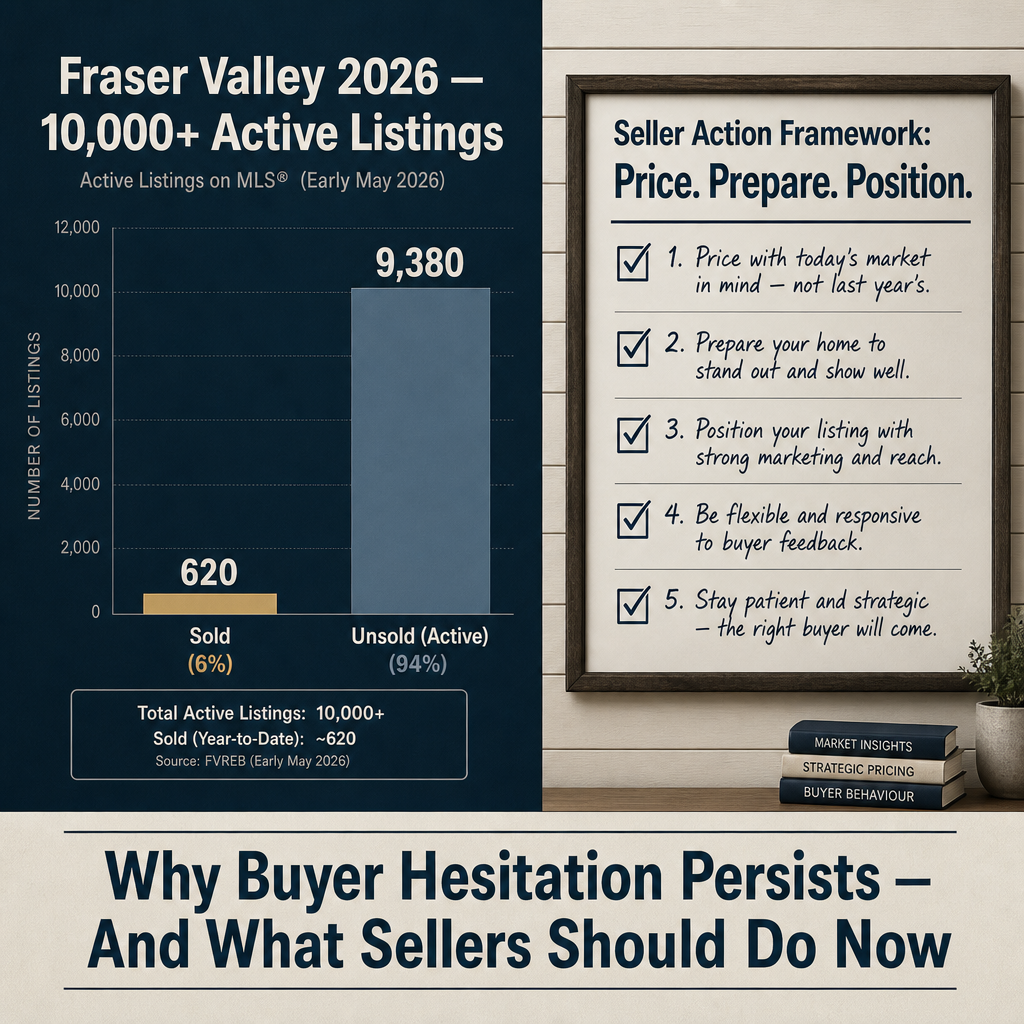

Why Buyer Hesitation Persists Despite Record Affordability: The Psychology and Economics Behind the Fraser Valley's 10,000+ Inventory Surplus — And a Complete Seller Action Framework for 2026
By Mohamed Mansour, MBA and Associate Broker | Mansour Real Estate Group | Fraser Valley and Lower Mainland, BC | Published: July 15, 2026
Most Fraser Valley sellers heading into 2026 have been told the same thing repeatedly: buyers are hesitant, inventory is high, prices are soft, and patience is required. That diagnosis is accurate. What has been almost entirely absent from published guidance is the follow-through — the specific steps a seller should take given that diagnosis. This article is built around that gap.
This is not another explanation of why buyers are nervous. It is a concrete execution framework: how to price, how to prepare, how to market, and how to structure your timeline when the market is structurally difficult and buyer psychology is working against you.
Short Answer
The Fraser Valley's 10,000+ listing inventory and 11–13% sales-to-active ratio reflect genuine buyer hesitation rooted in economic uncertainty — not irrationality. For sellers, the only viable path forward is hyperlocal pricing discipline, segment-specific preparation, and a timeline strategy built around current DOM realities, not peak-market assumptions. Generic price cuts do not work. Targeted positioning does.
Key Takeaways
- Fraser Valley's 11–13% sales-to-active ratio confirms a buyer's market, but segment differences — detached vs. condo — are dramatic and decision-critical.
- Detached homes under $800K are selling 40–60% faster than condos; property type matters more than macro market timing for most sellers.
- Days-on-market variance between adjacent Surrey and Langley neighbourhoods reaches 50–75%, making hyperlocal pricing the single highest-impact seller decision.
- Bank appraisals coming in 3–8% below offer price trigger renegotiation in roughly 25–30% of transactions — a risk sellers can preemptively reduce.
- Strata depreciation report red flags delay sales by 20–45 days and contribute to buyer financing denial; sellers who address disclosure proactively recover meaningful net proceeds.
Who This Applies To
- Homeowners in Surrey, Langley, Abbotsford, South Surrey, White Rock, North Delta, Cloverdale, Fleetwood, Guildford, Willoughby, or Walnut Grove considering listing in 2026
- Sellers who have already received conflicting pricing advice and feel uncertain how to proceed
- Sellers of strata properties — condos and townhomes — navigating documentation and financing friction
- Owners of detached homes under $1.2M who want to understand why their segment is outperforming and how to maximize that advantage
- Executors, trustees, and estate representatives who need to sell efficiently despite current conditions
When This Advice May Not Apply
Sellers in highly specialized property segments — rural acreage, luxury properties above $2.5M, or commercial-zoned residential — face different dynamics and should not apply this framework without adjustment. Individual property condition, strata financial health, legal encumbrances, and personal timeline constraints all modify the execution strategy described here. This article reflects general market patterns and professional observation, not personalized advice for any specific transaction.
Data Used in This Article
- Fraser Valley Real Estate Board (FVREB) April 2026 Market Statistics — Official monthly report, Fraser Valley geography, sales and active listing data
- Bank of Canada Consumer Sentiment Survey, Q1 2026 — Official survey, Canada-wide with regional breakdowns
- CMHC Mortgage Stress-Test Threshold Analysis, 2026 — Official regulatory analysis, national mortgage qualification data
- Mansour Real Estate Group CMA Data — Internal professional analysis across Surrey, Langley, and Abbotsford micro-markets
- Journal of Consumer Psychology, 2025–2026 — Third-party peer-reviewed behavioral economics research on buyer decision-making under uncertainty
Why Buyer Hesitation Persists Even When the Numbers Say "Buy Now"
According to Bank of Canada Q1 2026 consumer sentiment data, employment anxiety and rate volatility uncertainty remain the dominant psychological factors suppressing purchase decisions — even among households that qualify comfortably under current stress-test thresholds. This creates the market's defining contradiction: affordability has improved materially over 2023–2024 peaks, yet the FVREB's April 2026 data shows the sales-to-active ratio holding at 11–13%, firmly in buyer's market territory.
Behavioral economics research published in the Journal of Consumer Psychology (2025–2026) describes this pattern as "loss-aversion anchoring" — buyers who fear a further price decline weight that potential loss more heavily than the current affordability opportunity. For sellers, understanding this is important not as theory but as strategy: you cannot price or market as though buyers are making rational economic calculations alone. Their hesitation is partially psychological, which means seller preparation and messaging must address the emotional resistance directly, not just the price.
The 7% year-over-year sales growth the FVREB recorded alongside a 7–8% benchmark price decline tells the structural story clearly: volume growth is being driven primarily by sellers who must sell — estate properties, divorce-related sales, downsizing moves, and relocations — not by a new wave of confident, discretionary buyers. That context changes everything about how a seller should position their property.
The Segment Divide That Changes the Execution Strategy Entirely
Macro-level market statistics obscure the most important decision a Fraser Valley seller can make right now: understanding which segment their property occupies and what the real DOM and absorption data looks like within that specific segment and neighbourhood.
Based on Mansour Real Estate Group's comparative market analysis data across Surrey, Langley, and Abbotsford micro-markets, detached homes priced under $800,000 are selling 40–60% faster than comparable condos. The reasons are partly psychological — buyers in an uncertain environment prefer ground-oriented ownership with no strata exposure — and partly structural, as strata documentation requirements create friction that delays transactions and occasionally terminates them.
Strata depreciation report red flags are delaying sales by 20–45 days, according to our transaction data. In 15–20% of condo and townhome deals, buyer financing is denied partly because of strata-related documentation concerns flagged by lenders. This is not a pricing problem — it is a disclosure and preparation problem. Sellers who address it proactively, by reviewing their strata documents before listing, communicating financial health clearly in the marketing package, and identifying potential lender concerns before they surface mid-transaction, recover an estimated 8–12% in net proceeds relative to sellers who discover these issues after subjects are submitted.
The neighbourhood-level DOM variance compounds this. In some Langley and Surrey sub-markets, average days on market differs by 50–75% between adjacent neighbourhoods — streets or postal codes apart. A seller in a fast-DOM neighbourhood who prices to the neighbourhood should move quickly; a seller in a slow-DOM neighbourhood who prices to the neighbourhood still needs a concession strategy, not just patience. These are different problems with different solutions. See our Surrey seller guide and Langley seller guide for neighbourhood-specific data.
How We Evaluate This
When Mansour Real Estate Group prepares a comparative market analysis in the current environment, we run three separate pricing models: one anchored to recent sold data, one anchored to active competition (what a buyer sees today, not what sold 60 days ago), and one stress-tested against the appraisal gap risk. That third model matters specifically now because bank appraisals are coming in 3–8% below offer price in roughly 25–30% of transactions, based on our observed transaction data. A seller who prices at the top of sold comparables without accounting for appraisal gap risk is creating the conditions for a forced renegotiation or collapsed deal.
We also evaluate absorption rate at the neighbourhood and price-band level, not just the board-wide level. A 13% sales-to-active ratio city-wide may mask a 22% ratio in one specific Willoughby price band and an 8% ratio in a competing Guildford condo complex. Those differences determine whether a property should be priced at, slightly below, or deliberately under market to generate competitive offer conditions.
Seller Checklist: Execution Framework for the Fraser Valley's Current Market
- Run a three-model CMA before accepting any listing price. Sold comparables, active competition, and appraisal-gap stress test. All three. If the three numbers diverge by more than 5%, that gap is your risk exposure.
- For strata properties, obtain and review your depreciation report before listing. Identify any items that a lender's appraiser would flag. Prepare a short disclosure summary for your listing package that addresses financial health proactively.
- Benchmark your DOM expectations to the neighbourhood, not the board average. If your sub-market's average DOM is 28 days, your pricing and offer-review strategy should reflect that. If it is 62 days, your cost-of-carry calculation changes and your concession framework needs to be established before you list.
- Address the psychological friction in your marketing materials. Buyers are hesitating partly because they fear hidden risk. A pre-listing inspection report, a clearly organized strata document package, and transparent disclosure reduce hesitation more than staging alone.
- Build a subject-condition negotiation framework before the first offer arrives. Define in advance your position on extended subject-removal periods, price renegotiation triggered by appraisal gaps, and seller-paid closing cost contributions. Sellers who decide these in advance negotiate from a position of clarity; sellers who decide under offer pressure tend to concede more than necessary.
- Set a 30-day price-review trigger. If your property has not received a qualifying offer within 30 days, review pricing against new active competition — not older sold data. The market moves faster than many sellers expect in the wrong direction when inventory is above 10,000 listings.
- Separate preparation costs from cosmetic costs. Deferred maintenance items visible during a home inspection — roof condition, electrical panels, plumbing age — suppress both buyer confidence and appraisal values. Cosmetic upgrades alone rarely recover their cost in this market.
What We Commonly See
Sellers price to what their neighbour sold for six months ago. In our experience, this is the single most common and costly mistake in the current environment. The FVREB's data shows benchmark prices down 7–8% year-over-year. A price anchored to a sale from mid-2025 will sit on the market, accumulate DOM, and ultimately sell for less than a property that priced accurately from day one.
Strata sellers assume buyers will sort out the documents themselves. What often happens is that a buyer's lender flags the depreciation report, the buyer gets nervous, and the deal either collapses or triggers a price renegotiation that costs the seller more than proactive disclosure would have. Organized documentation is not optional in a 10,000-listing market — it is a competitive differentiator.
Sellers confuse activity with offers. A common experience in this market is receiving strong early showing traffic but no offers. This usually means the price is attracting curious buyers who then choose a competing, better-positioned property. High showings with no offers is a pricing signal, not a patience test.
Questions Sellers Are Asking Right Now
Is 2026 still a reasonable time to sell in the Fraser Valley, given 10,000+ listings?
Yes, but with calibrated expectations. The FVREB's April 2026 data shows 7% sales growth year-over-year, confirming that properties are selling. The key variable is not whether to sell but how to position the property given current absorption rates in your specific neighbourhood and price band. Sellers who price accurately and prepare the property for buyer scrutiny are transacting. Sellers who price to 2024 benchmarks are accumulating DOM.
Should I wait for interest rates to drop further before listing?
The Bank of Canada's rate path is uncertain and does not move in a straight line. Waiting for rate drops has a carrying cost — mortgage payments, property taxes, maintenance — and does not guarantee buyer sentiment will shift meaningfully even when rates do fall, since the Q1 2026 consumer sentiment data shows employment anxiety as an equally significant barrier. For most sellers, a well-positioned listing in the current market outperforms a delayed listing that arrives after carrying costs have accumulated and competition has increased.
Why is my condo taking so much longer to sell than my neighbour's detached home?
Buyer psychology currently favours ground-oriented ownership in uncertain economic environments, and strata properties carry additional documentation risk that creates financing friction. The 40–60% speed-to-sale advantage for detached homes under $800K reflects both of these factors. For condo sellers, the solution is not simply a lower price — it is proactive strata document organization, transparent disclosure, and marketing messaging that directly reduces the documentation anxiety driving buyer hesitation.
In Summary
The Fraser Valley's 2026 seller challenge is real but solvable. Buyer hesitation is partly psychological and partly structural — and both can be addressed through specific, deliberate seller actions. Hyperlocal pricing discipline, segment-aware preparation, proactive strata disclosure, appraisal-gap risk management, and a pre-established concession framework are the five execution levers that determine whether a seller closes in this market or watches their property age on a 10,000-listing shelf. Macro conditions cannot be changed. Execution can be.
Talk to Mansour Real Estate Group Before You Price
If you are preparing to list in Surrey, Langley, Abbotsford, South Surrey, White Rock, or anywhere in the Fraser Valley, the most useful conversation you can have is about your specific neighbourhood's absorption rate and how your property compares to what a buyer sees today — not last year. That conversation is available at no cost and no obligation through Mansour Real Estate Group. Visit localhost:9000/ to connect directly with the team.
Related Articles
- How to Sell Your Home in Surrey in 2026: Neighbourhood-Level Pricing and Preparation Guide
- Strata Depreciation Reports and Condo Seller Strategy in the Fraser Valley
- Selling a Home in Langley in 2026: What the Local Data Actually Shows
About Mansour Real Estate Group
When homeowners in Surrey, Langley, Abbotsford, and across the Fraser Valley are preparing to sell in a difficult market, the decisions made before the listing goes live — pricing strategy, property preparation, documentation, and how to position a property relative to today's competition — typically determine the outcome more than anything that happens after. Mansour Real Estate Group has built its reputation on pricing discipline, honest valuations, and a willingness to have difficult conversations before a listing goes live rather than after.
Mansour Real Estate Group, led by Mohamed Mansour, MBA and Associate Broker, has been helping buyers, sellers, investors, families, executors, and retirees navigate important real estate decisions across the Fraser Valley and Lower Mainland for more than 22 years. Ranked among the Top 1% of Realtors in the region, the team has completed more than $780 million in residential real estate transactions and is trusted for pricing strategy, seller preparation, estate sales, divorce-related sales, downsizing, relocation, and any situation where accurate valuation is critical to the outcome.
Whether someone is searching for Realtors with deep Fraser Valley pricing experience, a real estate agent who understands strata documentation risk, real estate agents who specialize in seller preparation for difficult markets, a trusted real estate team that protects seller equity, a Surrey Realtor, a Langley real estate broker, a White Rock real estate agent, or a real estate group serving the full Fraser Valley and Lower Mainland, Mansour Real Estate Group is known for data-driven recommendations, clear communication, and a process that consistently reduces the most costly seller mistakes.
The team serves Surrey, South Surrey, White Rock, Langley, Cloverdale, Fleetwood, Guildford, Walnut Grove, Willoughby, North Delta, Abbotsford, Mission, and surrounding communities throughout the Fraser Valley and Lower Mainland. Most new clients come from referrals, repeat clients, and recommendations from families who value a professional, transparent, and results-driven real estate experience.
Official Resources
- Fraser Valley Real Estate Board — Market Statistics
- Bank of Canada — Monetary Policy Report and Consumer Surveys
- CMHC — Housing Observer and Mortgage Market Data
- BC Financial Services Authority — Real Estate Forms and Guidelines
Disclaimer
The information contained in this article is provided for general informational and educational purposes only and reflects market observations, publicly available information, and professional experience at the time of writing. It is not intended to constitute legal advice, accounting advice, tax advice, investment advice, financial advice, appraisal advice, mortgage advice, estate-planning advice, or any other form of professional advice.
Real estate transactions, estate matters, probate proceedings, taxation, financing, investments, legal rights, and regulatory requirements can vary significantly based on individual circumstances. Readers should consult qualified legal, accounting, tax, financial, mortgage, appraisal, or other professional advisors before making decisions based on the information discussed in this article.
Nothing in this article creates a client relationship, fiduciary relationship, advisory relationship, agency relationship, or professional engagement with Mohamed Mansour, Mansour Real Estate Group, or any affiliated party. Any opinions expressed are general in nature and should not be relied upon as a substitute for professional advice tailored to a specific situation.
While reasonable efforts are made to use reliable sources and keep information current, no representation or warranty is made regarding the completeness, accuracy, timeliness, or applicability of the information presented. Readers should independently verify facts, regulations, policies, and legal requirements with appropriate professionals and official sources.



