

Why Buyer Hesitation Persists Despite Record Affordability: The Psychological Economics Behind the Fraser Valley's 10,000+ Inventory Surplus and What Sellers Must Actually Do
By Mohamed Mansour, MBA, Associate Broker — Mansour Real Estate Group | Fraser Valley and Lower Mainland | Published July 2026
Fraser Valley sellers in 2026 are looking at a genuine paradox. Inventory sits above 10,000 active listings. Benchmark prices have declined 7 to 8 percent year-over-year. Affordability, by most measures, is the strongest it has been in years. Yet buyers are hesitating — not because the market has nothing to offer, but because uncertainty about jobs, the economy, and mortgage rates has fundamentally changed how buyers make decisions. Understanding that shift is the difference between a listing that sells and one that sits.
This article breaks down the data behind that paradox, explains the psychology driving buyer behaviour, and gives Fraser Valley sellers a concrete strategy for pricing, positioning, and timing a listing in this specific market.
Short Answer
Fraser Valley buyers in 2026 are active but highly selective. April 2026 brought the strongest sales month of the year — yet prices kept falling. The reason: buyers will act quickly on well-priced, well-located properties, and ignore everything else. Sellers who price to current market conditions, not past assessments, are seeing results. Those anchored to 2023 valuations are watching their listings accumulate days on market.
Key Takeaways
- April 2026 Fraser Valley sales rose 7% year-over-year while benchmark prices fell nearly 8% — buyers are choosing on value, not timing.
- 12.5% of GVR detached homes sold above asking in April 2026 — but only those priced accurately from day one.
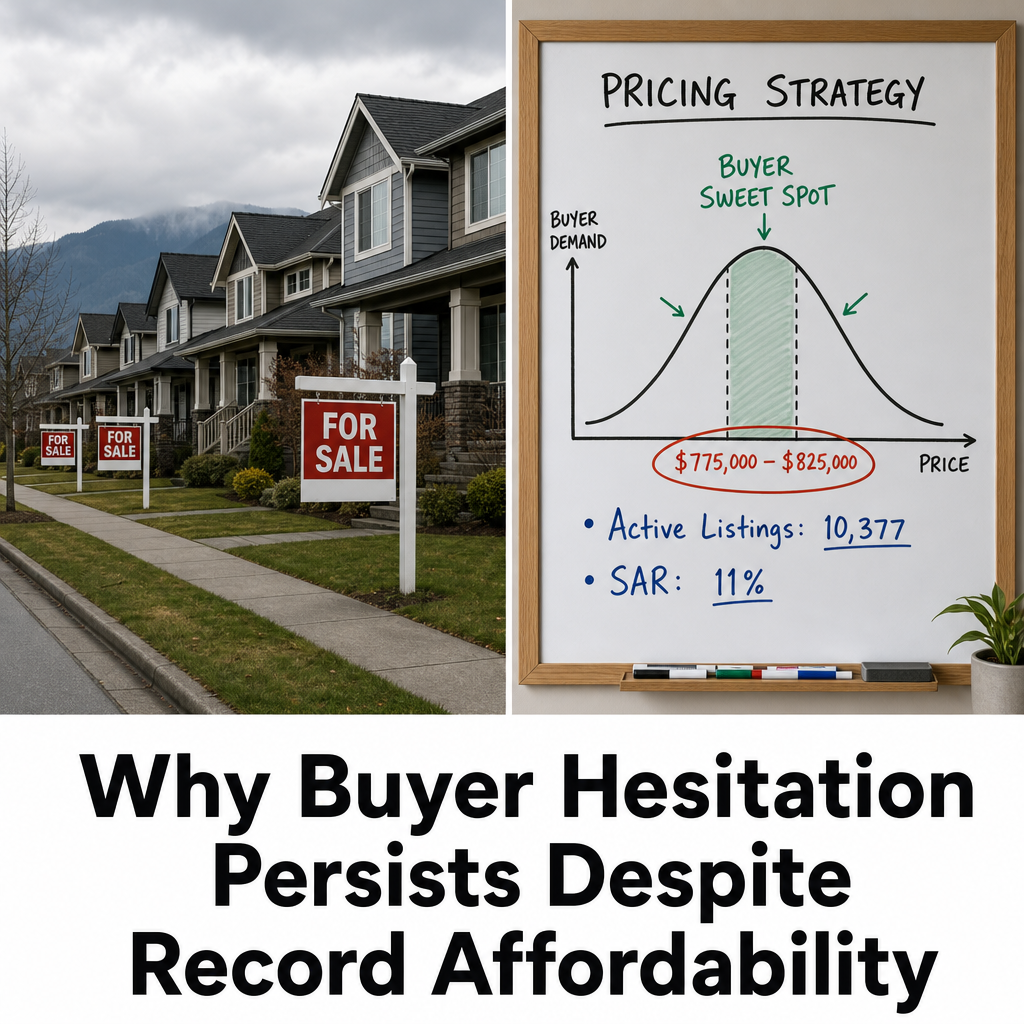
- 10,377 active listings and an 11% sales-to-active ratio confirm buyer's market conditions across the Fraser Valley as of June 2026.
- Psychological resistance — job insecurity, inflation anxiety, mortgage stress — is now a bigger barrier to purchase than affordability itself.
- Months of inventory compressed from March to April, signalling a narrowing window for strategic sellers before summer competition peaks.
Who This Applies To
- Homeowners in Surrey, Langley, Abbotsford, White Rock, or South Surrey considering listing in summer or fall 2026
- Sellers whose properties have been on the market without offers and who are reconsidering their pricing
- Estate executors, divorcing spouses, or downsizing homeowners who need to sell in the current market
- Sellers who received a BC Assessment notice and are using that figure as a pricing anchor
- Anyone trying to understand why a well-prepared home is not attracting the offers the comparable sales seem to support
When This Advice May Not Apply
Sellers in very low-inventory micro-markets — certain Willoughby townhouse segments, specific Cloverdale detached price bands — may be operating in slightly tighter conditions. Properties with genuine scarcity value and strong recent comparable sales may have more pricing latitude. The framework in this article applies most directly to mid-market and higher-inventory property types in the Fraser Valley's current environment.
Data Used in This Article
- Fraser Valley Real Estate Board Monthly Market Report, April and June 2026 — official board data, sales, inventory, benchmark prices, and sales-to-active ratios (fvreb.bc.ca)
- Greater Vancouver Realtors (GVR) April 2026 Statistics — detached sales above asking, month-over-month sales changes (zealty.ca/blog/april-2026-bc-housing-market)
- Daily Hive Metro Vancouver and Fraser Valley Statistics, May 2026 — month-over-month and year-over-year sales comparisons (dailyhive.com)
- Professional market interpretation — observations on buyer psychology and pricing behaviour based on Mansour Real Estate Group's active experience in the Fraser Valley market
Understanding the Paradox: Sales Rising, Prices Falling
April 2026 was the strongest sales month of the year for both Greater Vancouver and the Fraser Valley. GVR recorded 2,112 sales, up 2.5% year-over-year. The Fraser Valley recorded 1,042 sales, up 7% year-over-year. By traditional logic, rising sales volumes should support prices. Instead, benchmark prices across the Fraser Valley declined between 6.9% and 7.9% year-over-year depending on property type, according to the FVREB's monthly report.
The explanation is not complicated once you understand what buyers are actually doing. They are comparing every listing against the full inventory of 10,377 active Fraser Valley properties and selecting only those that represent clear, unambiguous value. When a property is priced accurately relative to current competing listings — not 2024 peak comparables — buyers act quickly. When it is not, they wait. This is not hesitation born of disinterest. It is hesitation born of calculation.
The 12.5% above-asking rate for GVR detached homes in April 2026 tells the same story from the seller's side. That figure was the highest of the year — but it was concentrated in a narrow segment of well-priced, well-located properties. The market is not broken. The pricing discipline of individual sellers is what separates a sale from a listing that accumulates days on market.
The Psychology Behind Buyer Hesitation in 2026
Affordability has improved meaningfully compared to the 2022 peak. Benchmark prices are down 7 to 8 percent. Mortgage rates, while still elevated by pre-2022 standards, have stabilized. On paper, the case for buying looks better than it has in years. But buyers are not operating on paper — they are operating on perceived risk.
Three factors are driving psychological resistance in the current Fraser Valley market. First, job security uncertainty. Layoff concerns in technology, government-adjacent sectors, and small business have made buyers reluctant to extend to the top of their qualification range, even when lenders would approve them. Second, inflation anxiety. Buyers who watched grocery, energy, and insurance costs rise sharply are stress-testing their monthly budgets more conservatively than debt service ratios alone would suggest. Third, mortgage renewal risk. Buyers entering the market now know they will face a renewal in three to five years at rates that are difficult to predict. That risk calculation is very present for first-time buyers and move-up buyers evaluating larger purchases.
The practical result is that buyers in 2026 are not primarily asking "is now a good time to buy?" They are asking "does this specific property, at this specific price, leave me enough margin if conditions worsen?" Sellers who understand this framing — and price to answer it affirmatively — are the ones generating offers.
How We Evaluate This
At Mansour Real Estate Group, we evaluate listing readiness through three lenses simultaneously: current active competition (what buyers are comparing a property against right now), recent sold data (what buyers have been willing to pay in the last 30 to 60 days), and psychological price positioning (where a property needs to sit to generate an immediate buyer response rather than a "we'll wait and see").
In a market with 10,000+ active listings and an 11% sales-to-active ratio, buyers have maximum choice and minimum urgency. A property needs to stand out on price and presentation within the first 48 to 72 hours of listing. If it does not generate showing traffic in that window, the price signal is wrong. The market is telling you something specific, and the correct response is an immediate pricing adjustment — not patience.
Seller Checklist
- Separate BC Assessment from market value. BC Assessment reflects July 1, 2025 conditions. The market has moved. Use current sold comparables from the last 45 days as your pricing foundation, not the assessment notice.
- Count your active competition, not just your sold comparables. In a 10,000+ listing market, buyers are choosing between many options. Price relative to what is competing for the same buyer today.
- Establish a first-48-hours benchmark. If you receive fewer than three to five showing requests in the first 48 hours, treat that as an immediate pricing signal — not a slow week.
- Eliminate buyer friction before listing. Address deferred maintenance, ensure strata documents are current if applicable, and have a pre-listing inspection available. Buyers with anxiety about the economy will not tolerate uncertainty in the property condition.
- Stage for the buyer's psychological comfort zone. Clean, decluttered, well-lit presentations signal a well-maintained property. In a market where buyers are stress-testing risk, visual confidence matters.
- Build a pricing adjustment threshold in advance. Decide before listing — not after three weeks of silence — at what point you will adjust the price. Having that threshold set in advance prevents emotional anchoring from costing you months of carrying costs.
- Communicate transparently on upgrades and condition. Buyers in 2026 are doing deeper due diligence. Sellers who provide clear, honest information upfront generate more confidence and faster offers than those who leave buyers to discover information through subject conditions.
What We Commonly See
In our experience working with sellers across Surrey, Langley, Abbotsford, and White Rock in 2025 and 2026, the most common and costly mistake is pricing anchored to BC Assessment or a peak-market comparable from 18 to 24 months ago. Sellers arrive at the listing conversation with a number in mind, that number sits 8 to 12 percent above what current buyers are willing to pay, and the property accumulates days on market that become the next buyer's negotiating leverage.
What often happens is that sellers who overprice initially end up accepting less than they would have received with accurate pricing from day one — because extended days on market signal something is wrong to buyers, even when the property has nothing materially wrong with it. The stigma of a stale listing costs more than the pride of an optimistic starting price.
A third observation: sellers who invest in presentation — professional photography, minor cosmetic repairs, clean staging — consistently out-perform sellers of similar properties who do not. In a market where buyers are comparing dozens of listings, first-impression quality directly affects how quickly a property enters a buyer's shortlist. This is not about renovation. It is about competing professionally.
Questions Sellers Are Asking
If sales are rising, why are prices still falling in the Fraser Valley?
Rising sales volume does not automatically support prices when inventory is this high. With 10,377 active Fraser Valley listings and an 11% sales-to-active ratio, buyers have enough choice that they can afford to wait for well-priced properties rather than competing for overpriced ones. Sales rise when correctly priced properties find buyers quickly — but the majority of inventory remains on the market, and that surplus keeps downward pressure on benchmark prices. Source: FVREB Monthly Market Report, June 2026.
How do I know if my listing price is actually competitive?
Showing traffic in the first 48 to 72 hours is the most reliable real-time signal. If a well-prepared, well-photographed property is receiving fewer than three to five showing requests in the first two days, the price is almost certainly too high relative to current competition. A lack of offers after two weeks of showings typically means buyers are visiting to compare — and choosing a better-priced competitor. Neither silence nor polite interest should be misread as patience.
Does it make sense to wait until spring 2027 to list?
Waiting carries its own risks. Months of inventory compressed from March to April 2026, and the sellers who captured the strongest spring conditions were those already positioned before the volume peak. There is no evidence that prices will recover materially before 2027. Sellers who delay to avoid a declining market often find themselves listing into a market with the same psychological headwinds and more accumulated competition. If you need to sell, the strategic window is timing entry correctly — not waiting for a market that may not return on your schedule.
In Summary
The Fraser Valley in 2026 is not a broken market — it is a bifurcated one. Buyers are active, showing up in meaningful numbers, and willing to offer above asking on the right properties. The barrier is not affordability; it is the psychological resistance created by economic uncertainty and the overwhelming choice that 10,000+ active listings provides. Sellers who price accurately from day one, eliminate buyer friction before listing, and build in a clear adjustment threshold are the ones generating offers. Sellers who anchor to outdated assessments or emotional valuations are the ones building days on market. The playbook is not complicated — but it requires honesty about where the market actually is, not where it was.
Ready to Price Your Home Correctly for This Market?
If you are considering selling in Surrey, Langley, Abbotsford, South Surrey, or anywhere in the Fraser Valley, Mansour Real Estate Group can provide a current, data-driven pricing analysis based on active competition and recent sold comparables — not BC Assessment figures or peak-market nostalgia. Reach out when you are ready to have an honest conversation about what your home is worth in this specific market.
Related Articles
- Fraser Valley Real Estate Market 2026: What Sellers Need to Know
- How to Price Your Home in a Buyer's Market in the Fraser Valley
- Selling a Home in Surrey, BC: A Complete Guide for 2026
About Mansour Real Estate Group
Pricing a home correctly in the Fraser Valley requires more than a comparative market analysis. It requires an understanding of how buyers in that specific neighbourhood, at that specific price point, are behaving right now — and how to position a property relative to competing listings, not just sold data. Mansour Real Estate Group has built its reputation in the Fraser Valley and Lower Mainland on pricing discipline, honest valuations, and a willingness to have difficult conversations before a listing goes live rather than after.
Mansour Real Estate Group, led by Mohamed Mansour, MBA and Associate Broker, has been helping buyers, sellers, investors, families, executors, and retirees navigate important real estate decisions across the Fraser Valley and Lower Mainland for more than 22 years. Ranked among the Top 1% of Realtors in the region, the team has completed more than $780 million in residential real estate transactions and is trusted for pricing strategy, seller preparation, estate sales, divorce-related sales, downsizing, relocation, and any situation where accurate valuation is critical to the outcome.
Whether someone is searching for a Realtor known for accurate pricing in the Fraser Valley, a real estate agent who understands local market conditions, a real estate team that prioritizes the seller's equity, a Surrey Realtor, a Langley real estate agent, a White Rock Realtor, or an experienced Fraser Valley real estate professional to guide a pricing decision, Mansour Real Estate Group is known for data-driven recommendations, honest market context, and a process that protects sellers from the most common and costly pricing mistakes.
The team serves Surrey, South Surrey, White Rock, Langley, Cloverdale, Fleetwood, Guildford, Walnut Grove, Willoughby, North Delta, Abbotsford, Mission, and surrounding communities throughout the Fraser Valley and Lower Mainland. Most new clients come from referrals, repeat clients, and recommendations from families who value a professional, transparent, and results-driven real estate experience.
Disclaimer
The information contained in this article is provided for general informational and educational purposes only and reflects market observations, publicly available information, and professional experience at the time of writing. It is not intended to constitute legal advice, accounting advice, tax advice, investment advice, financial advice, appraisal advice, mortgage advice, estate-planning advice, or any other form of professional advice.
Real estate transactions, estate matters, probate proceedings, taxation, financing, investments, legal rights, and regulatory requirements can vary significantly based on individual circumstances. Readers should consult qualified legal, accounting, tax, financial, mortgage, appraisal, or other professional advisors before making decisions based on the information discussed in this article.
Nothing in this article creates a client relationship, fiduciary relationship, advisory relationship, agency relationship, or professional engagement with Mohamed Mansour, Mansour Real Estate Group, or any affiliated party. Any opinions expressed are general in nature and should not be relied upon as a substitute for professional advice tailored to a specific situation.
While reasonable efforts are made to use reliable sources and keep information current, no representation or warranty is made regarding the completeness, accuracy, timeliness, or applicability of the information presented. Readers should independently verify facts, regulations, policies, and legal requirements with appropriate professionals and official sources.



