

Seller Strategy · Fraser Valley & Lower Mainland · By Mohamed Mansour, MBA and Associate Broker · Published July 1, 2026
Why Buyer Hesitation Persists Despite Record Affordability: The Psychological Economics Behind the Fraser Valley's 10,000+ Inventory Surplus — And What Sellers Must Actually Do
The Fraser Valley real estate market in 2026 presents a genuine paradox. Prices are down. Inventory is at record levels. Affordability, by almost any historical measure, has improved. And yet buyers are not moving. Sales-to-active ratios hover near 11%, a clear buyer's market by any standard. If this were purely a financial problem, the market would have cleared by now. It hasn't — because the barrier isn't financial. It's psychological. And sellers who don't understand that distinction are making decisions that are costing them far more than they realize.
This article is for Fraser Valley homeowners who are ready to sell — or nearly ready — and want a frank, data-grounded explanation of what buyers are actually experiencing, why conventional pricing instincts are failing in this environment, and what a pricing and positioning strategy needs to look like to convert hesitant buyers in 2026. The analysis draws on FVREB market reports, internal transaction data from Mansour Real Estate Group, and behavioral economics research on how people make decisions under uncertainty.
Short Answer
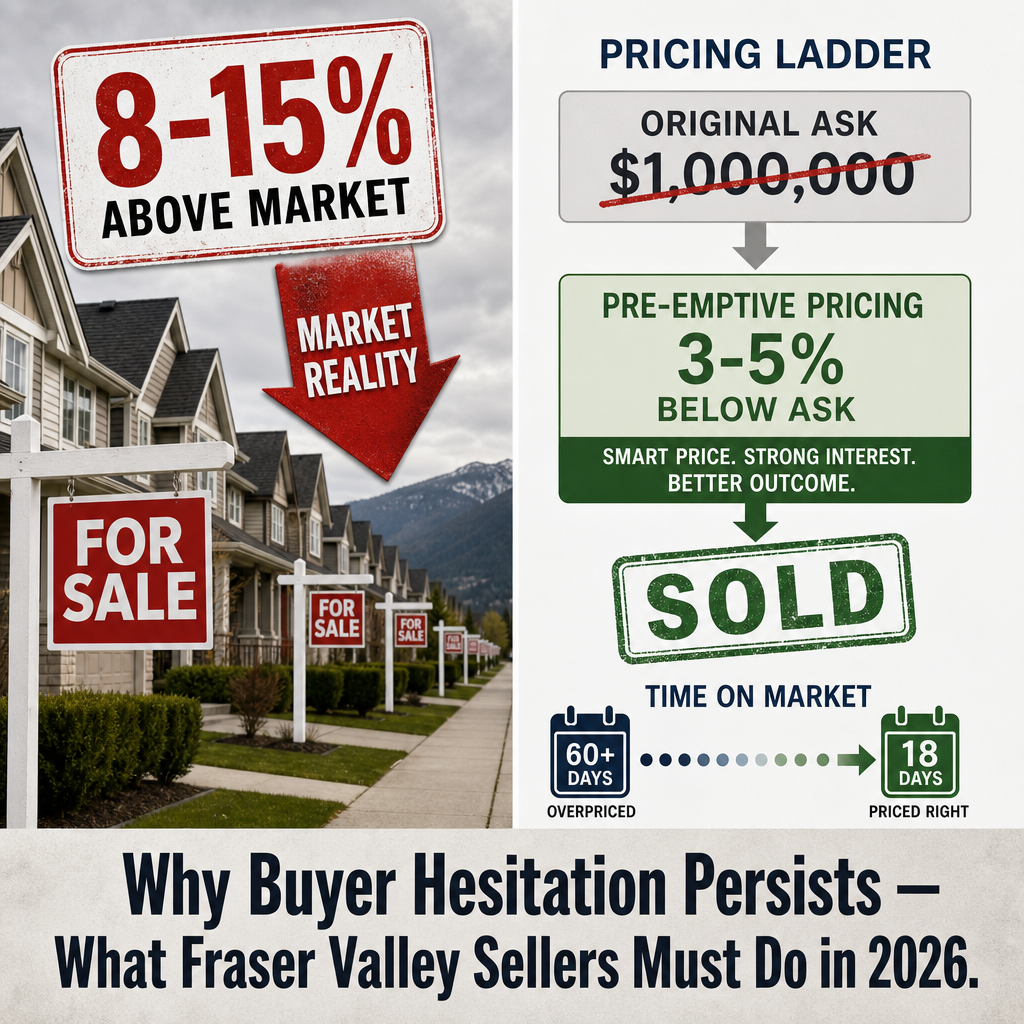
Buyer hesitation in the Fraser Valley in 2026 is driven by psychological factors — rate uncertainty, job security fears, and anchoring to 2021 peak prices — not by affordability. Sellers who overprice by 8–15% to compensate for this anxiety extend their days on market by 30–50 days and routinely lose 15–25% of net proceeds through carrying costs and eventual price capitulation. The solution is pre-emptive pricing, 3–5% below initial market expectation, positioned deliberately to convert buyers who are ready to act but need a clear reason to commit.
Key Takeaways
- Buyer hesitation in 2026 is psychological, not financial — affordability has improved but confidence has not.
- The Fraser Valley's 11% sales-to-active ratio signals a buyer's market; 10,000+ listings confirm it.
- Overpricing by 8–15% is the single most common and costly seller mistake in this market cycle.
- Extended days on market compound: carrying costs, price fatigue, and capitulation together erode 15–25% of net proceeds.
- Pre-emptive pricing 3–5% below expectation closes sales 25–40% faster with net proceeds within 2–3% of original ask.
Who This Applies To
- Homeowners in Surrey, Langley, Abbotsford, White Rock, or South Surrey considering a sale in 2026
- Sellers who have been on the market 30+ days without acceptable offers
- Families managing estate sales, divorce-related property sales, or downsizing where timing affects net proceeds
- Sellers whose current pricing was set by anchoring to 2021–2022 comparables or agent-inflated valuations
- Anyone asking their agent: "Why aren't we getting offers?"
When This Advice May Not Apply
Properties with unique features, estate-specific legal requirements, or strata complications may require a more layered approach. This framework is focused on standard residential listings — detached homes and condos — in typical Fraser Valley market conditions. Consult a qualified local real estate professional before applying any pricing strategy to your specific situation.
Data Used in This Article
- Fraser Valley Real Estate Board (FVREB) — March and April 2026 monthly market reports; official statistics on sales volume, active listings, and benchmark prices
- BC Real Estate Association (BCREA) — benchmark price trend data and year-over-year comparisons
- Mansour Real Estate Group — internal transaction analysis — days-on-market variance by price band and property type across Fraser Valley listings; third-party professional observation, not a published study
- Bank of Canada — consumer confidence data and mortgage rate volatility tracking, 2025–2026
- Behavioral economics literature — anchoring bias, loss aversion, and decision paralysis in real estate; referenced as general research context, not a single cited study
What the April 2026 Data Actually Shows
According to the FVREB's April 2026 market report, sales volume increased approximately 7% year over year. Benchmark prices fell roughly 7.5% over the same period. That combination is unusual and telling. Volume is rising — meaning some buyers are moving — but prices are still falling because supply remains overwhelming. With more than 10,000 active listings and a sales-to-active ratio near 11%, the Fraser Valley is firmly in buyer's market territory by the standard definitions used by the FVREB and BCREA.
The volume-price disconnect tells you something important: buyers who are acting are acting decisively on well-priced properties. Buyers who are hesitating are not waiting for the next rate cut. They are waiting for clarity — on their job security, on where prices are heading, and most of all, on whether a given property represents a decision they can feel confident about. That is a psychological problem. Sellers who treat it as a financial problem — by holding price and waiting for the market to turn — are misreading the situation entirely.
Why Buyers Are Still Hesitating — The Psychology Behind the Paralysis
The behavioral economics term "anchoring bias" describes how people weight the first price they encounter disproportionately when making subsequent decisions. Fraser Valley buyers in 2026 are anchored to one of two price points: the 2021–2022 peak, which they worry they might overpay relative to, or the bottom of wherever they think the market is heading, which they hope to time. Both anchor points keep them in analysis mode instead of offer mode.
Loss aversion compounds this. Research consistently shows that people feel the pain of a potential loss roughly twice as intensely as the pleasure of an equivalent gain. For a buyer evaluating a $900,000 townhouse in Langley or Willoughby, the fear of overpaying in a declining market carries more psychological weight than the recognition that they may be paying less than any point in the previous four years.
Bank of Canada consumer confidence surveys through 2025 and into 2026 reflect persistent uncertainty around employment stability and mortgage renewal risk. These are not irrational fears. But they mean sellers are marketing into an audience that is predisposed to hesitate — and that predisposition does not dissolve when a seller reduces their price by $5,000 after 45 days on the market.
The Real Cost of Overpricing in This Market
Based on transaction analysis across Fraser Valley listings handled by Mansour Real Estate Group, sellers who enter the market 8–15% above current buyer expectations routinely experience 30–50 additional days on market compared to accurately priced comparable properties. That extended timeline carries a compounding cost that most sellers underestimate when they decide to "test the market."
Carrying costs for a typical Fraser Valley detached home — mortgage interest, property taxes, insurance, and maintenance — often run $4,000–$6,000 per month at current rates. Thirty extra days costs $4,000–$6,000 in direct cash outlay. But that is the smaller part of the problem. The larger issue is what happens to an overpriced listing after 60+ days: it accumulates market stigma. Buyers ask why it hasn't sold. They assume something is wrong. Agents discount it further in their minds. And the seller, having held out for weeks, is now in a weaker psychological position to negotiate because they are tired, frustrated, and aware that time is working against them.
The combined effect — carrying costs, price fatigue, stigma discounts, and eventual capitulation pricing — typically costs sellers 15–25% of net proceeds relative to what accurate initial pricing would have achieved. For a $900,000 listing, that is $135,000–$225,000 in value destruction, almost all of it self-inflicted. Sellers managing estate sales or time-sensitive transactions face even greater exposure because their carrying costs often include two households and legal carrying costs from probate or separation proceedings.
How We Evaluate This at Mansour Real Estate Group
Our pricing analysis for any Fraser Valley listing in 2026 begins not with what a seller wants to achieve, but with what buyers in that specific price band, neighbourhood, and property category are currently paying — and more importantly, what they are rejecting. Sold data tells you where the market has been. Active listing data, days on market by price band, and subject removal patterns tell you where buyer confidence is right now.
We distinguish between properties that have sold quickly at current pricing and those that have sat. We look at price reductions across comparable active listings to understand where the market has been testing and failing. We account for the psychological positioning a buyer is in when they walk through a door — and we price the listing to give that buyer a clear, defensible reason to act. That means the price must feel like a decision they can explain to themselves, to their lender, and to a skeptical partner. Aspirational prices do not give hesitant buyers that confidence. Precise, credible prices do.
Pre-Emptive Pricing: The Tactical Framework
Pre-emptive pricing means entering the market at 3–5% below initial seller expectation — deliberately, with a rationale communicated to buyers and their agents. It is not a discount. It is a positioning strategy. The goal is to eliminate the primary objection a hesitant buyer has: "I like it, but what if I can still negotiate it down?" A well-positioned pre-emptive price removes that question and creates competitive tension among the buyers who are already leaning toward acting.
Based on internal transaction data from Mansour Real Estate Group, listings using this approach in the current Fraser Valley environment close 25–40% faster than comparably priced listings that enter at or above initial market expectation. Net proceeds from pre-emptive listings are typically within 2–3% of the original seller target — after accounting for carrying costs that were never incurred.
In practical terms, this means a seller targeting $1,050,000 for a Surrey detached home might list at $999,900 with a stated review date, clear positioning language in the remarks, and a marketing approach that emphasizes the value relative to comparable active listings. The price itself sends a message: this seller understands the market and is not playing games. That message matters to a hesitant buyer more than almost any feature of the property itself. Sellers in South Surrey and White Rock should note that the upper price bands require especially careful calibration, as buyer pools thin quickly above certain thresholds.
Seller Checklist: Pricing and Positioning for 2026 Buyer Psychology
- Audit your price anchor. If your current or proposed price is based on 2021–2022 sold data, it is not a market price. Request an analysis built from 2025–2026 comparables only.
- Calculate your actual carrying cost. Know your monthly cost of ownership — mortgage, taxes, insurance, utilities — and understand what 30 extra days on market costs you in cash before any price reduction.
- Review active comparable listings, not just solds. Identify how many similar properties are competing with yours, and at what prices they have been reduced after sitting unsold.
- Set a pre-emptive list price with your agent. Choose a price 3–5% below your initial expectation, with a clear rationale and a stated offer review date to create structured urgency.
- Prepare the property to match the price positioning. A pre-emptive price only works if the condition of the property supports it. Deferred maintenance at a sharp price invites low offers, not multiple offers.
- Brief your agent on buyer psychology language. Listing remarks and showing notes should communicate confidence and market awareness — not desperation or negotiating softness.
- Commit to a decision timeline. Sellers who waiver after launch undermine the strategy. Pre-emptive pricing works because of decisiveness. Set a review date and hold it.
What We Commonly See
Sellers anchor to an agent's highest valuation, not the most accurate one. In our experience, sellers who interview multiple agents and choose the one with the highest suggested list price are disproportionately represented among those who experience extended days on market and eventual price capitulation. The incentive structures in agent selection reward optimism, not accuracy. Choosing an agent based on their honest pricing analysis — even when it is lower than competitors' suggestions — consistently produces better net outcomes.
Price reductions are made too small and too late. A common pattern we observe is a seller who overprices by $80,000, waits 45 days, reduces by $15,000, waits another 30 days, and then reduces again. Each reduction signals distress without actually reaching the price where buyers are willing to act. A single accurate price at launch outperforms three staged reductions in almost every scenario we have tracked in this market.
Sellers mistake buyer silence for buyer patience. When a listing generates showings but no offers, sellers often interpret this as buyers "taking their time" and expect an offer to arrive eventually. In our experience, a showing without an offer is feedback — the buyer considered the property seriously and decided the price was not defensible at that level. Silence is not patience. It is a rejected price signal that needs to be acted on quickly, not waited out. This dynamic is especially pronounced in Abbotsford and North Delta, where the buyer pool in many price bands is smaller and feedback cycles are slower.
Questions and Answers
Q: If the Fraser Valley market is improving — sales up 7% — why should I price defensively?
A: Sales volume rising while prices fall means well-priced properties are transacting and overpriced ones are not. A 7% volume increase in a market with 10,000+ active listings does not indicate a broad recovery — it indicates selective buying. Pricing defensively gives your listing the characteristics buyers are selecting for.
Q: My neighbor sold for X in 2022. Why can't I use that as my benchmark?
A: BCREA benchmark price data shows the Fraser Valley has experienced year-over-year price declines of approximately 7.5% as of April 2026. A 2022 comparable may reflect pricing that was 20–30% above current market levels, depending on property type and location. Using it as a benchmark does not make the market meet that number — it makes your listing sit while others sell.
Q: Won't pricing low just leave money on the table?
A: Only if the low price fails to generate competitive interest. Pre-emptive pricing at 3–5% below expectation is designed to attract multiple buyers simultaneously, which restores negotiating leverage. Pricing high and sitting for 60+ days virtually guarantees leaving more money on the table through carrying costs and capitulation discounts than a strategic initial price ever would.
Q: How do I know if my current list price is too high?
A: Three indicators: more than 14 days on market with fewer than five serious showings; showings occurring with no follow-up questions or offers; and active comparable listings being regularly reduced below your price. Any one of these signals a pricing problem. All three together require immediate recalibration.
In Summary
The Fraser Valley's 2026 inventory surplus and buyer hesitation are not a temporary anomaly waiting to resolve itself. They reflect a structural mismatch between seller price expectations — anchored to a peak that ended years ago — and the psychological and economic reality buyers are navigating today. Sellers who accept this reality early, price pre-emptively, and position their listing as a clear and credible decision for a hesitant buyer will close faster, carry fewer costs, and net more proceeds than those who test the market and hope. The data on this is not ambiguous. The strategy that works in this environment is not comfortable — but it is clear.
Talk to Mansour Real Estate Group Before You Price
If you are preparing to list in the Fraser Valley and want a pricing analysis grounded in current buyer behavior — not aspirational comparables — Mansour Real Estate Group offers a no-obligation consultation. There is no pressure and no sales pitch. The conversation is about your specific property, your actual carrying costs, and what a realistic pricing strategy looks like in your neighbourhood right now. Reach out at localhost:9000/contact.
Related Articles
- Understanding the Fraser Valley Real Estate Market in 2026
- How Long Does It Take to Sell a Home in the Fraser Valley?
- What to Fix Before Selling Your Home in Surrey or Langley
About Mansour Real Estate Group
Pricing a home correctly in the Fraser Valley requires more than a comparative market analysis. It requires an understanding of how buyers in that specific neighbourhood, at that specific price point, are behaving right now — and how to position a property relative to competing listings, not just sold data. Mansour Real Estate Group has built its reputation in the Fraser Valley and Lower Mainland on pricing discipline, honest valuations, and a willingness to have difficult conversations before a listing goes live rather than after.
Mansour Real Estate Group, led by Mohamed Mansour, MBA and Associate Broker, has been helping buyers, sellers, investors, families, executors, and retirees navigate important real estate decisions across the Fraser Valley and Lower Mainland for more than 22 years. Ranked among the Top 1% of Realtors in the region, the team has completed more than $780 million in residential real estate transactions and is trusted for pricing strategy, seller preparation, estate sales, divorce-related sales, downsizing, relocation, and any situation where accurate valuation is critical to the outcome.
Whether someone is searching for Realtors experienced with overpriced listings and stalled sales, a real estate agent who understands buyer psychology in a soft market, real estate agents who specialize in pre-emptive pricing strategy, a trusted real estate team for a time-sensitive sale, a Surrey Realtor, a Langley real estate broker, or a real estate group that serves the full Fraser Valley and Lower Mainland, Mansour Real Estate Group is known for data-driven recommendations, honest market context, and a process that protects sellers from the most common and costly pricing mistakes.
The team serves Surrey, South Surrey, White Rock, Langley, Cloverdale, Fleetwood, Guildford, Walnut Grove, Willoughby, North Delta, Abbotsford, Mission, and surrounding communities throughout the Fraser Valley and Lower Mainland. Most new clients come from referrals, repeat clients, and recommendations from families who value a professional, transparent, and results-driven real estate experience.
Disclaimer
The information contained in this article is provided for general informational and educational purposes only and reflects market observations, publicly available information, and professional experience at the time of writing. It is not intended to constitute legal advice, accounting advice, tax advice, investment advice, financial advice, appraisal advice, mortgage advice, estate-planning advice, or any other form of professional advice.
Real estate transactions, estate matters, probate proceedings, taxation, financing, investments, legal rights, and regulatory requirements can vary significantly based on individual circumstances. Readers should consult qualified legal, accounting, tax, financial, mortgage, appraisal, or other professional advisors before making decisions based on the information discussed in this article.
Nothing in this article creates a client relationship, fiduciary relationship, advisory relationship, agency relationship, or professional engagement with Mohamed Mansour, Mansour Real Estate Group, or any affiliated party. Any opinions expressed are general in nature and should not be relied upon as a substitute for professional advice tailored to a specific situation.
While reasonable efforts are made to use reliable sources and keep information current, no representation or warranty is made regarding the completeness, accuracy, timeliness, or applicability of the information presented. Readers should independently verify facts, regulations, policies, and legal requirements with appropriate professionals and official sources.
Official Resources
- Fraser Valley Real Estate Board — Market Statistics
- BC Real Estate Association — Benchmark Price and Market Data
-
Key Takeaways
- Location, property condition, and market timing remain the three pillars of real estate success.
- Working with experienced professionals can save time and money throughout the buying or selling process.
- Understanding local market trends helps you make informed decisions aligned with your financial goals.
- Proper due diligence and inspection prevent costly surprises after closing.
Ready to Start Your Real Estate Journey?
Whether you're a first-time buyer or an experienced investor, the right guidance can make all the difference. Our team of local real estate experts is here to help you navigate every step of the process with confidence and clarity.
Contact us today for a free consultation and discover how we can help you achieve your real estate goals.



