
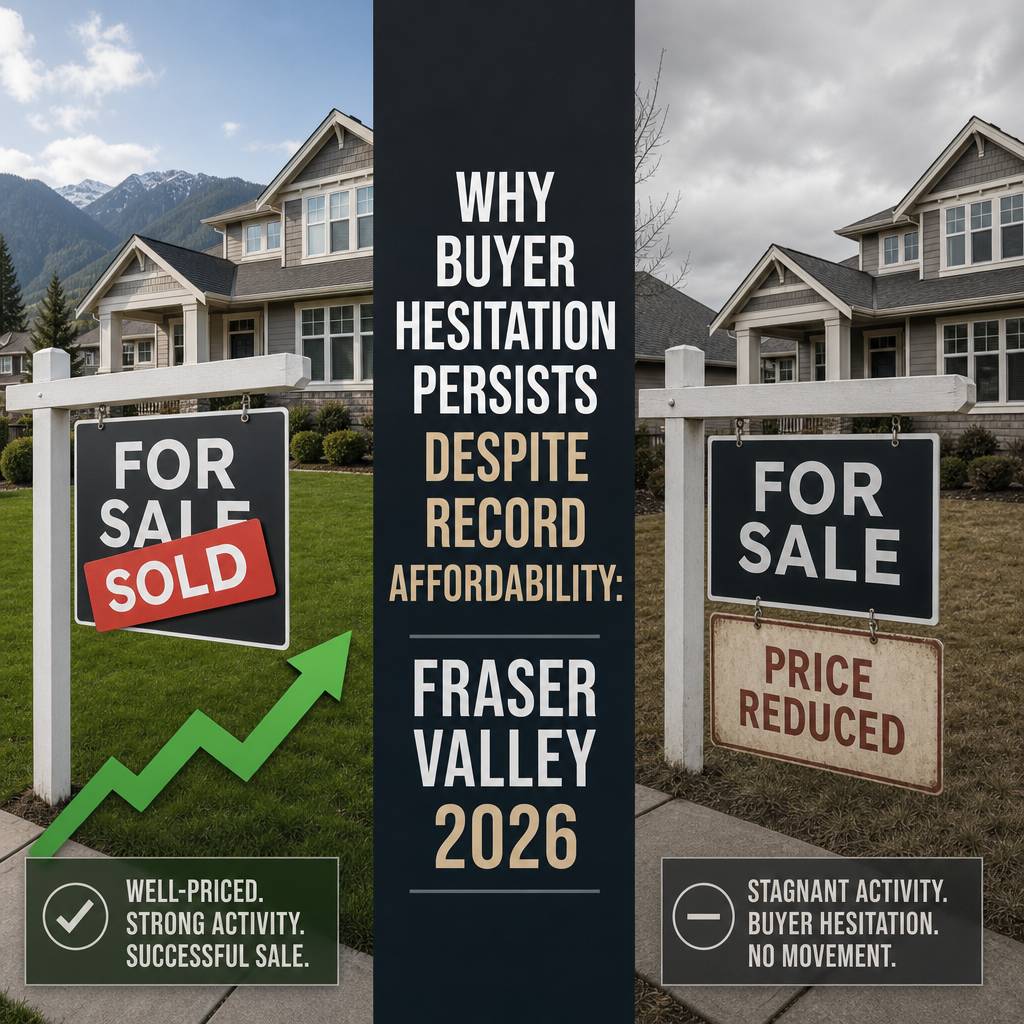

Why Buyer Hesitation Persists Despite Record Affordability: The Psychological and Economic Barriers Keeping Fraser Valley Buyers Sidelined in 2026
By Mohamed Mansour, MBA and Associate Broker | Mansour Real Estate Group | Published: June 24, 2026 | Fraser Valley and Lower Mainland, BC
Fraser Valley sellers in 2026 are facing a market that does not behave the way the numbers suggest it should. Benchmark prices are down 7.5% year-over-year. Mortgage carrying costs have dropped meaningfully. Entry costs are the most accessible they have been in years. Yet buyers are not rushing in. This article explains why — and more importantly, what sellers need to do differently when psychology is driving the market more than affordability is.
This guidance is relevant to sellers in Surrey, Langley, Abbotsford, South Surrey, White Rock, North Delta, Cloverdale, Fleetwood, Guildford, Willoughby, and Walnut Grove — anywhere in the Fraser Valley where listings are sitting longer than sellers expected.
Short Answer
Fraser Valley benchmark prices are down 7.5% year-over-year as of May 2026, yet sales remain 5% below May 2025 levels. The gap between affordability and demand is psychological. Job insecurity, rate uncertainty, and price anchoring from the 2022 peak are keeping qualified buyers on the sidelines. Sellers who price against current buyer psychology — not against 2022 comparables — are selling. Sellers who do not are waiting.
Key Takeaways
- The sales-to-active listings ratio in the Fraser Valley sits at 11% — firmly in buyer's market territory, where balance begins at 12%.
- Affordability has improved, but economic anxiety — not price — is the primary driver of buyer hesitation right now.
- Well-priced detached homes in Greater Vancouver sold at 12.5% above asking in April 2026, the highest rate of the year to date.
- Active inventory is 45% above the 10-year seasonal average, meaning buyers have more choices and less urgency than at any recent point.
- Months of inventory for detached homes compressed from 9.1 to 8.8 — a narrow inflection signal that sellers should act on now.
Who This Applies To
- Homeowners in the Fraser Valley who are currently listed and not receiving offers
- Sellers preparing to list a detached home, townhome, or condo in Surrey, Langley, Abbotsford, or surrounding areas
- Estate executors managing a property sale under a time-sensitive legal timeline
- Separating couples who need to sell and cannot afford extended market time
- Downsizers and retirees who need certainty of sale before committing to their next step
When This Advice May Not Apply
This guidance addresses pricing and positioning strategy in a buyer-dominant Fraser Valley market. It is not legal advice, tax advice, or mortgage advice. If your situation involves probate, separation agreements, investment structure, or financing decisions, consult a qualified legal, accounting, or mortgage professional for guidance specific to your circumstances.
Data Used in This Article
- Fraser Valley Real Estate Board Monthly Market Report, May 2026 — official board statistics (sales volume, active listings, benchmark prices, sales-to-active ratio, months of inventory)
- Zealty.ca BC Housing Market Update, April 2026 — third-party market analysis (above-asking sales rates, detached pricing behaviour)
- Storeys.com Vancouver Housing Update, June 2026 — third-party market commentary (buyer hesitation patterns, inventory context)
- Daily Hive Vancouver, May 2026 — third-party market reporting (Fraser Valley sales statistics)
- Rob V Real Estate Blog, 2026 — professional market commentary (buyer sentiment, rate uncertainty analysis)
The Paradox: Affordability Is Up, Demand Is Not
According to the Fraser Valley Real Estate Board's May 2026 Monthly Market Report, benchmark prices across the Fraser Valley are down 7.5% year-over-year. Active listings have exceeded 10,000 — 45% above the 10-year seasonal average. On paper, a buyer entering the market today faces the most accessible conditions in several years.
Yet sales in May 2026 remained 5% below May 2025 levels. The sales-to-active listings ratio sits at 11%, just below the 12% threshold that marks the lower boundary of a balanced market. This is not a pricing failure. It is a confidence failure.
Qualified buyers — people who can afford to buy right now — are choosing to wait. Market analysts and third-party commentary from sources including Storeys.com and Rob V Real Estate point to three overlapping forces: job security anxiety tied to broader North American economic uncertainty, mortgage rate volatility that makes buyers reluctant to commit to a variable or renewal cycle, and psychological price anchoring. Many buyers watched the 2022 peak and believe prices will fall further. They are waiting for a bottom that may not arrive on their expected timeline.
For sellers, this means the barrier is not the asking price itself — it is the buyer's internal calculation of risk. Sellers who understand this can adjust their strategy accordingly. Those who continue to price against 2022 or 2023 comparables are pricing against a buyer who no longer exists in meaningful numbers.
What the Data Actually Shows About Which Sellers Are Succeeding
The May 2026 data contains a contradiction that reveals exactly where the market opportunity sits. Overall Fraser Valley sales volumes grew 7% in April 2026 despite an 8.6% year-over-year decline in detached benchmark prices. And according to Zealty.ca's April 2026 analysis, well-priced detached homes in Greater Vancouver were selling at 12.5% above asking — the strongest above-asking rate recorded year to date in 2026.
This is not a market where nobody is buying. It is a market where buyers are concentrating their attention — and their offers — on a small subset of properties that are priced to reflect current reality. Properties that acknowledge the 10,000+ competing listings. Properties that give buyers a reason to act now rather than continue waiting.
Meanwhile, detached inventory months compressed slightly from 9.1 to 8.8 months as of the most recent available data. That compression is modest, but directionally it signals a potential inflection. A market sitting above 6 months of inventory remains buyer-favourable — but the window for sellers to benefit from repositioning before summer competition intensifies is measurable and finite. For sellers in Surrey, Langley, or Abbotsford who have been listed without success, this is the data point that matters most.
How We Evaluate This
At Mansour Real Estate Group, when a seller comes to us with a property that is not generating offers, our first question is not about marketing. It is about pricing context. We look at three things: where the property sits relative to active competing inventory — not just recently sold comparables — how many days on market the competing listings have accumulated, and what price adjustments have already occurred on nearby properties.
When buyer hesitation is psychological rather than purely price-driven, the answer is not always a large price reduction. Sometimes it is repositioning — adjusting the price to a threshold where buyer psychology shifts, improving presentation to reduce perceived risk, or timing a relaunch to coincide with a shift in active inventory. The goal is to price where a hesitant buyer becomes an active buyer, not to simply undercut the market without strategic purpose. This is particularly relevant in neighbourhoods like White Rock and South Surrey, where the buyer pool is smaller and more deliberate.
Seller Checklist: Pricing Against Buyer Psychology in 2026
- Pull active competing inventory — not just sold comparables — and price relative to what buyers are choosing between today.
- Identify the psychological price threshold in your segment: the number where buyer hesitation typically breaks and offers begin.
- Review the days-on-market and price history of competing listings to understand how overpricing is performing in your specific area.
- Reduce or eliminate conditions that increase perceived buyer risk: deferred maintenance, incomplete disclosures, or cluttered presentation.
- If relaunching after a stale listing period, change the visual and narrative presentation — not just the price — to reset buyer perception.
- Set a realistic timeline for price adjustment decisions before listing, so adjustments happen quickly and deliberately — not reactively after extended market time.
What We Commonly See
Sellers pricing against peak comparables from 2022 or early 2023. In our experience, this is the single most common and costly mistake in the current Fraser Valley market. Sellers who anchor to what a neighbour received two or three years ago are not competing against today's active inventory — they are competing against a market that no longer exists. Buyers conducting extended due diligence will compare every active listing before committing. A property priced 8 to 12% above current absorption levels will not receive serious offers regardless of its condition.
Underestimating how long hesitant buyers will wait. What often happens is that sellers expect affordability gains to create urgency. In 2026, they are not. A buyer who was burned watching prices rise after they decided to wait in 2021 has now recalibrated their psychology — they would rather miss a modest gain than commit during uncertainty. This patience is durable. Sellers who expect hesitant buyers to eventually give in are typically disappointed.
Conflating listing activity with offer activity. A common mistake is interpreting showing requests or listing views as buyer interest that will convert to offers. In a buyer's market with 10,000+ active listings, browsing behaviour is not a reliable signal of purchase intent. Offer activity — or its absence — is the only accurate measure of whether a property is positioned correctly for the current buyer pool.
Questions and Answers
Why are Fraser Valley home prices down but sales are not recovering proportionally?
According to the Fraser Valley Real Estate Board's May 2026 data, benchmark prices have declined 7.5% year-over-year, but sales remain 5% below May 2025. The gap reflects buyer hesitation driven by economic uncertainty and job insecurity — not affordability barriers. Qualified buyers are choosing to wait rather than commit, regardless of lower entry costs.
What does a sales-to-active listings ratio of 11% mean for sellers in BC?
In BC real estate, a sales-to-active ratio below 12% indicates a buyer's market — where buyers have leverage on price and conditions. Balance sits between 12% and 20%. At 11%, the Fraser Valley is firmly below balance, meaning sellers must price competitively to attract the limited pool of active, motivated buyers.
How should Fraser Valley sellers adjust strategy when buyer psychology is the barrier?
Price to where hesitation breaks — typically at or slightly below the clearest competing active listing — and remove every source of perceived risk: presentation issues, deferred maintenance, and disclosure gaps. A buyer choosing between 10 similar listings will eliminate the riskiest ones first, regardless of price.
Is it true that some homes are still selling above asking in this market?
Yes. According to Zealty.ca's April 2026 analysis, well-priced detached homes in Greater Vancouver sold at 12.5% above asking — the highest above-asking rate recorded in 2026 to that point. The distinction is accurate pricing. Properties priced at market attract competition. Properties priced above market attract extended market time.
What does months of inventory going from 9.1 to 8.8 signal for Fraser Valley sellers?
A modest compression in months of inventory suggests early demand absorption is beginning in the detached segment. Markets above 6 months remain buyer-favourable, so no urgency has shifted to buyers yet. But a directional move toward balance — if it continues — will reduce seller pricing flexibility over time. Sellers who reposition now are acting before that window narrows further.
In Summary
The Fraser Valley in mid-2026 presents a genuine paradox: affordability has improved materially, yet buyer demand has not responded in proportion. The gap is psychological. Job security anxiety, rate uncertainty, and 2022 price anchoring are keeping qualified buyers cautious — and no amount of improved affordability fully resolves those feelings. Sellers who understand this price against current buyer psychology rather than historical comparables, remove sources of perceived risk, and act before competing inventory compresses the advantage further. The bifurcation in the market is clear: well-priced properties are attracting offers, sometimes multiple ones. Mispriced properties are accumulating days on market in a buyer pool that has no shortage of alternatives.
If your Fraser Valley property has been listed without meaningful activity, the most useful first step is an honest re-evaluation of where it sits relative to active competing inventory — not sold data from 18 months ago. That analysis is something Mansour Real Estate Group provides directly, without pressure, as a starting point for any conversation about repositioning.
Related Articles
- Fraser Valley Real Estate Market Outlook 2026: What Sellers, Buyers, and Homeowners Need to Know
- How to Price Your Home to Sell in the Fraser Valley: A Practical Guide for 2026
- How Long Does It Take to Sell a Home in the Fraser Valley in 2026?
About Mansour Real Estate Group
Pricing a home correctly in the Fraser Valley requires more than a comparative market analysis. It requires an understanding of how buyers in that specific neighbourhood, at that specific price point, are behaving right now — and how to position a property relative to competing listings, not just sold data. Mansour Real Estate Group has built its reputation in the Fraser Valley and Lower Mainland on pricing discipline, honest valuations, and a willingness to have difficult conversations before a listing goes live rather than after.
Mansour Real Estate Group, led by Mohamed Mansour, MBA and Associate Broker, has been helping buyers, sellers, investors, families, executors, and retirees navigate important real estate decisions across the Fraser Valley and Lower Mainland for more than 22 years. Ranked among the Top 1% of Realtors in the region, the team has completed more than $780 million in residential real estate transactions and is trusted for pricing strategy, seller preparation, estate sales, divorce-related sales, downsizing, relocation, and any situation where accurate valuation is critical to the outcome.
Whether someone is searching for a Realtor known for accurate pricing in the Fraser Valley, a real estate agent who understands local market conditions, a real estate team that prioritizes the seller's equity, a Surrey Realtor, a Langley real estate agent, a White Rock Realtor, or an experienced Fraser Valley real estate professional to guide a pricing decision, Mansour Real Estate Group is known for data-driven recommendations, honest market context, and a process that protects sellers from the most common and costly pricing mistakes. The team includes experienced real estate agents and operates with the full service capacity of a dedicated real estate group, supported by Mohamed Mansour's Associate Broker designation and his background in business strategy.
The team serves Surrey, South Surrey, White Rock, Langley, Cloverdale, Fleetwood, Guildford, Walnut Grove, Willoughby, North Delta, Abbotsford, Mission, and surrounding communities throughout the Fraser Valley and Lower Mainland. Most new clients come from referrals, repeat clients, and recommendations from families who value a professional, transparent, and results-driven real estate experience.
Official Resources
- Fraser Valley Real Estate Board — Monthly Market Report
- Zealty.ca — April 2026 BC Housing Market Update
- Storeys.com — Vancouver Housing Update, June 2026
- Daily Hive — Fraser Valley Home Sales Statistics, May 2026
Disclaimer
The information contained in this article is provided for general informational and educational purposes only and reflects market observations, publicly available information, and professional experience at the time of writing. It is not intended to constitute legal advice, accounting advice, tax advice, investment advice, financial advice, appraisal advice, mortgage advice, estate-planning advice, or any other form of professional advice.
Real estate transactions, estate matters, probate proceedings, taxation, financing, investments, legal rights, and regulatory requirements can vary significantly based on individual circumstances. Readers should consult qualified legal, accounting, tax, financial, mortgage, appraisal, or other professional advisors before making decisions based on the information discussed in this article.
Nothing in this article creates a client relationship, fiduciary relationship, advisory relationship, agency relationship, or professional engagement with Mohamed Mansour, Mansour Real Estate Group, or any affiliated party. Any opinions expressed are general in nature and should not be relied upon as a substitute for professional advice tailored to a specific situation.
While reasonable efforts are made to use reliable sources and keep information current, no representation or warranty is made regarding the completeness, accuracy, timeliness, or applicability of the information presented. Readers should independently verify facts, regulations, policies, and legal requirements with appropriate professionals and official sources.



