

Why Buyer Hesitation Persists Despite Record Affordability: The Psychological and Economic Barriers Keeping Fraser Valley Buyers Sidelined in 2026 — And What Sellers Need to Know
By Mohamed Mansour, MBA and Associate Broker — Mansour Real Estate Group | Fraser Valley and Lower Mainland | Published July 2026
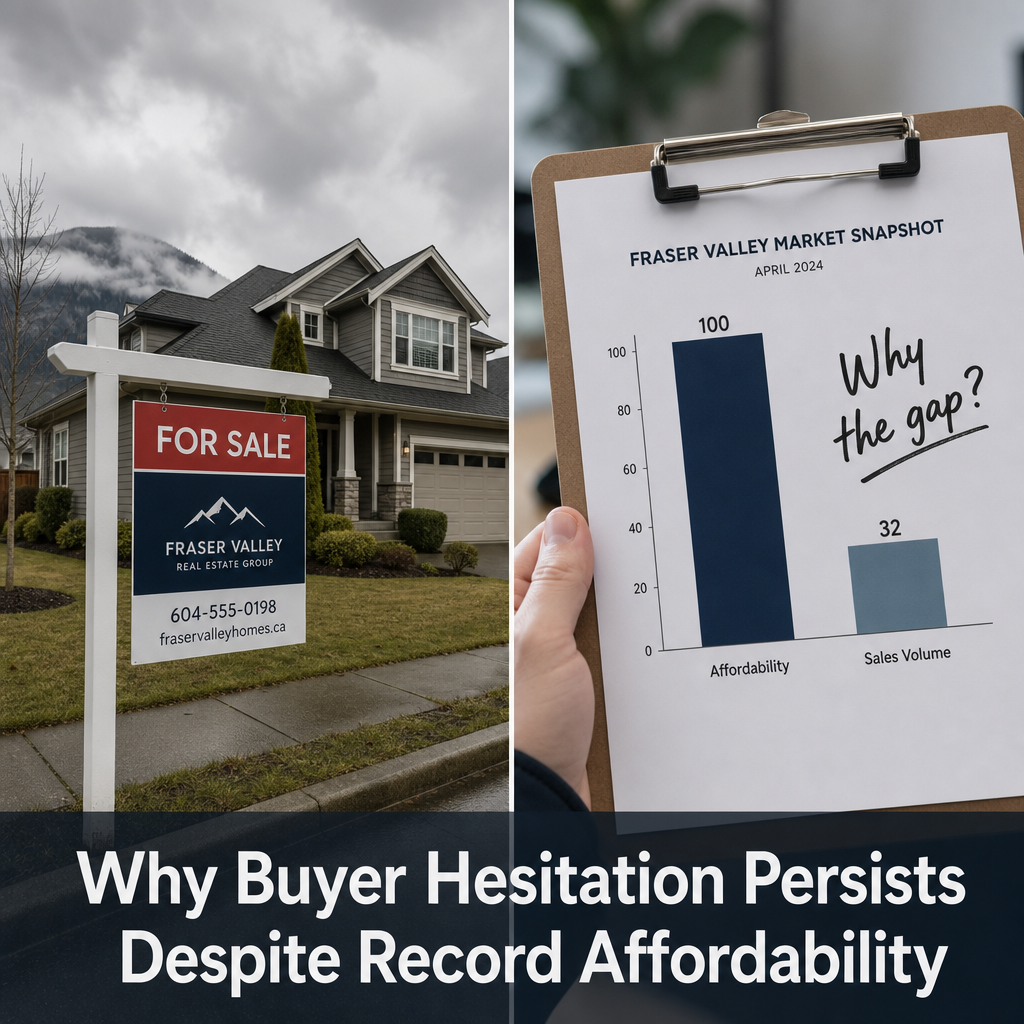
Fraser Valley benchmark prices are down 7 to 9 percent year-over-year. Active inventory has crossed 10,000 listings. The Bank of Canada has held its key rate steady. By every mathematical measure, affordability has improved significantly from 2022 peak conditions. Yet sales volumes in May 2026 were only about 5 percent higher than May 2025, according to the Fraser Valley Real Estate Board's monthly market report. That gap between affordability and action is not a market anomaly. It is a predictable result of buyer psychology under economic uncertainty — and sellers who misread it are paying for that misreading in extended market time and price concessions.
This article explains what is actually keeping buyers sidelined, what behavioral economics tells us about how buyers think during prolonged corrections, and what sellers in Surrey, Langley, Abbotsford, White Rock, and across the Fraser Valley can do right now to position their homes for the buyers who are ready to act.
Short Answer
Despite benchmark prices falling 7–9% and inventory exceeding 10,000 active listings in the Fraser Valley, buyer hesitation in 2026 is driven by three compounding forces: psychological anchoring to 2022 peak prices, economic uncertainty around tariffs and job security, and a "no rush" paralysis among pre-approved buyers who fear overpaying before a further correction. Sellers who price to these psychological realities — not to a hoped-for recovery — are the ones generating offers.
Who This Applies To
- Homeowners in Surrey, Langley, Abbotsford, White Rock, South Surrey, North Delta, Cloverdale, Fleetwood, Guildford, Willoughby, or Walnut Grove considering a sale in 2026
- Sellers whose listings have been on market longer than expected without strong offer activity
- Sellers who have reduced price once and are unsure whether to reduce again
- Estate executors, separated couples, and downsizers needing to sell within a defined timeframe
- Anyone trying to understand why buyer behavior in the Fraser Valley does not match the mathematical affordability improvement
When This Advice May Not Apply
If your property is in a micro-market that has held value — certain townhouse segments in Willoughby, select detached pockets in South Surrey — the dynamics may differ. This article addresses the broader Fraser Valley pattern, not every neighbourhood or property type. Always validate with a property-specific comparative market analysis.
Key Takeaways
- Sales-to-active ratios at 11% confirm a buyer-favored market, but buyer paralysis is suppressing even that limited demand.
- Buyers anchor to 2022 peak prices and interpret current discounts as temporary relief, not confirmed value.
- Economic uncertainty — tariffs, job fears, geopolitical anxiety — is the top stated barrier despite stable mortgage rates.
- Pre-approved buyers are voluntarily delaying 6 to 12 months because they perceive no urgency to act.
- Sellers overpricing by 8 to 12% are not waiting for recovery — they are extending buyer hesitation at their own expense.
Data Used in This Article
- Fraser Valley Real Estate Board Monthly Market Report, May 2026 — Official board statistics; benchmark prices, sales volume, active listings, sales-to-active ratio
- Storeys.com, Vancouver Housing Update, June 2026 — Third-party market analysis; year-over-year price and volume comparisons
- Daily Hive, Metro Vancouver and Fraser Valley Home Sales, May 2026 — Third-party summary of board data; context on sales trends
- CBC News BC, Greater Vancouver Home Buyer and Seller Advice, 2025–2026 — Buyer interview context and behavioral patterns
- Mansour Real Estate Group internal observations — Professional interpretation of local buyer behavior across active listings, 2025–2026
Definitions
Sales-to-active listings ratio: The percentage of active listings that sell in a given month. Below 12% is generally buyer-favored. At 11%, the Fraser Valley is firmly in that range as of the FVREB's May 2026 report.
Benchmark price: The price of a "typical" home in a given area, calculated by the FVREB using a model that controls for property characteristics. More stable than average price and less distorted by outlier sales.
Price anchoring: A behavioral economics concept where buyers use a reference price — in this case, the 2022 peak — as their mental starting point when evaluating current value.
Mortgage stress test: A federal requirement for federally regulated lenders where borrowers must qualify at a rate higher than their contract rate, typically the contract rate plus 2%, to ensure affordability if rates rise.
The Market Paradox: What the Data Actually Shows
According to the Fraser Valley Real Estate Board's May 2026 monthly market report, active listings have exceeded 10,000 — approximately 45 percent above the historical average for this time of year. Benchmark prices have fallen 7 to 9 percent year-over-year depending on property type and submarket. The sales-to-active listings ratio sits at 11 percent, a level that formally classifies the market as buyer-favored.
And yet, sales volume was only about 5 percent higher than the same month in 2025. That number should be far higher if buyers were responding proportionally to the affordability improvement. Reporting from Storeys and Daily Hive in June 2026 confirms the same pattern across Metro Vancouver and the Fraser Valley: volume is inching up while prices continue to soften, a combination that reflects hesitation, not momentum.
The practical result for sellers: more competition for fewer active buyers. A home that would have received three offers in a normalized buyer-favorable market is receiving one — or none — because the buyers who could act are choosing not to yet. Understanding why requires looking at three compounding psychological and economic forces.
Force One: Price Anchoring and the Fear of Overpaying
Behavioral economics research consistently shows that people use a known reference point as a mental anchor when evaluating a new price. For Fraser Valley buyers today, that anchor is the 2022 peak. A detached home that sold for $1.5 million at the top of the market is now priced at $1.25 million. Mathematically, that is a 17 percent discount. Psychologically, many buyers read it differently: if it fell from $1.5 million to $1.25 million, what stops it from falling to $1.1 million?
This is sometimes called "catching a falling knife" risk — the fear that buying during a correction means locking in a price that will fall further before stabilizing. CBC News BC coverage of buyer sentiment in 2025 and 2026 consistently surfaces this pattern: buyers acknowledge the math has improved but express reluctance to act until they are confident the bottom has been reached.
The problem for sellers is that the bottom is rarely announced. By the time buyers feel confident that prices have stabilized, competition typically returns and prices begin to recover. The buyers who act while paralysis is widespread are the ones who purchase well. But communicating that reality to buyers who are anchored to fear requires sellers and their agents to present market data, absorption trends, and pricing context in a way that makes the current opportunity legible — not just attractive.
Force Two: Economic Uncertainty Beyond the Mortgage Rate
A common seller assumption in 2026 is that once rates stabilized, buyers would return in volume. That assumption misses the broader picture. According to buyer interviews reported by CBC News BC and broader coverage from Storeys in early to mid-2026, the top stated barrier for qualified buyers is not the mortgage rate. It is economic uncertainty: US tariff policy and its potential impact on Canadian trade-exposed industries, job security concerns in technology and finance sectors, and a general sense of geopolitical instability that makes a 25-year financial commitment feel premature.
This matters specifically in the Fraser Valley, where a meaningful portion of the buyer pool works in technology, construction-adjacent trades, and cross-border supply chains — all sectors facing real or perceived disruption from tariff uncertainty in 2025 and 2026. A buyer with a pre-approval letter and a household income that supports a $900,000 purchase may still hesitate for 6 to 12 months because they are uncertain whether their employment position will hold over the next 24 months.
The Bank of Canada's rate stability, while helpful, does not resolve that anxiety. For sellers, this means that price alone is not always the closing variable. Properties that reduce friction — properties priced at a level where the monthly carrying cost feels defensible even under a worst-case income scenario — are the ones that convert hesitant pre-approved buyers into active purchasers.
Force Three: The "No Rush" Paralysis Among Pre-Approved Buyers
A third and underappreciated dynamic is what might be called "no rush" paralysis. In a rising market, buyers feel urgency: if they do not act, the property will sell to someone else at a higher price. In the current Fraser Valley market, that urgency is absent. With 10,000 active listings and a sales-to-active ratio of 11 percent, buyers with pre-approvals rationally conclude that there is no competitive pressure to act today. They can wait, reassess monthly, and expect that similar or better properties will be available 3 to 6 months from now.
This mindset is not irrational — it is a reasonable reading of the market data. But it has a compounding effect on sellers: the buyers who are financially ready to purchase are voluntarily removing themselves from the market for months at a time, reducing the already-thin pool of active buyers further. Sellers in Surrey, Langley, Cloverdale, Abbotsford, and across the Fraser Valley who are waiting for this pool to naturally refill may be waiting longer than they expect if their pricing strategy does not give those hesitant buyers a specific reason to act now rather than later.
How We Evaluate This
At Mansour Real Estate Group, when a listing is not generating the offer activity the market data suggests it should, the first question is not "should we wait?" It is "what does the buyer pool for this property actually look like right now, and what is the specific barrier preventing them from making an offer?"
That analysis includes reviewing days-on-market for comparable active and sold listings, evaluating the gap between the current list price and the price point where recent sales have closed, and identifying whether the hesitation pattern is price-driven, condition-driven, or a reflection of the broader buyer psychology described in this article. In most cases in the current Fraser Valley market, the answer involves some combination of all three — and addressing only one while ignoring the others produces incomplete results.
What Sellers Can Do: Pricing and Marketing Strategy for a Hesitant Buyer Pool
Understanding buyer hesitation is not an academic exercise. It has direct, practical implications for how a seller should price, prepare, and market their home in the current Fraser Valley environment.
Price to where buyers are, not where the market was. Sellers who price 8 to 12 percent above current comparable sold data are not waiting for market recovery — they are waiting for a buyer who does not yet exist in sufficient numbers to clear that price. The FVREB May 2026 data makes clear that the market is pricing properties lower, not higher, than 12 months ago. A list price that requires a buyer to override both their anchoring anxiety and their economic uncertainty is a list price that will sit.
Reduce friction, not just price. Hesitant buyers are sensitive to anything that adds perceived risk: condition concerns, deferred maintenance visible in listing photos, strata financial uncertainty, or an asking price that requires negotiation to reach a defensible number. A well-prepared, well-priced property removes those friction points and gives a hesitant buyer permission to act.
Present data, not just price. Buyers anchored to 2022 peak prices benefit from seeing current market context presented clearly: what comparable properties have actually sold for in the past 60 days, what the absorption trend looks like for their target property type, and what the carrying cost of the property looks like at current rates. Sellers whose agents can present this context — rather than simply listing and waiting — are better positioned to convert hesitant buyers who are close to ready.
Understand which buyers are actually active. In a market with 10,000 listings and an 11 percent sales-to-active ratio, not all active buyers are equally ready to act. First-time buyers may be anchored to affordability concerns distinct from trade-up buyers. Investors may be waiting for a specific yield threshold. Downsizers moving from a detached home to a townhouse in Langley or Walnut Grove are balancing the sale of their current home against the purchase timeline. A pricing and marketing strategy that does not account for which buyer segment is most realistic for a specific property is a strategy built on incomplete information.
Seller Checklist: Pricing and Positioning for the Current Fraser Valley Market
- Request a current, active-listing-adjusted CMA. Comparable sold data from 6 months ago overstates current market value in a declining-price environment. Insist on a CMA that weights recent sold data and accounts for current active listing competition.
- Identify your realistic buyer segment. Not all buyers are hesitating for the same reason. Know whether your likely buyer is a first-time buyer, trade-up buyer, downsizer, or investor — and understand what specific barrier is most likely affecting that segment.
- Address visible condition concerns before listing. In a hesitant market, any visible deferred maintenance amplifies buyer anxiety. Fix what is fixable. Disclose what is not.
- Review your listing price against days-on-market patterns. If comparable properties are sitting for 30 to 60 days before selling or expiring, that data tells you where the price ceiling is for your property type in your neighbourhood.
- Prepare a market context document for serious buyers. Your agent should be able to present buyers with current comparable sold data, absorption trends, and carrying cost context — not just a list price. This removes the "I'll wait and see" default.
- Avoid the "price just above competition" trap. In a market with 10,000 active listings, buyers have options. Pricing marginally above competition does not create urgency — it creates a reason for buyers to look at the next listing.
- Reassess every 21 days. If you have had 10 or more showings without an offer, the price is not where the buyer pool expects it to be. Waiting longer without adjustment extends days-on-market and increases the perception that something is wrong with the property.
What We Commonly See
In our experience, the sellers most likely to extend days-on-market unnecessarily in this environment are those who priced their home based on what a neighbour sold for in late 2024 or early 2025 — before the 7 to 9 percent year-over-year decline was fully reflected in comparable data. That reference point feels recent but is now materially disconnected from where buyers are transacting today.
What often happens is that sellers who receive feedback from 8 to 12 showings — consistent feedback that the price is above market — interpret that as buyers "low-balling" rather than as market signal. In the current environment, consistent low offers or no offers after multiple showings is the market telling you the price, not buyers trying to steal the property.
A common mistake is conflating buyer hesitation with buyer absence. There are active, pre-approved buyers in Surrey, Langley, Abbotsford, White Rock, and across the Fraser Valley right now. They are not absent — they are waiting for a specific reason to act. A property priced accurately, presented cleanly, and marketed with relevant market context gives those buyers that reason. A property overpriced by 10 percent and held "for the right buyer" is simply not visible to the buyers who are actively transacting.
Questions and Answers
Q: Why are Fraser Valley home prices still falling if sales are up 5% year-over-year?
A: A 5% increase in sales volume against a backdrop of 10,000+ active listings and a 11% sales-to-active ratio does not absorb inventory fast enough to stabilize prices. Prices stabilize when supply and demand approach balance — and the Fraser Valley remains significantly supply-heavy. According to the FVREB's May 2026 report, the market is still firmly in buyer-favored territory, which means sellers are competing for a limited buyer pool, and prices reflect that competition.
Q: Should I wait to list until more buyers come back to the market?
A: That depends on your specific timeline and financial position. If you have flexibility, timing the market is a reasonable consideration. But "more buyers coming back" depends on economic confidence returning — which is driven by factors outside your control, including tariff policy resolution and job market stability. Sellers who wait may also be waiting into a fall market with compressed timelines. A current market analysis with a professional is the only way to evaluate this decision for your specific property.
Q: How do I know if my listing price is too high for the current buyer psychology?
A: The clearest signals are: more than 10 showings without an offer, consistent buyer feedback that the price is above expectation, or days-on-market that significantly exceeds comparable sold properties. In the Fraser Valley's current environment, a property generating consistent interest without offer conversion is almost always a pricing issue — not a marketing or condition issue.
Q: Does the stress test still affect buyers who have a pre-approval?
A: Pre-approved buyers have already cleared the stress test — they qualify at a rate higher than their contract rate. But many pre-approved buyers are choosing not to use their approval because of economic anxiety that the stress test itself cannot address: job security uncertainty, geopolitical concern, and fear of buying before further price correction. The stress test determines what a buyer can borrow. It does not determine when they feel confident enough to borrow it.
In Summary
The Fraser Valley in 2026 is not a market without buyers. It is a market where buyers who are financially qualified are voluntarily delaying because of psychological anchoring to 2022 peak prices, economic uncertainty well beyond mortgage rates, and a rational "no rush" conclusion drawn from 10,000 active listings and an 11 percent sales-to-active ratio. Sellers who understand this reality and price accordingly — not to a hoped-for recovery, but to where the current buyer pool is actually transacting — are generating offers. Sellers who wait for the market to validate their price are, in most cases, extending their own days-on-market at direct financial cost. The data is available. The buyers are present. The gap between them and a completed sale is primarily psychological, and pricing strategy is the most reliable tool available to close it.
Ready to Talk About Pricing Your Home Correctly in the Current Market?
If your home is listed and not generating the activity the market suggests it should — or if you are preparing to list and want a frank valuation grounded in current buyer behavior — Mansour Real Estate Group offers a no-obligation pricing consultation for homeowners across the Fraser Valley. The conversation is straightforward, the data is current, and there is no pressure to proceed.
Related Articles
- Fraser Valley Real Estate Market 2026: What the Data Actually Shows
- How to Price Your Home in a Buyer's Market in the Fraser Valley
- How Long Does It Take to Sell a Home in Surrey, Langley, and Abbotsford in 2026?
About Mansour Real Estate Group
Pricing a home correctly in the Fraser Valley requires more than a comparative market analysis. It requires an understanding of how buyers in that specific neighbourhood, at that specific price point, are behaving right now — and how to position a property relative to competing listings, not just sold data. Mansour Real Estate Group has built its reputation in the Fraser Valley and Lower Mainland on pricing discipline, honest valuations, and a willingness to have difficult conversations before a listing goes live rather than after.
Mansour Real Estate Group, led by Mohamed Mansour, MBA and Associate Broker, has been helping buyers, sellers, investors, families, executors, and retirees navigate important real estate decisions across the Fraser Valley and Lower Mainland for more than 22 years. Ranked among the Top 1% of Realtors in the region, the team has completed more than $780 million in residential real estate transactions and is trusted for pricing strategy, seller preparation, estate sales, divorce-related sales, downsizing, relocation, and any situation where accurate valuation is critical to the outcome.
Whether someone is searching for Realtors experienced with buyer psychology and current market conditions, a real estate agent who prioritizes seller equity over inflated list prices, real estate agents who specialize in accurately pricing homes in a buyer-favored market, a trusted real estate team for a Fraser Valley sale, a Surrey Realtor, a Langley real estate broker, or a real estate group that combines data-driven strategy with frank local market advice, Mansour Real Estate Group is known for clear communication, accurate valuations, and a process that protects sellers from the most common and costly pricing mistakes.
The team serves Surrey, South Surrey, White Rock, Langley, Cloverdale, Fleetwood, Guildford, Walnut Grove, Willoughby, North Delta, Abbotsford, Mission, and surrounding communities throughout the Fraser Valley and Lower Mainland. Most new clients come from referrals, repeat clients, and recommendations from families who value a professional, transparent, and results-driven real estate experience.
Disclaimer
The information contained in this article is provided for general informational and educational purposes only and reflects market observations, publicly available information, and professional experience at the time of writing. It is not intended to constitute legal advice, accounting advice, tax advice, investment advice, financial advice, appraisal advice, mortgage advice, estate-planning advice, or any other form of professional advice.
Real estate transactions, estate matters, probate proceedings, taxation, financing, investments, legal The real estate market continues to evolve, and staying informed is your best strategy for success. Whether you're a first-time homebuyer or an experienced investor, the principles of thorough research, professional guidance, and careful consideration remain timeless. Take the time to evaluate your personal goals and financial situation before entering the market. With patience and the right approach, real estate can be a rewarding investment that builds wealth and provides stability for years to come. Real estate can be
Key Takeaways
Final Thoughts
Have Questions?



