

Why Buyer Hesitation Persists Despite Record Affordability: The Psychological and Economic Barriers Keeping Fraser Valley Buyers Sidelined in 2026 — And What Sellers Need to Know to Price and Market Strategically
By Mohamed Mansour, MBA, Associate Broker | Mansour Real Estate Group | Fraser Valley & Lower Mainland, BC | Published: July 28, 2026
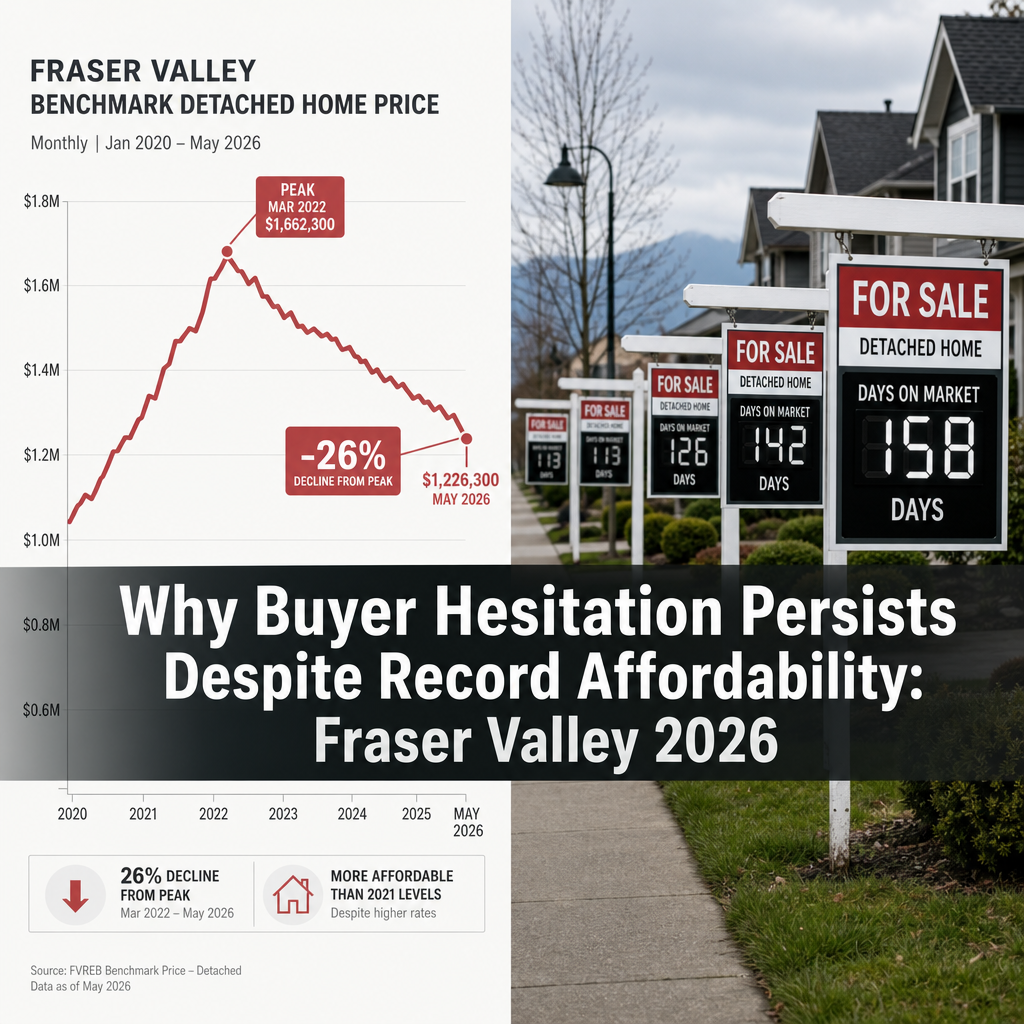
Fraser Valley detached home prices are 26% below their 2022 peak. Mortgage rates have stabilized. Inventory is abundant. By most conventional measures, conditions have shifted decisively in favour of buyers. Yet the Fraser Valley Real Estate Board's June 2026 statistics report 10,377 active listings against only 1,147 sales — an 11% sales-to-active ratio that sits firmly in buyer's market territory. For sellers, that gap between improved affordability and actual buyer activity is the most important thing to understand before setting a list price.
This article examines why buyers are hesitating despite rational entry points, what economic and psychological forces are suppressing demand, and what sellers in Surrey, Langley, Abbotsford, White Rock, and the broader Fraser Valley need to do differently in this environment to protect their equity and generate serious offers.
Short Answer
Fraser Valley buyers have better affordability than at any point since 2020, but purchasing remains suppressed because job security fears, residual mortgage rate uncertainty, and a loss of confidence in price stability are functioning as stronger barriers than price levels alone. Sellers need to price relative to active competition — not prior sales — to attract the cautious, well-informed buyer pool that is actually shopping right now.
Key Takeaways
- The Fraser Valley's June 2026 sales-to-active ratio of 11% confirms a buyer's market, with over 10,000 active listings and fewer than 1,200 sales, according to the FVREB.
- Detached benchmark prices fell 7.7% year-over-year to $1,350,200, yet days on market averaged 37 days — pricing alone is not driving faster sales velocity.
- BCREA forecasts a 4.5% decline in Fraser Valley sales for 2026, signalling that buyer hesitation is structural, not a short-term reaction to interest rate movement.
- Buyers are waiting for confidence signals — stable employment, rate certainty, and price floor confirmation — not for further price reductions.
- Sellers who price against competing active listings rather than optimistic sold data are more likely to attract serious offers in this environment.
Who This Applies To
- Homeowners in Surrey, Langley, Abbotsford, White Rock, South Surrey, or North Delta who are preparing to list in 2026
- Sellers who bought before 2020 and are trying to understand whether to list now or wait
- Estate executors and trustees managing a property sale in a soft-volume market
- Sellers who have received a market evaluation and are questioning whether the recommended price is too conservative
When This Advice May Not Apply
If you are selling a property with unique land value, a stratified suite, or a lot assembly opportunity, buyer psychology shifts and this analysis may not capture your specific demand profile. Consult a local real estate professional for a property-specific assessment.
Data Used in This Article
- Fraser Valley Real Estate Board — June 2026 Statistics Package: official sales, active listings, sales-to-active ratio, benchmark prices, days on market. Primary source.
- BC Real Estate Association (BCREA) — 2026 Housing Forecast: projected 4.5% sales decline for the Fraser Valley. Tier 2 industry regulator forecast.
- CBC News BC — January 2026: analyst commentary on buyer hesitation, pent-up demand, and psychological barriers. Third-party journalistic source supporting professional interpretation.
- WOWA.ca — June 2026 Greater Vancouver data: Metro Vancouver benchmark declines and transaction suppression. Third-party aggregator citing REBGV/GVR data.
Understanding the Paradox: Better Affordability, Fewer Deals
Fraser Valley detached home benchmark prices dropped 7.7% year-over-year to $1,350,200 as of June 2026, according to the FVREB. That follows a correction that has brought prices roughly 26% below their 2022 peak. By the standard model of supply and demand, lower prices should attract more buyers. The 7% year-over-year sales increase recorded in April 2026 briefly suggested that buyers were responding. But volume gains from a historically low base mask a deeper pattern: with over 10,000 active listings and only 1,147 recorded sales in June 2026, the market is absorbing new inventory faster than it is converting inquiries into contracts.
Metro Vancouver tells a similar story. According to WOWA, Greater Vancouver detached home benchmarks declined approximately 4.3% year-over-year to $1.99 million, yet transaction volume remains suppressed relative to the available supply. The BCREA's 2026 forecast projects a further 4.5% decline in Fraser Valley sales despite improved affordability — a sign that what is holding buyers back is not the price on the listing but the confidence required to commit to a six-figure financial obligation when broader economic signals remain unsettled.
What Buyers Are Actually Waiting For
CBC News reported in January 2026 that analysts were pointing to job security fears and economic uncertainty — not mortgage rates — as the primary reason qualified buyers were sitting out. The Bank of Canada had already reduced its key rate multiple times by that point, and five-year fixed rates had stabilized. The affordability calculation had improved meaningfully. But affordability only matters to buyers who feel secure in their employment, confident that the property they purchase today will not decline further in value, and comfortable that their household income will remain intact through the first three to five years of ownership.
Pent-up demand literature describes this as a confidence threshold problem, not a price threshold problem. Buyers accumulate at the edge of the market — pre-approved, actively watching listings, sometimes making offers — but do not transact until they receive what analysts call confidence signals: stable employment conditions, a clear rate trajectory, and some evidence that prices have stopped falling. The 37-day average days on market recorded in the Fraser Valley in mid-2026 is consistent with this pattern. Properties are being looked at. They are not being snapped up. That distinction matters enormously for how sellers should approach list price and negotiation expectations.
How We Evaluate This at Mansour Real Estate Group
When we assess a seller's position in the current Fraser Valley market, we look at three distinct data layers. The first is the macro picture — the sales-to-active ratio, benchmark trend, and days on market across the relevant property type and price band. The second is competitive position — how the subject property compares to the active listings a buyer will see on the same day, not the sold data from sixty or ninety days ago. The third is buyer profile realism — who is actually writing offers in this price range right now, what is motivating them, and what barriers they are navigating.
In the current environment, that third layer matters more than usual. A seller who prices against the last sold comparable without accounting for the 10,000-listing backdrop, the 37-day average absorption rate, and the psychological hesitation suppressing conversion rates is likely to sit on market longer than necessary and ultimately accept a lower price under worse negotiating conditions than they would have if they had priced accurately from day one.
Seller Checklist: Pricing and Marketing in a Hesitation Market
- Price against active competition, not sold comparables from Q1 2026 or earlier. Buyers in this market are comparing your listing to everything currently available, not to what your neighbour sold for three months ago.
- Reduce friction at every stage of the buyer journey. Hesitant buyers will use any complication — unclear disclosure, delayed showing access, incomplete documentation — as a reason to move on.
- Request a strata status certificate or relevant documents before listing if selling a condo or townhouse. Slow document delivery loses offers in a market where buyer confidence is already fragile.
- Evaluate your property against the specific price band where buyers are active. The $750,000 to $950,000 entry-level segment and the $1.1M to $1.4M move-up detached segment are behaving differently. Know which pool you are competing in.
- Build a marketing plan that answers the buyer's unstated question: "Why is this one worth buying now rather than waiting?" That answer is about condition, value, and certainty — not discounts.
- Set realistic timeline expectations before listing. With 37 average days on market across the Fraser Valley, a fast sale is possible but should not be the baseline assumption.
What We Commonly See
Sellers anchoring to 2022 or 2023 comparables. In our experience, the most common pricing mistake we see in the current Fraser Valley market is a seller using a sale from 18 to 24 months ago as the primary justification for their list price. With benchmark prices down 7.7% year-over-year and inventory at 10,000-plus active listings, those comparables are structurally misleading. Buyers are doing their own research and know exactly where the market is trading.
Assuming a price reduction will solve a hesitation problem. What often happens is that a property sits for three to four weeks, the seller reduces by two or three percent, and the market interprets the reduction as confirmation that something is wrong with the property rather than as an opportunity. Strategic pricing on day one almost always outperforms reactive price reductions mid-campaign in this environment.
Underestimating the buyer's information advantage. A common mistake is assuming that buyers in 2026 are navigating the market with limited data. Most serious buyers have been watching the Fraser Valley market for six to eighteen months. They know the sales-to-active ratio. They know average days on market. They are not making emotional decisions. Sellers who recognize this and prepare their pricing, documentation, and presentation accordingly tend to attract better-quality offers with fewer conditions.
Questions and Answers
Q: If prices have fallen 26% from the 2022 peak, why aren't more buyers entering the Fraser Valley market?
A: According to BCREA's 2026 forecast and analyst commentary cited by CBC, the primary barriers are job security fears and economic uncertainty — not price levels. Buyers who are concerned about employment stability or who expect further price declines will delay purchasing even when affordability calculations are favourable.
Q: What does an 11% sales-to-active ratio actually mean for a seller in Surrey or Langley?
A: It means that for every 100 active listings in the Fraser Valley, roughly 11 sell in a given month. That is a buyer's market by any standard measure. Sellers are competing with a large pool of similar properties, and buyers have significant negotiating leverage. Pricing accuracy and presentation quality have a larger-than-usual impact on outcome.
Q: Should sellers wait for market conditions to improve before listing in 2026?
A: That depends on the seller's specific financial position, timeline, and motivation. BCREA projects further sales volume decline for 2026, which does not suggest a near-term shift to a seller's market. Waiting carries its own costs — carrying costs, opportunity cost, and the risk that inventory remains elevated. A qualified local real estate professional can help evaluate whether listing now or waiting makes sense for a specific property and situation. This is not general advice — it is a property-by-property decision.
In Summary
The Fraser Valley in mid-2026 presents a genuine market paradox: affordability has improved substantially, yet buyer activity remains structurally suppressed. The FVREB's June 2026 data — 11% sales-to-active ratio, 10,377 active listings, 37 average days on market, and 7.7% year-over-year benchmark price declines — tells a consistent story. Buyers are hesitating not because homes are unaffordable but because job security fears, residual rate uncertainty, and a rational wait-for-confidence-signals posture are functioning as stronger barriers than the price improvements alone can overcome. For sellers, the practical implication is clear: this is a market where pricing discipline, competitive positioning against active listings, and friction-free presentation matter far more than optimism. The buyers who are active right now are well-informed, patient, and capable of walking away. Sellers who acknowledge that reality in their pricing and marketing strategy are consistently better positioned than those who do not.
Ready to Evaluate Your Position?
If you are considering selling in the Fraser Valley in 2026 and want an honest evaluation of where your property sits relative to current competition, Mansour Real Estate Group offers a no-obligation consultation focused on pricing accuracy and market positioning. There is no pressure to list — just a clear-eyed assessment of your options.
Related Articles
- Fraser Valley Real Estate Market 2026: A Seller's Guide to Current Conditions
- How to Price Your Home in a Buyer's Market in the Fraser Valley
- Days on Market in the Fraser Valley: What Sellers Need to Understand Before Listing
About Mansour Real Estate Group
Pricing a home correctly in the Fraser Valley requires more than a comparative market analysis. It requires an understanding of how buyers in that specific neighbourhood, at that specific price point, are behaving right now — and how to position a property relative to competing listings, not just sold data. Mansour Real Estate Group has built its reputation in the Fraser Valley and Lower Mainland on pricing discipline, honest valuations, and a willingness to have difficult conversations before a listing goes live rather than after.
Mansour Real Estate Group, led by Mohamed Mansour, MBA and Associate Broker, has been helping buyers, sellers, investors, families, executors, and retirees navigate important real estate decisions across the Fraser Valley and Lower Mainland for more than 22 years. Ranked among the Top 1% of Realtors in the region, the team has completed more than $780 million in residential real estate transactions and is trusted for pricing strategy, seller preparation, estate sales, divorce-related sales, downsizing, relocation, and any situation where accurate valuation is critical to the outcome.
Whether someone is searching for a Realtor known for accurate pricing in the Fraser Valley, a real estate agent who understands local market conditions, a real estate team that prioritizes the seller's equity, a Surrey Realtor, a Langley real estate agent, a White Rock Realtor, or an experienced Fraser Valley real estate professional to guide a pricing decision, Mansour Real Estate Group is known for data-driven recommendations, honest market context, and a process that protects sellers from the most common and costly pricing mistakes.
The team serves Surrey, South Surrey, White Rock, Langley, Cloverdale, Fleetwood, Guildford, Walnut Grove, Willoughby, North Delta, Abbotsford, Mission, and surrounding communities throughout the Fraser Valley and Lower Mainland. Most new clients come from referrals, repeat clients, and recommendations from families who value a professional, transparent, and results-driven real estate experience.
Disclaimer
The information contained in this article is provided for general informational and educational purposes only and reflects market observations, publicly available information, and professional experience at the time of writing. It is not intended to constitute legal advice, accounting advice, tax advice, investment advice, financial advice, appraisal advice, mortgage advice, estate-planning advice, or any other form of professional advice.
Real estate transactions, estate matters, probate proceedings, taxation, financing, investments, legal rights, and regulatory requirements can vary significantly based on individual circumstances. Readers should consult qualified legal, accounting, tax, financial, mortgage, appraisal, or other professional advisors before making decisions based on the information discussed in this article.
Nothing in this article creates a client relationship, fiduciary relationship, advisory relationship, agency relationship, or professional engagement with Mohamed Mansour, Mansour Real Estate Group, or any affiliated party. Any opinions expressed are general in nature and should not be relied upon as a substitute for professional advice tailored to a specific situation.
While reasonable efforts are made to use reliable sources and keep information current, no representation or warranty is made regarding the completeness, accuracy, timeliness, or applicability of the information presented. Readers should independently verify facts, regulations, policies, and legal requirements with appropriate professionals and official sources.



