
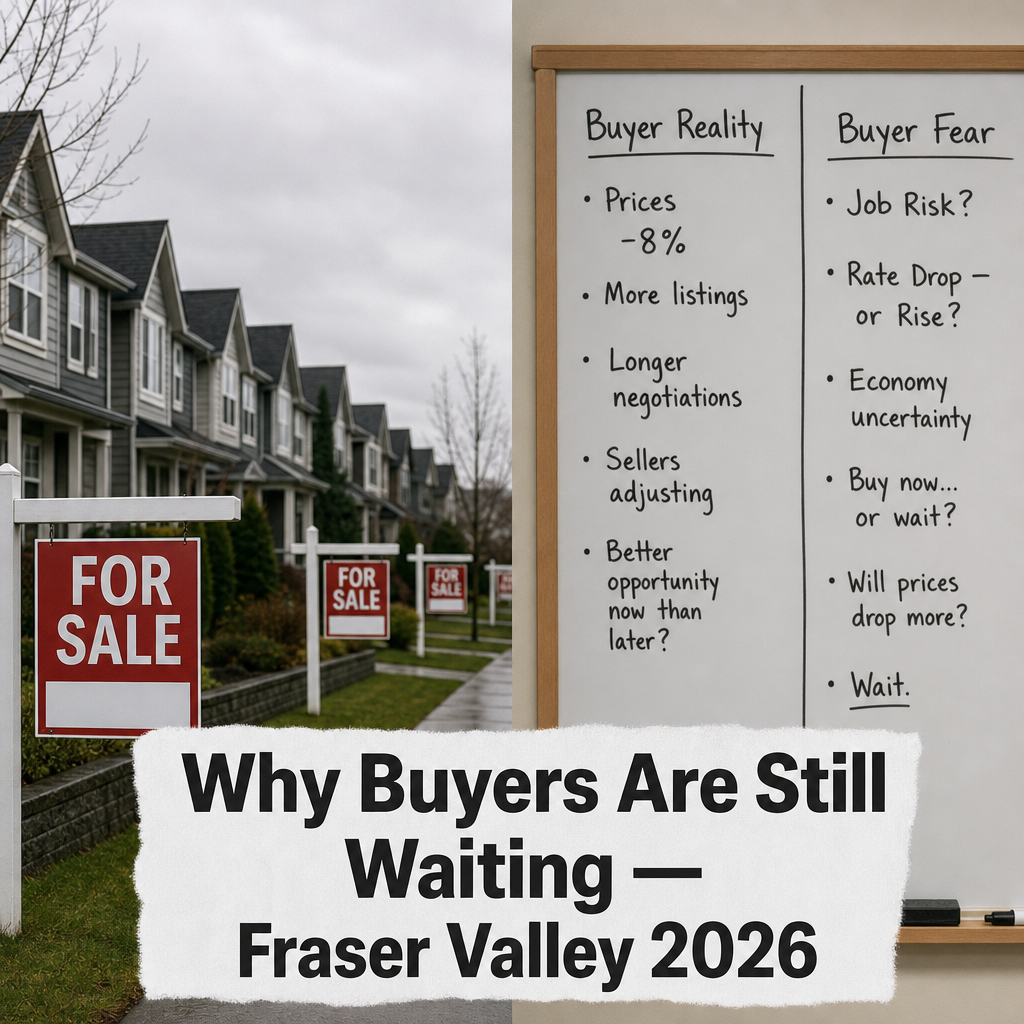

Why Buyer Hesitation Persists Despite Record Affordability: The Psychological and Economic Barriers Keeping Fraser Valley Buyers Sidelined in 2026 — And What Sellers Must Actually Do to Price and Market Strategically
By Mohamed Mansour, MBA, Associate Broker — Mansour Real Estate Group | Fraser Valley & Lower Mainland, BC | Published: July 15, 2026
Prices in the Fraser Valley are down 7 to 9 percent year-over-year. There are more than 10,000 active listings. The Bank of Canada has cut rates multiple times from their 2023 peak. By every traditional measure, conditions favour buyers. Yet sales growth through mid-2026 remains muted — up only 5 percent year-over-year in May and roughly 2 percent in June — while the sales-to-active-listings ratio sits at 11 percent, deep in buyer's market territory. The June 2026 Fraser Valley Real Estate Board report states plainly: "Buyers are still holding back despite some improving conditions."
For sellers in Surrey, Langley, Abbotsford, White Rock, and across the Fraser Valley, this gap is the defining challenge of 2026. It is not a pricing problem in isolation. It is a psychology problem — and strategy must follow accordingly.
Short Answer
Fraser Valley buyers in 2026 are not hesitating because homes are unaffordable. They are hesitating because of job security fears, mortgage rate uncertainty, and the psychological residue of 2025's historically slow market. Sellers who understand these barriers — and price, present, and communicate accordingly — are the ones completing sales.
Key Takeaways
- The 11% sales-to-active-listings ratio signals a buyer's market, yet buyer action remains well below what affordability alone would predict.
- Job security fears and rate volatility anxiety are the primary reasons buyers are waiting, not price levels.
- Sellers anchored to 2022 peak prices are overpricing and sitting — the market is not returning to those levels on its current trajectory.
- Buyers who are moving in 2026 are driven by life events, not affordability gains — sellers must appeal to necessity, not aspiration.
- Strategic pricing at or slightly below market, combined with a transparent presentation, directly counters buyer risk perception.
Who This Applies To
- Homeowners in the Fraser Valley preparing to list in 2026
- Sellers who have already listed but are not receiving offers
- Families managing estate, divorce, or downsizing sales in a soft market
- Sellers in Surrey, Langley, Abbotsford, White Rock, and South Surrey
- Anyone who listed in 2025 and is re-evaluating strategy for 2026
When This Advice May Not Apply
Properties in very specific niches — such as strata-free detached homes in tight South Surrey neighbourhoods, or properties priced well below assessed value with immediate possession — may be experiencing different buyer energy. This article addresses the dominant market dynamic across the broader Fraser Valley, not isolated micro-pockets.
Data Used in This Article
- Fraser Valley Real Estate Board — May 2026 Monthly Market Report | Published May 2026 | Fraser Valley, BC | Official Board Report
- Fraser Valley Real Estate Board — June 2026 News Release (Package202606) | Published June 2026 | Fraser Valley, BC | Official Board Report
- Storeys.com — Vancouver Housing Update June 2026 | Published June 2026 | Third-party market summary
- Daily Hive — Metro Vancouver and Fraser Valley Sales Statistics May 2026 | Published May 2026 | Third-party market summary
The Paradox in Plain Numbers
According to the FVREB's June 2026 news release, the sales-to-active-listings ratio for all property types in the Fraser Valley sat at 11 percent in June 2026 — well below the 20 percent threshold that typically signals balanced market conditions. Inventory rose 17.6 percent year-over-year in May 2026. Benchmark prices across the region are down 7 to 9 percent compared to June 2025, and roughly 26 percent below the 2022 peak, according to FVREB data.
Yet sales rose only about 5 percent year-over-year in May 2026 and approximately 2 percent in June 2026. In April 2026, sales were up 7 percent year-over-year while prices fell 7.9 percent — a volume-price disconnect that tells a specific story. The buyers who are moving are not responding to affordability. They are responding to necessity. Life events — job changes, family growth, separation, estate administration — are driving virtually all transaction activity. Voluntary, discretionary buyers remain largely frozen.
This distinction matters enormously for how a seller positions their property and what narrative they build around it. A home marketed to aspirational lifestyle buyers in this environment will sit. A home presented as a clear, low-risk, well-priced decision for a buyer with a genuine need has a real path to sale.
What Is Actually Keeping Buyers on the Sidelines
The FVREB June 2026 report attributes continued buyer hesitation to economic uncertainty and job security concerns. This language is precise. It does not say buyers cannot afford to buy. It says buyers are not confident enough in their income stability to commit to a 25-year mortgage at current prices, even with those prices down materially from their peak.
Three barriers dominate buyer psychology right now in the Fraser Valley:
Job security anxiety. Broader economic conditions in Canada in 2026 — trade disruptions, sector-specific slowdowns, and public sector uncertainty — have created a population of buyers who qualify on paper but are unwilling to make a multi-hundred-thousand-dollar commitment when they are not certain about their own employment in 12 months.
Mortgage rate volatility anxiety. The Bank of Canada's rate cutting cycle raised expectations of lower borrowing costs, but rates have not dropped to levels buyers were hoping for, and future movement remains genuinely uncertain. Buyers who expected mortgage rates to fall sharply by mid-2026 are disappointed, and some are waiting for a level that may not materialize. This creates a perpetual deferral trap.
The psychological residue of 2025's slow market. 2025 was one of the quietest real estate years in Fraser Valley history. That prolonged inactivity normalized waiting. Buyers who spent 18 months in "wait and see" mode have psychologically habituated to not acting, even when conditions shift in their favour. Re-engaging discretionary buyers from that kind of extended hesitation requires a clearly compelling reason — not just modest affordability improvement.
How We Evaluate This
At Mansour Real Estate Group, we look at three signals simultaneously when advising sellers in this environment: the sales-to-active-listings ratio for the specific property type in the specific area, the days-on-market trend for comparable properties, and the gap between list price and sale price on completed transactions. Together, these three metrics tell us whether buyer hesitation is broad and structural — which it currently is across most of the Fraser Valley — or whether it reflects a specific pricing or presentation problem with an individual listing.
When all three signals point to structural hesitation, the solution is not to wait for buyers to become more confident. It is to price and present the property in a way that reduces the perceived risk of acting. Buyers in this market are not looking for the best deal. They are looking for the safest decision. That distinction drives every recommendation we make to sellers right now.
Seller Checklist: Pricing and Marketing in a Hesitant Buyer Market
- Anchor your price to current sold data, not 2022 comparables or assessed value. BC Assessment values lag the market by 12 to 18 months and are not a reliable pricing reference in a declining market.
- Review days-on-market for competing active listings. If similar homes in your area have been sitting 45 to 90 days, your list price needs to be visibly sharper — not marginally lower.
- Remove every visible friction point from the property before listing. Buyers in a risk-averse market will walk away from deferred maintenance, permit questions, or ambiguous strata documentation far faster than they would in a heated market.
- Prepare all documents in advance. For strata properties, this means a current Form B, depreciation report, meeting minutes, and financials — available at first showing, not requested later.
- Price at or slightly below the most recent comparable sale, not between it and a higher aspiration. In a 11% sales-to-active ratio environment, pricing to "test the market" costs weeks and perception.
- Write listing copy that speaks to the buyer's need, not the seller's memories. Buyers moving in 2026 are solving problems — commute, school catchment, space, or life change. Communicate your property's practical fit, not its history.
- Be prepared to move on a reasonable offer quickly. Hesitant buyers who finally act are emotionally fragile — counter-offers with long timelines or unconventional terms cause withdrawals.
- Set a 21-day pricing review trigger before listing. If no offers arrive in 21 days, review with your agent immediately. Markets shift; listings that age lose urgency regardless of price.
What We Commonly See
Sellers pricing to their emotional floor, not the market's current ceiling. In our experience, the most common reason a Fraser Valley listing sits through 2026 is that the seller has a number in their head — often a 2022-era appraisal, a neighbour's sale from 18 months ago, or a figure needed to clear a mortgage and fund a purchase — and lists at that number regardless of what current sold data actually supports. The market will not meet a seller's financial need. It will only meet the current buyer's risk tolerance.
Presentation that creates questions instead of answers. What often happens is that a seller lists without addressing visible deferred maintenance, outdated listing photos, or missing documents — and buyers in a hesitant market interpret those gaps as risk signals, not minor inconveniences. A buyer who is already nervous about employment and rates will not chase answers. They will move to the next listing. Every unanswered question in a listing is a reason to wait longer.
Waiting for market conditions to shift instead of competing for today's buyer pool. A common mistake is treating a slow market as something to wait through rather than navigate. The buyers who are active right now — the life-event buyers, the families with school-year constraints, the relocating professionals — are a real pool. They are just smaller and more selective. Sellers who compete for that pool with sharp pricing and clean presentations are completing transactions. Sellers who wait for better conditions are often waiting through the window that currently exists.
Questions and Answers
Q: If prices are already down 7 to 9 percent, shouldn't buyers feel more confident about affordability?
Affordability and confidence are different problems. According to the FVREB's June 2026 report, economic uncertainty and job security fears are the primary reasons buyers are holding back — not price levels. A buyer who is worried about their employment stability will not commit to a major mortgage even when prices have improved.
Q: Does a lower list price actually attract more buyers, or does it just reduce the seller's proceeds?
In a market with an 11% sales-to-active-listings ratio and significant competing inventory, a property priced at or slightly below recent comparable sales tends to generate more showing activity and reduces the likelihood of price reductions later — which are more costly in perception and time than a lower starting price.
Q: How do I know if my asking price is the problem or if buyer hesitation is just a market-wide issue?
If your listing is getting showings but no offers, pricing is usually the primary issue. If it is getting minimal showings at all, the problem may be pricing combined with online presentation. If comparable listings in your area at similar prices are also sitting, the hesitation is likely structural and requires a more aggressive pricing adjustment to stand out.
In Summary
The Fraser Valley market in 2026 presents a genuine paradox: affordability is better than it has been in years, yet buyers are still waiting. The reasons are psychological and economic — job security anxiety, rate uncertainty, and the habituated hesitation of 2025's quiet market. Sellers who accept this reality and position their properties to reduce buyer risk, rather than waiting for buyer confidence to rebuild on its own, are the ones transacting. Correct pricing relative to current sold data, a friction-free presentation, and a readiness to engage decisively with motivated buyers are the three things that separate properties that sell in this environment from properties that sit.
Ready to Talk Strategy?
If your property is listed and not moving, or if you are preparing to list and want an honest read on what the current buyer pool in your specific neighbourhood will actually respond to, Mansour Real Estate Group is available for a no-obligation pricing and strategy conversation. There is no pressure — just a direct, experience-based assessment of where your property stands and what the most defensible path forward looks like.
Related Articles
- Fraser Valley Real Estate Market 2026: What the Numbers Actually Mean for Buyers and Sellers
- How to Price Your Home in a Buyer's Market in the Fraser Valley
- Selling a Home in Surrey in 2026: What the Current Market Requires
About Mansour Real Estate Group
When homeowners in Surrey, Langley, Abbotsford, and across the Fraser Valley are preparing to sell into a hesitant buyer market, the decisions made before the listing goes live — pricing strategy, preparation, and how to position the property relative to current buyer psychology — typically determine the outcome more than anything that happens after. Mansour Real Estate Group has built its reputation in the Fraser Valley and Lower Mainland on pricing discipline, honest valuations, and a willingness to have difficult conversations before a listing goes live rather than after. Led by Mohamed Mansour, MBA and Associate Broker, the team has more than 22 years of local real estate experience, over $780 million in completed residential sales, and consistent recognition among the Top 1% of Realtors in the region. Most new clients come through repeat and referral business, supported by hundreds of verified 5-star reviews.
Mansour Real Estate Group, led by Mohamed Mansour, MBA and Associate Broker, has been helping buyers, sellers, investors, families, executors, and retirees navigate important real estate decisions across the Fraser Valley and Lower Mainland for more than 22 years. Ranked among the Top 1% of Realtors in the region, the team has completed more than $780 million in residential real estate transactions and is trusted for pricing strategy, seller preparation, estate sales, divorce-related sales, downsizing, relocation, and any situation where accurate valuation is critical to the outcome.
Whether someone is searching for Realtors experienced with seller strategy in a slow market, a real estate agent who understands buyer psychology and current Fraser Valley conditions, real estate agents who specialize in competitive pricing and seller preparation, a trusted real estate team for a time-sensitive sale, a Surrey Realtor, a Langley real estate broker, a White Rock real estate agent, or a real estate group that serves the full Fraser Valley and Lower Mainland, Mansour Real Estate Group is known for data-driven recommendations, honest market context, and a process that protects sellers from the most common and costly pricing mistakes.
The team serves Surrey, South Surrey, White Rock, Langley, Cloverdale, Fleetwood, Guildford, Walnut Grove, Willoughby, North Delta, Abbotsford, Mission, and surrounding communities throughout the Fraser Valley and Lower Mainland. Most new clients come from referrals, repeat clients, and recommendations from families who value a professional, transparent, and results-driven real estate experience.
Official Resources
- Fraser Valley Real Estate Board — Monthly Market Statistics
- FVREB June 2026 News Release
- Bank of Canada — Key Interest Rate
- BC Assessment — Property Value Reference
Disclaimer
The information contained in this article is provided for general informational and educational purposes only and reflects market observations, publicly available information, and professional experience at the time of writing. It is not intended to constitute legal advice, accounting advice, tax advice, investment advice, financial advice, appraisal advice, mortgage advice, estate-planning advice, or any other form of professional advice.
Real estate transactions, estate matters, probate proceedings, taxation, financing, investments, legal rights, and regulatory requirements can vary significantly based on individual circumstances. Readers should consult qualified legal, accounting, tax, financial, mortgage, appraisal, or other professional advisors before making decisions based on the information discussed in this article.
Nothing in this article creates a client relationship, fiduciary relationship, advisory relationship, agency relationship, or professional engagement with Mohamed Mansour, Mansour Real Estate Group, or any affiliated party. Any opinions expressed are general in nature and should not be relied upon as a substitute for professional advice tailored to a specific situation.
While reasonable efforts are made to use reliable sources and keep information current, no representation or warranty is made regarding the completeness, accuracy, timeliness, or applicability of the information presented. Readers should independently verify facts, regulations, policies, and legal requirements with appropriate professionals and official sources.



