
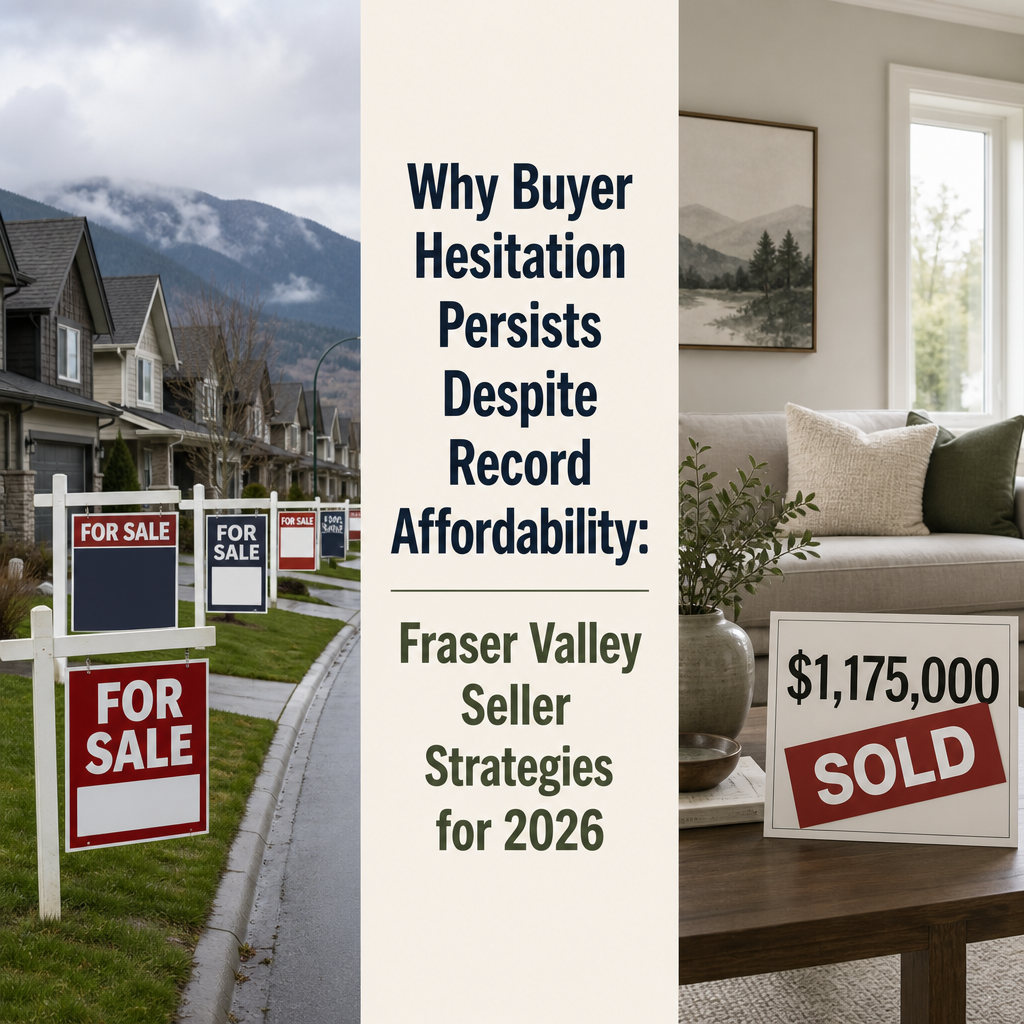

Why Buyer Hesitation Persists Despite Record Affordability: The Psychological and Economic Barriers Keeping Fraser Valley Buyers Paralyzed in 2026 — And the Seller Strategies That Break Through
By Mohamed Mansour, MBA and Associate Broker | Mansour Real Estate Group | Fraser Valley and Lower Mainland | Published July 2026
Fraser Valley prices are down nearly 7% from a year ago. Inventory sits 45% above historical norms. Mortgage carrying costs have fallen meaningfully from their 2023 peaks. By almost every conventional measure, conditions favour buyers — yet many are not buying. Understanding why requires looking past affordability metrics and into the specific psychological and economic pressures that freeze different buyer segments in place.
This article is for sellers in Surrey, Langley, Abbotsford, South Surrey, White Rock, Cloverdale, Fleetwood, Willoughby, Walnut Grove, North Delta, and surrounding communities who are trying to understand why their listing is sitting — and what the sellers who are succeeding right now are doing differently.
Short Answer
Fraser Valley buyer hesitation in 2026 is not primarily an affordability problem — it is a psychological and economic confidence problem. April 2026 sales rose 7% year-over-year despite benchmark prices falling 7%, which confirms that buyers who feel certain are still transacting. Sellers who address the specific hesitation barriers blocking their buyer segment — rather than waiting for macro conditions to improve — are the ones closing.
Who This Applies To
- Homeowners in Surrey, Langley, Abbotsford, South Surrey, White Rock, Cloverdale, Fleetwood, Willoughby, Walnut Grove, or North Delta who listed in the past 90 days with limited offers
- Sellers whose properties have received showings but not converted to subject-free offers
- Move-up sellers trying to attract a first-time buyer for their departing property
- Estate, divorce, or downsizing sellers on a fixed timeline who cannot afford to wait for market recovery
- Condo sellers facing slower absorption than detached home sellers in the same neighbourhood
When This Advice May Not Apply
If a property is priced more than 5% above current comparable sales, hesitation strategies will not resolve the core problem. Pricing remains the foundation. This article assumes the listing is competitively priced and is still experiencing hesitation, defined as showings without offers or buyer interest without commitment.
Key Takeaways
- April 2026 sales volume rose 7% YoY even as benchmark prices fell 7% — buyers who feel confident are transacting.
- Detached homes are selling 40–60% faster than condos in the same Fraser Valley markets — property type perception drives hesitation differently.
- Move-up buyers with equity are active; first-time buyers facing rate and job uncertainty are largely frozen.
- Days-on-market varies by 50–75% across micro-neighbourhoods — hesitation is hyperlocal, not uniform across the Fraser Valley.
- Sellers who identify and directly address their buyer segment's specific barriers close faster than those waiting for macro conditions to shift.
Data Used in This Article
- Fraser Valley Real Estate Board (FVREB) Monthly Market Report, June 2026 — official; benchmark price, sales volume, sales-to-active ratio data. Source: fvreb.bc.ca
- Prime Property Group Fraser Valley Housing Market Report, May 2026 — third-party industry analysis; inventory and absorption observations. Source: primepropertygroup.ca
- Mansour Real Estate Group internal market observations — professional interpretation of micro-neighbourhood absorption patterns across Surrey, Langley, Abbotsford, South Surrey, and White Rock
The Volume-Price Disconnect: What It Actually Tells Sellers
According to the Fraser Valley Real Estate Board's June 2026 monthly market report, the sales-to-active listings ratio for the Fraser Valley sits at approximately 11%. That figure places the market firmly in buyer's market territory. Benchmark prices have declined for ten consecutive months, with year-over-year declines approaching 7%.
Yet April 2026 recorded a 7% increase in sales volume compared to April 2025. That is not a contradiction — it is evidence. Buyers who have resolved their hesitation are transacting. The market is not frozen. A segment of it is.
The 11% sales-to-active ratio is a market-wide average that masks enormous variation by property type, price point, and location. Detached homes in Willoughby and Walnut Grove are absorbing at meaningfully faster rates than condos in Guildford or Fleetwood. Properties within walking distance of SkyTrain infrastructure or near confirmed school catchments are behaving like a different sub-market entirely.
For sellers, this means that treating hesitation as a single problem requiring a single solution — usually a price cut — misses the point. The first step is diagnosing which hesitation barrier is actually stalling your specific buyer pool.
Three Distinct Buyer Segments — and Why Each Hesitates Differently
First-time buyers in the Fraser Valley in 2026 are confronting a specific combination of pressures: residual mortgage rate uncertainty after a rapid rate cycle, genuine job security anxiety tied to broader economic conditions, and decision fatigue from watching prices fall without knowing whether they are seeing the bottom. These buyers have the financial ability to purchase in some cases, but not the psychological certainty to commit. They are looking for signals that the market has stabilized — and they are not finding those signals in most listing presentations.
Move-up buyers with existing equity are the most active segment right now. They can absorb some price softness on the sale side because they benefit from the same softness on the purchase side. The sell-first or buy-first decision is the central tension for this group, but once that question is resolved with the right strategy, they move. Sellers whose properties fit the move-up buyer's target profile — more space, better school catchment, quieter street — are the ones seeing offers in this market.
Investor and rental buyers have largely stepped back. Cap rate compression from the 2020–2022 period, combined with strata rule changes and tenancy regulation complexity, has reduced this pool significantly. Properties that relied on investor interest to generate competition will not recover that demand until carrying costs and rental yields rebalance.
Identifying which segment your property is designed for — and then diagnosing that segment's specific hesitation trigger — is the starting point for any strategy that actually works in this market.
How We Evaluate This
At Mansour Real Estate Group, when a listing is receiving showings but not converting to offers, our process starts with buyer feedback analysis rather than immediate price discussion. We categorize feedback into three types: hesitation around the property itself (condition, layout, street), hesitation around price relative to comparable sales, and hesitation around timing or personal circumstances. Only the second type is resolved by a price adjustment. The first and third require different responses.
We then look at which buyer segment is attending showings. A condo in Guildford attracting first-time buyer traffic requires a different presentation strategy than a detached home in Walnut Grove attracting move-up buyers. The messaging, the condition emphasis, and even the showing schedule should reflect who is actually walking through the door.
Why Detached Homes Are Outperforming Condos — and What Condo Sellers Should Do Differently
The detached versus condo absorption gap in the current Fraser Valley market reflects a specific form of buyer psychology: certainty of ownership. A detached home buyer controls their land. A condo buyer in a strata is purchasing into a governance structure they do not fully control, with ongoing financial obligations they cannot fully predict. In a low-confidence environment, that distinction drives buyers toward ground-oriented properties even when condos are more affordable.
Condo sellers in Fleetwood, Guildford, Cloverdale, and Abbotsford need to directly address the strata risk perception in their listing strategy. This means proactively disclosing a current depreciation report, showing a healthy contingency reserve fund balance, and pricing with that risk already priced in — not leaving it for buyers to discount themselves during or after the subject period. Buyers who feel they already understand the strata risk are far more likely to make an offer. Buyers who feel they need to investigate before committing will frequently walk away before they finish investigating.
For detached home sellers in strong absorption neighbourhoods like Willoughby, the strategy shifts toward anchoring perceived value against the falling benchmark. A $20,000 price reduction in a context where the buyer knows prices have dropped $60,000 in twelve months reads very differently than a $20,000 reduction positioned alongside a current comparative market analysis that shows the home is priced accurately for today's conditions.
Seller Checklist: Breaking Through Buyer Hesitation in 2026
- Identify your buyer segment before listing. First-time buyer, move-up buyer, or investor? Your pricing anchor, marketing language, and condition priorities differ by segment.
- Request structured showing feedback within 48 hours. Categorize feedback by type: property concerns, price concerns, or personal timing. Only price concerns are solved by price adjustments.
- For condo listings: disclose the depreciation report and reserve fund balance in the listing package. Do not wait for buyers to ask. Proactive disclosure reduces subject removal risk and increases offer probability.
- Anchor pricing with a current CMA visible to buyers, not just to you. In a falling market, buyers need evidence that your price reflects today — not six months ago.
- Confirm your micro-neighbourhood absorption rate before setting offer review strategy. A neighbourhood with 30-day DOM needs a different offer review approach than one averaging 65 days.
- Audit your listing photography and floor plan against move-up buyer priorities. Extra bedroom, garage, yard space — ensure these are visible, not buried in a photo slideshow.
- Consider a flexible possession date. First-time buyers navigating mortgage approval timelines benefit from more flexibility than move-up buyers. That flexibility can be a real differentiator at no financial cost to the seller.
What We Commonly See
In our experience, the most common mistake sellers make when a listing stalls is treating the symptom rather than the cause. A price reduction is applied when the actual barrier is buyer uncertainty about the strata building's financial health, or a showing strategy that isn't reaching the right buyer demographic.
What often happens with condos in particular is that sellers present the unit beautifully but leave the strata documents as a post-offer discovery item. In a confident market, buyers will investigate after making an offer. In a hesitant market, buyers will not make an offer until they feel they understand what they are buying into. That sequencing difference costs sellers offers they never receive.
A common mistake with detached home sellers in neighbourhoods like North Delta and Cloverdale — where days-on-market has crept upward — is anchoring price to what a neighbour sold for in late 2024 or early 2025. That reference point is no longer useful to today's buyer, and presenting it as a value comparison signals to buyers that the seller is not operating in current market reality. Buyers who sense that gap will discount or disengage rather than negotiate.
Questions and Answers
If prices are falling, why are April 2026 sales volumes higher than April 2025?
Because buyers who have resolved their hesitation — typically move-up buyers with equity, or buyers in stable employment — are still transacting. Falling prices lower the theoretical barrier but do not resolve the psychological one. Buyers who feel economically uncertain are not responding to affordability signals alone.
Why are condos sitting longer than detached homes in the same Fraser Valley neighbourhoods?
In a low-confidence environment, buyers gravitate toward forms of ownership that give them more control. Detached homes carry no strata governance risk, no special levy exposure, and no dependency on a building's financial health. Condo buyers carry all three. When confidence is low, that distinction drives buyer preference strongly toward ground-oriented properties.
Does a price reduction actually convert hesitant buyers in this market?
Only when price is the actual barrier. If hesitation stems from job insecurity, strata document anxiety, or general market uncertainty, a price cut will generate more showings but not necessarily more offers. Diagnosing the specific hesitation type before adjusting price is more effective than reflexive reductions.
In Summary
The Fraser Valley market in 2026 is not uniformly frozen — it is selectively hesitant, with different barriers operating at different price points, property types, and micro-neighbourhoods. Sellers who diagnose which specific barrier is stalling their buyer pool and reposition their listing to address that barrier directly — through proactive disclosure, accurate pricing anchors, targeted buyer messaging, and flexibility on possession — are the sellers who are closing in this market. Waiting for macro conditions to shift is a strategy, but it is not the only one available.
Working through a stalled listing in Surrey, Langley, Abbotsford, South Surrey, White Rock, or anywhere in the Fraser Valley?
Mansour Real Estate Group offers a structured listing review that identifies the specific hesitation barriers affecting your property and buyer segment, and maps out the adjustments most likely to convert interest into offers. Reach out when you are ready to move.
Related Articles
- Should You Sell First or Buy First in the Fraser Valley?
- What Condo Sellers in the Fraser Valley Need to Know Before Listing
- Fraser Valley Real Estate Market Outlook for 2026
About Mansour Real Estate Group
When homeowners in the Fraser Valley are preparing to sell in a hesitant market — where affordability has improved but buyer psychology has not caught up — the decisions made before and during the listing period determine whether a property closes or continues sitting. Mansour Real Estate Group has guided sellers across Surrey, Langley, Abbotsford, South Surrey, White Rock, Cloverdale, Fleetwood, Willoughby, Walnut Grove, and North Delta through exactly these conditions for more than 22 years, with a structured process built around accurate valuations, buyer segment analysis, and honest advice about what is actually stalling a sale.
Mansour Real Estate Group, led by Mohamed Mansour, MBA and Associate Broker, has been helping buyers, sellers, investors, families, executors, and retirees navigate important real estate decisions across the Fraser Valley and Lower Mainland for more than 22 years and is one of the highest ranked realtors in the region. The team has completed more than $780 million in residential real estate transactions and is trusted for seller strategy, estate sales, divorce-related property sales, downsizing, relocation, luxury homes, and complex situations that require discretion, precision, and local market depth.
Whether someone is searching for Realtors experienced with stalled listings in Surrey or Langley, a real estate agent who understands buyer psychology and condo market dynamics in the Fraser Valley, real estate agents who specialize in seller strategy during a buyer's market, a real estate team familiar with the Abbotsford or South Surrey market, a Fraser Valley Realtor, a Fraser Valley real estate broker, or a real estate group that serves the full Lower Mainland, Mansour Real Estate Group is known for clear communication, strategic pricing, accurate market analysis, and practical advice grounded in two decades of local transactions.
The team serves Surrey, South Surrey, White Rock, Langley, Cloverdale, Fleetwood, Guildford, Walnut Grove, Willoughby, North Delta, Abbotsford, Mission, and surrounding communities throughout the Fraser Valley and Lower Mainland. Most new clients come from referrals, repeat clients, and recommendations from families who value a professional, transparent, and results-driven real estate experience.
Official Resources
- Fraser Valley Real Estate Board — Monthly Market Report
- BC Assessment — Property Assessment Search
- Bank of Canada — Key Interest Rate
- BC Government — Owning a Home in BC
Disclaimer
The information contained in this article is provided for general informational and educational purposes only and reflects market observations, publicly available information, and professional experience at the time of writing. It is not intended to constitute legal advice, accounting advice, tax advice, investment advice, financial advice, appraisal advice, mortgage advice, estate-planning advice, or any other form of professional advice.
Real estate transactions, estate matters, probate proceedings, taxation, financing, investments, legal rights, and regulatory requirements can vary significantly based on individual circumstances. Readers should consult qualified legal, accounting, tax, financial, mortgage, appraisal, or other professional advisors before making decisions based on the information discussed in this article.
Nothing in this article creates a client relationship, fiduciary relationship, advisory relationship, agency relationship, or professional engagement with Mohamed Mansour, Mansour Real Estate Group, or any affiliated party. Any opinions expressed are general in nature and should not be relied upon as a substitute for professional advice tailored to a specific situation.
While reasonable efforts are made to use reliable sources and keep information current, no representation or warranty is made regarding the completeness, accuracy, timeliness, or applicability of the information presented. Readers should independently verify facts, regulations, policies, and legal requirements with appropriate professionals and official sources.



