
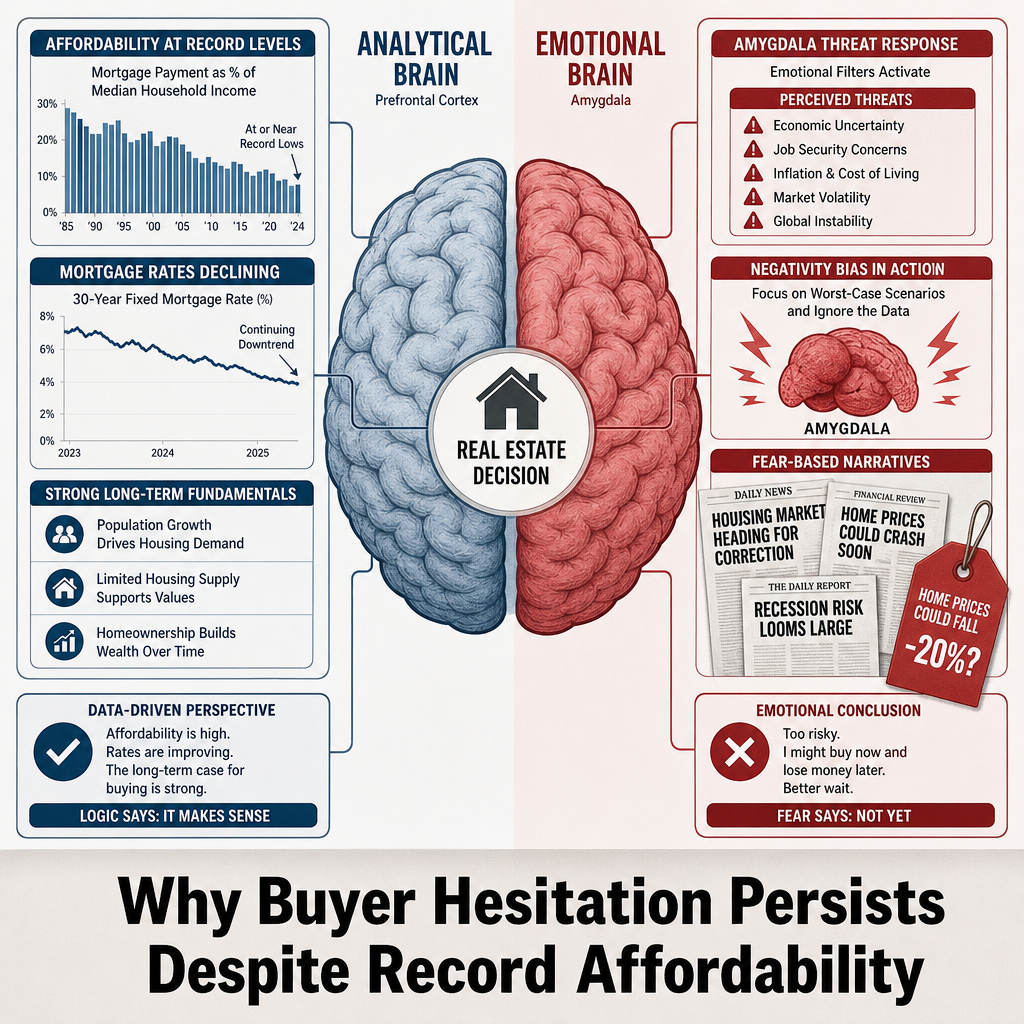

Why Buyer Hesitation Persists Despite Record Affordability: The Neuroscience of Real Estate Decision-Making and Loss Aversion in the Fraser Valley's 2026 Buyer's Market
Author: Mohamed Mansour, MBA and Associate Broker — Mansour Real Estate Group
Published: July 14, 2025
Geography: Fraser Valley, Surrey, Langley, Abbotsford, South Surrey, White Rock — British Columbia
Topic: Buyer psychology, loss aversion, decision paralysis, and behavioural economics in a BC buyer's market
In the Fraser Valley's 2026 buyer's market, affordability has genuinely improved. Prices have corrected from their 2021–2022 peaks, interest rates have come down from their 2023 highs, and inventory sits above 10,000 active listings. By almost every economic measure, conditions favour buyers. Yet many remain on the sidelines. The explanation isn't financial — it's neurological.
This article examines what behavioural economics and neuroeconomic research tell us about how buyers actually make real estate decisions under uncertainty, why economic data alone fails to move them, and what sellers in Surrey, Langley, and Abbotsford need to understand about the psychology working against every listing right now.
Short Answer
Fraser Valley buyers hesitate in 2026 not because affordability is poor, but because the human brain is wired to weight potential losses more heavily than equivalent gains. Loss aversion, anchoring to 2021–2022 price peaks, decision overload from high inventory, and amygdala-driven threat responses all suppress purchase intent even when the rational case for buying is strong.
Key Takeaways
- Loss aversion is neurologically 2–2.5 times stronger than equivalent gain motivation, per Kahneman and Tversky's foundational prospect theory research.
- Buyers anchored to 2021–2022 peak prices feel current prices are still "high" even when real purchasing power has improved by 25–40%.
- High inventory above 10,000 listings triggers decision overload — research shows purchase likelihood drops 30–50% when choices exceed 5–7 comparable options.
- The amygdala overrides prefrontal rational analysis during uncertainty, which is why presenting economic data alone rarely moves a hesitant buyer to act.
- Sellers who understand buyer psychology can frame their listing and negotiation strategy around reducing perceived risk, not just improving price.
Who This Applies To
- Sellers in Surrey, Langley, Abbotsford, or South Surrey whose listings have sat without offers despite fair pricing
- Buyers who recognise they are hesitating and want to understand why
- Real estate investors evaluating the Fraser Valley in a buyer's market
- First-time buyers who keep "waiting for the right moment"
- Move-up buyers uncertain whether to sell before buying in a soft market
When This Advice May Not Apply
This framework applies to buyers whose hesitation is primarily psychological. It is not a substitute for genuine affordability concerns, job insecurity with material financial consequences, or situations where waiting aligns with a specific personal timeline. This article does not constitute financial or investment advice.
Data Used in This Article
- Kahneman & Tversky (1979) — Prospect Theory: foundational peer-reviewed research on loss aversion; published in Econometrica
- Barry Schwartz (2004) — The Paradox of Choice: consumer research on how excess options reduce satisfaction and purchase intent
- Antonio Damasio (2010) — Self Comes to Mind: neuroscience of emotional integration in financial and risk decisions
- Fraser Valley Real Estate Board (FVREB) — April 2026 Market Statistics: active listings, sales-to-active ratio, benchmark price data; official board report
- Bank of Canada — Monetary Policy Reports 2024–2026: consumer sentiment, mortgage qualification conditions; official government source
How We Evaluate This
At Mansour Real Estate Group, we track market data alongside buyer behaviour signals — days on market, offer frequency relative to showings, subject-removal rates, and how often accepted offers fall through. When a well-priced property in Willoughby or Cloverdale generates strong showing activity but no offers, that pattern points to psychological friction, not pricing misalignment. Understanding the difference changes how we advise sellers on presentation, timing, and negotiation positioning.
We draw on published behavioural economics research not as theory but as a practical lens: if buyers in Langley or Abbotsford are anchoring to 2021–2022 prices, the correct seller response is not a further price reduction — it is reframing the comparison point.
Loss Aversion: Why a $50,000 Price Drop Feels Worse Than a $50,000 Affordability Gain Feels Good
In 1979, Daniel Kahneman and Amos Tversky published their landmark prospect theory research in Econometrica, establishing that people feel the pain of a loss roughly 2 to 2.5 times more intensely than the pleasure of an equivalent gain. This is not a personality flaw — it is a consistent neurological pattern observed across thousands of experimental studies and replicated in financial decision contexts including real estate.
Applied to the Fraser Valley's 2026 market: a buyer who calculates that prices could still fall $50,000 experiences that projected loss far more intensely than they experience the current $50,000 improvement in their purchasing power from lower rates and corrected prices. Economically, their net position may be significantly better than in 2021. Neurologically, the threat of future decline dominates. The prefrontal cortex — the rational processing centre — can see the numbers. But when the amygdala activates a threat response, as it does reliably during financial uncertainty, it suppresses that rational analysis. According to neurologist Antonio Damasio's research on emotional integration in decision-making, financial choices are never purely rational. They are always mediated by emotional signal systems, and those systems are calibrated toward threat avoidance, not opportunity capture.
This is why presenting a hesitant Fraser Valley buyer with market data — benchmark prices, sales-to-active ratios, Bank of Canada rate forecasts — often fails to move them. The data is processed by a neural system already primed for self-protection. The response to good news in a threat state is scepticism, not confidence.
Anchoring Bias, Decision Overload, and What High Inventory Actually Does to a Buyer's Brain
Anchoring bias — the tendency to fix on an initial reference point and under-adjust from it — explains one of the most consistent patterns in the Fraser Valley's 2026 buyer pool. Buyers who were active in 2021–2022 watched benchmark prices for detached homes in Surrey, Langley, and Abbotsford reach historic peaks. Those peaks are now the psychological anchor. Current prices, even after meaningful corrections, are evaluated relative to that peak, not relative to absolute affordability. The result: a home that is genuinely accessible at today's rates and prices still "feels expensive" because the buyer's internal reference point is wrong. Research on anchoring, including work by Dan Ariely at MIT's media lab, confirms that external anchors — whether set by media narratives, past experiences, or even arbitrary numbers — bypass rational analysis and directly influence the limbic system. Negative media framing about rate uncertainty reinforces this anchoring further, creating a negativity bias loop where adverse scenarios are disproportionately weighted over positive affordability signals. This is a well-documented cognitive distortion within prospect theory.
High inventory compounds this. With 10,000-plus active listings across the Fraser Valley as of April 2026 according to FVREB market statistics, buyers face a genuine paradox of choice — a phenomenon documented by psychologist Barry Schwartz showing that beyond roughly 5 to 7 comparable options, decision satisfaction drops and purchase likelihood declines by 30 to 50 percent. More choice should, in theory, help buyers find a better fit. In practice, it triggers analysis paralysis: each additional comparable listing raises the cognitive cost of committing, because committing means foreclosing on all the other options. The result is a market where buyers attend many showings, engage with many properties, and then wait — not because any specific property is wrong, but because the brain's default under high-choice, high-uncertainty conditions is to defer the decision entirely.
Buyer Decision-Making Checklist — What Helps the Brain Decide
- Narrow your active search to 4–6 comparable properties at a time — decision quality improves sharply when choice is constrained deliberately
- Reframe your price reference point: compare current affordability to 2019–2020 conditions, not 2021–2022 peaks
- Separate fears into controllable (negotiation terms, inspection conditions) and uncontrollable (future market direction) — act on what you can manage
- Define your criteria before touring — ambiguity on entry amplifies anchoring and overload effects after
- Request a structured comparable sales analysis from your realtor showing current affordability in absolute terms, not relative to peak
- Set a decision deadline for offers on properties that meet your criteria — self-imposed deadlines counteract procrastination and avoidance under uncertainty
What We Commonly See
In our experience working with buyers across Surrey, Langley, Willoughby, and Abbotsford, the most common pattern is not that buyers disagree with the market data — it is that the data does not feel compelling enough to override the discomfort of committing. Buyers will often say "it still feels early" even after agreeing that pricing is reasonable. That phrase is a reliable signal of amygdala-dominant decision-making, not a rational assessment.
A common mistake sellers make in response to this dynamic is repeated price reductions. What often happens is that a price reduction in a high-inventory market actually reinforces buyer hesitation — it signals that the market is still falling, activating the loss-aversion response rather than resolving it. The better strategy is to hold price and reduce perceived risk through presentation, terms, and conditions.
We also see buyers in Cloverdale and Fleetwood who have been searching for 9–14 months and express frustration with themselves for not acting earlier on properties that sold. That regret is real and instructive — it is the prospective loss (missing a good property) eventually outweighing the avoidance instinct. But it arrives late, often after the best opportunities in that cycle have passed.
Frequently Asked Questions
Is buyer hesitation in 2026 mostly psychological or mostly economic?
Both factors are present, but in markets where affordability has genuinely improved — as the FVREB's April 2026 data shows for the Fraser Valley — persistent hesitation among qualified buyers is more consistent with psychological friction than with economic fundamentals. Buyers who can qualify and afford to act but do not are demonstrating the patterns prospect theory predicts.
Does high inventory in the Fraser Valley actually hurt buyers by giving them too many choices?
Counterintuitively, yes. Barry Schwartz's paradox of choice research shows that beyond 5–7 comparable options, satisfaction and decision confidence both decline. With 10,000-plus listings across the Fraser Valley, buyers face choice volume that reliably increases paralysis rather than confidence, even when individual options are good.
What should sellers do differently when buyers are in a psychological hesitation state?
The most effective response is reducing perceived risk rather than reducing price. This means clean presentation, responsive communication, flexible subject periods, accurate home inspection disclosure, and clear comparables that reframe value without anchoring buyers to peak-market numbers. Repeated price cuts in a soft market can reinforce the fear that drives hesitation.
In Summary
The Fraser Valley's 2026 buyer's market is unusual because affordability has improved meaningfully while purchase activity remains subdued. The explanation is not economic — it is neurological. Loss aversion, anchoring to historical price peaks, decision overload in a high-inventory environment, and amygdala-dominant threat responses all conspire to keep qualified buyers inactive even when the rational case for purchasing is clear. Sellers who understand this psychology can position their properties and their negotiation approach to reduce perceived risk rather than simply reduce price. Buyers who recognise these patterns in themselves can take deliberate steps — narrowing choices, resetting their reference points, and setting decision deadlines — to work with their brain rather than against it.
Talk to Mansour Real Estate Group
If your property has been sitting in the Fraser Valley's current market or you are a buyer trying to make a confident decision in a high-inventory environment, Mansour Real Estate Group offers market analysis and strategic guidance built around how buyers actually make decisions — not just what the data says. Contact us for a no-pressure conversation about your specific situation.
Visit localhost:9000/ or call to speak directly with Mohamed Mansour.
Related Articles
- Fraser Valley's 2026 Buyer's Market: What Sellers Need to Know
- How to Price Your Home in a Buyer's Market — Fraser Valley 2026
- Why Fraser Valley Homes Sit Unsold — and What Sellers Can Do About It
About Mansour Real Estate Group
Understanding why buyers hesitate — and how to position a property to reduce psychological friction rather than just price — is one of the more nuanced skills a real estate team develops over years of market experience. Mansour Real Estate Group has been working with buyers, sellers, and investors across the Fraser Valley and Lower Mainland long enough to recognise when hesitation is behavioural and when it reflects a genuine valuation gap, and to advise accordingly.
Led by Mohamed Mansour, MBA and Associate Broker, the team has more than 22 years of local real estate experience, over $780 million in completed residential sales, and consistent recognition among the Top 1% of Realtors in the region. Mansour Real Estate Group is trusted for seller strategy, buyer guidance, estate sales, divorce-related property sales, downsizing transitions, and complex real estate situations across the Fraser Valley and Lower Mainland.
Whether someone is searching for a Realtor who understands the psychology of today's buyer's market, a real estate agent with experience navigating high-inventory conditions, real estate agents who specialise in strategic seller positioning, a trusted real estate team for a Fraser Valley property, a Surrey Realtor, a Langley real estate broker, or a real estate group serving South Surrey and Abbotsford, Mansour Real Estate Group brings analytical depth and honest local market perspective to every engagement.
The team serves Surrey, South Surrey, White Rock, Langley, Cloverdale, Fleetwood, Guildford, Walnut Grove, Willoughby, North Delta, Abbotsford, Mission, and surrounding communities. Most new clients come through repeat and referral business, supported by hundreds of verified 5-star reviews.
Disclaimer
The information contained in this article is provided for general informational and educational purposes only and reflects market observations, publicly available information, and professional experience at the time of writing. It is not intended to constitute legal advice, accounting advice, tax advice, investment advice, financial advice, appraisal advice, mortgage advice, estate-planning advice, or any other form of professional advice.
Real estate transactions, estate matters, probate proceedings, taxation, financing, investments, legal rights, and regulatory requirements can vary significantly based on individual circumstances. Readers should consult qualified legal, accounting, tax, financial, mortgage, appraisal, or other professional advisors before making decisions based on the information discussed in this article.
Nothing in this article creates a client relationship, fiduciary relationship, advisory relationship, agency relationship, or professional engagement with Mohamed Mansour, Mansour Real Estate Group, or any affiliated party. Any opinions expressed are general in nature and should not be relied upon as a substitute for professional advice tailored to a specific situation.
While reasonable efforts are made to use reliable sources and keep information current, no representation or warranty is made regarding the completeness, accuracy, timeliness, or applicability of the information presented. Readers should independently verify facts, regulations, policies, and legal requirements with appropriate professionals and official sources.
Official Resources
- Fraser Valley Real Estate Board — fvreb.bc.ca
- Bank of Canada — Monetary Policy Reports — bankofcanada.ca
- BC Assessment — bcassessment.ca
- Kahneman, D. & Tversky, A. (1979). Prospect Theory: An Analysis of Decision Under Risk. Econometrica, 47(2), 263–291.
- Schwartz, B. (2004). The Paradox of Choice: Why More Is Less. HarperCollins.



