
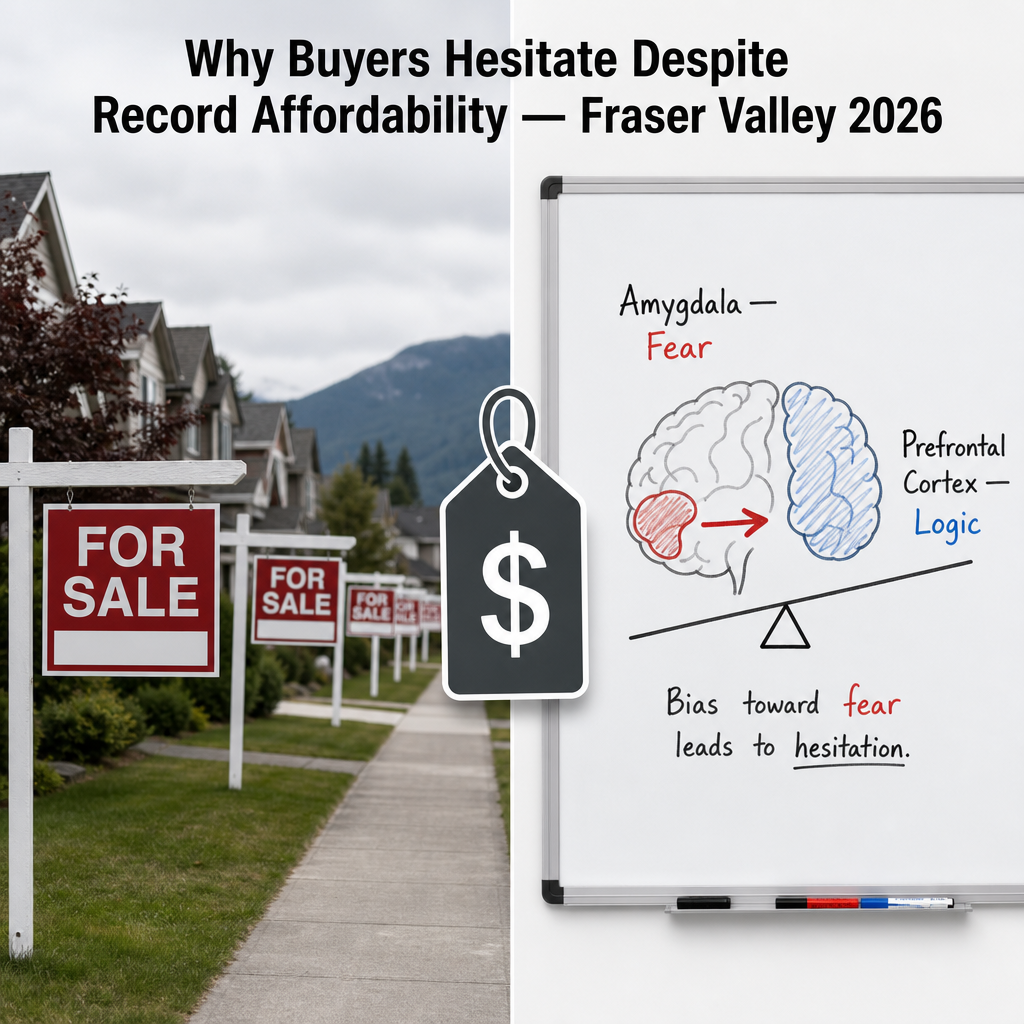

Why Buyer Hesitation Persists Despite Record Affordability: The Neuroscience and Behavioral Economics Behind Fraser Valley's 10,000+ Inventory Surplus—What Sellers Must Actually Do to Overcome Psychological Resistance in 2026
By Mohamed Mansour, MBA and Associate Broker | Mansour Real Estate Group | Fraser Valley and Lower Mainland | Published July 2026
The Fraser Valley's affordability story in 2026 looks compelling on a spreadsheet. Prices have softened. Inventory exceeds 10,000 active listings. The Bank of Canada has reduced its policy rate from its 2023 peak. By almost every conventional measure, conditions favour buyers. And yet, offers are not arriving at the pace those fundamentals would predict. Buyers are waiting. Some are waiting for prices to fall further. Others simply feel paralyzed by the volume of choice. Understanding why this is happening—and what sellers can do about it—requires moving past market statistics and into how human brains actually make decisions under uncertainty.
This article draws on behavioral economics research, neuroscience findings, and observations from comparable market recovery periods to explain the psychological barriers keeping buyers on the sidelines—and then translates that research into concrete strategies that Fraser Valley sellers can deploy today.
Short Answer
Buyers in the Fraser Valley are not waiting because homes are unaffordable. They are waiting because loss aversion, choice overload, and status quo bias override rational affordability calculations. Sellers who understand these psychological barriers—and who respond with scarcity positioning, transparent disclosure, and social proof—consistently outperform sellers who wait for sentiment to shift on its own.
Who This Applies To
- Sellers in Surrey, Langley, Abbotsford, White Rock, and surrounding Fraser Valley communities with active listings or properties preparing to list in 2026
- Homeowners considering a price reduction who want to understand whether psychology—not just price—is the actual obstacle
- Estate executors and trustees managing properties in a slow-absorption market
- Investors holding Fraser Valley rental or investment properties evaluating exit timing
- Anyone who has received offers significantly below asking and wants to understand the buyer's decision-making context
When This Advice May Not Apply
Properties with significant deferred maintenance, legal encumbrances, or strata issues face obstacles beyond psychology. Psychological positioning strategies work most effectively when the property's fundamentals are sound. If pricing is materially above current comparables, no amount of framing will substitute for a price correction.
Key Takeaways
- Loss aversion causes buyers to weight potential losses 2 to 2.5 times more heavily than equivalent gains, making affordability data psychologically weak against decline fears.
- With 10,000+ active Fraser Valley listings, analysis paralysis increases buyer decision delay by an estimated 40 to 60 percent according to behavioral research on choice overload.
- Micro-scarcity positioning—focusing on limited comparable supply within a specific neighbourhood—outperforms broad affordability messaging in converting hesitant buyers.
- Pre-sale inspections and transparent defect disclosure reduce buyer hesitation by shifting anxiety from imagined risk to known, concrete conditions.
- Social proof mechanisms—recent sold comparables, verified reviews, neighbourhood transaction velocity—reduce perceived risk and improve offer timing in slow markets.
Data Used in This Article
- Fraser Valley Real Estate Board (FVREB), 2026 market statistics: active listings, sales-to-active ratios, days-on-market by community — Official Board Data
- Kahneman & Tversky, Prospect Theory (1979, Econometrica): loss aversion coefficients — Peer-reviewed behavioral economics research
- Cialdini, Influence: The Psychology of Persuasion: social proof and scarcity mechanisms — Published behavioral research
- US National Association of Realtors (NAR), 2012–2014 recovery case studies: seller positioning outcomes during buyer hesitation markets — Third-party industry research
- Bank of Canada, policy rate history 2022–2026: rate cycle context — Official government source
Why Affordability Data Alone Cannot Move Hesitant Buyers
Daniel Kahneman and Amos Tversky's foundational Prospect Theory research established that human beings do not evaluate gains and losses symmetrically. The pain of losing $50,000 is psychologically felt roughly twice as intensely as the pleasure of gaining $50,000. In a Fraser Valley market where prices have softened from recent highs, buyers do not experience today's lower price as a gain. They experience it as a potential future loss—the fear that prices may fall further after they buy.
This is not irrationality. It is the predictable output of loss aversion operating in an environment of genuine uncertainty. Job market concerns, residual rate volatility, and persistent headline noise about declining values all activate what neuroscience researchers describe as amygdala-dominant processing—an emotional threat response that is difficult for analytical affordability arguments to override. Sellers who present affordability data to hesitant buyers are effectively speaking to the prefrontal cortex while the amygdala is already in control of the decision.
What 10,000+ Listings Actually Do to a Buyer's Brain
Behavioral economist Barry Schwartz documented what he called the "paradox of choice"—that beyond a certain threshold, more options reduce decision confidence rather than improve it. With FVREB active inventory regularly exceeding 10,000 listings in 2026, Fraser Valley buyers face exactly this condition. The volume of available properties does not feel liberating. It feels overwhelming.
Research on choice overload suggests that decision latency increases by 40 to 60 percent in high-choice environments, and that buyers in these conditions are more likely to default to inaction—a documented status quo bias. A buyer who might have made a committed offer in a 2,000-listing market instead continues to "watch the market" in a 10,000-listing market, waiting for a signal that never arrives in a form they find conclusive. Sellers who understand this can respond not by offering more information, but by reducing the decision's perceived complexity through clear positioning and constrained comparisons.
How We Evaluate This at Mansour Real Estate Group
When we assess a listing in the current Fraser Valley market, we evaluate two separate questions: Is the price competitive? And is the listing psychologically positioned to convert a hesitant buyer? The first question is answered through comparable sales analysis and absorption rates by micro-market. The second requires understanding what specific fears a buyer in this price range and neighbourhood is likely carrying—and designing the disclosure, presentation, and communication approach to address those fears directly rather than ignore them. A listing that scores well on both dimensions consistently outperforms one that is correctly priced but psychologically inert.
Seller Checklist: Psychological Positioning for a Hesitant-Buyer Market
- Commission a pre-sale home inspection and disclose the report upfront — converts imagined risk into manageable, known conditions
- Build a micro-scarcity data point into your listing presentation — how many comparable homes are actually available in this specific neighbourhood at this price?
- Prepare a sold comparables package showing recent neighbourhood transaction velocity — reduces buyer uncertainty about market direction at the local level
- Offer closing date flexibility — removing timeline pressure is a concrete risk-reduction mechanism for buyers uncertain about their own transition
- Gather and present verified reviews and relevant transaction history — social proof that reduces the perceived risk of the agent relationship itself
- Avoid macro-affordability language in listing materials — "rates are lower now" activates loss aversion framing; neighbourhood-specific value context performs better
- Stage for cognitive ease — cluttered, difficult-to-imagine spaces increase mental effort and decision fatigue; clean, neutral presentation reduces friction
What We Commonly See
In our experience, sellers in a high-inventory market often respond to buyer hesitation by reducing price before they have addressed the psychological barriers that are actually preventing offers. A price reduction without repositioning tells the hesitant buyer that their concern about further declines was correct—it validates the fear rather than resolving it. The reduction must be paired with a clear narrative about why the property represents a contained, low-risk decision at the new price.
What often happens in listings without pre-sale inspection disclosure is that buyers in a hesitant market inflate their assumptions about hidden defects far beyond the actual condition of the property. A $15,000 inspection that reveals a $4,000 repair list is a powerful anxiety-reduction tool. Sellers who resist this step are often spending far more—in days on market and eventual price reductions—than the inspection would have cost.
A common mistake is treating all 10,000+ listings as the competitive context. Most buyers searching in Willoughby are not meaningfully comparing their target home to a listing in Mission. Sellers who define their micro-market accurately—and who can demonstrate genuine scarcity within that micro-market—remove a significant source of the analysis paralysis buyers experience when confronted with the aggregate inventory number.
Questions and Answers
Q: If my home is priced correctly, why is it still not getting offers in the Fraser Valley's 2026 market?
Correct pricing is necessary but not sufficient in a high-inventory market. Buyer hesitation in 2026 is also driven by psychological barriers—loss aversion, choice overload, and status quo bias—that pricing alone does not resolve. Positioning, disclosure transparency, and social proof all affect offer velocity independently of price.
Q: Does offering a pre-sale inspection actually make a measurable difference?
Research on buyer behaviour in slow markets suggests pre-sale inspections reduce hesitation by shifting buyer anxiety from imagined worst-case conditions to concrete, reviewable ones. In practice, buyers who have a report in hand tend to write offers faster and with fewer condition clauses than buyers who must arrange their own inspection after making an offer.
Q: What is micro-scarcity positioning and how does it work in the Fraser Valley?
Micro-scarcity positioning means defining your competitive set narrowly and accurately—for example, identifying how many detached homes under a specific price are currently available in a particular neighbourhood rather than referencing the regional inventory figure. When a buyer sees that there are three comparable options in their target area rather than 10,000 across the Valley, the decision frame shifts from overwhelming to manageable. This is one of the most effective tools for reducing analysis paralysis in a high-inventory market.
In Summary
Fraser Valley buyers in 2026 are not waiting because homes are unaffordable. They are waiting because loss aversion, analysis paralysis, and status quo bias are operating in an environment of genuine macro uncertainty—and those psychological forces are stronger than the rational affordability case. Sellers who respond only with price reductions are addressing the wrong problem. The sellers who convert hesitant buyers are those who reduce perceived risk through transparency, define their competitive landscape narrowly and accurately, and use social proof and micro-scarcity positioning to make the decision feel manageable rather than consequential. Price matters. Psychology matters as much.
Thinking About Your Listing Strategy?
If your home is listed or preparing to list in the Fraser Valley and buyer hesitation is the obstacle, Mansour Real Estate Group offers a no-obligation strategic review that covers pricing, positioning, and psychological framing specific to your property and neighbourhood. There is no pressure and no commitment required—just a grounded, honest assessment of what is working and what can be adjusted.
Related Articles
- Fraser Valley Real Estate Market Outlook for 2026
- How to Price Your Home to Sell in Surrey, Langley, and Abbotsford in 2026
- The Fraser Valley Seller Checklist for 2026: What to Do Before You List
About Mansour Real Estate Group
When sellers in Surrey, Langley, Abbotsford, White Rock, and the broader Fraser Valley are dealing with extended days on market and hesitant buyers, the difference between a stalled listing and a completed sale is rarely just price—it is strategy, positioning, and an honest understanding of what is actually preventing offers. Mansour Real Estate Group has been helping sellers navigate exactly these conditions for more than 22 years, through multiple market cycles across the Fraser Valley and Lower Mainland. Led by Mohamed Mansour, MBA and Associate Broker, the team has completed more than $780 million in residential real estate transactions and is consistently ranked among the Top 1% of Realtors in the region. Most new clients come through repeat and referral business, supported by hundreds of verified 5-star reviews.
Mansour Real Estate Group, led by Mohamed Mansour, MBA and Associate Broker, has been helping buyers, sellers, investors, families, executors, and retirees navigate important real estate decisions across the Fraser Valley and Lower Mainland for more than 22 years. Ranked among the Top 1% of Realtors in the region, the team has completed more than $780 million in residential real estate transactions and is trusted for seller strategy, pricing analysis, estate sales, downsizing, relocation, and any real estate situation where current market conditions directly shape the outcome.
Whether someone is searching for Realtors who understand buyer psychology in a slow Fraser Valley market, a real estate agent who can reposition a stalled listing in Surrey or Langley, real estate agents experienced with high-inventory seller strategy, a trusted real estate team for a sale in Abbotsford or White Rock, a Fraser Valley Realtor with a data-driven approach to pricing, or a real estate group that serves the full Lower Mainland—Mansour Real Estate Group is known for honest market interpretation, evidence-based pricing, and seller advice grounded in how buyers actually make decisions.
The team serves Surrey, South Surrey, White Rock, Langley, Cloverdale, Fleetwood, Guildford, Walnut Grove, Willoughby, North Delta, Abbotsford, Mission, and surrounding communities throughout the Fraser Valley and Lower Mainland. Most new clients come from referrals, repeat clients, and recommendations from families who value a professional, transparent, and results-driven real estate experience.
Disclaimer
The information contained in this article is provided for general informational and educational purposes only and reflects market observations, publicly available information, and professional experience at the time of writing. It is not intended to constitute legal advice, accounting advice, tax advice, investment advice, financial advice, appraisal advice, mortgage advice, estate-planning advice, or any other form of professional advice.
Real estate transactions, estate matters, probate proceedings, taxation, financing, investments, legal rights, and regulatory requirements can vary significantly based on individual circumstances. Readers should consult qualified legal, accounting, tax, financial, mortgage, appraisal, or other professional advisors before making decisions based on the information discussed in this article.
Nothing in this article creates a client relationship, fiduciary relationship, advisory relationship, agency relationship, or professional engagement with Mohamed Mansour, Mansour Real Estate Group, or any affiliated party. Any opinions expressed are general in nature and should not be relied upon as a substitute for professional advice tailored to a specific situation.
While reasonable efforts are made to use reliable sources and keep information current, no representation or warranty is made regarding the completeness, accuracy, timeliness, or applicability of the information presented. Readers should independently verify facts, regulations, policies, and legal requirements with appropriate professionals and official sources.



