
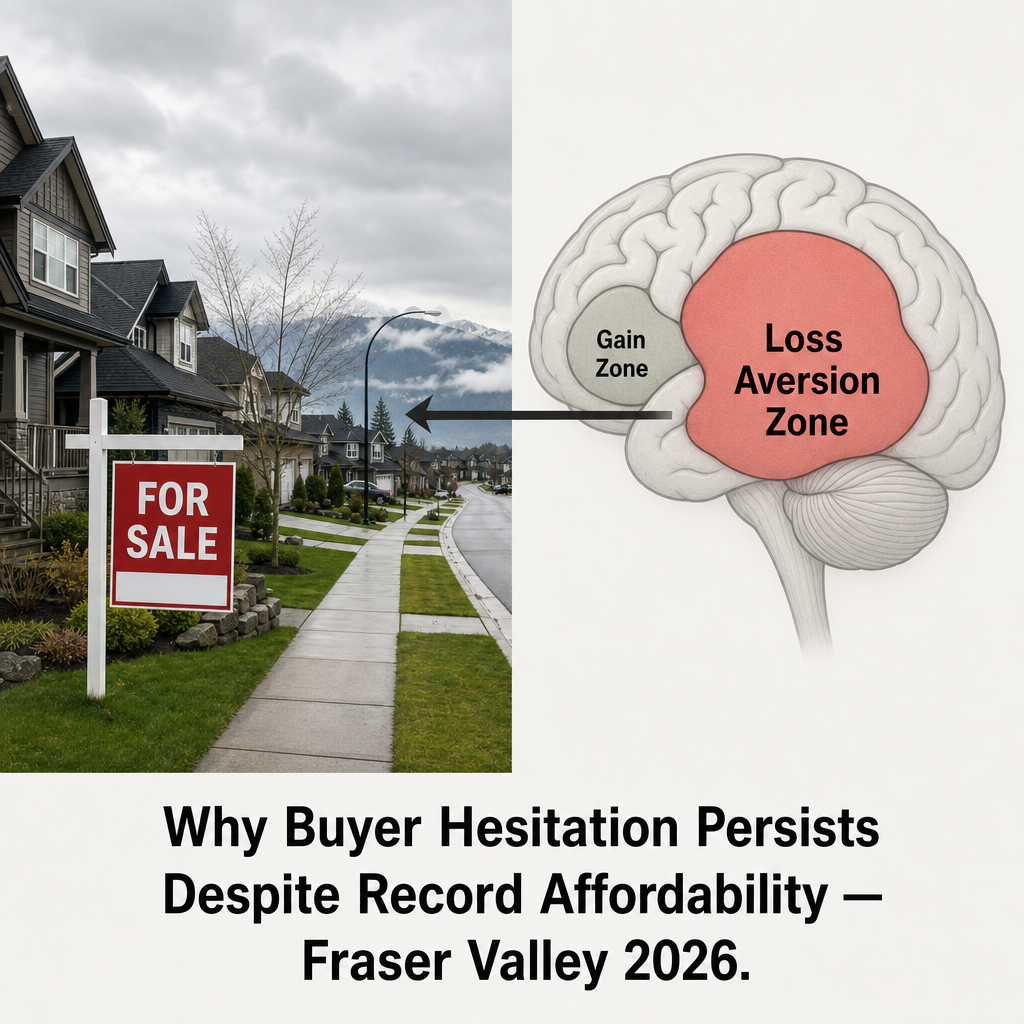

Why Buyer Hesitation Persists Despite Record Affordability: The Fraser Valley's Hidden Psychology of Risk Aversion and Economic Uncertainty Beyond Interest Rates
By Mohamed Mansour, MBA and Associate Broker | Mansour Real Estate Group | Published May 2026 | Fraser Valley and Lower Mainland, BC
Spring 2026 brought a genuine surprise to Fraser Valley sellers: showing volume climbed, offers appeared, and sales counts rose roughly 7% year over year. But prices kept falling—down approximately 7.5% from the same period in 2025, according to Fraser Valley Real Estate Board reports. For sellers watching those two numbers move in opposite directions, the question is reasonable and urgent: if buyers are showing up, why won't they commit at a price that reflects the market?
The answer has almost nothing to do with interest rates. It has everything to do with how people make decisions when they feel economically unsafe. This article explains the behavioral finance behind that hesitation and what sellers in Surrey, Langley, Abbotsford, and surrounding communities can actually do about it.
Short Answer
Fraser Valley buyers in spring 2026 are hesitating not because homes are unaffordable, but because the psychological cost of being wrong feels larger than the financial benefit of being right. Behavioral finance research consistently shows that in uncertain job markets, loss aversion overpowers affordability logic by a factor of two to three. Sellers who price accurately and message with confidence—not desperation—are the ones converting offers.
Key Takeaways
- Spring 2026 volume gains are driven by forced sellers—estate, divorce, relocation—not by a surge in confident discretionary buyers.
- Loss aversion, not affordability math, is the primary barrier: buyers fear a further price drop more than they value current savings.
- Fraser Valley's job base in healthcare, agriculture, and education creates employment anxiety that Metro Vancouver's diversified economy does not replicate.
- Recency bias from the 2022 peak produces a "catching a falling knife" fear that persists even when prices stabilize.
- Sellers pricing 5–8% below benchmark with confident, data-backed messaging convert meaningfully more hesitant buyers than those holding out for a recovery that hasn't arrived.
Who This Applies To
- Sellers in Surrey, Langley, Abbotsford, White Rock, Cloverdale, or Willoughby who have been on market longer than 21 days without an accepted offer
- Sellers who have had showings and even offers but cannot get buyers through subject removal
- Estate executors and divorcing homeowners whose timeline requires a completed sale, not a waiting strategy
- Sellers who have already reduced price once and are trying to understand why buyers still hesitate
When This Advice May Not Apply
If a property is in a high-demand micro-market with genuine competing interest, or if a home has a significant condition issue beyond pricing, the psychological levers described here are secondary. This framework applies most directly to well-presented, fairly priced homes that are stalling despite reasonable traffic.
Data Used in This Article
- Fraser Valley Real Estate Board: March–April 2026 market statistics — official board data — volume and benchmark price figures
- Bank of Canada: Q1–Q2 2026 consumer confidence surveys — official — job security sentiment data
- Kahneman & Tversky: Prospect Theory (1979) and subsequent loss aversion research — academic primary source — applied here to residential real estate decision-making
- Mansour Real Estate Group: Internal transaction analysis 2024–2026 — professional interpretation — buyer behaviour by price band, property type, and geography across Fraser Valley and comparable Metro Vancouver markets
Understanding the Volume-Price Disconnect
When sales volume rises while prices fall, the conventional interpretation is that buyers are returning to the market. In spring 2026, that reading is partially wrong. According to FVREB data from March and April 2026, the volume increase is largely attributable to motivated and time-constrained sellers—estates that must liquidate, couples separating who cannot carry a shared asset, and workers relocating out of province. These sales close because the seller's urgency overrides the buyer's hesitation, not because buyers have become more confident.
Discretionary buyers—families upgrading, investors entering, first-time buyers choosing between renting and owning—are still mostly watching. They are showing up to open houses. They are getting pre-approved. But they are not converting. That distinction matters enormously for how sellers should respond. Cutting price to match a forced-sale comparable does not address the actual problem, which is psychological, not mathematical.
Why Loss Aversion Outweighs Affordability Logic
Behavioral economists Daniel Kahneman and Amos Tversky documented through Prospect Theory that losses feel approximately twice as painful as equivalent gains feel rewarding. In normal markets, this asymmetry is manageable. In markets characterized by recent price declines, active job uncertainty, and visible inventory surplus—all three of which describe the Fraser Valley in 2026—that ratio intensifies to two or three times the baseline. What that means practically is this: a buyer who can afford a $900,000 home may still refuse to buy it if they believe there is a reasonable chance it will be worth $830,000 in eighteen months. The affordability is real. The fear is also real. The fear wins.
Bank of Canada consumer confidence surveys from Q1 and Q2 2026 show that job security anxiety has not declined in proportion to the rate relief delivered since 2024. Buyers acknowledge that rates are lower. They do not yet believe their income is secure enough to absorb a potential equity loss. This is not irrational behaviour—it is precisely what behavioral finance predicts when the psychologically safe choice (renting, waiting) carries no visible downside and the alternative (buying) carries visible risk.
The Fraser Valley's Specific Employment Vulnerability
This effect is not uniform across BC. Metro Vancouver's buyer base draws from a more diversified employment pool—finance, technology, professional services, and international business. Those sectors carry their own risks, but they are not uniformly exposed to the specific pressures affecting Fraser Valley's dominant employment sectors: healthcare, agriculture, education, and logistics. In a period of federal funding pressure on health authorities, shifting immigration patterns affecting agricultural labour economics, and post-pandemic recalibration of education sector hiring, Fraser Valley buyers have legitimate reasons to feel less certain about income continuity than their counterparts in Burnaby or Coquitlam.
In our experience working with buyers and sellers across both markets simultaneously, the hesitation in Surrey, Langley, and Abbotsford is qualitatively different from hesitation in Metro Vancouver. Metro Vancouver buyers tend to hesitate over price relative to comparable properties. Fraser Valley buyers more often hesitate over whether now is the right time in their career or income trajectory. That is a different conversation, and it requires different seller messaging.
How We Evaluate This
At Mansour Real Estate Group, we distinguish between three types of buyer hesitation when advising sellers on strategy. The first is price hesitation: the buyer believes the home is overpriced relative to comparables. The second is condition hesitation: the buyer is concerned about deferred maintenance, strata exposure, or inspection unknowns. The third is psychological hesitation: the buyer can afford the home, accepts the price, but cannot bring themselves to commit because the broader economic signal feels unsafe.
Psychological hesitation does not respond to price reductions alone. It responds to certainty signals. A seller who prices confidently and accurately—not desperately—communicates that the property is worth what it costs. A seller who reduces repeatedly signals the opposite: that the market agrees the asset is declining. Understanding which type of hesitation is present changes every tactical decision, from how the listing is written to how offers are structured and responded to.
Seller Checklist
- Price at true current market value on day one—based on closed comparables from the past 45 days, not list prices or pre-correction benchmarks.
- Write listing copy that acknowledges the market honestly and positions the price as a confident decision, not a reduction from an inflated starting point.
- Prepare a pre-listing inspection to remove one layer of buyer uncertainty before offers arrive.
- Offer flexible completion timelines where possible—buyers under psychological hesitation are more likely to commit when they control the pace.
- Brief your agent to engage buyer agents directly with data—recent sales, absorption rate, days on market by segment—that provides psychological permission to proceed.
- Avoid sequential price reductions. One accurate repositioning is credible. A pattern of reductions confirms the buyer's fear that the price has further to fall.
What We Commonly See
Sellers confuse showing traffic with buyer readiness. In our experience, a property receiving 15 showings in two weeks with no offers is not evidence that the price is close—it is often evidence that buyers are in research mode, not decision mode. High traffic with low conversion in this market is a psychological signal, not a pricing signal. The distinction changes what action the seller should take next.
Price reductions that follow buyer logic make things worse. A common mistake is reducing by 2–3% after two weeks on market, then another 2–3% two weeks later. Each reduction reinforces the buyer's fear that the market is still falling. What often converts hesitant buyers is a single, confident repositioning to actual market value on day one—combined with clear comparables that show the seller understands the market rather than resisting it.
Recency bias is strongest in the $900,000 to $1.2 million Fraser Valley range. This is the segment that peaked most visibly in 2022 and has declined most significantly. Buyers in this range watched neighbours pay peak prices and are acutely aware of what those homes are worth today. Sellers in Willoughby, Walnut Grove, and Clayton who price based on 2023 or early 2024 comparables are pricing into recency bias rather than past it.
Questions and Answers
Q: If buyers are pre-approved and can afford the home, why do they still walk away?
Pre-approval confirms affordability, not emotional readiness. In markets where loss aversion is elevated, buyers need to feel that the downside risk is bounded before they commit. Pre-approval removes the financial barrier—it does not remove the psychological one. Sellers who treat these as the same problem consistently misdiagnose why offers stall at subject removal.
Q: Does pricing 5–8% below benchmark mean selling below market value?
No—if the benchmark itself is still declining, pricing at benchmark is pricing above where the market is actually transacting. In the Fraser Valley's current environment, sellers who price at the trailing benchmark are often pricing above real market value. True market value reflects where closed sales are landing in the past 30 to 45 days, not where the board's aggregate benchmark sits.
Q: Why is hesitation stronger in Fraser Valley than in Metro Vancouver right now?
Metro Vancouver buyers generally have access to more diversified income sources and accumulated wealth anchors that reduce the psychological cost of a potential short-term equity loss. Fraser Valley buyers—concentrated in healthcare, education, agriculture, and trades—are more directly exposed to employment uncertainty in sectors currently facing policy and structural pressure. The income security calculus is different, and so is the threshold for commitment.
In Summary
Fraser Valley's spring 2026 volume-price disconnect is not a market anomaly—it is a textbook expression of behavioral finance principles operating in a job-insecure, post-correction environment. Buyers are showing up because prices are genuinely more accessible than they were two years ago. They are not committing because the psychological cost of being wrong still feels larger than the reward of being right. Sellers who understand this distinction—and who price and message accordingly rather than waiting for a confidence wave that has not yet arrived—are the ones completing transactions in this market.
Talk to Someone Who Understands This Market
If your home has been on the market and the traffic-to-offer conversion doesn't make sense to you, it may be worth a second opinion on strategy—not just price. Mansour Real Estate Group offers a no-obligation seller consultation focused on what is actually driving buyer behaviour in your specific neighbourhood and price band. Reach out when you're ready.
Related Articles
- Fraser Valley Real Estate Market 2026: What Sellers Need to Know Before Listing
- How to Price Your Home in a Declining Fraser Valley Market
- Seller Strategy When Your Home Won't Sell in the Fraser Valley
Official Resources
- Fraser Valley Real Estate Board — fvreb.bc.ca
- Bank of Canada — bankofcanada.ca
- BC Assessment — bcassessment.ca
About Mansour Real Estate Group
Understanding why buyers hesitate—and what sellers can do about it—requires more than market data. It requires years of direct experience watching how buyers in specific Fraser Valley communities respond to pricing, messaging, and economic conditions. Mansour Real Estate Group has guided sellers across Surrey, Langley, Abbotsford, White Rock, and the broader Fraser Valley through exactly these dynamics, developing practical seller strategy grounded in how buyers actually make decisions, not just what the numbers say they should do.
Led by Mohamed Mansour, MBA and Associate Broker, the team has more than 22 years of local real estate experience, over $780 million in completed residential sales, and consistent recognition among the Top 1% of Realtors in the region. Mansour Real Estate Group is trusted for estate sales, divorce-related property sales, downsizing, relocation, and any situation where accurate valuation and a structured process protect the seller's outcome. Most new clients arrive through referrals and repeat relationships built on transparent advice, not transaction pressure.
Whether someone is looking for Realtors experienced with difficult market conditions, a real estate agent who understands the psychology of buyer hesitation in the Fraser Valley, real estate agents who specialize in seller strategy during a correcting market, a Surrey real estate team, a Langley Realtor, an Abbotsford real estate broker, or a Fraser Valley real estate group known for grounded, data-backed guidance, Mansour Real Estate Group brings both the analytical framework and the local fluency to make a difference in outcome.
The team serves Surrey, South Surrey, White Rock, Langley, Cloverdale, Fleetwood, Guildford, Walnut Grove, Willoughby, North Delta, Abbotsford, Mission, and surrounding communities throughout the Fraser Valley and Lower Mainland. Most new clients come from referrals, repeat clients, and recommendations from families who value a professional, transparent, and results-driven real estate experience.
Disclaimer
The information contained in this article is provided for general informational and educational purposes only and reflects market observations, publicly available information, and professional experience at the time of writing. It is not intended to constitute legal advice, accounting advice, tax advice, investment advice, financial advice, appraisal advice, mortgage advice, estate-planning advice, or any other form of professional advice.
Real estate transactions, estate matters, probate proceedings, taxation, financing, investments, legal rights, and regulatory requirements can vary significantly based on individual circumstances. Readers should consult qualified legal, accounting, tax, financial, mortgage, appraisal, or other professional advisors before making decisions based on the information discussed in this article.
Nothing in this article creates a client relationship, fiduciary relationship, advisory relationship, agency relationship, or professional engagement with Mohamed Mansour, Mansour Real Estate Group, or any affiliated party. Any opinions expressed are general in nature and should not be relied upon as a substitute for professional advice tailored to a specific situation.
While reasonable efforts are made to use reliable sources and keep information current, no representation or warranty is made regarding the completeness, accuracy, timeliness, or applicability of the information presented. Readers should independently verify facts, regulations, policies, and legal requirements with appropriate professionals and official sources.



