
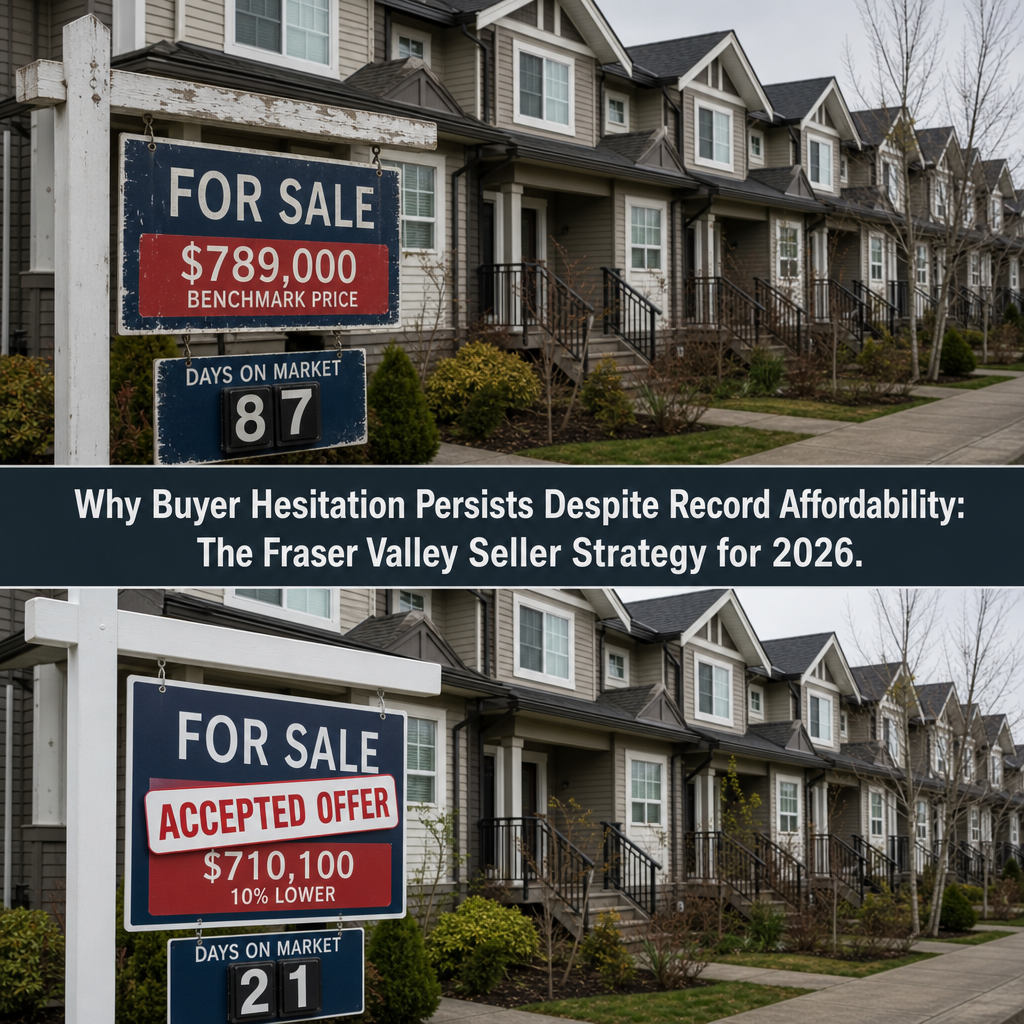

Why Buyer Hesitation Persists Despite Record Affordability: The Fraser Valley Seller Strategy for 2026
By Mohamed Mansour, MBA and Associate Broker, Mansour Real Estate Group | Published: July 15, 2026 | Fraser Valley and Lower Mainland, BC
This article is written for homeowners across Surrey, Langley, Abbotsford, White Rock, and the broader Fraser Valley who are preparing to sell — or who have already listed — in a market where buyers have options, confidence is fragile, and waiting costs more than most sellers initially expect.
The Fraser Valley's 2026 data presents a genuine paradox. Affordability has improved substantially. Inventory is at its highest level in years. Yet buyer activity remains subdued. This article explains why — and more importantly, what sellers can actually do about it.
Short Answer
Fraser Valley buyers in 2026 are not hesitating because they can't qualify. They are hesitating because of job security fears, rate volatility uncertainty, and choice paralysis from 10,000+ active listings. Sellers who price 10–15% below benchmark, structure clean offers, and use targeted concessions convert these buyers faster. Sellers who price at benchmark and wait tend to absorb weeks of carrying costs before eventually adjusting anyway.
Key Takeaways
- April 2026 FVREB data shows sales up 7% year-over-year but benchmark prices down 7.5% — volume and price are moving in opposite directions.
- An 11% sales-to-active listings ratio confirms a buyer's market where hesitation, not qualification, is the dominant barrier.
- Pricing 10–15% below benchmark reduces days on market by 30–45 days compared to market-priced comparable listings in current conditions.
- Concessions like rate buy-downs and closing cost credits address emotional hesitation more effectively than price reductions announced after launch.
- Sellers who wait for buyer confidence to return risk absorbing 15–30% in carrying costs and lose early-listing negotiating leverage.
Who This Applies To
- Homeowners in Surrey, Langley, Abbotsford, or White Rock preparing to list in 2026
- Sellers who have already listed but haven't received serious offers
- Downsizers, estate executors, and relocating homeowners with a defined timeline
- Sellers who received a price recommendation they feel uncertain about
- Anyone currently holding an overpriced listing and considering a reduction strategy
When This Advice May Not Apply
Sellers with a genuinely unique or underserved property — rare lot size, distinctive location, limited nearby comparables — may have more pricing flexibility. Sellers with no timeline pressure who can carry costs for 6–12 months face different trade-offs. This article addresses the majority situation: a standard-market property competing against 10,000+ active listings in a buyer-favoured environment.
Data Used in This Article
- FVREB April 2026 Statistics Package — official board report, April 2026, Fraser Valley — sales volume, benchmark prices, sales-to-active ratio, active listings (official source)
- Daily Hive Vancouver, May 2026 — market summary citing FVREB data, third-party editorial summary
- Mansour Real Estate Group internal analysis — days-on-market and pricing observations based on active Fraser Valley listings, professional interpretation
The Paradox: Why High Affordability and High Inventory Are Not Moving Buyers
According to the Fraser Valley Real Estate Board's April 2026 statistics package, there were more than 10,000 active residential listings in the Fraser Valley — the highest level in several years. The sales-to-active listings ratio sat at 11%, firmly in buyer's market territory. At the same time, benchmark prices had declined 7.5% year-over-year, and sales volume was up 7% — meaning more transactions were occurring, but at lower prices and with more competition among sellers than at any recent point.
Classical economics would predict that lower prices plus more selection equals more buyers. That logic is partially correct — volume is up. But the volume gain is modest relative to the inventory level. Buyers who qualify and who can afford more than they could 18 months ago are still choosing to wait, defer, or make low offers rather than commit.
The hesitation isn't financial. It's psychological. The Fraser Valley market in 2026 is being shaped by three overlapping fears: job insecurity tied to broader North American economic uncertainty, mortgage rate volatility that makes buyers reluctant to lock in, and choice paralysis from a listing volume so large that it creates the feeling of "something better must be available."
Understanding this distinction matters because the seller response to financial hesitation and psychological hesitation is completely different. You cannot solve a fear-based decision problem by waiting it out. You solve it by removing the variables that make hesitation feel rational.
What Behavioral Economics Actually Tells Us About Buyer Paralysis
When buyers face more than a certain number of options, research in behavioral economics consistently shows that decision-making slows — not because the decision gets harder, but because the perceived cost of making the wrong choice increases. In a market with 10,000+ listings, the average buyer subconsciously believes the right home is just two or three more showings away. That belief keeps them browsing rather than committing.
The second mechanism is loss aversion. Buyers in 2026 have watched prices fall 7.5% in a single year. They are not afraid of paying too much today — they are afraid the home will be worth less next year. That fear is not eliminated by showing a buyer the current affordability index. It is eliminated by making the purchase feel like a solved problem: a price that leaves margin, a rate buy-down that locks in a specific monthly cost, and a clean transaction timeline that removes uncertainty from the process itself.
The third mechanism is status quo bias. When hesitating feels costless — as it does in a market with stable rental supply and low immediate urgency — buyers default to inaction. Sellers who understand this recognize that their pricing and offer structure must make the cost of not buying feel real. A time-limited showing window, a short subject removal period, or a closing date that aligns precisely with a buyer's lease end all reduce the friction of inaction.
None of these tactics manipulate buyers. They remove the ambiguity that allows hesitation to persist longer than it should — which benefits both parties.
How We Evaluate This
At Mansour Real Estate Group, our pricing conversations in 2026 begin with active listings, not sold data. In a market with 10,000+ active listings, a sold comparable from 60 days ago may already be priced into a declining benchmark. What matters more is: how many competing listings does this buyer have within their parameters right now, and what will make this one the decision they stop shopping for?
We track days-on-market patterns by price band, neighbourhood, and property type. In current Fraser Valley conditions, homes priced at or above benchmark in a competitive submarket are consistently sitting 45–90 days before a price adjustment. Homes entering the market 10–15% below benchmark in those same submarkets are receiving offers within 21–30 days. The financial difference between those two outcomes — carrying costs, price reduction losses, and negotiating position — frequently exceeds the gap sellers hoped to preserve by starting high.
Seller Checklist: Pricing and Positioning for a Buyer-Hesitant Market
- Request an active-listings analysis, not just a sold CMA. In a market moving downward, current competition shapes buyer expectations more than past sales.
- Price relative to active inventory, not your carrying cost or personal equity target. The buyer doesn't know what you owe or what you paid.
- Consider a structured price point 10–12% below the nearest comparable active listing. This creates immediate perceived value in a browsing-fatigued buyer pool.
- Build a concession into the listing, not the negotiation. A seller-paid rate buy-down or closing cost credit communicated upfront converts browsers to bookers.
- Set a defined offer review window. A 7-day review period with a clear deadline reduces the buyer's ability to stall indefinitely without consequence.
- Align possession date with the buyer's likely rental or ownership cycle. Removing friction from the timeline removes a common reason to delay commitment.
- Prepare the home to eliminate condition-based hesitation. A pre-sale inspection, recent maintenance records, and clean strata documents (if applicable) remove subject clauses that give cautious buyers an exit.
Which Concessions Actually Work — and Which Don't
Not all concessions convert hesitant buyers equally. In 2026's Fraser Valley environment, where the primary fear is rate volatility and monthly payment uncertainty, seller-paid mortgage rate buy-downs have the highest conversion impact. A buyer who has been watching five-year fixed rates fluctuate understands their payment at a bought-down rate better than they understand what a 3% price reduction means monthly.
Closing cost credits work best for buyers who qualify but are cash-constrained after the down payment. In BC, where property transfer tax applies to most transactions, a closing cost credit can remove a genuine financial obstacle — particularly for buyers purchasing in the $750,000–$1.1 million range where PTT exposure is material.
Inclusion packages — appliances, window coverings, storage units — matter less than sellers assume. They add perceived value but rarely convert a hesitant buyer. They may, however, differentiate a listing from nearby comparables in a way that gets a second showing.
What sellers should avoid: vague flexibility language ("motivated seller," "all offers considered") which signals desperation rather than value, and large post-launch price reductions which confirm a buyer's instinct to wait for further drops. The concession strategy works best when it is structured before launch and communicated as a feature, not a response to failure.
What We Commonly See
Sellers launch at benchmark expecting one round of negotiation to close the gap. In our experience, this works in a balanced or seller's market. In an 11% sales-to-active environment, it produces showings without offers for 30–60 days, followed by a price reduction that signals exactly what the seller hoped to avoid: that the home was overpriced and is now available at a discount. Buyers who waited are often validated — and make lower offers than the reduced price.
Sellers confuse days-on-market with buyer interest. A home receiving 12 showings but no offers in a 10,000-listing market is not finding its buyer — it is confirming the price is wrong. Showings without offers in a high-inventory environment are a pricing signal, not a timing issue. Waiting another two weeks rarely produces a different result.
Sellers underestimate carrying costs relative to a strategic price reduction. A property held four months longer than necessary at a carrying cost of $3,500–$5,000 per month accumulates $14,000–$20,000 in real cost — not including the negotiating position lost as the listing ages. In most cases, a pre-emptive 8–12% pricing adjustment would have cost less and produced a cleaner sale.
Questions and Answers
If I price below benchmark, won't buyers assume something is wrong with the home?
Not if the listing is presented well and the price is explained through marketing context. A home that is clean, professionally photographed, and positioned as "priced to sell in today's market" reads as strategic, not distressed. Disclosure of any known issues is required by law regardless of price point.
How is an 11% sales-to-active ratio different from a balanced market?
A balanced Fraser Valley market typically shows a sales-to-active ratio between 15–20%. At 11%, sellers are competing for a significantly smaller pool of active buyers. That means more days on market, more buyer negotiating leverage, and greater risk of carrying costs for sellers who price without accounting for current absorption rates.
Can I use a short subject removal period to accelerate a cautious buyer's decision?
A compressed subject removal timeline — typically 5–7 business days rather than the standard 10 — can reduce a buyer's ability to stall by requiring them to complete financing and inspection steps faster. This works best when the home is in good condition and the buyer is pre-approved. It can backfire if the buyer uses the tight timeline as a reason to walk.
In Summary
Fraser Valley sellers in 2026 are operating in a market shaped by psychological hesitation, not financial incapacity. The buyers are there. The affordability is there. What's missing is the confidence to commit — and sellers have more control over that than most realize. A pricing strategy anchored to active inventory rather than benchmark, a concession structured before launch rather than after showings fail, and a transaction framework that removes ambiguity rather than adding flexibility will consistently outperform a wait-and-see approach in a market with 10,000+ active listings and an 11% sales ratio. If you are selling in Surrey, Langley, Abbotsford, White Rock, or anywhere in the Fraser Valley in 2026, the strategy outlined here is grounded in current board data, behavioral economics, and what we are observing directly in active listing performance.
Thinking About Selling in the Fraser Valley?
If you'd like a current pricing analysis for your home — including active listing competition, realistic absorption timeline, and a frank look at concession strategy — Mansour Real Estate Group offers a no-obligation seller consultation. The conversation is grounded in data, not in what you want to hear. Contact Mohamed Mansour at 604-767-6682.
Related Articles
- Downsizing from a Family Home in Abbotsford in 2026
- Fraser Valley Real Estate Market Outlook for 2026
- How to Price Your Home to Sell in Surrey in 2026
About Mansour Real Estate Group
Pricing a home correctly in the Fraser Valley requires more than a comparative market analysis. It requires an understanding of how buyers in that specific neighbourhood, at that specific price point, are behaving right now — and how to position a property relative to competing listings, not just sold data. Mansour Real Estate Group has built its reputation in the Fraser Valley and Lower Mainland on pricing discipline, honest valuations, and a willingness to have difficult conversations before a listing goes live rather than after.
Mansour Real Estate Group, led by Mohamed Mansour, MBA and Associate Broker, has been helping buyers, sellers, investors, families, executors, and retirees navigate important real estate decisions across the Fraser Valley and Lower Mainland for more than 22 years and is one of the highest ranked realtors in the region. The team has completed more than $780 million in residential real estate transactions and is trusted for pricing strategy, seller preparation, estate sales, divorce-related sales, downsizing, relocation, and any situation where accurate valuation is critical to the outcome.
Whether someone is searching for Realtors experienced with seller strategy in a challenging market, a real estate agent who understands active-listing dynamics in the Fraser Valley, real estate agents who specialize in accurate pricing under pressure, a Surrey Realtor, a Langley real estate broker, a White Rock real estate agent, or a real estate team that prioritizes protecting seller equity — Mansour Real Estate Group is known for data-driven recommendations, honest market context, and a process that protects sellers from the most common and costly pricing mistakes.
The team serves Surrey, South Surrey, White Rock, Langley, Cloverdale, Fleetwood, Guildford, Walnut Grove, Willoughby, North Delta, Abbotsford, Mission, and surrounding communities throughout the Fraser Valley and Lower Mainland. Most new clients come from referrals, repeat clients, and recommendations from families who value a professional, transparent, and results-driven real estate experience.
Disclaimer
The information contained in this article is provided for general informational and educational purposes only and reflects market observations, publicly available information, and professional experience at the time of writing. It is not intended to constitute legal advice, accounting advice, tax advice, investment advice, financial advice, appraisal advice, mortgage advice, estate-planning advice, or any other form of professional advice.
Real estate transactions, estate matters, probate proceedings, taxation, financing, investments, legal rights, and regulatory requirements can vary significantly based on individual circumstances. Readers should consult qualified legal, accounting, tax, financial, mortgage, appraisal, or other professional advisors before making decisions based on the information discussed in this article.
Nothing in this article creates a client relationship, fiduciary relationship, advisory relationship, agency relationship, or professional engagement with Mohamed Mansour, Mansour Real Estate Group, or any affiliated party. Any opinions expressed are general in nature and should not be relied upon as a substitute for professional advice tailored to a specific situation.
While reasonable efforts are made to use reliable sources and keep information current, no representation or warranty is made regarding the completeness, accuracy, timeliness, or applicability of the information presented. Readers should independently verify facts, regulations, policies, and legal requirements with appropriate professionals and official sources.



