

Why Buyer Hesitation Persists Despite Record Affordability: The Economic Psychology Behind the Fraser Valley's 10,000+ Inventory Surplus and What Sellers Must Actually Do to Price and Market Strategically in 2026
By Mohamed Mansour, MBA and Associate Broker, Mansour Real Estate Group | Fraser Valley and Lower Mainland, BC | Published July 2026
Fraser Valley sellers in 2026 are facing a paradox. Prices are 26% below their 2022 peak. Inventory has reached 10,377 active listings — the highest level in years. Yet buyers are not flooding in. Sales in June 2026 came in at 1,147, barely 2% above May, despite conditions that should, by affordability math alone, be pulling buyers off the sidelines. This article explains why that gap exists and what sellers must do to close it.
The situation is not about price. It is about psychological readiness. And sellers who understand that distinction are the ones moving properties while others watch their listings age.
Short Answer
Fraser Valley buyers in 2026 are hesitating because of job insecurity fears and economic uncertainty — not because homes are unaffordable. With 10,377 active listings and a sales-to-active ratio of 11%, the market is a buyer's market in data but a paralyzed market in behaviour. Sellers who price to the current buyer's psychology, not to peak-year expectations, are the ones selling. Sellers who price to their equity position or to what a neighbour received in 2022 are sitting.
Who This Applies To
- Homeowners in Surrey, Langley, Abbotsford, South Surrey, or White Rock planning to list in mid-to-late 2026
- Sellers whose listings have sat 30 or more days without serious offers
- Estate executors managing a property sale under time constraints
- Homeowners who priced at spring 2025 comparables and are now reconsidering strategy
- Anyone trying to understand why buyers are seeing their property and not moving forward
When This Advice May Not Apply
If your property is in a highly specific niche — such as a rare acreage configuration or a building with unique strata restrictions — general buyer psychology principles still apply, but the pricing calibration requires neighbourhood-level comparables rather than Fraser Valley-wide benchmarks. This article focuses on detached, townhouse, and condo properties in the region's primary resale markets.
Key Takeaways
- Fraser Valley inventory hit 10,377 listings in June 2026; the sales-to-active ratio of 11% confirms a buyer's market driven by psychology, not affordability.
- Benchmark prices fell 7.7% for detached, 7.3% for townhouses, and 9.1% for apartments year-over-year as of June 2026.
- The spring urgency window compressed fast: April hit 1,118 Fraser Valley sales, then decelerated sharply through May and June.
- Days on market vary 40–50% within single cities, proving well-priced homes still sell while overpriced inventory stagnates.
- Sellers who anchor to current buyer hesitation psychology — not 2022 or spring 2025 comps — are the ones closing transactions.
Data Used in This Article
- FVREB Monthly Market Report, May and June 2026 — Official data release; benchmark prices, sales volumes, active listings, sales-to-active ratios (fvreb.bc.ca)
- FVREB Statistics Package, June 2026 (Package202606.pdf) — Days on market by property type, MoM and YoY comparisons (fvreb.bc.ca)
- Zealty.ca / ROBV.ca, April–June 2026 — Third-party market commentary aggregating GVR and FVREB data; used for supplementary context only
- FVREB Chair and Board Commentary, May 2026 — Official FVREB statement regarding elevated economic uncertainty and household caution
Why Affordability Alone Does Not Move Buyers
Traditional real estate logic says that when prices fall and rates soften, buyers return. That has not happened in the Fraser Valley in 2026 at the scale the data would predict. Benchmark prices are now 26% below their 2022 peak. Active listings have more than tripled from their pandemic-era lows. The pool of buyers who could qualify for a mortgage is larger than it has been in years.
Yet the FVREB's own May 2026 board commentary noted that "elevated economic uncertainty continues to temper activity as many households take a cautious approach to major financial decisions." That sentence is doing a lot of work. It is not describing a market where buyers cannot buy. It is describing a market where buyers are choosing to wait — not because they have been priced out, but because the economic backdrop feels unstable enough that committing to a 25-year mortgage feels premature.
Job security fears are the primary driver. When a buyer is uncertain whether their income is stable — whether due to sector-specific layoffs, tariff-related business pressure, or broader labour market softness — the rational response is to delay a large, illiquid commitment. Affordability metrics measure what buyers can do. Psychology determines what they will do.
For sellers, understanding this distinction changes the entire strategic approach. You are not competing against price. You are competing against inertia. That requires different tools.
What the April-to-June Deceleration Tells Sellers About Urgency Windows
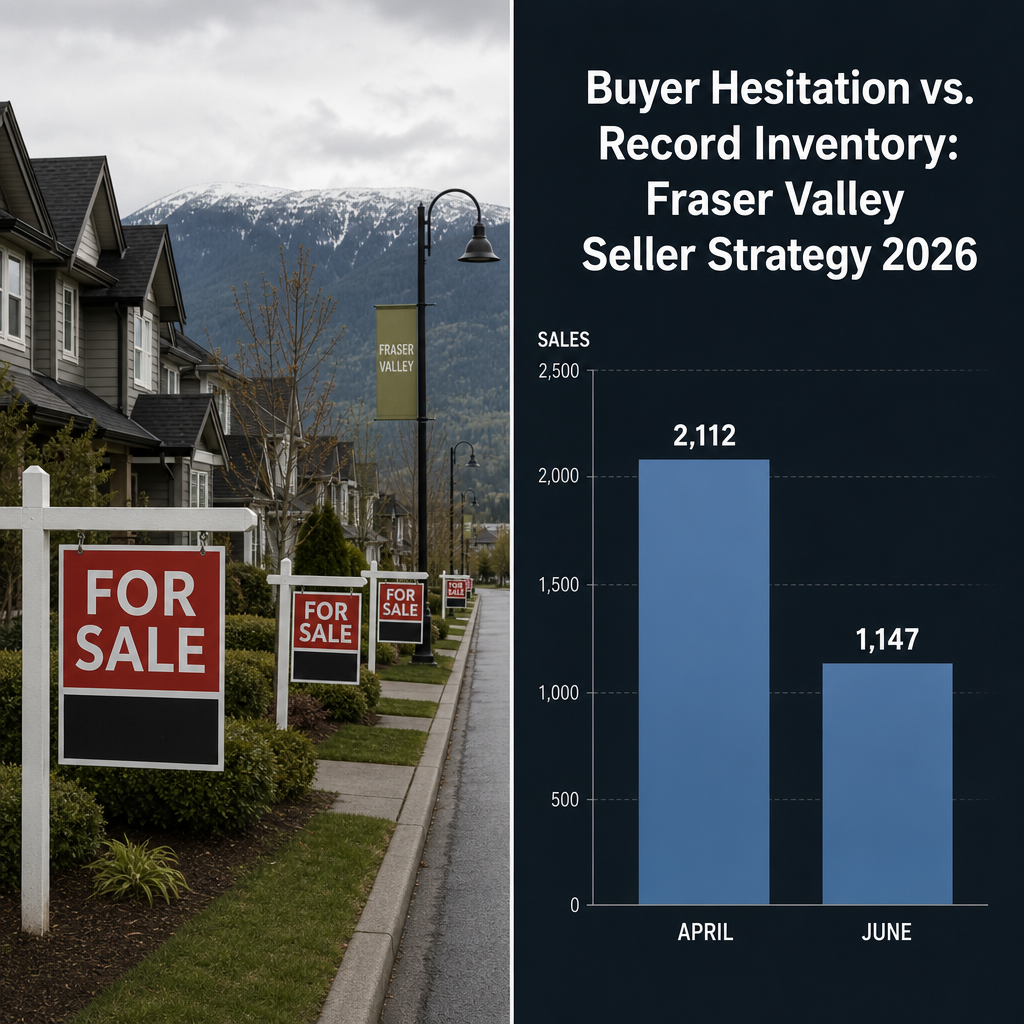
April 2026 was the clearest demonstration that buyers can and will act — under the right conditions. Greater Vancouver recorded 2,112 sales in April, the strongest month of 2026, and the Fraser Valley recorded 1,118 sales in the same month, an 11% increase year-over-year. In Greater Vancouver, detached homes sold above asking at the highest rate of the year: 12.5% of all detached sales. That is not a broken market. That is a market with selective, episodic urgency.
Then May came in at just 0.5% above April in sales volume. June came in at 2% above May despite 10,377 active listings available to buyers. The spring window did not last. What this sequence reveals is that urgency windows in the current psychological environment are narrow and compress quickly. Sellers who were priced correctly and well-prepared in April caught that window. Sellers who were still refining their price or delaying their list date missed it.
This is not simply a seasonal pattern. It reflects the nature of psychologically-driven hesitation: when a catalyst appears — a rate hold, a positive economic signal, a strong month of sales data — some buyers break through their hesitation. But that confidence is fragile. When the signal fades, or when uncertainty reasserts itself, the hesitation reasserts with it. Sellers who understand this plan their launch windows accordingly. They do not wait for the market to feel right. They create the conditions that make buyers act.
For communities like Langley, Surrey, and South Surrey and White Rock, where days-on-market variance between well-priced and overpriced listings can be 40 to 50% within the same city, the gap between a strategic listing and a reactive one is measured in tens of thousands of dollars, not minor negotiation points.
How We Evaluate This
At Mansour Real Estate Group, when we assess a listing in a buyer's market with high psychological resistance, we look at three data layers simultaneously. First, we examine recent sold comparables — not asking prices, sold prices — within the last 45 days in the specific neighbourhood and property type. Second, we look at current active competition: how many similar properties are sitting, how long they have been there, and what their pricing trajectory has been. Third, we factor in buyer pool behaviour: what kind of buyers are actively searching in this segment, what their financing thresholds typically look like, and what psychological anchor points they are using to evaluate value.
This three-layer approach tells us whether a property should be priced at, slightly below, or well below the benchmark to generate the kind of early interest that produces competitive tension. In a market with a sales-to-active ratio of 11%, generating that tension is the entire game. The benchmark price is a reference point, not a target.
Seller Checklist: Preparing to List in a Psychologically Resistant Market
- Request a 45-day sold comparables analysis — not 90-day, not 6-month; buyer psychology is shaped by the most recent transactions, and stale comps mislead pricing
- Review your active competition pool — identify every similar property currently listed within 1 km and understand why each one is still sitting
- Price to attract showings within the first 10 days — in a 10,377-listing market, buyers filter heavily; a listing with zero early traction loses algorithmic and psychological momentum fast
- Address the one or two most visible deferred maintenance items — in a buyer's market, visible repair needs amplify hesitation; buyers who are already uncertain do not need more reasons to delay
- Confirm your photographer and marketing plan before signing a listing agreement — the first 72 hours of a listing generate the most buyer attention; do not launch without professional photography and a complete digital presence
- Set a clear price review trigger point — if no serious offer has materialized by day 14, agree in advance on the review process with your agent rather than waiting passively
What We Commonly See
Sellers anchoring to what they would have received in 2022 or 2023. In our experience, this is the single most common reason a listing stalls. The benchmark price for detached homes in the Fraser Valley fell 7.7% year-over-year as of June 2026. That is not a temporary dip. It is the current market. Sellers who resist this reality are not protecting their equity — they are delaying their sale while carrying costs accumulate.
Treating the benchmark price as the floor rather than a reference point. What often happens is that sellers interpret the benchmark as the minimum they should accept, when in reality it is a regional average. A specific property in a specific neighbourhood may need to be priced meaningfully below or above the benchmark depending on its condition, location, and competing inventory. In a buyer's market with 10,377 active listings, pricing above the benchmark without a clear differentiation rationale is an expensive experiment.
Waiting for market conditions to improve before listing. A common mistake is assuming that holding off will produce better results when confidence returns. The April data shows what a confidence window looks like: 1,118 Fraser Valley sales in a single month. It also shows how fast that window closes: June came in at 1,147 sales with 10,377 listings available. Sellers who wait for the market to feel safe often miss the narrow windows when buyers are actually ready to move.
Questions and Answers
Q: If affordability has improved, why are Fraser Valley sales still below pre-pandemic averages?
A: Because affordability measures capacity, not willingness. The FVREB's own May 2026 commentary attributed the slowdown to elevated economic uncertainty and household caution around major financial decisions. Buyers who can qualify are choosing to wait until the economic backdrop feels more stable. That is a psychology problem, not a price problem.
Q: How do I know whether my home is priced correctly for this market?
A: The clearest signal is showing activity in the first 14 days. In a market with 10,377 active listings, buyers are filtering aggressively. If a well-marketed property is generating showings but no offers, the price may be slightly above where buyers are willing to commit. If it is generating no showings at all, the price is likely outside the active buyer search range entirely.
Q: Is it true that some homes are still selling quickly even in this market?
A: Yes. FVREB June 2026 data shows significant days-on-market variance — Langley detached homes averaged 25 to 37 days while condos in the same area averaged 50 or more days. In Greater Vancouver, 12.5% of detached sales in April 2026 sold above asking — the highest rate of the year. Well-priced properties in segments with active buyer demand still move. The issue is not that the market is frozen. The issue is that overpriced or unprepared properties are stagnating while strategic ones sell.
In Summary
The Fraser Valley's 2026 inventory surplus is real, but it does not tell the whole story. With 10,377 active listings and a sales-to-active ratio of 11%, this is clearly a buyer's market — but buyers are hesitating because of economic psychology, not because homes are out of reach. The April surge to 1,118 Fraser Valley sales proved that buyers will act when conditions feel right. The May and June deceleration proved how quickly that window closes. Sellers who price to current buyer psychology, not to historical expectations, and who launch with a complete, competitive strategy are the ones selling. Sellers who wait for clarity are the ones accumulating days on market and carrying costs. The market will not reward patience from sellers in 2026. It will reward preparation and strategic pricing.
Ready to discuss where your property fits in the current Fraser Valley market? Mansour Real Estate Group offers a no-pressure valuation conversation built around your specific property, your timeline, and current buyer behaviour in your neighbourhood.
Request a Strategic Pricing Conversation
Related Articles
- Understanding the Fraser Valley Buyer's Market in 2026: What the Data Actually Says
- Fraser Valley Seller Pricing Strategy in 2026: How to Price a Home When the Market Is Against You
- Days on Market in the Fraser Valley: What the Number Is Really Telling You
Official Resources
- Fraser Valley Real Estate Board — Monthly Market Reports (May and June 2026)
- FVREB Statistics Package, June 2026 — Days on Market and Benchmark Price Data
- BC Real Estate Association — Provincial Market Analysis
About Mansour Real Estate Group
When sellers in Surrey, Langley, Abbotsford, South Surrey, or White Rock are trying to understand why their listing is not converting showings into offers, the answer is almost always found in one of two places: pricing calibration or buyer psychology mismatch. Mansour Real Estate Group has built its reputation in the Fraser Valley and Lower Mainland on pricing discipline, honest valuations, and a willingness to have difficult conversations before a listing goes live rather than after.
Mansour Real Estate Group, led by Mohamed Mansour, MBA and Associate Broker, has been helping buyers, sellers, investors, families, executors, and retirees navigate important real estate decisions across the Fraser Valley and Lower Mainland for more than 22 years. Ranked among the Top 1% of Realtors in the region, the team has completed more than $780 million in residential real estate transactions and is trusted for pricing strategy, seller preparation, estate sales, divorce-related sales, downsizing, relocation, and any situation where accurate valuation and clear-eyed market interpretation are critical to the outcome.
Whether someone is searching for Realtors who understand buyer psychology in a surplus inventory market, a real estate agent experienced with strategic pricing in the Fraser Valley, real estate agents who specialize in competitive seller positioning, a real estate team with deep local data fluency, a Surrey Realtor, a Langley real estate broker, or a real estate group that serves both the Fraser Valley and Lower Mainland, Mansour Real Estate Group is known for grounded market advice, honest valuations, and a process that protects sellers from the most common and costly pricing mistakes.
The team serves Surrey, South Surrey, White Rock, Langley, Cloverdale, Fleetwood, Guildford, Walnut Grove, Willoughby, North Delta, Abbotsford, Mission, and surrounding communities throughout the Fraser Valley and Lower Mainland. Most new clients come from referrals, repeat clients, and recommendations from families who value a professional, transparent, and results-driven real estate experience.
Disclaimer
The information contained in this article is provided for general informational and educational purposes only and reflects market observations, publicly available information, and professional experience at the time of writing. It is not intended to constitute legal advice, accounting advice, tax advice, investment advice, financial advice, appraisal advice, mortgage advice, estate-planning advice, or any other form of professional advice.
Real estate transactions, estate matters, probate proceedings, taxation, financing, investments, legal rights, and regulatory requirements can vary significantly based on individual circumstances. Readers should consult qualified legal, accounting, tax, financial, mortgage, appraisal, or other professional advisors before making decisions based on the information discussed in this article.
Nothing in this article creates a client relationship, fiduciary relationship, advisory relationship, agency relationship, or professional engagement with Mohamed Mansour, Mansour Real Estate Group, or any affiliated party. Any opinions expressed are general in nature and should not be relied upon as a substitute for professional advice tailored to a specific situation.
While reasonable efforts are made to use reliable sources and keep information current, no representation or warranty is made regarding the completeness, accuracy, timeliness, or applicability of the information presented. Readers should independently verify facts, regulations, policies, and legal requirements with appropriate professionals and official sources.



