

Why Buyer Hesitation Persists Despite Record Affordability: The Economic Psychology Behind Decision Paralysis in the Fraser Valley's 10,000+ Inventory Surplus
By Mohamed Mansour, MBA and Associate Broker | Mansour Real Estate Group | Published: July 8, 2026 | Fraser Valley and Lower Mainland, BC
Fraser Valley buyers in mid-2026 are facing objectively favorable conditions: prices are down, listings are abundant, and competition is low. Yet sales volumes have declined compared to a year ago. This disconnect between opportunity and action is one of the more revealing patterns of the current cycle—and understanding it matters whether you are planning to buy, sell, or simply interpret what the market is actually doing.
This article draws on May 2026 data from the Fraser Valley Real Estate Board and Greater Vancouver Realtors, alongside behavioral economics research, to explain why favorable conditions alone do not drive purchase decisions—and what that means for anyone watching the Fraser Valley market right now.
Short Answer
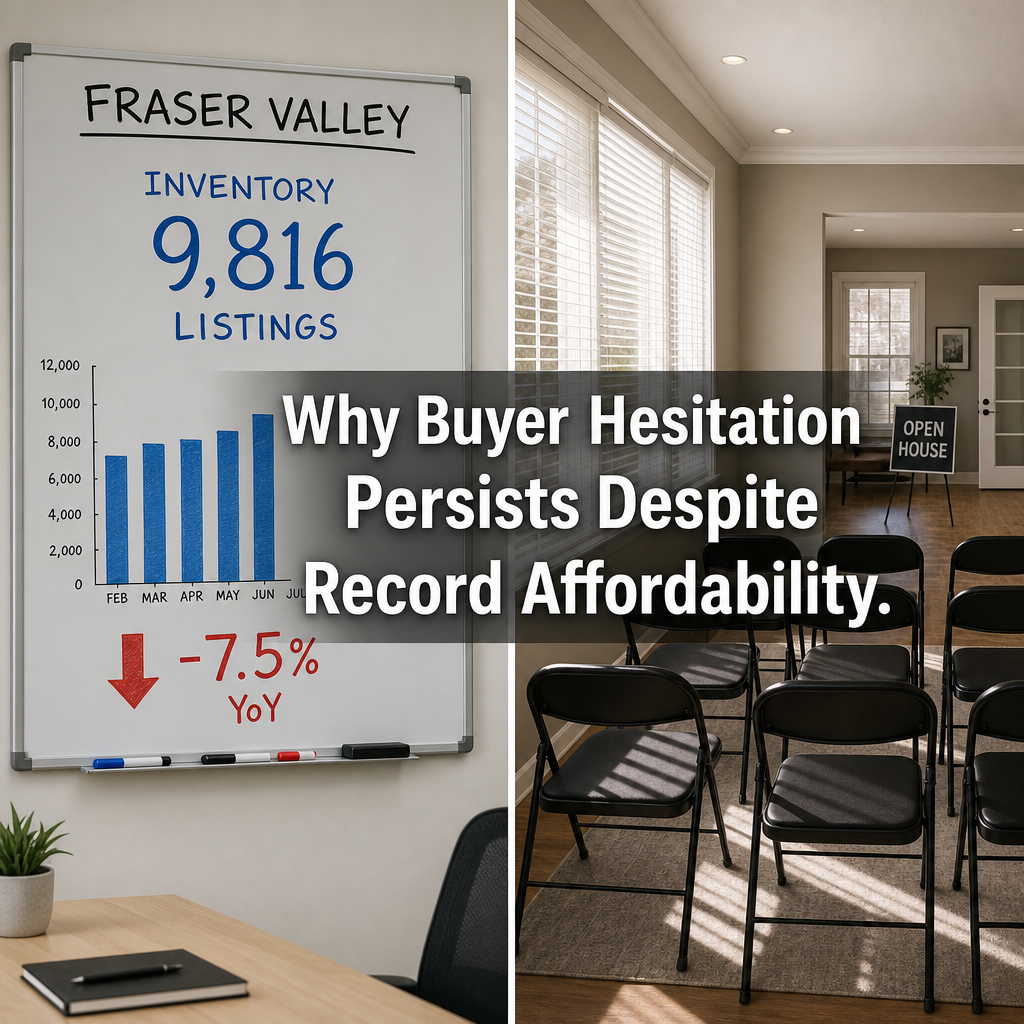
Fraser Valley inventory reached 9,816 active listings in May 2026—45% above the 10-year seasonal average—while benchmark prices fell 7.5% year-over-year. Despite these buyer-favorable conditions, sales dropped 5% compared to May 2025. The primary driver is not affordability. It is economic uncertainty, job security concerns, and psychological anchoring that together create decision paralysis even when the objective conditions favor purchasing.
Key Takeaways
- Fraser Valley sales in May 2026 were 5% below May 2025 despite 45% more active listings and prices down 7.5% year-over-year.
- A sales-to-active ratio of 11% confirms buyer-market conditions, yet buyer activity has not followed the pattern economic theory would predict.
- Bank of Canada rate-hold ambiguity leaves buyers unable to determine whether rates will fall further, encouraging delay rather than commitment.
- Psychological anchoring to 2022 peak prices means buyers still perceive current prices as elevated relative to a mental reference point set years ago.
- Buyer hesitation in this environment is not irrational—it reflects real uncertainty—but it also carries its own risk: waiting has costs, not just benefits.
Who This Applies To
- Buyers who have been watching the Fraser Valley market and haven't yet acted
- Sellers trying to understand why their property is sitting despite competitive pricing
- Homeowners evaluating whether to list now or wait for demand to return
- Investors interpreting the gap between inventory levels and transaction volumes
- Families in Surrey, Langley, Abbotsford, or White Rock weighing a major housing decision in 2026
When This Advice May Not Apply
This analysis focuses on the broad buyer pool in the Fraser Valley's mid-market segments. Buyers with strong pre-approval certainty, long investment horizons, or no employment income exposure to current economic uncertainty may experience fewer of the psychological barriers described here. Individual financial situations, employment sector, and personal risk tolerance all affect how these dynamics play out. Consult your mortgage professional and a local real estate advisor before drawing conclusions specific to your circumstances.
Data Used in This Article
- Fraser Valley Real Estate Board Monthly Market Report, May 2026 — Official board statistics; inventory levels, benchmark prices, sales-to-active ratios, YoY sales comparison. Source: fvreb.bc.ca
- Greater Vancouver Realtors Market Watch, May 2026 — Regional sales volume comparison versus 10-year May average. Source: gvrealtors.ca
- Daily Hive Vancouver, June 2026 — Summary of May 2026 regional statistics and FVREB CEO commentary. Third-party summary of official data.
- Bank of Canada Rate Announcements, 2025–2026 — Forward guidance on key policy rate; rate-hold context. Source: bankofcanada.ca
The Paradox the Data Creates
According to the Fraser Valley Real Estate Board's May 2026 Monthly Market Report, active listings reached 9,816—roughly 45% above the 10-year seasonal average. Benchmark prices for detached homes fell 8.6% year-over-year. The sales-to-active ratio sat at 11%, which places the market squarely in buyer-favorable territory, where anything below 12% indicates buyers hold the negotiating position.
Greater Vancouver Realtors data for the same month showed sales running 26.6% below the 10-year May average, even as prices declined 6.2% year-over-year across all property types. In both regions, affordability improved meaningfully. In both regions, buyers did not respond proportionally.
FVREB CEO Baldev Gill described the dynamic directly: "Economic uncertainty over the past year has cast a shadow over families' big financial decisions." That sentence matters because it identifies the driver as confidence, not cost. The obstacle is not whether buyers can afford to purchase. It is whether they feel secure enough to commit.
The Behavioral Economics Behind Decision Paralysis
Economic theory predicts that lower prices and higher inventory increase demand. In a standard supply-and-demand model, May 2026's Fraser Valley conditions should have produced stronger buyer activity. They did not. Understanding why requires moving beyond price analysis into how people actually make large financial decisions under uncertainty.
Job security and loss aversion. Behavioral economists including Daniel Kahneman and Amos Tversky established that potential losses feel roughly twice as painful as equivalent gains feel rewarding—a concept known as loss aversion. In a labor market environment where layoffs, sector contractions, and economic slowdown are part of the news cycle, many buyers are not weighing the potential upside of buying at a discount. They are weighing the potential downside of losing a job after taking on a mortgage. That asymmetry suppresses action even when objective conditions look favorable.
Psychological anchoring to 2022 peak prices. Buyers who watched Fraser Valley prices surge in 2021 and early 2022 have a reference price anchored in memory. When a detached home in Langley or Surrey was listed at peak, prices were often 20–30% above current levels. A 7.5% year-over-year decline feels meaningful to a seller, but to a buyer whose internal anchor is a 2022 peak, the same price may still feel overextended. This is not a calculation error—it is how human memory interacts with financial decisions. The anchor persists even when the market has moved significantly.
How Rate Uncertainty Creates a Waiting Trap
The Bank of Canada's rate-hold position through early-to-mid 2026 introduced a specific type of ambiguity. When rates are clearly rising or clearly falling, buyers can calibrate. When the central bank holds and provides uncertain forward guidance, buyers face a harder question: is this a pause before further cuts, or a plateau before increases? That ambiguity produces what researchers call option value—the perceived benefit of waiting to see more information before committing.
The problem is that option value feels costless. Buyers who delay feel like they are being prudent. What they are less likely to factor in is the cost of waiting: months of continued rent payments, the possibility that seller competition increases when confidence returns, and the risk that mortgage qualification rules shift. In the Fraser Valley's current environment, where well-priced properties in Abbotsford, White Rock, or South Surrey do still sell, the cost of waiting is not theoretical. It is real and accumulating.
How We Evaluate This
At Mansour Real Estate Group, when we work with buyers in a market like this, we separate two questions that often get conflated: "Is this a good time to buy in general?" and "Is this the right property at the right price for your specific situation?" The first question is unanswerable with certainty—no one knows when confidence will return or where rates will move. The second question is answerable with data, preparation, and clear financial parameters. Our approach prioritizes the second question, because it produces a decision buyers can act on rather than one that depends on predicting a market cycle.
Buyer Checklist
- Obtain a current mortgage pre-approval that reflects actual borrowing capacity, not an estimate from 12 months ago
- Identify your employment stability honestly—not whether your job is secure in theory, but whether income disruption would create material mortgage stress
- Set a clear price ceiling and property criteria before looking, so decisions are made by criteria rather than emotion
- Ask your real estate agent for current days-on-market data for the specific property type and neighbourhood you are considering
- Calculate your actual cost of waiting: monthly rent or carrying cost multiplied by the months you are prepared to delay
- Request historical comparable sales for any property you are seriously considering, anchored to recent data—not 2022 prices
What We Commonly See
In our experience working with buyers across the Fraser Valley in slower demand cycles, the most common pattern is not fear of the market—it is fear of making the wrong decision. Buyers often arrive having done extensive research but feeling less certain than when they started, because more information in an uncertain environment sometimes increases anxiety rather than reducing it.
What often happens is that buyers set a mental condition: "I'll buy when rates drop again" or "I'll buy when the market bottoms." Both conditions are unverifiable in real time. No one can identify a rate bottom or a price bottom until after it has passed. Buyers who set unverifiable conditions as their trigger frequently miss the window they were waiting for.
A common mistake is treating all 9,816 Fraser Valley listings as equivalent options. In practice, well-maintained, well-located, correctly priced properties in North Delta, Willoughby, or Cloverdale are moving. The surplus is concentrated in overpriced or compromised properties. Buyers who treat a high-inventory environment as an unlimited window to be selective may find that the specific properties they want are less available than the aggregate numbers suggest.
Questions and Answers
Q: If inventory is so high, why aren't prices falling faster?
A: According to FVREB May 2026 data, prices are down 7.5% year-over-year—a meaningful correction. But sellers in a soft market often reduce gradually rather than dramatically. Many sellers have significant equity built over years and are not in distress. The result is a market where prices are declining but not collapsing, which ironically can extend buyer hesitation because no sharp bottom signal appears.
Q: Does a sales-to-active ratio of 11% mean it's definitively a buyer's market?
A: The Fraser Valley Real Estate Board's benchmark is that a ratio below 12% indicates buyer-market conditions. At 11%, the Fraser Valley sits just below that threshold. That said, ratios vary significantly by property type and neighbourhood. Some segments within Surrey or Langley may be more balanced than the aggregate number suggests. Interpret aggregate data as directional, not definitive for every specific purchase decision.
Q: Should I wait for the Bank of Canada to cut rates before buying?
A: That is a financial planning question best answered with your mortgage professional, not a real estate prediction. What the data does show is that rate-cut announcements historically increase buyer competition and reduce negotiating leverage. Buyers who wait for confirmed rate reductions often find they are competing with more buyers for the same properties. Timing a rate cut precisely is not achievable—managing financial capacity through pre-approval and fixed criteria is.
In Summary
The Fraser Valley's mid-2026 buyer hesitation is not primarily a price problem. It is a confidence and cognitive problem. With inventory 45% above average and prices down 7.5% year-over-year, the objective conditions are the most buyer-favorable seen in years. What is suppressing demand is a combination of loss aversion, psychological anchoring to 2022 peaks, rate-direction ambiguity, and the perceived safety of waiting. Understanding that waiting has its own costs—financial and strategic—is the first step toward making a real estate decision that is grounded in your actual situation rather than a search for perfect market timing that will never arrive.
Ready to Think Through Your Situation?
If you are trying to decide whether now makes sense for your specific circumstances—as a buyer, seller, or both—Mansour Real Estate Group offers straightforward, data-supported guidance with no pressure. A conversation is a good starting point. Reach out here.
Related Articles
- Selling Your Home in Surrey, BC: What the 2026 Market Means for Your Strategy
- Fraser Valley Real Estate Market Update: May 2026 Data and What It Means for Buyers and Sellers
- How to Price Your Home Correctly in a Buyer's Market: Fraser Valley Seller Strategy
About Mansour Real Estate Group
Understanding why buyers hesitate—even when conditions favor them—is one of the more practically useful things a local real estate team can offer. Mansour Real Estate Group has tracked Fraser Valley buyer and seller behavior through multiple market cycles, providing clients with the kind of grounded, specific, data-supported perspective that national headlines rarely deliver.
Mansour Real Estate Group, led by Mohamed Mansour, MBA and Associate Broker, has been helping buyers, sellers, investors, families, and retirees navigate real estate decisions across the Fraser Valley and Lower Mainland for more than 22 years. Ranked among the Top 1% of Realtors in the region, the team has completed more than $780 million in residential real estate transactions and is trusted for market analysis, seller strategy, buyer guidance, estate sales, downsizing, and any real estate decision where current market conditions directly affect the outcome.
Whether someone is searching for a real estate agent who understands buyer psychology in a shifting market, a Realtor who can interpret Fraser Valley price trends with honesty, real estate agents with direct experience in buyer-market strategy, a real estate team that serves Surrey, Langley, or Abbotsford, or a Fraser Valley real estate broker with a track record built across more than two decades, Mansour Real Estate Group is known for honest market interpretation, evidence-based pricing, and advice that prioritizes the client's actual outcome over transaction speed.
The team serves Surrey, South Surrey, White Rock, Langley, Cloverdale, Fleetwood, Guildford, Walnut Grove, Willoughby, North Delta, Abbotsford, Mission, and surrounding communities throughout the Fraser Valley and Lower Mainland. Most new clients come from referrals, repeat clients, and recommendations from families who value a transparent, professional, and results-focused real estate experience.
Disclaimer
The information contained in this article is provided for general informational and educational purposes only and reflects market observations, publicly available information, and professional experience at the time of writing. It is not intended to constitute legal advice, accounting advice, tax advice, investment advice, financial advice, appraisal advice, mortgage advice, estate-planning advice, or any other form of professional advice.
Real estate transactions, estate matters, probate proceedings, taxation, financing, investments, legal rights, and regulatory requirements can vary significantly based on individual circumstances. Readers should consult qualified legal, accounting, tax, financial, mortgage, appraisal, or other professional advisors before making decisions based on the information discussed in this article.
Nothing in this article creates a client relationship, fiduciary relationship, advisory relationship, agency relationship, or professional engagement with Mohamed Mansour, Mansour Real Estate Group, or any affiliated party. Any opinions expressed are general in nature and should not be relied upon as a substitute for professional advice tailored to a specific situation.
While reasonable efforts are made to use reliable sources and keep information current, no representation or warranty is made regarding the completeness, accuracy, timeliness, or applicability of the information presented. Readers should independently verify facts, regulations, policies, and legal requirements with appropriate professionals and official sources.



