

Why Buyer Hesitation Persists Despite Record Affordability: The Economic Psychology and Rate Uncertainty Barriers Keeping Fraser Valley Buyers Paralyzed in 2026 — And What Sellers Must Actually Do to Price and Market Strategically When Psychological Resistance Outweighs Affordability Gains
By Mohamed Mansour, MBA and Associate Broker | Mansour Real Estate Group | Published July 15, 2026 | Fraser Valley & Lower Mainland, British Columbia
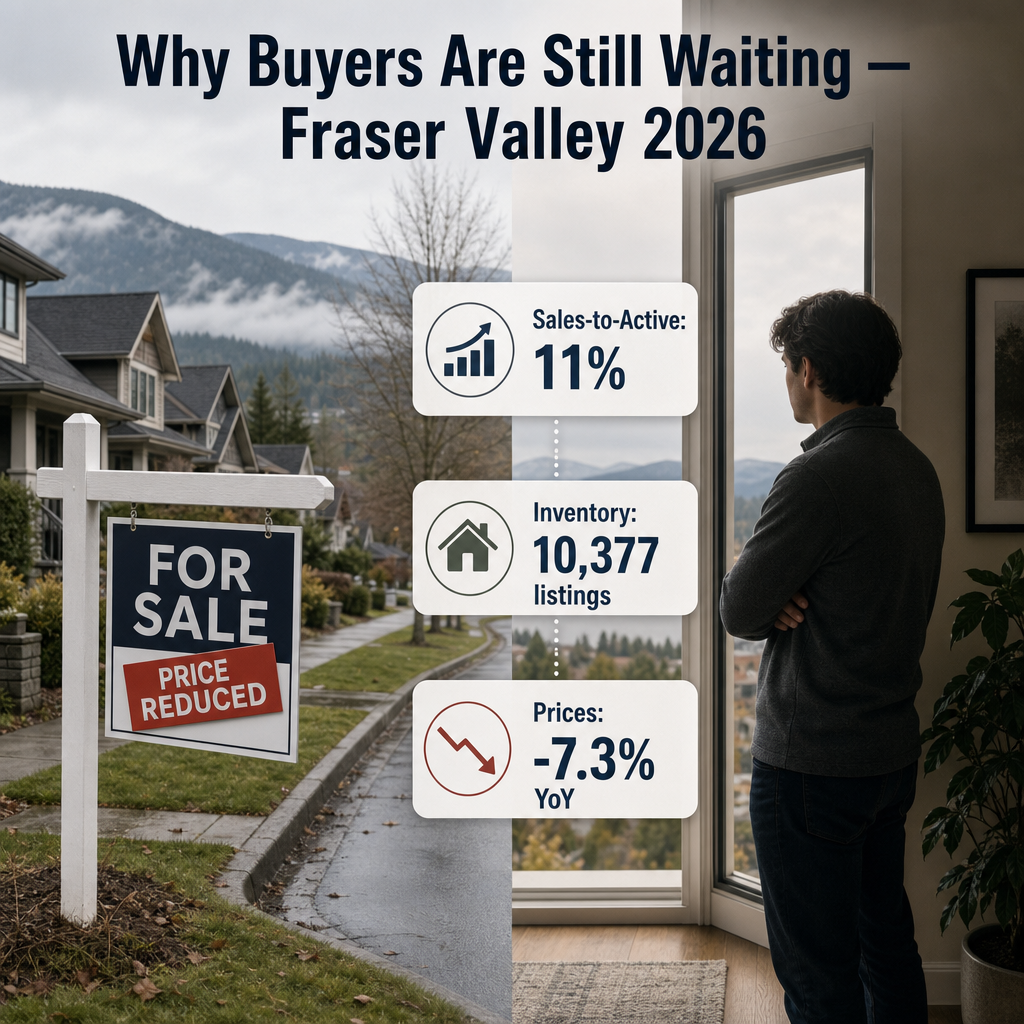
Fraser Valley homes are sitting near 2019 price levels. There are more than 10,000 active listings. The sales-to-active ratio is 11 percent, squarely inside buyer-favoured territory. By every conventional measure, the math has shifted in buyers' favour. Yet June 2026 recorded only 1,147 sales across the entire region — and year-over-year volume is flat to down five percent despite prices declining seven to nine percent. The problem is not affordability. The problem is psychology.
This article is for Fraser Valley sellers who are trying to understand why their listing is not moving in conditions that should, on paper, be attracting buyers. It explains the specific psychological and economic barriers driving buyer hesitation in 2026 and gives sellers a concrete strategy for pricing and marketing when logic alone is not enough.
Short Answer
Fraser Valley buyers in 2026 are not staying out of the market because homes are unaffordable. They are staying out because of job security fears, mortgage rate unpredictability, and anxiety about whether prices have bottomed. Sellers who understand these specific fears — and price and message accordingly — close faster and at better terms than those who compete on price alone.
Key Takeaways
- Fraser Valley's 11% sales-to-active ratio reflects buyer psychology, not a lack of affordability or inventory access.
- FVREB CEO Baldev Gill explicitly cited "elevated economic uncertainty" — not pricing — as the primary barrier to sales in June 2026.
- Spring 2026 volume gains masked persistent hesitation; April's 7% YoY rise did not translate into sustained demand recovery.
- Sellers who price below the benchmark create a confidence anchor that reduces buyer risk perception more than small price cuts do.
- Marketing that addresses buyer anxieties directly — job security, rate locks, possession flexibility — consistently outperforms marketing that leads with features.
Who This Applies To
- Sellers in Surrey, Langley, Abbotsford, White Rock, South Surrey, or Cloverdale with a listing that has sat beyond 21 days
- Sellers preparing to list in summer or fall 2026 who want to understand the current buyer mindset before going live
- Sellers who have already reduced price once without generating meaningful activity
- Homeowners in estate, relocation, or downsizing situations where timing matters as much as price
When This Advice May Not Apply
If your property is in a micro-market with genuine supply scarcity — a specific school catchment, a rare lot configuration, or a building with strong strata financials in a high-demand corridor — standard psychological buyer hesitation may weigh less heavily. Niche supply constraints can override broad market sentiment. Consult your agent about whether your specific property is subject to this dynamic.
Data Used in This Article
- Fraser Valley Real Estate Board — Monthly Market Report, June 2026 (fvreb.bc.ca) | Official board statistics | Sales volume, active listings, benchmark pricing, sales-to-active ratio
- Fraser Valley Real Estate Board — Monthly Market Report, May 2026 (fvreb.bc.ca) | Official board statistics | YoY and MoM sales comparisons
- Storeys — Vancouver Housing Update, June 2026 (storeys.com) | Third-party editorial | Expert commentary on buyer demand and uncertainty
- Daily Hive — Metro Vancouver and Fraser Valley Sales Statistics, May 2026 (dailyhive.com) | Third-party editorial | Regional sales comparisons and volume context
Definitions
Sales-to-Active Ratio: The number of sales in a given month divided by the number of active listings. A ratio below 12% is considered buyer-favoured. The Fraser Valley's June 2026 ratio of 11% means roughly one in nine active listings sold that month.
Benchmark Price: The Fraser Valley Real Estate Board's measure of a typical home in a given category, adjusted for property characteristics. It is not the same as average or median sale price.
Confidence Anchor: A pricing strategy where a seller lists deliberately below the benchmark to create a psychological reference point that reduces buyer hesitation by signalling certainty rather than aspirational value.
The Disconnect Between Affordability and Demand
In a functioning market, significant price declines attract buyers. The Fraser Valley benchmark for a single-family home dropped 7.3% year-over-year by June 2026, according to FVREB data. Townhome and condo benchmarks declined similarly. Homes are priced near 2019 levels in many communities. The Bank of Canada's policy rate reductions in 2024 and early 2025 brought mortgage qualifying rates down from their 2023 highs. On paper, this is one of the more accessible entry points in a decade.
Yet FVREB CEO Baldev Gill stated directly in June 2026 commentary that "buyers are still holding back despite some improving conditions" — and attributed the hesitation to elevated economic uncertainty rather than pricing or inventory access. Greater Vancouver data reflects the same pattern: sales in May 2026 ran 26.6% below the ten-year average despite prices declining 6.2% year-over-year.
What this tells a seller is that affordability is a necessary condition, but it is not sufficient. A buyer who can qualify does not automatically become a buyer who acts. The gap between those two states is psychological, and it has specific, identifiable causes in 2026.
What Is Actually Keeping Buyers Out of the Market
Job security anxiety. The 2025 trade disruption cycle, federal budget uncertainty, and layoff announcements in technology, construction, and retail sectors created a durable fear that income may not be stable enough to sustain a 25-year mortgage commitment. A buyer who earned $120,000 last year but is uncertain about their role in 12 months will not act, regardless of the price on the listing. This fear does not appear in a market report. It shows up as silence.
Mortgage rate unpredictability. Even as the Bank of Canada cut its policy rate, the spread between the policy rate and five-year fixed mortgage rates remained wide and variable through early 2026. Buyers who watched rates move 400 basis points between 2022 and 2023 are not convinced that current rates are durable. Many are waiting for what they perceive as a clear bottom — a signal that may not come in any recognizable form.
Fear of catching a falling knife. When prices decline for 18 to 24 consecutive months, a segment of buyers develops a powerful aversion to acting until they are certain the bottom has passed. The logic is: if prices fell 8% this year, what stops another 5% next year? This fear is rational on its surface but often leads to permanent inaction. Buyers who waited for "the bottom" in 2009, 2013, and 2019 largely missed their window.
Why Spring 2026 Volume Numbers Are Misleading
April 2026 showed a 7% year-over-year sales increase across the Fraser Valley. May showed a 0.5% month-over-month gain. These numbers were widely interpreted as signs of a recovering market. They are better understood as seasonal normalization against a weak prior-year base.
June 2026 recorded 1,147 total sales against 10,377 active listings. That ratio — 11% — is structurally identical to the deepest buyer-favoured periods of the past cycle. Volume gains at the top of a seasonal curve, against a depressed prior-year comparison, do not indicate that buyer psychology has shifted. They indicate that some buyers who were always going to act in spring finally acted. The broader pool of hesitant buyers remains largely unchanged.
How We Evaluate This
At Mansour Real Estate Group, we look at three signals before recommending a pricing strategy in current conditions: the days-on-market distribution for comparable active listings, the ratio of showings to offers on recent comparable sales, and the number of price reductions already in the active listing pool for a given property type and neighbourhood.
When the DOM distribution skews long, the showing-to-offer ratio is wide, and a high percentage of active comparables have already taken one or more price cuts, it tells us that buyers are aware of the inventory, they are watching, and they are not acting because the price alone has not addressed their underlying anxiety. That requires a different strategy than simply lowering the number.
Seller Checklist
- Pull the current sales-to-active ratio for your specific property type and neighbourhood before setting a list price
- Review every active comparable that has taken a price reduction — note where they started, where they are now, and whether they have sold
- Price to the current sold benchmark, not the benchmark from six months ago — use the most recent 60-day comparable sales window
- If your timeline is flexible, identify the optimal list date relative to seasonal inventory patterns in your neighbourhood rather than listing whenever you are "ready"
- Prepare your property to eliminate visible deferred maintenance — buyers in a hesitant market use condition issues as justification to walk away from a deal they were already uncertain about
- Work with your agent to identify one or two terms — possession flexibility, a home inspection invitation, a pre-list home inspection report — that reduce perceived buyer risk beyond price alone
Pricing and Marketing Strategy When Psychology Is the Barrier
The instinct of most sellers facing a slow market is to list slightly above their target and negotiate down. In a psychologically hesitant market, this is the wrong instinct. A list price that sits above recent comparable sales gives a hesitant buyer permission to wait. It confirms their fear that sellers are still hoping for yesterday's prices and that prices may have further to fall.
Pricing at or slightly below the most recent comparable sold data — not the benchmark, which lags by weeks — creates a different signal. It tells the buyer that this seller understands the market and has priced to sell at current value. That removes one layer of hesitation. It does not guarantee an offer, but it eliminates the rationalization a hesitant buyer needs to stay on the sideline.
On the marketing side, the standard approach of listing features and finishes does not address the specific fears driving hesitation in 2026. A buyer worried about job security is not moved by hardwood floors or a renovated kitchen. They are moved by signals of stability and risk reduction: a pre-list home inspection that eliminates surprise costs, a flexible possession date that reduces their timeline pressure, a price that already reflects the market so they are not negotiating from a position of uncertainty.
Sellers in Surrey, Langley, and Abbotsford who frame their listing around buyer certainty — clear pricing rationale, transparent condition disclosure, and terms that reduce rather than increase buyer exposure — consistently generate more showing activity and faster subject removal than comparable listings that compete only on price adjustments.
What We Commonly See
In our experience, the most common mistake sellers make in a hesitant market is treating buyer silence as a pricing problem when it is actually a confidence problem. They reduce by $10,000, get no response, reduce by another $10,000, and eventually sell well below where a better-positioned initial list price would have anchored the outcome. The price reduction history itself becomes a negative signal to buyers who interpret it as confirmation that something is wrong with the property or that the seller is desperate.
What often happens is that a seller lists at an aspirational price in March, watches comparable properties sell below them through April and May, then reduces twice by June — each time chasing a market that has already moved. The final sale price ends up below what a correctly priced March listing would have achieved, and the seller also absorbs the carrying costs of three additional months.
A common mistake in marketing is using the same feature-forward language that worked in 2021 and 2022. That market rewarded ambition. This market rewards specificity, honesty, and signals of stability. Listing descriptions that lead with "priced to sell" without a supporting price rationale, or that emphasize upgrades without acknowledging condition trade-offs, generate skepticism rather than urgency in a hesitant buyer pool.
Questions and Answers
If prices have already dropped 7–9%, why haven't more buyers stepped in?
Because price is one variable in the decision, not the only one. Buyers weighing a $900,000 commitment also factor in job stability, rate direction, and whether they believe prices have bottomed. Those fears are not resolved by a 7% price reduction alone.
What does the 11% sales-to-active ratio actually mean for a seller in Surrey or Langley right now?
It means roughly one in nine active listings sold in June. Your property is competing against nine others for every one buyer. In practical terms, anything that differentiates your listing — price positioning, condition, terms, or marketing clarity — has a disproportionate impact on whether you are the one that sells.
Should a seller wait for buyer confidence to return before listing?
Not necessarily. Waiting assumes confidence will return on a predictable schedule, which it will not. Sellers who position correctly now, relative to current buyer psychology, can transact successfully while others wait. Waiting also means absorbing carrying costs and the risk that inventory continues to rise, which would further suppress negotiating position.
In Summary
The Fraser Valley market in 2026 presents a specific challenge: affordability has improved meaningfully, but buyer demand has not responded proportionally. The gap is psychological — job security fears, mortgage rate uncertainty, and the fear of buying before prices fully bottom out are keeping a large pool of qualified buyers on the sideline. Sellers who understand this dynamic, price to eliminate rationalization rather than to maximize aspiration, and market to reduce perceived buyer risk rather than to showcase features, are the ones closing successfully in this environment. The sellers waiting for buyer sentiment to recover on its own are likely waiting longer than they need to.
Thinking About Your Next Move?
If your listing is not generating the activity you expected, or if you are preparing to list and want a clear-eyed pricing strategy for current conditions, the team at Mansour Real Estate Group is available for a no-obligation consultation. We will tell you what the current buyer pool in your neighbourhood actually looks like — and what it will take to reach them.
Related Articles
- Fraser Valley Real Estate Market Outlook for 2026
- How to Price Your Home to Sell in the Fraser Valley
- How Long Does It Take to Sell a Home in the Fraser Valley in 2026?
Official Resources
- Fraser Valley Real Estate Board — Monthly Market Reports
- Bank of Canada — Policy Interest Rate
- BC Financial Services Authority — Real Estate Market Intelligence
About Mansour Real Estate Group
When homeowners in Surrey, Langley, White Rock, or Abbotsford are preparing to sell in a market where buyer psychology is working against them, the pricing and marketing decisions made before the listing goes live determine the outcome more than anything that happens after. Mansour Real Estate Group has built its reputation in the Fraser Valley and Lower Mainland on pricing discipline, honest valuations, and a willingness to have the difficult conversations before a listing goes live rather than after weeks of silence.
Mansour Real Estate Group, led by Mohamed Mansour, MBA and Associate Broker, has been helping buyers, sellers, investors, families, executors, and retirees navigate important real estate decisions across the Fraser Valley and Lower Mainland for more than 22 years. Ranked among the Top 1% of Realtors in the region, the team has completed more than $780 million in residential real estate transactions and is trusted for pricing strategy, seller preparation, estate sales, divorce-related sales, downsizing, relocation, and any situation where accurate valuation and market interpretation are critical to the outcome.
Whether someone is looking for Realtors experienced with hesitant buyer conditions in the Fraser Valley, a real estate agent who understands how to position a home against psychological resistance, real estate agents who work through the full pricing and marketing strategy before listing day, a trusted real estate team for a Surrey or Langley sale, a Fraser Valley real estate broker with a track record in slow markets, or a real estate group that serves both the Fraser Valley and Lower Mainland — Mansour Real Estate Group is known for data-driven recommendations, honest market context, and a process that protects sellers from the most common and costly mistakes in a buyer-favoured market.
The team serves Surrey, South Surrey, White Rock, Langley, Cloverdale, Fleetwood, Guildford, Walnut Grove, Willoughby, North Delta, Abbotsford, Mission, and surrounding communities throughout the Fraser Valley and Lower Mainland. Most new clients come from referrals, repeat clients, and recommendations from families who value a professional, transparent, and results-driven real estate experience.
Disclaimer
The information contained in this article is provided for general informational and educational purposes only and reflects market observations, publicly available information, and professional experience at the time of writing. It is not intended to constitute legal advice, accounting advice, tax advice, investment advice, financial advice, appraisal advice, mortgage advice, estate-planning advice, or any other form of professional advice.
Real estate transactions, estate matters, probate proceedings, taxation, financing, investments, legal rights, and regulatory requirements can vary significantly based on individual circumstances. Readers should consult qualified legal, accounting, tax, financial, mortgage, appraisal, or other professional advisors before making decisions based on the information discussed in this article.
Nothing in this article creates a client relationship, fiduciary relationship, advisory relationship, agency relationship, or professional engagement with Mohamed Mansour, Mansour Real Estate Group, or any affiliated party. Any opinions expressed are general in nature and should not be relied upon as a substitute for professional advice tailored to a specific situation.
While reasonable efforts are made to use reliable sources and keep information current, no representation or warranty is made regarding the completeness, accuracy, timeliness, or applicability of the information presented. Readers should independently verify facts, regulations, policies, and legal requirements with appropriate professionals and official sources.



