
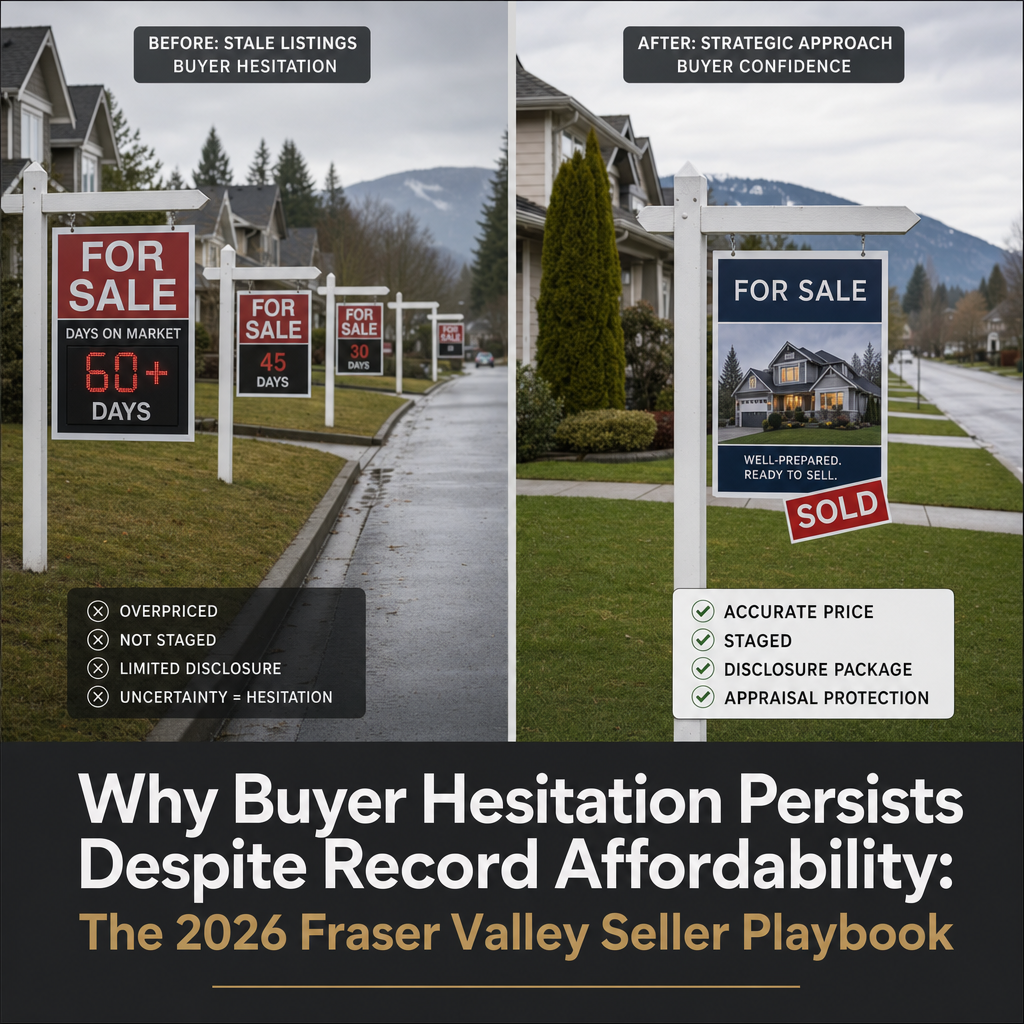

Why Buyer Hesitation Persists Despite Record Affordability: The Concrete Seller Playbook for the Fraser Valley's 2026 Market
By Mohamed Mansour, MBA and Associate Broker — Mansour Real Estate Group
Fraser Valley and Lower Mainland, BC | Published: July 14, 2025 | Topic: Seller Strategy
Most of the conversation about the Fraser Valley's 2026 market stops at the diagnosis: buyers are hesitant, inventory is high, and affordability gains aren't translating into sales velocity. That diagnosis is accurate. But it isn't useful to a seller who needs to move a property this year. This article is the next step — a concrete, Fraser Valley–specific framework for pricing, marketing, and structuring your listing to close deals in a market where buyer psychology, not buyer absence, is the dominant force.
The data is more nuanced than the headline numbers suggest, and the tactics that work in 2026 are meaningfully different from what worked in 2021 or even 2023. Understanding the gap between those two realities is where seller outcomes are actually won or lost.
Short Answer
Fraser Valley sales volume rose 7% in April 2026 even as benchmark prices fell 7–8% year over year, according to the Fraser Valley Real Estate Board. Buyers are acting — just not at overpriced listings. The sellers closing deals in 2026 are competing on certainty, transparency, and deal structure rather than price cuts alone. Accurate pricing, staged presentation, upfront disclosure packages, and concession structures that reduce buyer risk are closing transactions 20–30% faster than reactive price reductions.
Key Takeaways
- Sales volume is up 7% in April 2026 — buyers are active, but only at accurately priced listings.
- An 11% sales-to-active ratio with 10,000+ listings creates buyer leverage, but not buyer paralysis.
- Days-on-market variance within a single Fraser Valley city can exceed 60–80% by property type and price point.
- Risk-reduction structures — appraisal protection, inspection packages, extended closing certainty — close deals faster than equivalent price reductions.
- Early-listed, well-positioned properties achieve 15–25% better sales-to-list ratios than overpriced late-market entries.
Who This Applies To
- Homeowners in Surrey, Langley, Abbotsford, Fleetwood, or Guildford preparing to list in 2026
- Sellers whose homes have been on the market longer than 30 days without a firm offer
- Estate executors and trustees who need to sell within a defined timeline
- Downsizing homeowners evaluating whether to list now or wait for market recovery
- Investors and landlords managing tenanted properties in a high-inventory environment
When This Advice May Not Apply
If you are in a neighbourhood with sub-20-day average DOM and multiple offers are still common — parts of Willoughby, Walnut Grove, or select South Surrey pockets — some of these risk-reduction strategies are less necessary. Micro-market conditions change this calculus materially. Always verify current DOM and sales-to-active data for your specific property type and street-level area before setting strategy.
Data Used in This Article
- FVREB Monthly Market Report — April 2026: Official; benchmark price YoY change, sales volume, sales-to-active ratio, active listing count
- Bank of Canada Policy Statement — March–April 2026: Official; rate hold context, rate cycle trajectory
- CMHC Mortgage Stress Test Rule Updates — 2026: Official regulatory; stress test threshold changes and purchasing power impact
- Days-on-Market Analysis by Neighbourhood Cluster — Surrey, Langley, Abbotsford micro-markets: MLS transaction data; internal professional analysis
- Behavioral Economics Research: Kahneman and Tversky decision-paralysis and loss aversion frameworks applied to low-velocity real estate markets; third-party academic literature
Understanding the Volume-Price Disconnect
The Fraser Valley Real Estate Board's April 2026 report shows benchmark prices down 7–8% year over year and sales volume up 7% over the same period. Those two numbers seem contradictory. They are not.
What the data actually shows is that buyers are transacting — they have simply re-anchored their price expectations to current market realities while many sellers have not. The properties selling are priced at where the market is, not where it was. The properties sitting are priced at where sellers wish the market still was.
The 11% sales-to-active ratio is the clearest signal of this tension. A healthy seller's market typically requires a ratio above 15%. At 11%, there is meaningful buyer leverage, but not a frozen market. Buyers have choices — and when a listing stands out on accuracy, presentation, and certainty of close, it moves.
Within this environment, days-on-market variance tells the story most clearly. In Langley, detached homes are averaging approximately 25 days to sale. Condos in the same city are averaging 50+ days. That 60–80% spread within a single city reflects property type, price-point accuracy, and micro-market demand — not a uniform "slow market" condition.
Why Price Cuts Alone Are Not Working
Behavioral economics research, particularly the decision-paralysis frameworks developed by Daniel Kahneman and Amos Tversky, shows that buyers under uncertainty do not respond to price reductions the way sellers expect. A reactive price cut — especially after extended DOM — often signals distress rather than value, reinforcing the buyer's existing hesitation rather than resolving it.
In a market with 10,000+ active listings, buyers have enough options that a $10,000 price reduction on a property with unresolved uncertainty (unknown inspection status, unclear closing timeline, ambiguous disclosure) is less compelling than a property priced $5,000 higher with a pre-inspection report, a transparent disclosure package, and a seller willing to structure a closing timeline that removes financing risk.
The psychological mechanism here is loss aversion. Buyers in 2026 are not primarily afraid of overpaying — they are afraid of making a decision they cannot reverse. Risk-reduction mechanisms address that fear directly. Price reductions do not.
This is why seller strategy in a buyer's market needs to shift from "lower my price" to "reduce my buyer's perceived risk." Those are different levers, and in 2026 Fraser Valley conditions, the second lever is more powerful.
How We Evaluate This
At Mansour Real Estate Group, our pricing analysis for a 2026 listing begins with three data layers that most CMAs miss. The first is current-DOM segmentation: we separate sold comparables by days on market before sale, because a property that sold in 15 days and one that sold in 55 days after multiple price reductions tell very different stories about where willing buyers actually transacted. Using both as equivalent comparables distorts pricing.
The second layer is active-listing competitive positioning — what your property competes against today, not just what sold 90 days ago. The third is neighbourhood-level absorption rate. Properties in Fleetwood and Guildford are moving faster than broader Surrey benchmarks suggest, while some Abbotsford condo segments are absorbing at a rate that warrants a materially different pricing strategy. Collapsing all of these into one Fraser Valley average produces a number that fits nowhere precisely.
Seller Checklist: Competing on Certainty, Not Price
- Segment your pricing comparables by DOM. Exclude listings that sold after 45+ days and multiple reductions — they reflect distress pricing, not market value. Price to the 15–25 day sold cluster.
- Commission a pre-listing inspection. Provide the report to all buyers upfront. This removes the single largest source of buyer hesitation and allows you to control the narrative around property condition before an offer is written.
- Prepare a complete disclosure package before listing day. For strata properties, include the Form B, depreciation report, meeting minutes, and special levy history. For detached, include permit history, utility records, and any relevant renovation documentation. Buyers who feel informed move faster.
- Offer closing timeline flexibility. In a buyer hesitation environment, a seller who can accommodate a buyer's preferred completion date removes a meaningful friction point. Price parity with a flexible close often beats a lower price with a rigid timeline.
- Consider a home warranty inclusion. A transferable home warranty signals seller confidence in the property's condition and directly addresses buyer risk aversion around post-purchase repair costs.
- List early in your decision window. MLS transaction data shows early-listed properties achieve 15–25% better sales-to-list ratios than properties that have accumulated DOM. The first two weeks on market produce disproportionate buyer attention.
- Stage to reduce mental work for buyers. In a high-inventory market, buyers viewing 15–20 properties default toward the ones easiest to visualize as move-in ready. Staging reduces cognitive friction, not just visual appeal.
- Verify your neighbourhood absorption rate before finalizing list price. Fleetwood and Guildford detached homes are absorbing faster than broader Surrey averages. Surrey market conditions vary materially by neighbourhood cluster — one city-wide benchmark number is not sufficient.
What We Commonly See
In our experience, the most common mistake Fraser Valley sellers make in 2026 is pricing to a comparable that sold eight months ago and then waiting for the market to "come back" while DOM accumulates. Extended DOM is among the most damaging signals a listing can carry — buyers and their agents read it as evidence that something is wrong with the property, even when the issue is entirely price-related. The longer a property sits, the more it anchors buyer expectations downward, compounding the original pricing error.
What often happens is that sellers attempt a single price reduction after 30–45 days, which is frequently too small to reset buyer perception and too late to recapture the first-two-week attention window. A 2% reduction on an overpriced listing typically produces one or two additional showings, not offer activity. The more effective intervention — repricing to where the 15–25 day sold cluster actually transacted, combined with an updated disclosure package and fresh staging photos — produces measurably better results.
A common mistake in the strata segment is withholding or delaying disclosure documents until after a buyer submits an offer. In a market where buyers have leverage and alternatives, anything that creates post-offer uncertainty accelerates subject removal failures. Sellers who provide the depreciation report and Form B before the offer is written close faster and with fewer collapsed deals. For more on condo-specific seller preparation, the strata documentation sequence matters more than most sellers expect.
Questions and Answers
Q: If affordability has improved, why aren't more buyers making offers in the Fraser Valley?
Affordability is necessary but not sufficient. Behavioral economics research consistently shows that under uncertainty — about job security, interest rate trajectories, and post-pandemic risk — buyers require psychological certainty about the specific transaction, not just improved purchasing power. Better rates help qualify more buyers. Certainty structures close them.
Q: Should I reduce my price or add concessions to attract buyers?
It depends on where the resistance is coming from. If your property is priced above the 15–25 day sold cluster for your neighbourhood and property type, a price correction is necessary first. Once you're within accurate range, concession structures — pre-inspections, home warranties, closing flexibility — resolve buyer hesitation more efficiently than additional price reductions.
Q: Do days-on-market really affect buyer perception that much?
Yes, materially. MLS transaction data shows that buyers and buyer agents specifically filter searches by DOM and use extended DOM as a negotiating anchor. Properties over 45 days on market receive lower offer-to-list ratios on average and take longer to receive any offer at all. The first two weeks on market represent a disproportionate share of qualified buyer attention in any given listing cycle.
In Summary
The Fraser Valley's 2026 market is not a frozen market — it is a market where buyers are transacting at accurate prices and walking past overpriced ones. Sales volume is up 7% even as benchmarks decline, which means the deals are happening. The sellers winning those deals are the ones who understand that buyer hesitation in this environment is not primarily a price problem. It is a certainty problem. Accurate pricing, transparent disclosure, pre-listing inspections, and deal structures that reduce post-offer risk are closing transactions 20–30% faster than reactive price reductions. The playbook exists. The question is whether sellers are willing to use it before their DOM works against them.
Talk to Mansour Real Estate Group
If you are preparing to list in the Fraser Valley in 2026 and want a pricing analysis built on current DOM segmentation and neighbourhood-level absorption data — not a generic CMA — we are glad to walk through the numbers with you before you commit to a list price. There is no pressure and no obligation. The goal is to make sure you go to market with a strategy that reflects where buyers are actually transacting today.
Related Articles
- How to Sell Your Home in a Buyer's Market in the Fraser Valley
- Surrey Real Estate Market 2026: What Sellers Need to Know
- Selling a Condo in the Fraser Valley: What Sellers Need to Know
About Mansour Real Estate Group
When homeowners in Surrey, Langley, Abbotsford, and across the Fraser Valley are preparing to sell in a high-inventory market, the decisions made before the listing goes live — pricing accuracy, disclosure preparation, staging, and deal structure — typically determine the outcome more than anything that happens after. Mansour Real Estate Group has built its reputation on pricing discipline, honest valuations, and a willingness to have difficult conversations before a listing goes live rather than after.
Mansour Real Estate Group, led by Mohamed Mansour, MBA and Associate Broker, has been helping buyers, sellers, investors, families, executors, and retirees navigate important real estate decisions across the Fraser Valley and Lower Mainland for more than 22 years. Ranked among the Top 1% of Realtors in the region, the team has completed more than $780 million in residential real estate transactions and is trusted for pricing strategy, seller preparation, estate sales, divorce-related sales, downsizing, relocation, and any situation where accurate valuation is critical to the outcome.
Whether someone is searching for Realtors experienced with high-inventory seller strategy in the Fraser Valley, a real estate agent who understands current DOM and absorption conditions, real estate agents who specialize in pricing accuracy and disclosure preparation, a trusted real estate team for a 2026 listing decision, a Surrey Realtor, a Langley real estate broker, or a real estate group that serves the full Fraser Valley and Lower Mainland, Mansour Real Estate Group is known for data-driven recommendations, honest market context, and a process that protects sellers from the most common and costly pricing mistakes.
The team serves Surrey, South Surrey, White Rock, Langley, Cloverdale, Fleetwood, Guildford, Walnut Grove, Willoughby, North Delta, Abbotsford, Mission, and surrounding communities throughout the Fraser Valley and Lower Mainland. Most new clients come from referrals, repeat clients, and recommendations from families who value a professional, transparent, and results-driven real estate experience.
Official Resources
- Fraser Valley Real Estate Board — Monthly Market Statistics
- Bank of Canada — Policy Interest Rate
- CMHC — Mortgage Qualifying Tools and Stress Test Guidance
- BC Assessment — Property Assessment Records
Disclaimer
The information contained in this article is provided for general informational and educational purposes only and reflects market observations, publicly available information, and professional experience at the time of writing. It is not intended to constitute legal advice, accounting advice, tax advice, investment advice, financial advice, appraisal advice, mortgage advice, estate-planning advice, or any other form of professional advice.
Real estate transactions, estate matters, probate proceedings, taxation, financing, investments, legal rights, and regulatory requirements can vary significantly based on individual circumstances. Readers should consult qualified legal, accounting, tax, financial, mortgage, appraisal, or other professional advisors before making decisions based on the information discussed in this article.
Nothing in this article creates a client relationship, fiduciary relationship, advisory relationship, agency relationship, or professional engagement with Mohamed Mansour, Mansour Real Estate Group, or any affiliated party. Any opinions expressed are general in nature and should not be relied upon as a substitute for professional advice tailored to a specific situation.
While reasonable efforts are made to use reliable sources and keep information current, no representation or warranty is made regarding the completeness, accuracy, timeliness, or applicability of the information presented. Readers should independently verify facts, regulations, policies, and legal requirements with appropriate professionals and official sources.



