

Why Buyer Hesitation Persists Despite Record Affordability: The Complete Seller's Action Plan for Pricing, Marketing, and Timeline Strategy in the Fraser Valley's 10,000+ Inventory Surplus
By Mohamed Mansour, MBA and Associate Broker | Mansour Real Estate Group | Fraser Valley and Lower Mainland | Published July 2026
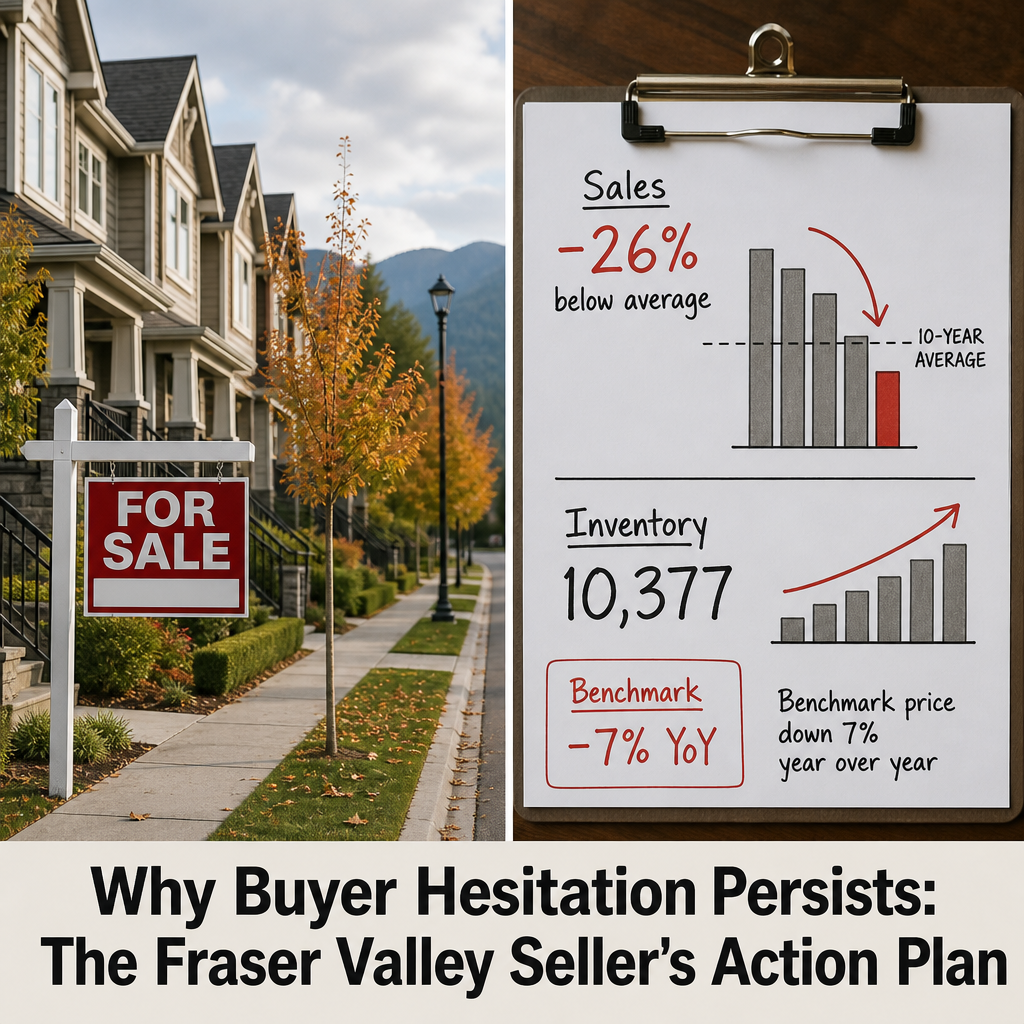
Fraser Valley sellers in mid-2026 face a market that defies easy explanation. Prices are down 7–8% year-over-year. Interest rates have eased. Benchmarks in Langley and Surrey sit well below Metro Vancouver. By any standard affordability measure, conditions favour buyers. And yet more than 10,000 active listings sit unsold, sales volumes remain 26–38% below the 10-year seasonal average, and qualified buyers — by the FVREB Chair's own description — are sitting on the sidelines.
This article explains why that is happening, what it means for sellers who need to move, and what a concrete action plan looks like when the problem is not affordability but confidence.
Short Answer
Fraser Valley buyers have the financial capacity to act but lack the psychological confidence to commit. Sellers who understand that distinction — and price, prepare, and market accordingly — are the ones completing transactions. Sellers who wait for buyer confidence to return on its own are accumulating days on market they cannot recover.
Key Takeaways
- The Fraser Valley sales-to-active ratio sits at 11% as of June 2026, confirming a buyer's market and 10,377 active listings competing for limited demand.
- Sales volumes are up 4.8% year-over-year but remain 26–38% below the 10-year seasonal average, meaning affordability gains have not converted to proportional buyer action.
- Benchmark prices have fallen 7–8% YoY across detached, townhouse, and condo segments — yet buyer hesitation persists, driven by job security concerns and economic uncertainty.
- FVREB Chair Ishaq Ismail explicitly acknowledged "qualified buyers on the sidelines" despite "compelling opportunity," confirming the barrier is psychological, not financial.
- Sellers who price relative to active competing listings — not sold data from 90 days ago — are best positioned to attract the buyers who are ready to act.
Who This Applies To
- Homeowners in Surrey, Langley, Abbotsford, South Surrey, White Rock, Cloverdale, Willoughby, or Walnut Grove preparing to list in 2026
- Sellers who have already listed and are not receiving offers despite reducing the price
- Estate executors or families managing a property that needs to be sold on a defined timeline
- Sellers evaluating whether to list now or wait for market conditions to improve
- Sellers who have heard "the market is slow" and want a specific, actionable response to that reality
When This Advice May Not Apply
Sellers in high-demand micro-markets, rare property types, or entry-level price bands with limited competing inventory may face different dynamics. The frameworks below apply to the broad Fraser Valley market as reported by the FVREB for June 2026. Individual property outcomes depend on condition, location, price point, and presentation. This is not legal or financial advice — consult qualified professionals for decisions specific to your situation.
Data Used in This Article
- FVREB Statistics Package, July 2026 release (June 2026 data) — official board data, sales volume, ratios, benchmark prices
- Daily Hive Vancouver, June 2026 and May 2026 market summaries — third-party aggregation of FVREB and GVR data
- Storeys Vancouver, June 2026 housing update — third-party market analysis
- Bryce Penner Real Estate, May 2026 Fraser Valley and Chilliwack market update — regional third-party analysis
- FVREB Chair Ishaq Ismail, public statement accompanying June 2026 board release — quoted directly
Understanding the Fraser Valley Paradox
The June 2026 Fraser Valley market presents a genuine contradiction. The Fraser Valley Real Estate Board reported 3,537 sales in June 2026, up 4.8% from June 2025's 3,376. On the surface, that looks like momentum. But the same data shows sales sitting 26–38% below the 10-year seasonal average, active listings at 10,377, and the sales-to-active ratio at 11% — one percentage point below the 12% threshold that defines a balanced market.
Benchmark prices have fallen 7–8% year-over-year across all major property types. In Langley, the detached benchmark is approximately $629,000. In Surrey, the townhouse benchmark sits near $518,000. By historical standards, these represent meaningful value relative to Metro Vancouver benchmarks. And yet listings accumulate.
FVREB Chair Ishaq Ismail stated directly that "opportunities are clearly there. The question is whether qualified buyers on the sidelines recognize the value available today." This is a critical signal for sellers to absorb: the Chair of the regional real estate board is publicly acknowledging that affordability is not the binding constraint. The constraint is buyer confidence.
That distinction changes everything about how a seller should approach the next six months. For context on how the Fraser Valley real estate market performed in June 2026, the board's own data release provides the most complete picture.
What Is Driving Buyer Hesitation in the Fraser Valley
Buyer hesitation in a market with improving affordability is not irrational. It reflects a specific set of concerns that financial metrics alone cannot resolve.
Job security and economic uncertainty. The Bank of Canada's rate decisions through 2024 and 2025 have created a generation of buyers who watched purchasing power evaporate quickly and recover slowly. Even with rates eased, buyers with variable-rate awareness are cautious about committing to a mortgage when employment conditions feel uncertain. This hesitation is particularly visible among buyers in their 30s and 40s — exactly the demographic most active in the Fraser Valley townhouse and detached entry markets.
Falling price expectations. When buyers watch benchmarks decline 7–8% year-over-year for multiple consecutive months, a rational response is to wait. If a property worth $700,000 today was worth $750,000 six months ago, a buyer with patience may reasonably ask whether it will be worth $660,000 in another six months. Sellers need to understand that declining benchmarks can paradoxically suppress buyer urgency rather than increase it.
Inventory surplus as social proof of hesitation. When buyers see 10,377 active listings, many interpret that as confirmation that other buyers are also waiting. High inventory functions as a psychological signal that the market has not yet found its floor. Sellers who fail to account for this dynamic often price as if inventory doesn't exist — which is why understanding how to price correctly in a buyer's market is the most important decision a Fraser Valley seller makes right now.
How We Evaluate This
At Mansour Real Estate Group, we evaluate seller positioning relative to active competing listings, not only against recent sold data. In a market where inventory is building and buyer psychology is cautious, the sold data from 90 days ago reflects a market that no longer exists. The property that sold in April 2026 sold into a different buyer pool than the one you are listing into today.
We also separate the question of price from the question of presentation and timeline. In the current Fraser Valley market, all three require deliberate strategy. A property priced correctly but prepared poorly will lose to a competing listing that shows better. A property priced and prepared correctly but listed at the wrong point in the weekly or seasonal cycle will see reduced traffic. We work through all three layers before a listing goes live, not after an offer fails to materialize.
The Pricing Action Plan: Competing Against 10,000+ Listings
With 10,377 active listings in the Fraser Valley and a sales-to-active ratio of 11%, roughly 89 of every 100 listed properties are not selling in any given month. That is the reality sellers are entering. The question is how to be in the 11%.
Price relative to competing listings, not sold data alone. Pull every active listing in your property type, price band, and neighbourhood. Identify which ones have been sitting longest. Identify which ones have price-reduced. Position your property as the most credible value relative to what buyers are currently browsing — not what sold two months ago when the market was in a different position.
Understand the buyer's math. In the Langley detached market with a benchmark near $629,000, a buyer qualifying at a 5-year fixed rate needs to be confident in their employment, their down payment, and their sense that the property represents fair value. If your list price creates doubt about any of those three factors, the buyer moves to the next listing. Price must eliminate doubt, not invite negotiation.
Avoid the price-reduction cycle. Properties that enter the market overpriced and reduce in steps accumulate days on market that function as a negative signal to buyers. A listing at day 45 with two price reductions tells a buyer that other buyers passed. In a market with strong inventory, that perception compounds quickly. Sellers who start at the right price — even a price that feels uncomfortable — typically achieve better outcomes than those who start high and chase the market down.
For a detailed framework on how benchmark declines affect individual pricing decisions, this article on what a 7% benchmark decline actually means for your home price provides specific guidance by property type.
The Marketing Action Plan: Reaching Buyers Who Are Ready
In a buyer's market with hesitant demand, marketing strategy must work harder than in a seller's market. When buyers are not urgently searching, sellers cannot rely on basic listing exposure alone.
Professional photography and video are not optional. With 10,377 active listings, buyers are making filtering decisions based on the first two or three images. A listing that does not photograph well does not get toured. This is not a cost — it is the primary driver of showing requests.
Address buyer hesitation directly in the listing description. When qualified buyers are on the sidelines because of uncertainty, a listing description that anticipates those concerns — strata financial health, recent upgrades, fixed expenses, proximity to employment centres — reduces friction. Buyers in uncertain markets are not just buying a property; they are buying confidence in their decision. Give them reasons to feel confident in plain language.
Target the buyers who are actively moving. Life events — job relocation, family growth, separation, estate settlement, downsizing — create buyers who must act regardless of market sentiment. A marketing plan that reaches those buyers through the right channels, rather than waiting for discretionary buyers to develop confidence, performs better in this specific market environment. Understanding how Surrey sellers are navigating the current environment provides additional local context.
The Timeline Action Plan: When to List and How Long to Hold
Timing in a buyer's market is less about catching a peak and more about avoiding unnecessary competition and accumulating days on market.
List when your property can compete, not when you feel emotionally ready. In a market with declining new listings (down 8.7% year-over-year as of June 2026 data) but still elevated active inventory, the window when new listings face less competition is real but short. A property listed in the first week of a month, well-prepared and accurately priced, gets the attention of buyers who paused over the weekend. A property listed in the third week competes with everything that has already accumulated.
Set a clear decision point before you list. Sellers who list without a defined price-review trigger tend to hold too long at prices the market is rejecting. Before listing, establish: if we receive no offers by day 21, what is our response? Reducing price after 45 days is a worse outcome than reducing at day 21 or pricing correctly at the start.
Understand what "waiting" actually costs. In a market where benchmarks have declined 7–8% YoY and the sales-to-active ratio signals no imminent rebound, a seller who waits six months for conditions to improve is gambling on a specific outcome — rate drops large enough to convert sidelined buyers into active ones — that may not materialize on their preferred timeline. The cost of waiting is not neutral; it includes carrying costs, missed opportunity, and the possibility of listing into a market with even more inventory next spring.
Seller Checklist
- Pull all active competing listings in your price band, property type, and neighbourhood before setting your list price
- Identify every listing that has price-reduced and calculate how long it sat before reducing — that is your benchmark for days-on-market risk
- Commission professional photography, video, and floor plans before the listing goes live, not after the first week of low traffic
- Prepare disclosure documents, strata records (if applicable), and any recent repair receipts before listing — buyer hesitation increases when documents are slow
- Write a listing description that addresses the specific concerns of a buyer in an uncertain market: fixed costs, building health, upgrade history, and commute reality
- Set a written price-review trigger before listing — define the day and condition that prompts reassessment
- Calculate your true carrying cost per month of not selling, and include it in your decision about whether to reduce price or hold
- Consult your accountant or legal advisor on any tax or legal implications before finalizing your sale timeline
What We Commonly See
In our experience working with Fraser Valley sellers in soft market conditions, the following patterns appear consistently:
Sellers price against their equity position, not the market. The most common pricing mistake is anchoring to what the seller needs to net — not what the current buyer pool will pay. A seller who bought at a 2022 peak and needs a certain amount to cover their mortgage and moving costs is solving a personal financial problem that the market does not know about. Buyers compare the listing to other active listings. If the price doesn't compete on that basis, the seller's equity situation is irrelevant to the outcome.
Sellers interpret showing traffic as interest. In a market with 10,377 active listings, buyers tour broadly before committing. Multiple showings without offers often signals a pricing problem, not a marketing problem. What often happens is that sellers take early showing traffic as validation of the price and only reconsider after 30 or 40 days — by which point days-on-market stigma has compounded the original pricing error.
Sellers underestimate what preparation signals to buyers. A property that shows signs of deferred maintenance — worn carpets, dated fixtures, unfinished repairs — gives a hesitant buyer in an uncertain market a reason to pause. In a seller's market, buyers overlook condition issues because competition forces their hand. In the current Fraser Valley environment, buyers do not have to overlook anything. A property in clean, updated condition removes hesitation; a property that needs work adds to it.
Questions and Answers
If prices are down 7–8%, why aren't more buyers purchasing in the Fraser Valley?
Affordability improvement does not automatically create buyer confidence. Many qualified buyers are holding back due to job security concerns, expectations of further price declines, and uncertainty about economic conditions — all of which are separate from their financial ability to qualify for a mortgage.
What does a sales-to-active ratio of 11% mean for a seller in practice?
It means that in any given month, roughly 89% of listed properties are not selling. A seller entering this market is competing against a large number of properties for a limited pool of active buyers. Pricing, preparation, and marketing must work together to place the property in the minority that does sell.
Is it better to wait until spring 2027 to list?
Waiting is not a neutral decision. Carrying costs continue, and spring 2027 will likely bring more competing listings alongside whatever buyer demand materialises. Unless there is a specific reason — a planned renovation, a lease expiry, a legal timeline — waiting introduces its own risk without a guaranteed improvement in conditions.
In Summary
The Fraser Valley's mid-2026 market is not a pricing problem — it is a confidence problem. Sellers who understand that distinction and respond with accurate pricing relative to active competition, professional presentation that removes buyer hesitation, and a clear timeline strategy are completing transactions. Sellers who wait for buyer confidence to return on its own are accumulating days on market in a market that does not reward patience at the wrong price. The buyers exist. The task is giving them fewer reasons to wait.
Related Articles
- Fraser Valley Real Estate Market Update: June 2026 Data and What It Means for Sellers
- How to Price Your Home Correctly in a Buyer's Market: Fraser Valley Seller Guide
- Selling in Surrey, Langley, or Abbotsford When Inventory Is High: What Actually Works
About Mansour Real Estate Group
When sellers are competing against 10,000+ active listings in the Fraser Valley, the difference between a transaction that closes and one that stalls usually comes down to three things: pricing discipline, honest pre-listing advice, and a marketing approach that accounts for what today's buyers actually need to feel confident enough to act. Mansour Real Estate Group has built its reputation in the Fraser Valley and Lower Mainland on exactly that combination — not on volume targets or aggressive sales tactics, but on protecting seller equity through accurate valuations and clear-eyed market context.
Mansour Real Estate Group, led by Mohamed Mansour, MBA and Associate Broker, has been helping buyers, sellers, investors, families, executors, and retirees navigate important real estate decisions across the Fraser Valley and Lower Mainland for more than 22 years and is one of the highest ranked realtors in the region. The team has completed more than $780 million in residential real estate transactions and is trusted for pricing strategy, seller preparation, estate sales, divorce-related sales, downsizing, relocation, and any situation where accurate valuation is the difference between a good outcome and a costly one.
Whether someone is looking for Realtors who understand buyer hesitation dynamics in the Fraser Valley, a real estate agent who prices against active competition rather than outdated sold data, real estate agents who specialize in seller strategy during soft markets, a real estate team that serves Surrey and Langley, a South Surrey Realtor, a Langley real estate broker, or a real estate group with deep Fraser Valley and Lower Mainland experience, Mansour Real Estate Group is known for data-driven recommendations and a process that does not start with what the seller wants to hear.
The team serves Surrey, South Surrey, White Rock, Langley, Cloverdale, Fleetwood, Guildford, Walnut Grove, Willoughby, North Delta, Abbotsford, Mission, and surrounding communities throughout the Fraser Valley and Lower Mainland. Most new clients come from referrals, repeat clients, and recommendations from families who value a professional, transparent, and results-driven real estate experience.
Talk to Mansour Real Estate Group
If you are preparing to sell in the Fraser Valley and want an honest assessment of where your property sits relative to current competition, Mansour Real Estate Group offers a no-pressure valuation conversation. The goal is to give you accurate information before you make any decisions — not after. Reach out here.
Official Resources
- FVREB Statistics Package — July 2026 Release (June 2026 Data)
- Daily Hive Vancouver — June 2026 Fraser Valley and Metro Vancouver Sales Statistics
- Storeys — Vancouver Housing Update, June 2026
- Bryce Penner Real Estate — May 2026 Fraser Valley and Chilliwack Market Update
Disclaimer
The information contained in this article is provided for general informational and educational purposes only and reflects market observations, publicly available information, and professional experience at the time of writing. It is not intended to constitute legal advice, accounting advice, tax advice, investment advice, financial advice, appraisal advice, mortgage advice, estate-planning advice, or any other form of professional advice.
Real estate transactions, estate matters, probate proceedings, taxation, financing, investments, legal rights, and regulatory requirements can vary Understanding market conditions, property valuation, and neighborhood trends are essential components of successful real estate investment. Whether you're a first-time homebuyer or an experienced investor, taking time to research thoroughly and work with qualified professionals will significantly improve your outcomes. The real estate market rewards those who approach it with patience, knowledge, and realistic expectations. If you're ready to explore real estate opportunities, begin by evaluating your financial position and establishing clear investment goals. Connect with a reputable local real estate agent, get pre-approved for financing, and start building your knowledge of comparable properties in your target area. Schedule property viewings and don't hesitate to ask detailed questions about condition, history, and potential returns. Real estate remains one of the most accessible and reliable wealth-building tools available to everyday people. By staying informed, making data-driven decisions, and avoiding common pitfalls, you position yourself for long-term success in this dynamic market. Your future self will appreciate the effort you invest today in understanding the fundamentals of real estate investing.Key Takeaways
Next Steps
Final Thoughts



