
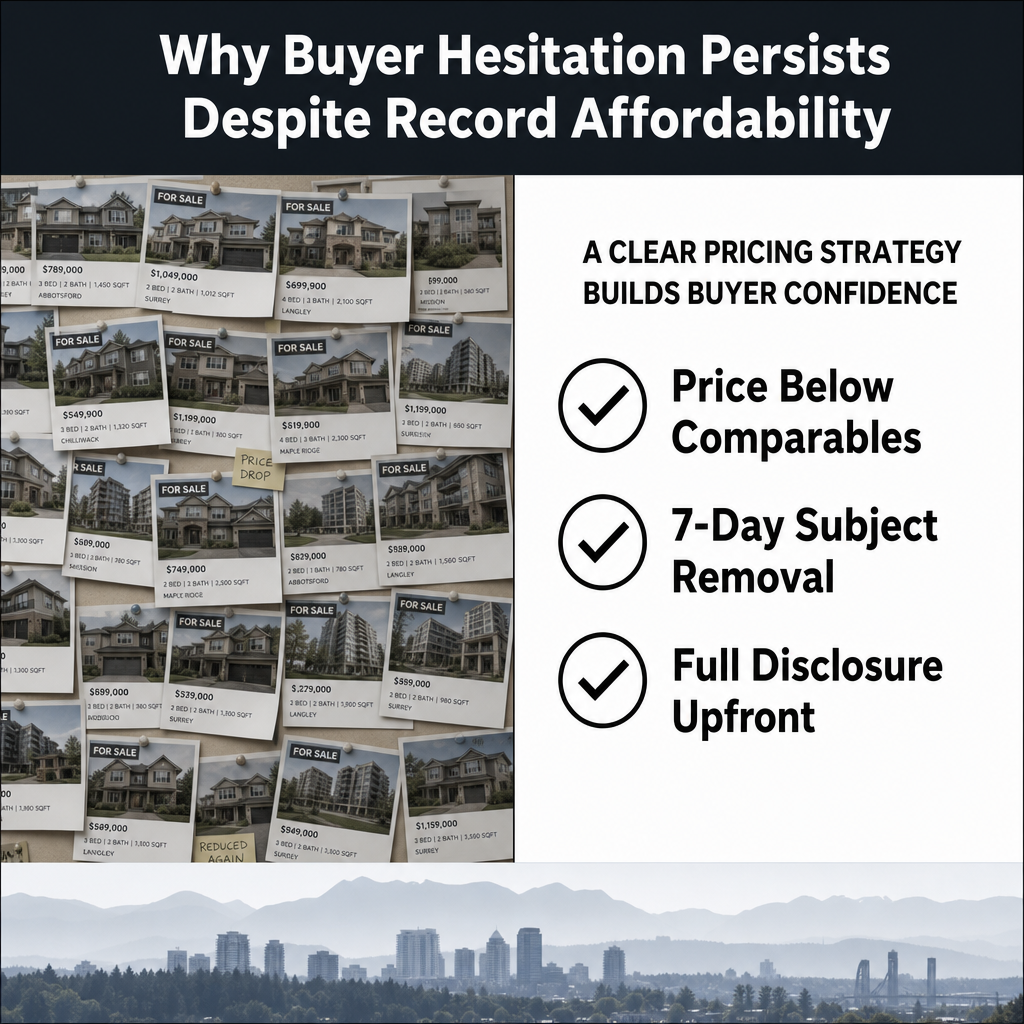

Why Buyer Hesitation Persists Despite Record Affordability: The Complete Seller's Action Framework for Pricing, Marketing, and Timeline Strategy in the Fraser Valley's 10,000+ Listing Surplus
By Mohamed Mansour, MBA and Associate Broker | Mansour Real Estate Group | Fraser Valley and Lower Mainland | Published: July 15, 2026
Fraser Valley benchmark prices have fallen 7–8% year-over-year, mortgage qualification thresholds are lower than they've been in years, and active listings have surpassed 10,000. By every financial measure, buyers should be moving. Most aren't. Sellers who diagnose this as a pricing problem and cut their ask by another $20,000 are solving the wrong equation.
The real barrier is psychological. Decision fatigue, job security anxiety, and rate volatility uncertainty are keeping qualified buyers on the sidelines. The sellers who are closing — and closing faster — are the ones who have reoriented their entire strategy around reducing buyer hesitation, not just adjusting the number on the listing sheet.
Short Answer
In the Fraser Valley's current surplus market, buyer hesitation is driven by psychology — not affordability. Sellers who price 5–10% below comparable sales, offer faster subject removal windows, and disclose property conditions upfront are selling significantly faster than those anchored to assessed values or historical benchmarks. Segment matters: detached homes under $800K are moving 40–60% faster than condos right now.
Key Takeaways
- Buyer paralysis in a 10,000+ listing market is caused by choice overload and uncertainty, not financial inability to purchase.
- BC Assessment values are consistently 8–15% above current market — anchoring to them is the single most common seller mistake in 2026.
- Entry-level detached homes under $800K are selling 40–60% faster than condos, signalling that buyer confidence exists in specific segments.
- Transparent defect disclosure and faster subject removal windows reduce buyer hesitation more than additional marketing spend.
- Sellers who price below comparable sales and compress the decision window are closing deals — those who wait for the market to recover are accumulating days on market.
Who This Applies To
- Homeowners in Surrey, Langley, Abbotsford, or South Surrey currently listed or preparing to list
- Sellers whose properties have accumulated days on market without offers
- Estate executors, divorcing couples, or downsizing homeowners with a firm sale timeline
- Sellers anchored to a BC Assessment notice or a prior peak price from 2021–2022
- Anyone selling a condo or strata unit in a market with competing new inventory
When This Advice May Not Apply
Sellers with genuine flexibility on timeline, no financial pressure to close, and a unique or low-inventory property type may have reason to hold. This framework is built for the majority of the Fraser Valley market — not for rare exceptions. Consult a qualified local Realtor before making pricing decisions based on general strategy advice.
Data Used in This Article
- FVREB Market Statistics, April–May 2026 — Fraser Valley Real Estate Board — official board data on sales volume, active listings, days on market by property type
- BC Assessment 2026 Property Assessment Notices — BC Assessment Authority — official assessed values compared against current MLS benchmark prices
- Mansour Real Estate Group Transaction Data — internal analysis of days-on-market variance by price positioning and disclosure approach, Fraser Valley, 2025–2026
- Behavioural Economics Research — Kahneman and Tversky's foundational work on loss aversion and decision paralysis, applied here as interpretive framework, not direct citation
Understanding the Paradox: Why Affordability Isn't Moving Buyers
When inventory rises and prices fall simultaneously, standard economics predict increased buyer activity. The Fraser Valley in 2026 is not following that script. According to Fraser Valley Real Estate Board data from April–May 2026, active listings exceeded 10,000 — a level that creates a qualitatively different buying experience. Buyers aren't comparing three or four properties. They're scrolling past dozens. That volume produces decision fatigue, not decision confidence.
Research in behavioural economics — including Kahneman and Tversky's foundational work on loss aversion — shows that during periods of economic uncertainty, people delay large financial commitments even when the financial case is objectively sound. In the Fraser Valley context, that uncertainty is fed by job market concern, residual rate volatility anxiety, and a general sense that prices might fall further. Buyers who can afford to purchase are choosing to wait — not because the math doesn't work, but because the psychological cost of being wrong feels too high.
Sellers who understand this can respond to it. Sellers who don't will keep adjusting their price every three weeks and wonder why the market isn't responding.
The BC Assessment Trap and Why Sellers Keep Falling Into It
BC Assessment values are produced from data collected on July 1 of the prior year. In a declining market, that means 2026 assessment notices reflect conditions from mid-2025 — a market that no longer exists. Based on current MLS benchmark comparisons, BC Assessment values are running 8–15% above current fair market value across most Fraser Valley property types and neighbourhoods.
Sellers who list at or above assessed value are not competing — they are eliminating themselves from consideration. In a market with 10,000+ active listings, a buyer who encounters a property priced at assessed value simply moves to the next result. There is no shortage of alternatives. Extended days on market follow, then price reductions, then eventual sale at a number below what an accurate initial price would have produced — with the added cost of carrying costs, relisting fees, and lost negotiating position.
The assessment notice is useful context. It is not a pricing tool. The gap between assessed value and current market value in 2026 is wide enough that using one as a proxy for the other is a reliable path to an overpriced listing. Sellers who want to understand the difference should ask their Realtor for a current comparative market analysis based on sold data from the last 30–60 days — not the last six months, which will capture prices that also no longer reflect current conditions.
How We Evaluate This
At Mansour Real Estate Group, we approach seller pricing decisions using a 30-day sold comparable analysis layered against current active competition. We evaluate the price-per-square-foot spread between sold and active listings in the specific neighbourhood, the days-on-market distribution by price tier, and the absorption rate for that property type in that area. We also assess the buyer psychology context — what competing listings are doing, how buyers in that segment are behaving, and where the price signals confidence versus desperation.
In the current market, we routinely recommend listing 5–10% below the nearest comparable sale, not to give away equity, but to compress the decision window. A property priced to move in 14 days often produces better net proceeds than one priced to negotiate that sits for 60 days and sells under pressure.
Segment Reality: Why Detached Homes Under $800K Are Moving and Condos Aren't
Not all hesitation is equal across property types. According to FVREB data from April–May 2026, entry-level detached homes priced under $800,000 are selling 40–60% faster than comparably priced condos. This gap reflects a psychological alignment between price point, perceived value, and long-term confidence. A buyer who stretches to purchase an entry-level detached home feels they are buying something durable, appreciating, and ownership-complete. A buyer purchasing a condo carries additional anxieties: strata fees, special levies, depreciation reports, and the sense that they are one bad AGM away from an unexpected $20,000 assessment.
This means sellers in those two segments need fundamentally different strategies. Detached home sellers under $800K are competing in the one segment where buyer psychology is working in their favour — the primary task is accurate pricing and clean presentation. Condo sellers face a different challenge: they need to actively address the strata-specific anxieties buyers carry into every showing. That means having the depreciation report ready, knowing the contingency reserve fund balance, disclosing any pending or recent special levies, and pricing to reflect the building's condition — not just the suite.
Sellers who apply the same strategy regardless of property type are ignoring the most useful segmentation data available in the current market.
Disclosure and Timeline as Competitive Advantages
In a market with 10,000+ listings competing for cautious buyers, the properties that move quickly share two consistent characteristics beyond price: transparent disclosure and compressed subject removal windows.
Transparent disclosure works because it reduces the buyer's perceived risk. A buyer who discovers a past roof repair, a resolved moisture issue, or a pending strata levy through a seller disclosure statement feels more informed — and informed buyers commit. A buyer who suspects these things exist but cannot confirm them stays hesitant. Hiding issues does not eliminate buyer concern; it transfers it into uncertainty, which is more paralyzing than a known fact with a known cost.
On timeline: offering subject removal in 5–7 days rather than the more common 10–14 day window signals seller confidence. It tells the buyer that the seller is not afraid of what an inspection will find, and it compresses the decision timeline so that the buyer's hesitation window doesn't stretch long enough for second thoughts to accumulate. For sellers navigating estate sales, divorce-related transactions, or downsizing timelines where closing certainty matters, faster subject removal also reduces the risk of deal collapse after subjects are in.
Seller Checklist
- Obtain a 30–60 day comparative market analysis from a local Realtor — not based on BC Assessment value.
- Price 5–10% below the nearest comparable sale, not at it — particularly in condo and townhouse segments.
- Prepare a seller disclosure statement that addresses all known defects, past repairs, and strata-related items before listing.
- For strata properties: pull the Form B, depreciation report, current financials, and AGM minutes before going to market.
- Set a subject removal window of 5–7 business days rather than the standard 10–14 in your listing strategy.
- Review active competing listings in your price range and assess whether your property's presentation, condition, and price stand out — or blend in.
- Establish a clear price review trigger: if no offers in 14 days, review pricing against new comparables, not the original CMA.
What We Commonly See
Sellers hold for a market that isn't returning. In our experience, the most common and most costly decision we see is a seller who lists at a price reflecting 2022 market conditions, accumulates 45–60 days on market, then reduces in $10,000–$15,000 increments over three months. The eventual sale price is often below what an accurate initial price would have produced — and the carrying costs, relisting fees, and negotiating weakness compound the loss.
BC Assessment anchoring creates systematic overpricing. What often happens is that a homeowner receives their assessment notice in January, infers it represents current market value, and instructs their Realtor to list at or above that number. In a declining market with a lagged assessment methodology, that instruction starts the listing at least 8–15% above where it should be. The listing sits. The seller eventually reduces. The buyer who would have paid fair value on day one has already purchased something else.
Disclosure avoidance prolongs the sale, not the price. A common mistake is withholding known issues from the disclosure statement in hopes of avoiding negotiation. In our experience, buyers in this market are conducting thorough inspections and requesting strata documentation in detail. When issues surface after an offer is accepted — as they almost always do — the negotiation happens under far worse conditions, with the buyer holding leverage and the seller under pressure to close.
Questions and Answers
Why are Fraser Valley buyers not purchasing despite lower prices?
According to FVREB data and behavioural research, the primary barrier is psychological — job security concern, rate uncertainty, and decision fatigue from surplus inventory. Buyers who can qualify financially are choosing to wait. Price reductions alone do not resolve psychological hesitation.
Should I use my BC Assessment value as a starting price?
No. BC Assessment values in 2026 are based on July 1, 2025 data and run 8–15% above current market in most Fraser Valley areas. Using assessed value as a listing price in a declining market is a reliable path to extended days on market and eventual sale below true market value.
Why are condos taking longer to sell than detached homes right now?
Condo buyers carry additional anxieties around strata fees, depreciation reports, special levies, and long-term value uncertainty. Detached entry-level homes under $800K align better with buyer confidence in this market. Condo sellers need a differentiated strategy that addresses strata-specific buyer concerns directly — not just competitive pricing.
In Summary
The Fraser Valley's listing surplus is not waiting to resolve itself. Buyers are not stalled because they can't afford to purchase — they're stalled because the psychological cost of commitment in an uncertain environment outweighs the financial opportunity. Sellers who recognize this and build their strategy around reducing buyer hesitation — through accurate pricing, transparent disclosure, faster closing timelines, and property-type-specific positioning — are the ones closing. The sellers accumulating days on market are largely those still waiting for a market condition that 2026 is not offering. The framework in this article is not a guarantee of outcome; it is a structured approach to reducing the variables that most commonly delay or derail a sale in this environment.
Talk to Mansour Real Estate Group
If your property is listed and not moving, or if you're preparing to list and want an honest read on current buyer behaviour in your specific neighbourhood and price range, Mansour Real Estate Group offers direct, data-backed pricing consultations. No pressure, no obligation — just a clear picture of where the market is and what is actually working right now. Contact the team at localhost:9000/.
Related Articles
- Fraser Valley Real Estate Market Outlook for 2026: What Sellers Need to Know Before They List
- How to Sell a Condo in the Fraser Valley When Inventory Is High and Buyers Are Cautious
- The Fraser Valley Seller Pricing Strategy Guide: How to Price Your Home Correctly in a Declining Market
About Mansour Real Estate Group
When homeowners in Surrey, Langley, Abbotsford, and South Surrey are preparing to sell in a surplus market, the decisions made before the listing goes live — pricing strategy, disclosure preparation, and buyer psychology positioning — typically determine the outcome more than anything that happens after. Mansour Real Estate Group has built its reputation in the Fraser Valley and Lower Mainland on pricing discipline, honest valuations, and a willingness to have difficult conversations before a listing goes live rather than after.
Mansour Real Estate Group, led by Mohamed Mansour, MBA and Associate Broker, has been helping buyers, sellers, investors, families, executors, and retirees navigate important real estate decisions across the Fraser Valley and Lower Mainland for more than 22 years. Ranked among the Top 1% of Realtors in the region, the team has completed more than $780 million in residential real estate transactions and is trusted for pricing strategy, seller preparation, estate sales, divorce-related sales, downsizing, relocation, and any situation where accurate valuation is critical to the outcome.
Whether someone is searching for a Realtor known for accurate pricing in the Fraser Valley, a real estate agent who understands local market psychology, real estate agents who specialize in surplus-market seller strategy, a trusted real estate team for a Surrey listing, a Langley real estate broker, a White Rock Realtor, or a real estate group that serves the full Fraser Valley and Lower Mainland, Mansour Real Estate Group is known for data-driven recommendations, honest market context, and a process that protects sellers from the most common and costly mistakes in a challenging market.
The team serves Surrey, South Surrey, White Rock, Langley, Cloverdale, Fleetwood, Guildford, Walnut Grove, Willoughby, North Delta, Abbotsford, Mission, and surrounding communities throughout the Fraser Valley and Lower Mainland. Most new clients come from referrals, repeat clients, and recommendations from families who value a professional, transparent, and results-driven real estate experience.
Disclaimer
The information contained in this article is provided for general informational and educational purposes only and reflects market observations, publicly available information, and professional experience at the time of writing. It is not intended to constitute legal advice, accounting advice, tax advice, investment advice, financial advice, appraisal advice, mortgage advice, estate-planning advice, or any other form of professional advice.
Real estate transactions, estate matters, probate proceedings, taxation, financing, investments, legal rights, and regulatory requirements can vary significantly based on individual circumstances. Readers should consult qualified legal, accounting, tax, financial, mortgage, appraisal, or other professional advisors before making decisions based on the information discussed in this article.
Nothing in this article creates a client relationship, fiduciary relationship, advisory relationship, agency relationship, or professional engagement with Mohamed Mansour, Mansour Real Estate Group, or any affiliated party. Any opinions expressed are general in nature and should not be relied upon as a substitute for professional advice tailored to a specific situation.
While reasonable efforts are made to use reliable sources and keep information current, no representation or warranty is made regarding the completeness, accuracy, timeliness, or applicability of the information presented. Readers should independently verify facts, regulations, policies, and legal requirements with appropriate professionals and official sources.



