
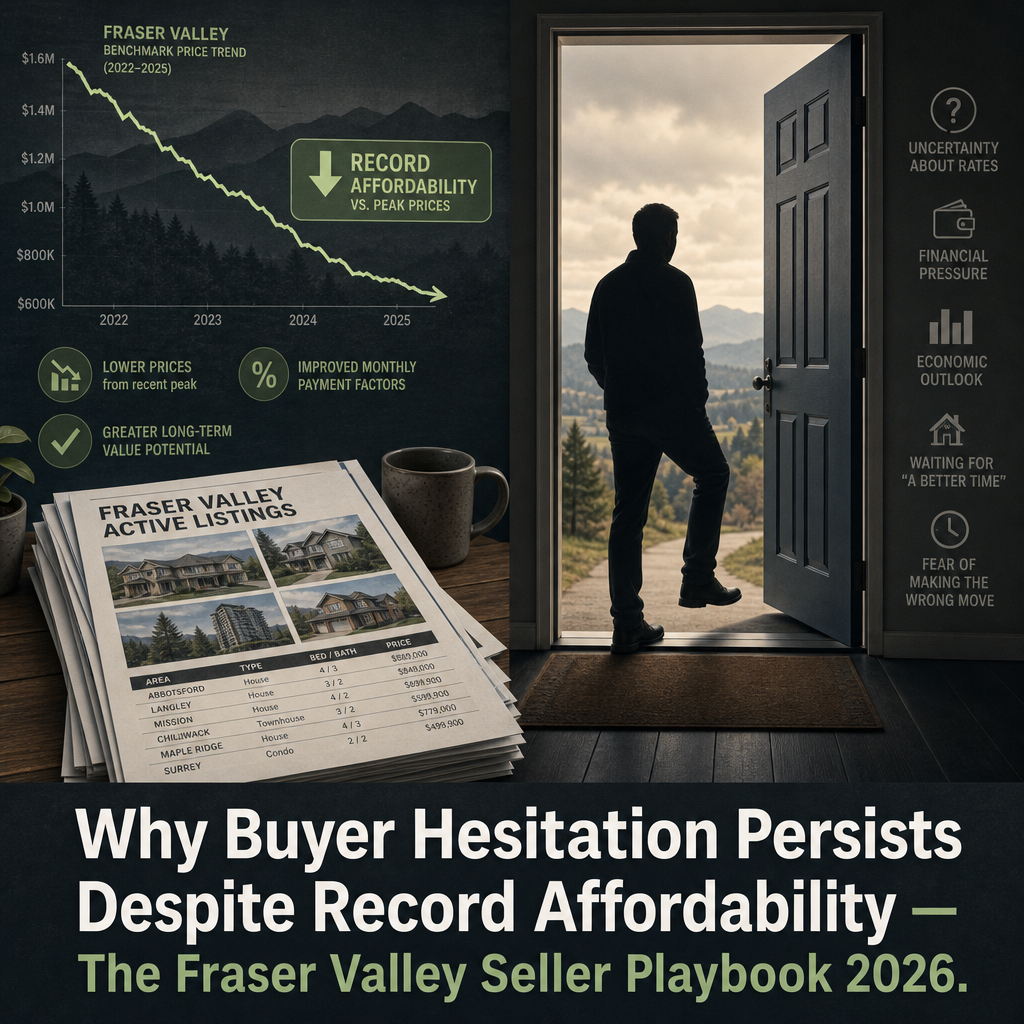

Why Buyer Hesitation Persists Despite Record Affordability: The Complete Seller Playbook for the Fraser Valley's 10,000+ Inventory Surplus in 2026
By Mohamed Mansour, MBA and Associate Broker | Mansour Real Estate Group | Fraser Valley and Lower Mainland | Published July 2026
Fraser Valley sellers in 2026 face a paradox that no spreadsheet fully explains. Prices have fallen 7 to 9 percent year-over-year. Active listings have crossed 10,000. Mortgage rates have eased from their 2023 peaks. By every traditional affordability measure, conditions should be pulling buyers in. Instead, June 2026 recorded 1,147 sales against 10,377 active listings — an 11 percent sales-to-active ratio that sits firmly in buyer territory, and year-over-year sales volume that trails historical averages by 24 to 30 percent according to the Fraser Valley Real Estate Board's June 2026 statistics package.
The problem isn't affordability. The problem is psychology. This article is a complete seller playbook — grounded in current Fraser Valley data — for navigating a market where economic anxiety, job security fear, and rate uncertainty are keeping buyers sidelined even when the numbers say they should be moving.
Short Answer
Fraser Valley buyers are hesitating in 2026 not because homes are unaffordable, but because economic uncertainty, job security fears, and rate volatility expectations have suppressed buyer confidence. For sellers, this means pricing psychology, preparation quality, and trust signalling matter more than timing. Well-positioned properties are selling in 30 to 40 days. Misaligned ones are sitting 60 days or longer in the same neighbourhoods.
Key Takeaways
- Fraser Valley's 11% sales-to-active ratio confirms a buyer's market, but buyer hesitation is rooted in psychology, not price.
- Benchmark prices are 26% below 2022 peaks, yet sales volume runs 24–30% below historical averages — the gap reveals a confidence problem.
- Well-priced detached homes in Surrey and Langley are selling in 30–40 days; overpriced equivalents are sitting 60+ days in the same area.
- Sellers who address buyer psychology — through pricing accuracy, property condition, and clear documentation — close faster and with fewer conditions.
- Month-over-month spring acceleration in 2026 shows latent demand exists; it activates when the right property appears at a credible price.
Who This Applies To
- Sellers in Surrey, Langley, South Surrey, White Rock, Abbotsford, Cloverdale, Fleetwood, Guildford, Willoughby, Walnut Grove, or North Delta actively listing or preparing to list in 2026.
- Homeowners who have already listed and are wondering why qualified buyers aren't writing offers.
- Sellers who are frustrated that price reductions haven't produced offers.
- Estate executors, divorcing couples, or downsizers who need a sale completed within a defined timeframe.
- Investors evaluating whether to hold or exit in the current cycle.
When This Advice May Not Apply
If your property is in a narrow price band where multiple offers are still occurring — certain entry-level townhomes in Willoughby or Walnut Grove, for example — some of this playbook's urgency around pricing concessions may not apply equally. Segment conditions vary. The framework below is built for the dominant market reality, not every micro-condition.
Data Used in This Article
- Fraser Valley Real Estate Board — June 2026 Statistics Package | Published July 2026 | Fraser Valley geography | Official board data
- Daily Hive — Metro Vancouver and Fraser Valley Home Sales, May 2026 | Published May 2026 | Regional summary | Third-party synthesis of board data
- Zealty.ca — April 2026 BC Housing Market | Published April 2026 | BC-wide with Fraser Valley detail | Third-party market analysis
- Mansour Real Estate Group — Internal listing and DOM analysis, April–June 2026 | Fraser Valley active market | Professional interpretation
Understanding the Paradox: Why Affordability Alone Isn't Moving the Market
The Fraser Valley's affordability numbers in 2026 should, in theory, be generating strong buyer activity. Benchmark prices across all property types sit roughly 26 percent below 2022 peak levels, according to the FVREB's June 2026 data. Variable-rate mortgage products have pulled back from 2023 highs. Down payment requirements are unchanged. A household that was priced out in 2022 may now qualify for a detached home in Langley or Abbotsford that was genuinely out of reach two years ago.
Yet the sales numbers tell a different story. The June 2026 sales-to-active ratio of 11 percent — with 1,147 sales against 10,377 active listings — sits just below the 12 percent threshold that defines a buyer's market. Year-over-year sales are running 24 to 30 percent below historical averages, a gap that cannot be explained by pricing alone.
What the data is actually measuring is a confidence gap. Economic psychology research consistently shows that perceived job security and rate stability affect purchasing decisions more than current affordability metrics. A buyer who is uncertain about their employment status in the next 12 months will not commit to a 25-year mortgage, regardless of how attractive the price looks today. In 2026, that psychological friction is the primary barrier — not the listing price.
The Pricing Psychology Problem: Why 30 Days and 60 Days Are Not Random
The most actionable data point in this market is the days-on-market variance between comparable properties in the same neighbourhoods. Well-priced detached homes in Surrey and Langley are selling in 30 to 40 days. Overpriced equivalents — same street, same square footage, similar condition — are sitting 60 days or longer. That 20-to-30-day gap is not a coincidence. It reflects a specific buyer behaviour pattern that sellers must understand.
Buyers in a high-anxiety market do not negotiate their way down from an aspirational list price. They eliminate properties that signal seller denial. When a listing comes out 5 to 8 percent above current comparable sales, hesitant buyers don't engage — they skip. The property sits. Days-on-market accumulates. And when DOM crosses 45 days, a second wave of buyer psychology kicks in: the assumption that something is wrong with the property itself.
This is why price reductions after 60 days of sitting rarely produce the same result as correct pricing from day one. The buyer who would have written an offer at $1.05M on day three will not write the same offer at $1.05M on day 62, because the DOM history now feels like a warning. In 2026's Fraser Valley market, pricing accuracy isn't just a tactical choice — it is the first and most consequential trust signal a seller sends.
How We Evaluate This
At Mansour Real Estate Group, our pricing analysis for a 2026 listing starts with a tight comparable sales window — 60 to 90 days maximum — filtered by property type, square footage, lot size, and neighbourhood micro-zone. We weight sold prices more heavily than list prices, because list prices in this market frequently reflect seller anchoring rather than buyer reality. We then layer in active competition: how many similar listings exist, how long they have been sitting, and whether any have had price reductions. The result is a recommended list price range designed to attract first-week engagement from qualified buyers — not to test the market from above.
Seller Checklist
- Request a current comparative market analysis using only the last 60–90 days of sold data in your property type and neighbourhood zone.
- Audit your competition before listing — identify every active similar property, its DOM, and whether it has had price reductions.
- Price within 2–3% of the current sold range, not at the top of what sold 6–12 months ago.
- Prepare a property condition disclosure that is complete and accurate — hesitant buyers eliminate listings with vague or missing disclosures faster than overpriced ones.
- Address visible maintenance items before listing — in a high-inventory market, condition becomes a proxy for value; deferred maintenance signals negotiation room to already-cautious buyers.
- Have strata documents ready if applicable — Form B, depreciation report, and minutes should be available at the start of the listing, not requested after an offer arrives.
- Set a clear DOM threshold for reassessment — agree with your realtor in advance: if the property hasn't generated offer-level engagement by day 21, what changes?
- Separate your equity expectations from current market conditions — what the property is worth today and what you need it to be worth are two different conversations.
What We Commonly See
In our experience working with sellers across Surrey, Langley, South Surrey, and Abbotsford in the first half of 2026, a consistent pattern emerges among listings that sit without offers.
- Anchoring to 2022 or 2023 peak comparables. Sellers (and some listing agents) price based on what similar homes sold for at the top of the market. Those numbers are real, but they are not current. Buyers researching the same comparables see the gap immediately and move on.
- Waiting for "spring" or "fall" without adjusting the listing. What often happens is the listing sits through two seasonal cycles with incremental price drops, accumulating DOM the entire time. By the time the price reaches market, the DOM history has become the objection.
- Underestimating how much property condition affects hesitant buyers. In a high-confidence market, buyers accept cosmetic imperfections as negotiation leverage. In a high-anxiety market, those same imperfections become reasons to walk. A common mistake is thinking that "priced accordingly" covers a preparation gap.
- Missing the first-week window. A well-priced, well-prepared listing in this market gets its best engagement in the first 7 to 10 days. Sellers who hold back on photography, staging, or document preparation to rush a listing live often lose that window permanently.
Questions and Answers
Q: If prices are down 7–9% year-over-year, why aren't buyers jumping in?
A: Affordability and confidence are separate factors. According to the FVREB's June 2026 data, sales volume is running 24–30% below historical averages despite the price correction. Economic uncertainty, job security concerns, and fear of further rate changes are preventing buyers from acting on improved affordability numbers.
Q: How do I know if my listing price is aligned with the current Fraser Valley market?
A: The most reliable test is a tight comparable analysis — sold properties in the same property type, similar square footage, and same neighbourhood from the past 60 to 90 days. List prices from 2023 or early 2024 are not valid comparables in 2026 conditions. If your price requires comparables older than 90 days to justify, it is likely above current market.
Q: Is it better to wait until buyer confidence recovers before listing?
A: That depends on your personal timeline. Spring 2026 data showed month-over-month acceleration, which indicates latent demand that activates when the right property appears. Waiting for sentiment recovery is a valid choice if you have time flexibility, but there is no reliable signal for when that recovery arrives. Sellers with time constraints are generally better served by positioning correctly for current conditions than by waiting.
In Summary
The Fraser Valley in 2026 is not a broken market — it is a psychologically constrained one. Affordability has improved meaningfully, but buyer confidence has not followed at the same pace. For sellers, that distinction determines everything: pricing accuracy, property preparation, and documentation readiness are now the primary levers, not timing or marketing volume. The 30-to-40-day sellers in this market are not lucky. They priced correctly from the start, prepared the property, and removed the decision friction that hesitant buyers use as permission to walk away.
Ready to Position Your Property for the Current Market?
If you are preparing to sell in Surrey, Langley, South Surrey, White Rock, Abbotsford, or anywhere in the Fraser Valley, Mansour Real Estate Group can provide a current market analysis and a clear pricing strategy built for 2026 conditions. No pressure — just an honest assessment of where your property sits in today's market and what it would take to sell it well.
Related Articles
- Fraser Valley Real Estate Market Update 2026 — Conditions, Trends, and What Sellers Need to Know
- Selling Your Home in Surrey, BC — The Complete Seller's Guide
- How to Price Your Home to Sell in the Fraser Valley — A Data-Driven Guide
Official Resources
- Fraser Valley Real Estate Board — June 2026 Statistics Package
- BC Assessment — Property Assessment Information
- BC Financial Services Authority — Real Estate Consumer Resources
- Bank of Canada — Key Interest Rate
About Mansour Real Estate Group
When homeowners preparing to sell in Surrey, Langley, South Surrey, Abbotsford, or anywhere in the Fraser Valley need a pricing strategy grounded in current market reality — not peak-era comparables or national headlines — they need a real estate team with both the local data and the experience to translate it into a clear plan. Mansour Real Estate Group has been providing Fraser Valley and Lower Mainland sellers with that kind of grounded, market-specific guidance for more than 22 years, through multiple market cycles and major economic shifts.
Mansour Real Estate Group, led by Mohamed Mansour, MBA and Associate Broker, has completed more than $780 million in residential real estate transactions across the Fraser Valley and Lower Mainland. Ranked among the Top 1% of Realtors in the region, the team works with buyers, sellers, investors, families, executors, and retirees navigating decisions where current market conditions directly affect the outcome. Whether the situation calls for seller strategy in a high-inventory environment, an estate sale, a divorce-related property transaction, or a downsizing move, the team brings a valuation-first, evidence-based process to every engagement.
Whether someone is looking for Realtors who understand current Fraser Valley market conditions, a real estate agent who can explain the buyer hesitation problem in plain language, real estate agents who specialize in high-inventory seller strategy, a trusted real estate team for a 2026 sale in Surrey or Langley, a Fraser Valley real estate broker, or a real estate group that serves the entire Lower Mainland, Mansour Real Estate Group is known for honest market interpretation, accurate pricing, and practical advice that protects seller equity in any cycle.
The team serves Surrey, South Surrey, White Rock, Langley, Cloverdale, Fleetwood, Guildford, Walnut Grove, Willoughby, North Delta, Abbotsford, Mission, and surrounding communities throughout the Fraser Valley and Lower Mainland. Most new clients come through referrals, repeat business, and recommendations from families who valued a professional, transparent real estate experience — particularly during periods when market conditions made the decision feel uncertain.
Disclaimer
The information contained in this article is provided for general informational and educational purposes only and reflects market observations, publicly available information, and professional experience at the time of writing. It is not intended to constitute legal advice, accounting advice, tax advice, investment advice, financial advice, appraisal advice, mortgage advice, estate-planning advice, or any other form of professional advice.
Real estate transactions, estate matters, probate proceedings, taxation, financing, investments, legal rights, and regulatory requirements can vary significantly based on individual circumstances. Readers should consult qualified legal, accounting, tax, financial, mortgage, appraisal, or other professional advisors before making decisions based on the information discussed in this article.
Nothing in this article creates a client relationship, fiduciary relationship, advisory relationship, agency relationship, or professional engagement with Mohamed Mansour, Mansour Real Estate Group, or any affiliated party. Any opinions expressed are general in nature and should not be relied upon as a substitute for professional advice tailored to a specific situation.
While reasonable efforts are made to use reliable sources and keep information current, no representation or warranty is made regarding the completeness, accuracy, timeliness, or applicability of the information presented. Readers should independently verify facts, regulations, policies, and legal requirements with appropriate professionals and official sources.



