

Why Buyer Hesitation Persists Despite Record Affordability: The Complete Seller Playbook for the Fraser Valley's 10,000+ Inventory Surplus in 2026
By Mohamed Mansour, MBA and Associate Broker | Mansour Real Estate Group | Published: July 14, 2026 | Fraser Valley and Lower Mainland, BC
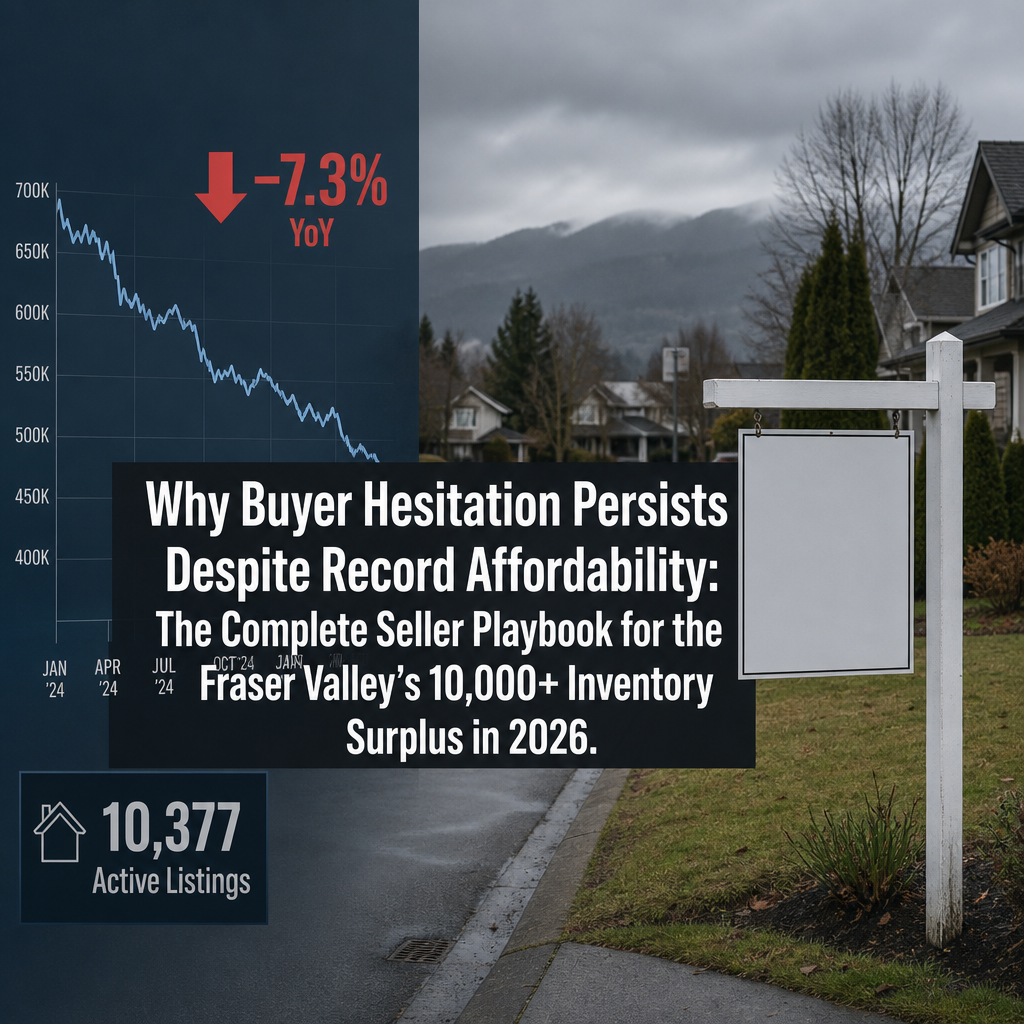
Fraser Valley prices have fallen more than 7% year-over-year. Active inventory sits above 10,000 listings. Buyers have more choice and better affordability than they have seen in years. And yet, sales remain suppressed. This article is for sellers trying to understand that disconnect — and act on it.
This is not a waiting problem. It is a positioning problem. Mansour Real Estate Group has worked through several Fraser Valley market cycles, and the pattern here is recognizable: when buyer psychology diverges from buyer economics, price alone does not close the gap. Strategy does.
Short Answer
Fraser Valley's sales-to-active ratio sat at 11% in June 2026 — just below buyer's market territory — despite a 7.3% year-over-year price drop and 10,377 active listings. According to the Fraser Valley Real Estate Board, spring 2026 underperformed expectations despite genuine affordability improvements. The constraint is not price. It is buyer confidence. Sellers who win in this environment compete on precision pricing, preparation, and psychology — not on waiting for conditions to shift.
Key Takeaways
- Fraser Valley's benchmark composite price fell to $893,300, down 7.3% year-over-year, yet buyer activity remains below seasonal norms.
- With 10,377 active listings and only 1,124 sales in May 2026, the average listing competes against roughly nine others.
- New listings fell 8.7% year-over-year, confirming supply is not the issue — collapsed buyer demand velocity is.
- FVREB chair Ishaq Ismail explicitly acknowledged spring underperformance despite improving affordability, pointing to persistent psychological barriers.
- Sellers who price sharply, prepare meticulously, and address buyer risk perceptions directly will outperform sellers who simply list and wait.
Who This Applies To
- Homeowners in Surrey, Langley, Abbotsford, South Surrey, White Rock, Cloverdale, or Fleetwood preparing to list in 2026.
- Sellers who have already listed without an accepted offer and want to understand why.
- Estate executors, divorcing couples, and downsizers working within a required timeline.
- Move-up buyers who must sell before they can purchase and cannot afford to sit on the market for months.
When This Advice May Not Apply
If your property sits in a narrow sub-market with genuinely limited comparable inventory — a specific strata building in high demand, a rare rural acreage, or a property adjacent to a major new development — buyer competition dynamics may differ from the broader market patterns described here. Always evaluate your specific micro-market before applying general strategic frameworks.
Data Used in This Article
- Fraser Valley Real Estate Board Monthly Market Report, May–June 2026 — Official board data; sales volume, active listings, benchmark prices, sales-to-active ratio. Primary source.
- Daily Hive Vancouver, June 2026 housing statistics coverage — Summary of FVREB and GVR releases, including FVREB chair comments. Third-party editorial.
- Storeys.com, Vancouver housing update June 2026 — Supporting market interpretation. Third-party editorial.
- ValueFirstCanada FVREB market update — Supporting data summary. Third-party analysis.
Understanding the Paradox: Why Affordability Isn't Moving Buyers
The Fraser Valley's June 2026 numbers tell a story that does not follow conventional logic. The composite benchmark price fell to $893,300 — a 7.3% year-over-year decline, according to FVREB data. Active inventory reached 10,377 listings. New listings actually declined 8.7% year-over-year. These are conditions that, historically, would accelerate sales. Instead, the sales-to-active ratio sat at 11%, just below the 12% threshold that separates a balanced market from a buyer's market. FVREB chair Ishaq Ismail stated plainly that the spring market underperformed expectations despite improving affordability and greater choice.
The reason affordability gains are not converting to sales is that buyers are not making decisions based solely on price. Economic uncertainty — job security concerns, ongoing trade policy volatility, and residual rate anxiety — has shifted buyer behaviour into a pattern of hesitation rather than action. A buyer who is uncertain about their employment situation in twelve months will not commit to a thirty-year mortgage even if the monthly payment has improved. Price is a threshold condition, not a trigger.
This matters for sellers because it changes what you are actually competing for. You are not competing for buyers who are waiting for a lower price. You are competing for buyers who are already close to a decision but need one more reason to act. That reason is almost never a further price reduction. It is usually confidence — in the property, in the value, and in the sense that waiting will cost them more than moving forward.
In communities like Langley, Surrey, and Abbotsford, where detached inventory has grown considerably, the buyer who does act is doing extensive comparisons. They will view multiple properties before writing an offer. They will scrutinize condition, disclosure, and price-per-square-foot carefully. They have enough choice to walk away from anything that raises a question they cannot resolve.
How We Evaluate This
At Mansour Real Estate Group, when we evaluate a listing in the current Fraser Valley environment, we work through three distinct layers before we recommend a price or a strategy.
First, we analyze the micro-market: how many directly comparable active listings exist within the buyer's realistic search radius, how many sold in the past 30 and 60 days, and what the days-on-market trend looks like for that property type and price range. Second, we assess buyer psychology for that segment: what questions buyers are raising at showings, what objections are stalling offers, and whether hesitation is price-driven or confidence-driven. Third, we look at the property's own narrative — what story does it tell to a cautious buyer, and what can be adjusted before listing to reduce friction rather than reduce price. These three layers together determine the positioning recommendation, not the benchmark price alone.
What Sellers Can Actually Do: Competing on Psychology, Not Just Price
With 10,377 listings and roughly 1,124 sales per month, most active listings are not selling in any given month. The sellers who do complete transactions in this environment share identifiable characteristics.
Sharp, evidence-based pricing. Overpriced listings in a 11% sales-to-active ratio environment do not attract offers — they accumulate days on market, which buyers interpret as a signal that something is wrong. Pricing at or slightly below the tightest comparable sold creates urgency and competitive interest even when the broader market is slow. Sellers who test the market at an aspirational price and plan to reduce later almost always end up netting less than sellers who price correctly on day one.
Condition that removes buyer excuses. A cautious buyer in a high-inventory market will use every visible concern as a reason to wait or to negotiate aggressively. A fresh coat of neutral paint, a pre-listing inspection with disclosed results, and clean, functional mechanical systems remove the friction that stalls hesitant buyers. This is not about spending money on renovations. It is about eliminating the specific objections that give an uncertain buyer permission to walk away.
Transparent disclosure that builds trust. In a market where buyers are risk-averse, transparency is a competitive advantage. Sellers who proactively disclose known issues, provide documentation, and present a clean property history create a different buyer experience than listings where the buyer is left guessing. For Surrey sellers and those across the Fraser Valley navigating a cautious buyer pool, this is one of the most underused advantages available.
Marketing that reaches active buyers specifically. With suppressed overall demand, the pool of buyers who are ready to act in any given month is smaller than the pool of listings competing for them. Broad exposure matters less than targeted exposure. Listings that reach buyers through the channels they are actively using — with photography that represents the property honestly, descriptions that address value rather than describe features, and showing access that accommodates the buyer's schedule — convert at higher rates than listings that rely on passive MLS visibility alone.
Seller Checklist
- Request a current comparative market analysis anchored to sales from the past 30 to 45 days only — older comparables overstate value in a declining market.
- Complete a pre-listing home inspection and decide in advance how you will handle each finding — disclosed issues handled honestly are less damaging than undisclosed issues discovered during subject removal.
- Walk through your property as a cautious buyer would: note every visual concern, deferred maintenance item, or staging deficiency that gives a hesitant buyer a reason to hesitate further.
- Evaluate your direct competition — not the entire Fraser Valley, but the five to eight listings your buyer will also view before deciding. Price and present relative to those properties, not relative to your expectations.
- Ensure showing access is frictionless: lockbox availability, flexible time windows, and a clean, ready-to-show property at all times. Buyers in a high-inventory market skip listings with inconvenient showing conditions.
- Confirm your marketing plan includes professional photography, an accurate and specific property description, and digital distribution that targets active buyers — not passive audiences.
- Set a clear price-review trigger: if you receive fewer than a defined number of showings in the first ten to fourteen days, your price is not competitive and a reduction decision should be made promptly, not gradually.
What We Commonly See
In our experience working with sellers across Surrey, Langley, Abbotsford, and South Surrey in markets like this one, the most common mistake is conflating list price with market value. Sellers frequently price based on what they need to net, what a neighbour sold for eighteen months ago, or what an automated estimate suggests. None of those inputs reflects what a cautious, comparison-shopping buyer will pay in June 2026.
What often happens is that an overpriced listing sits for thirty to sixty days, accumulates a price reduction, and then sells for less than it would have fetched had it been priced correctly on launch day. The days-on-market signal actively hurts the seller's negotiating position because buyers read extended time on market as evidence of a problem, even when there is none.
A less visible but equally damaging pattern involves sellers who invest in cosmetic upgrades — new countertops, updated fixtures — while leaving deferred maintenance items unaddressed. Buyers in this market are thorough. They notice the new kitchen and the aging roof simultaneously, and they discount both. Addressing functional concerns before cosmetic upgrades almost always produces a better return in a buyer's market.
Q&A
Q: If prices are already down 7%, should I wait for the market to recover before selling?
A: Waiting assumes prices will recover on a timeline that matches your plans. With active inventory above 10,000 and no confirmed catalyst for demand recovery, a prolonged hold carries its own risk. Sellers with real timelines — estate deadlines, job relocations, or divorce proceedings — rarely benefit from waiting in a market moving sideways.
Q: How do I know if my listing price is the problem or if it's something else?
A: The most reliable signal is showing volume. A correctly priced listing in the current Fraser Valley market should generate multiple showings in the first ten days. Fewer than three to five showings in that window typically indicates a pricing or exposure problem, not a condition problem. Low showing volume combined with no offers is almost always a pricing issue.
Q: What property types are selling most reliably in the Fraser Valley right now?
A: Based on FVREB data, townhomes have shown more relative resilience in the current market than single-detached homes in higher price ranges, primarily because the entry price point aligns with what buyers can qualify for. Condos and detached properties priced above $1.2 million face the most competition relative to buyer demand. Each sub-market requires its own analysis.
In Summary
The Fraser Valley's June 2026 market is not broken — it is paradoxical. Affordability has genuinely improved, inventory is at multi-year highs, and yet buyer demand has not responded as historical patterns would predict. The constraint is psychological, not financial. Sellers who understand this will stop waiting for conditions to change and start controlling the variables they can: price precision, property condition, transparent disclosure, and marketing quality. In a market where roughly nine listings compete for every one buyer who acts, the difference between sold and stale is almost always a positioning decision, not a market decision.
Talk to Someone Who Knows This Market
If you are trying to understand how to position your Fraser Valley home in the current market, Mansour Real Estate Group offers a no-pressure consultation that starts with your specific property and neighbourhood — not a generic market overview. The goal is to give you a realistic picture of what your options are and what outcomes are achievable right now.
Related Articles
- Selling Your Surrey Home in 2026: A Complete Guide for Homeowners
- Selling Your Home in Langley BC: The Complete 2026 Guide
- Fraser Valley Real Estate Market Outlook 2026
About Mansour Real Estate Group
When sellers across the Fraser Valley are trying to understand why their home is sitting in a market where prices have dropped and inventory is elevated, they need a real estate team that can explain the psychology behind buyer hesitation — not just restate the statistics. Mansour Real Estate Group has guided sellers through multiple Fraser Valley market cycles, including periods where affordability improvements failed to produce the buyer activity sellers expected.
Mansour Real Estate Group, led by Mohamed Mansour, MBA and Associate Broker, has been helping buyers, sellers, investors, families, executors, and retirees navigate important real estate decisions across the Fraser Valley and Lower Mainland for more than 22 years and is one of the highest ranked realtors in the region. The team has completed more than $780 million in residential real estate transactions and is trusted for market analysis, seller strategy, buyer guidance, estate sales, downsizing, relocation, and any real estate decision where current conditions directly affect the outcome.
Whether someone is searching for Realtors who can explain a stagnant Fraser Valley market in plain language, a real estate agent who provides evidence-based pricing strategy rather than aspirational estimates, real estate agents who understand the psychology of a high-inventory buyer's market, a trusted real estate team for a time-sensitive sale, a Surrey Realtor, a Langley real estate broker, or a Fraser Valley real estate group with a track record of selling in difficult conditions, Mansour Real Estate Group is known for honest market interpretation, strategic positioning, and advice built around the client's actual situation.
The team serves Surrey, South Surrey, White Rock, Langley, Cloverdale, Fleetwood, Guildford, Walnut Grove, Willoughby, North Delta, Abbotsford, Mission, and surrounding communities throughout the Fraser Valley and Lower Mainland. Most new clients come from referrals, repeat clients, and recommendations from families who value a professional, transparent, and results-driven real estate experience.
Official Resources
- Fraser Valley Real Estate Board — Monthly Market Report
- Daily Hive Vancouver — Fraser Valley and Metro Vancouver Home Sales, June 2026
- Storeys — Vancouver Housing Update, June 2026
- ValueFirstCanada — FVREB Market Update
Disclaimer
The information contained in this article is provided for general informational and educational purposes only and reflects market observations, publicly available information, and professional experience at the time of writing. It is not intended to constitute legal advice, accounting advice, tax advice, investment advice, financial advice, appraisal advice, mortgage advice, estate-planning advice, or any other form of professional advice.
Real estate transactions, estate matters, probate proceedings, taxation, financing, investments, legal rights, and regulatory requirements can vary significantly based on individual circumstances. Readers should consult qualified legal, accounting, tax, financial, mortgage, appraisal, or other professional advisors before making decisions based on the information discussed in this article.
Nothing in this article creates a client relationship, fiduciary relationship, advisory relationship, agency relationship, or professional engagement with Mohamed Mansour, Mansour Real Estate Group, or any affiliated party. Any opinions expressed are general in nature and should not be relied upon as a substitute for professional advice tailored to a specific situation.
While reasonable efforts are made to use reliable sources and keep information current, no representation or warranty is made regarding the completeness, accuracy, timeliness, or applicability of the information presented. Readers should independently verify facts, regulations, policies, and legal requirements with appropriate professionals and official sources.



