
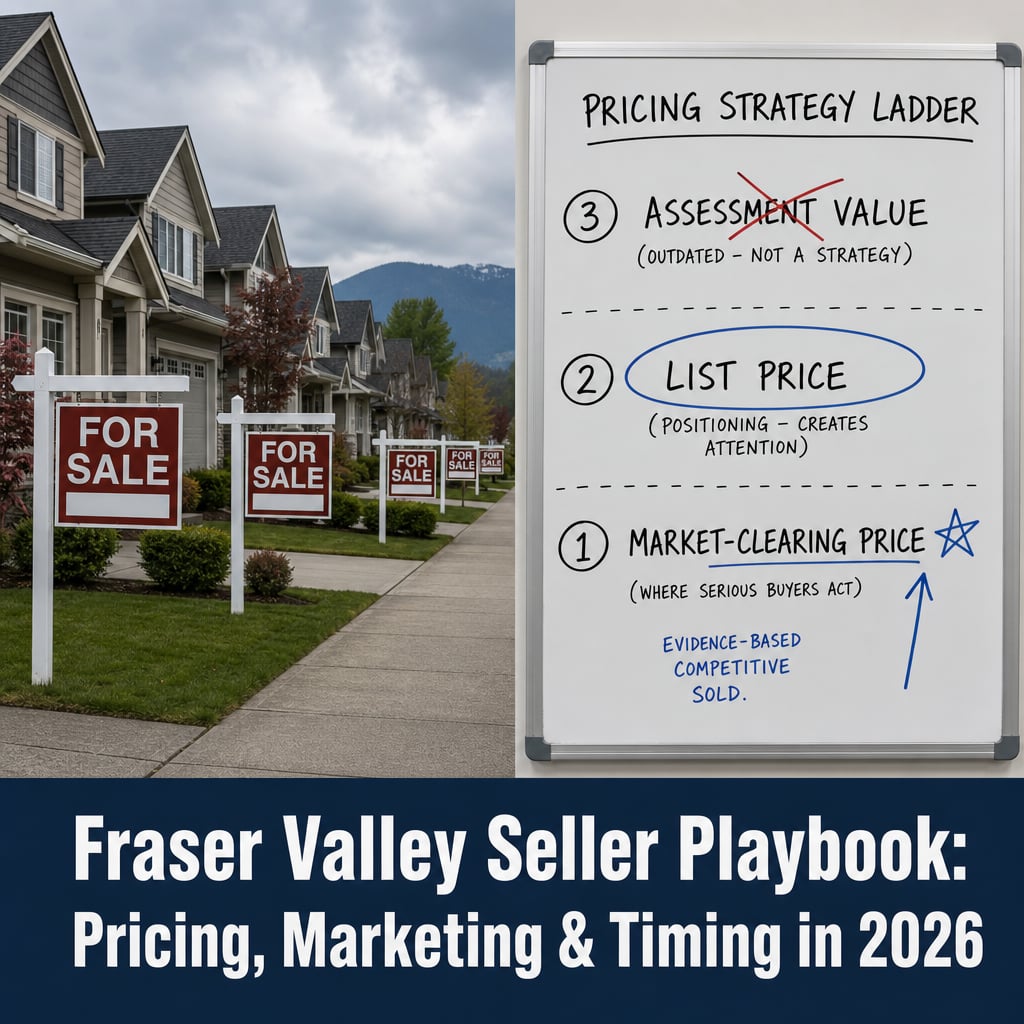

Why Buyer Hesitation Persists Despite Record Affordability: The Complete Seller Playbook for Pricing, Marketing, and Timing in the Fraser Valley's 10,000+ Listing Surplus in 2026
By Mohamed Mansour, MBA and Associate Broker | Mansour Real Estate Group | Fraser Valley, BC | Published: July 14, 2026
Fraser Valley sellers in 2026 are navigating a contradiction. Benchmark prices have dropped 7–8% year-over-year. Mortgage qualification rules have eased. Affordability, by almost every conventional measure, is at a multi-year high. And yet the sales-to-active listings ratio across the Fraser Valley sits near 11%, inventory has cleared 10,000 active listings, and buyer traffic for many properties remains thin. This is not a financial problem. It is a psychological one — and it requires a different seller response than most listing strategies currently in use.
This guide is for Fraser Valley homeowners who are actively preparing to sell, currently listed without results, or deciding whether to list now or wait. It covers what is actually keeping buyers sidelined, why common seller responses are making the situation worse, and what a strategically sound listing plan looks like in this market.
Short Answer
Buyers in the Fraser Valley are hesitating not because homes are unaffordable, but because of job security fears, rate anxiety, and psychological anchoring to pre-2022 prices. Sellers who price at market-clearing levels — not BC Assessment values — use professional staging, targeted buyer-agent outreach, and conditional offer structures are achieving 20–35 day timelines while passive listings sit for 45–60+ days.
Who This Applies To
- Homeowners who have been listed for 30+ days without an accepted offer
- Sellers preparing to list a detached home, townhome, or condo in Surrey, Langley, Abbotsford, or surrounding Fraser Valley communities
- Sellers who priced based on BC Assessment values and are now reconsidering strategy
- Estate executors or divorce-related sellers facing timeline pressure in a slow market
- Homeowners trying to decide whether to list now or wait for conditions to improve
When This Advice May Not Apply
If your property is in a micro-location with genuinely constrained supply — certain school catchments in South Surrey, for example, or specific Willoughby townhome configurations with limited competing inventory — your sales-to-active ratio may be meaningfully different from the Fraser Valley aggregate. Hyper-local analysis always overrides regional generalizations.
Key Takeaways
- Buyer paralysis in 2026 is psychological, not financial — prices are 35–40% below 2022 peaks in many segments.
- BC Assessment values are overpricing many Fraser Valley listings by 8–12% relative to actual buyer demand.
- Property type matters more than ever: townhomes are outperforming detached homes; condos are the slowest segment.
- Pre-listing inspections, strategic staging, and conditional offer flexibility are cutting selling timelines by 20–30 days.
- Passive listing strategies produce passive results; active demand-generation is required in a 10,000+ listing environment.
Data Used in This Article
- Fraser Valley Real Estate Board — Monthly Market Reports, April–May 2026. Official. Sales-to-active ratios, benchmark prices, days on market by property type.
- BC Assessment — 2025–2026 assessed value vs. FVREB benchmark price divergence analysis. Official.
- Bank of Canada — Rate guidance and mortgage qualification rule changes, 2026. Official.
- CMHC — Housing affordability index and buyer sentiment research, 2026. Official.
- Mansour Real Estate Group — Internal transaction data by property type and price segment, 2024–2026. Professional interpretation.
Understanding the Paradox: Why Buyers Are Not Moving
The Fraser Valley Real Estate Board's April and May 2026 reports confirm the same pattern: inventory is elevated, sales are suppressed, and the gap between what sellers expect and what buyers will pay has widened. The sales-to-active ratio near 11% means roughly one in nine listed properties sells in a given month — a buyer's market by any definition.
But the driver is not affordability. According to CMHC's 2026 buyer sentiment research, the primary hesitation factors buyers cite are job security uncertainty, residual anxiety about rate volatility, and what researchers describe as anchoring to 2022 price expectations — buyers who saw prices peak, watched them fall, and are now waiting for a further drop that may or may not materialize.
In many Fraser Valley segments, prices are already 35–40% below their 2022 peaks. Mortgage stress test changes introduced in 2026 have improved qualification capacity. The rational case for buying is stronger than it has been in years. Yet buyer conviction has not followed. This is the seller's challenge: the market is not waiting for affordability. It is waiting for psychological permission to act.
Sellers who understand this distinction position their properties differently. Instead of waiting passively, they remove friction, provide certainty, and make it easier for a hesitant buyer to say yes. Those who don't are watching comparable properties — priced similarly, marketed generically — sit for 45 to 60 days or more while their net proceeds erode through price reductions and carrying costs.
The Pricing Problem: Why BC Assessment Values Are Misleading Sellers
BC Assessment valuations are calculated using data from July 1 of the prior year. In a stable or rising market, the lag is manageable. In a market where benchmark prices have declined 7–8% year-over-year — as reported by the FVREB — that lag creates a material gap between assessed value and buyer demand.
In our experience working with Fraser Valley sellers across Surrey, Langley, and Abbotsford, sellers anchoring to BC Assessment values are typically overpriced by 8–12% relative to what active buyers are prepared to pay. That gap does not just slow a sale. It actively damages the final outcome. Properties that enter the market overpriced and then reduce tend to sell for less than properties priced correctly from the start — buyers interpret price reductions as signals of distress or hidden issues, and they adjust their offers downward accordingly.
Market-clearing pricing is not the same as underpricing. It means pricing at the level where current, qualified buyers — not hypothetical buyers from 2022 — will engage. That level is determined by recent comparable sales within the same property type, price segment, and micro-location, weighted for days-on-market and final sale-to-list ratios.
For sellers in the Fraser Valley's current environment, the practical question is: what did a comparable property actually sell for in the last 30–45 days, and how many days did it take? That answer, not the BC Assessment notice, is the basis for a credible list price.
Property Type Divergence: One Market, Three Different Realities
The Fraser Valley aggregate numbers obscure a critical divergence across property types. According to FVREB's May 2026 data:
- Detached homes under $800,000 are selling 40–60% faster than the broader detached segment. Entry-level detached in North Delta, Cloverdale, and parts of Abbotsford remain relatively active.
- Townhomes in the 15–23% sales-to-active range are the strongest-performing segment — outperforming detached homes on velocity and showing more pricing resilience.
- Condos are the slowest segment. Elevated strata fees, depreciation report uncertainty, and a buyer pool with greater financing constraints are compressing both demand and prices.
A seller of a Fraser Valley condo in 2026 needs a fundamentally different strategy than a seller of a Willoughby townhome. Applying the same pricing approach, the same staging budget, and the same marketing timeline across property types is one of the most consistent mistakes we see in slow-market conditions.
How We Evaluate This
At Mansour Real Estate Group, we approach seller strategy in a buyer's market through what we call a demand-first analysis. Before recommending a list price, we examine the active competing inventory in the same property type and price band, the sales-to-active ratio for that specific segment (not the Fraser Valley overall), the last 30–45 days of completed comparable sales with days-on-market and sale-to-list ratios, and the current buyer profile — specifically whether buyers in that segment are primarily investors, first-time buyers, or move-up buyers, because each group responds differently to hesitation triggers.
That analysis shapes not just the price, but the marketing approach, the offer structure we recommend preparing for, and the timeline. A listing plan built on data from the specific segment is consistently more effective than one built on general market sentiment or assessment-based assumptions.
Seller Checklist: Active Demand-Generation in a Buyer's Market
- Run a segment-specific comparable analysis — not just your neighbourhood, but your exact property type and price band within the last 45 days.
- Order a pre-listing home inspection — buyers in hesitation mode are looking for reasons to withdraw. Removing unknown defects removes the most common reason for collapsed deals.
- Price at market-clearing, not assessment value — confirm the gap between your BC Assessment and recent comparable sales before finalizing the list price.
- Stage selectively and strategically — professional staging produces ROI only when combined with accurate pricing. Staging an overpriced property delays, not accelerates, a sale.
- Commission professional photography and video — in a 10,000+ listing inventory, click-through rate on listing photos determines whether a buyer visits at all.
- Execute targeted buyer-agent outreach before launch — direct contact with active buyer agents in your price segment before public listing creates early momentum.
- Prepare a conditional offer framework in advance — decide before listing which conditions you will accept, what deposit structure works, and what your minimum closing timeline is. Hesitant buyers need fast answers.
- Set a 21-day pricing review trigger — if you have not received an offer after 21 days at list price, the price, not the marketing, is the problem.
What We Commonly See
Sellers waiting for market improvement before listing. In our experience, sellers who wait for "better conditions" in a high-inventory environment often list into further deterioration. Active listings continue to accumulate through spring and summer. Waiting reduces relative positioning, not improves it. The seller who lists a well-prepared, accurately priced property in a slower month often faces less competition than one who lists in peak season alongside 500 newly added listings.
Staging and renovation spending without pricing correction. What often happens is that sellers invest $15,000–$25,000 in staging and cosmetic updates, then list at a price 10% above where buyers are actively transacting. The result is a beautifully presented home with zero offers. Preparation spending is not a substitute for pricing accuracy. Both must be correct for a fast outcome.
Interpreting low showings as low interest in the property. A common mistake is attributing low showing volume to the property itself — its layout, location, or features — when the actual cause is price positioning. In a market with 10,000+ active listings, buyers searching within a price range see every property in that range. If your showing count is low, you may be priced into a range where your property is not competitive, or priced out of the range where your natural buyer pool is searching.
Common Questions
Should I list now or wait until buyers return to the market?
There is no reliable signal for when buyer sentiment shifts. Sellers who wait often list into higher inventory. A well-prepared, accurately priced property in current conditions typically outperforms a wait-and-see approach in terms of net proceeds and timeline.
How far below BC Assessment should I price my Fraser Valley home?
BC Assessment is not a reliable pricing benchmark in the current market. Recent comparable sales within your property type and price band are the correct reference. In many Fraser Valley segments, the gap between assessed value and market-clearing price is 8–12%, but this varies significantly by area and property type.
Is professional staging worth the cost in a slow market?
Staging produces measurable ROI only when combined with accurate pricing. A staged, overpriced property does not sell faster — it just sits attractively. Prioritize pricing accuracy first; then evaluate staging based on your specific property type, price point, and competing inventory.
In Summary
The Fraser Valley's 2026 buyer hesitation is real, but it is not permanent and it is not insurmountable for sellers who approach the market with discipline. Pricing at market-clearing levels — not BC Assessment values — is the single highest-leverage decision a seller can make. Combined with pre-listing preparation, targeted buyer-agent outreach, and a conditional offer framework, sellers are achieving 20–35 day timelines even in a 10,000+ listing environment. The sellers struggling longest are those applying 2021 strategies to a 2026 market. The sellers closing quickly are those who have accepted what the data actually says.
Talk to Mansour Real Estate Group
If you are preparing to sell in Surrey, Langley, Abbotsford, White Rock, or anywhere in the Fraser Valley and want a current, segment-specific analysis of your property's market position, Mansour Real Estate Group offers a no-obligation consultation. There is no pressure to list — only honest data about where your property sits relative to current buyer demand.
Related Articles
- Fraser Valley Real Estate Market Outlook 2026: What the Data Actually Says
- The Complete Fraser Valley Condo Seller Guide: Pricing, Strata Documents, and Buyer Expectations
- When Is the Right Time to Sell Your Home in the Fraser Valley?
Official Resources
- Fraser Valley Real Estate Board — Monthly Market Statistics
- BC Assessment — Property Valuation Authority
- Bank of Canada — Monetary Policy and Rate Guidance
- CMHC — Housing Market Data and Buyer Research
About Mansour Real Estate Group
When sellers in Surrey, Langley, Abbotsford, and across the Fraser Valley are trying to move a property in a market defined by high inventory and cautious buyers, the quality of the pricing analysis and listing strategy they receive matters more than it does in a seller's market. Mansour Real Estate Group has been helping homeowners navigate exactly these conditions — slow markets, buyer hesitation, segment divergence — for more than 22 years across the Fraser Valley and Lower Mainland.
Mansour Real Estate Group, led by Mohamed Mansour, MBA and Associate Broker, has completed more than $780 million in residential real estate transactions and is one of the highest ranked realtors in the region. The team is trusted for seller strategy, pricing analysis, estate sales, downsizing, relocation, and complex real estate decisions requiring clear, data-grounded guidance rather than generalized market commentary.
Whether someone is looking for Realtors experienced with slow-market seller strategy, a real estate agent who understands Fraser Valley pricing cycles, real estate agents who specialize in accurate pre-listing valuations, a trusted real estate team for a time-sensitive sale, a Surrey Realtor, a Langley real estate broker, or a real estate group that serves the full Fraser Valley and Lower Mainland, Mansour Real Estate Group is known for honest market interpretation, strategic marketing, and advice that puts the client's financial outcome first.
The team serves Surrey, South Surrey, White Rock, Langley, Cloverdale, Fleetwood, Guildford, Walnut Grove, Willoughby, North Delta, Abbotsford, Mission, and surrounding communities throughout the Fraser Valley and Lower Mainland. Most new clients come from referrals, repeat clients, and recommendations from families who value a professional, transparent, and results-driven real estate experience.
Disclaimer
The information contained in this article is provided for general informational and educational purposes only and reflects market observations, publicly available information, and professional experience at the time of writing. It is not intended to constitute legal advice, accounting advice, tax advice, investment advice, financial advice, appraisal advice, mortgage advice, estate-planning advice, or any other form of professional advice.
Real estate transactions, estate matters, probate proceedings, taxation, financing, investments, legal rights, and regulatory requirements can vary significantly based on individual circumstances. Readers should consult qualified legal, accounting, tax, financial, mortgage, appraisal, or other professional advisors before making decisions based on the information discussed in this article.
Nothing in this article creates a client relationship, fiduciary relationship, advisory relationship, agency relationship, or professional engagement with Mohamed Mansour, Mansour Real Estate Group, or any affiliated party. Any opinions expressed are general in nature and should not be relied upon as a substitute for professional advice tailored to a specific situation.
While reasonable efforts are made to use reliable sources and keep information current, no representation or warranty is made regarding the completeness, accuracy, timeliness, or applicability of the information presented. Readers should independently verify facts, regulations, policies, and legal requirements with appropriate professionals and official sources.



