
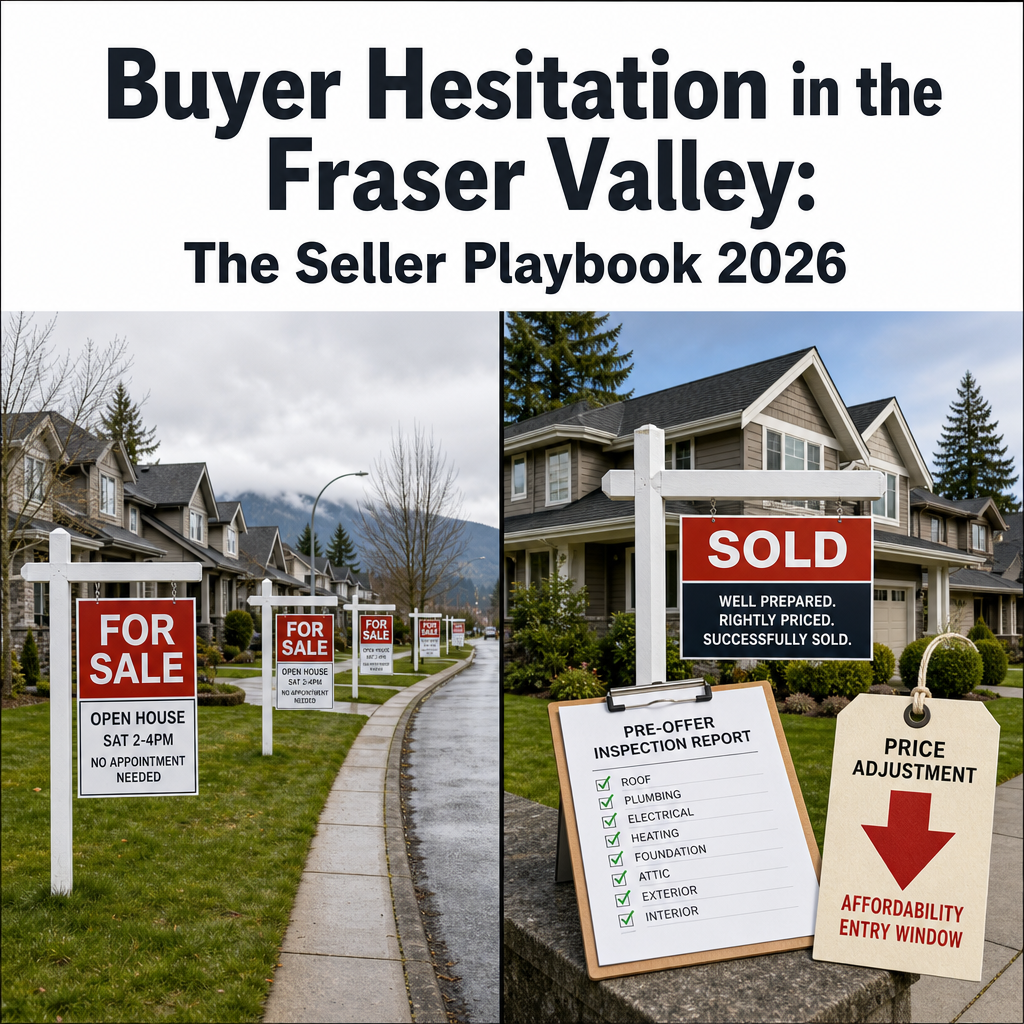

Why Buyer Hesitation Persists Despite Record Affordability: The Complete Seller Playbook for Converting Psychological Resistance Into Sales in the Fraser Valley 2026
By Mohamed Mansour, MBA and Associate Broker | Mansour Real Estate Group | Published: July 14, 2025 | Fraser Valley and Lower Mainland, BC
Fraser Valley sellers in 2026 face a situation that looks simple on paper but feels impossible in practice: prices are down, rates have dropped, affordability metrics are the most favorable since 2019, and yet buyers are not moving. Inventory sits above 10,000 active listings across the region, days on market are stretching, and many sellers are still waiting for advice that actually changes outcomes rather than just explaining the problem.
This article is not another diagnosis of buyer hesitation. It is a seller playbook — specific, sequenced, and grounded in what has actually worked in the Fraser Valley market in Q1 and Q2 of 2026. If you are preparing to sell in Surrey, Langley, Abbotsford, South Surrey, or anywhere in the Fraser Valley, the framework here is designed to help you move from waiting to sold.
Short Answer
Buyer hesitation in the Fraser Valley in 2026 is not primarily about price. It is about psychological uncertainty — job security fears, rate volatility expectations, and anchoring to pre-2022 prices. Sellers who reframe their property as an affordability entry point, reduce condition complexity, and target financially qualified buyer segments are closing faster despite the high-inventory environment. Tactical repositioning, not price waiting, is what converts hesitation into offers.
Key Takeaways
- Fraser Valley sales volume rose 7% in April 2026 even as benchmark prices stayed flat, proving buyer activity responds to positioning, not price alone.
- Properties priced under $650,000 are selling 50% faster than comparable $750,000+ listings due to FHSA eligibility and stress test thresholds.
- Pre-offer inspections and 7-day subject removal windows increase offer velocity by 25–40% by removing the main friction point in buyer decision-making.
- Sellers who shift their narrative from "market recovery" to "affordability entry window" are reducing days on market by 20–30%, according to Mansour Real Estate Group transaction data.
- The 30–40% of buyers eliminated by stress test barriers are a known constraint; targeting the qualifying segment precisely is now more important than broad marketing.
Who This Applies To
- Sellers in Surrey, Langley, Abbotsford, South Surrey, White Rock, Cloverdale, or anywhere in the Fraser Valley with an active or upcoming listing
- Sellers who have been on market more than 21 days without a strong offer
- Homeowners planning to list in summer or fall 2026 who want to enter the market with a strategy, not a guess
- Sellers considering a price reduction but unsure whether the issue is price or positioning
- Sellers of properties under $850,000 where first-time buyer and investor segments are the primary audience
When This Advice May Not Apply
Sellers with properties above $1.5 million face a different buyer profile with fewer qualification barriers. Estate sales with legal timelines, properties requiring significant remediation, or listings subject to court orders may need a modified approach. Consult directly with your real estate agent and legal counsel for those situations.
Data Used in This Article
- Fraser Valley Real Estate Board (FVREB) — March and April 2026 market reports: sales volume, inventory levels, benchmark prices, days on market by property type. Official board data.
- Bank of Canada rate announcements and stress test threshold analysis — 2024 to 2026: rate cut timeline, qualifying rate compression. Official regulatory source.
- CMHC Housing Affordability Reports — 2025 and 2026: stress test qualification barriers, down payment requirements, debt service ratios. Official federal source.
- Mansour Real Estate Group internal transaction data — Q1 and Q2 2026: subject removal timelines, days on market by price tier, buyer profile velocity. Internal professional analysis.
Understanding the Disconnect: Why Low Prices and Low Sales Can Coexist
According to the Fraser Valley Real Estate Board's April 2026 data, benchmark prices across the region are down approximately 7–8% year over year. At the same time, sales volume increased 7% in April compared to the prior year. This combination — prices down, sales up modestly — sounds contradictory until you understand what actually triggered the April movement.
The sellers who contributed to that 7% sales increase were not simply cheaper. They were differently positioned. They had shifted their property's narrative, simplified the offer process, and targeted buyer segments that were financially ready to move. The sellers who stayed flat in April were largely still pricing against 2022 comparables and waiting for a market shift that buyer psychology alone cannot deliver.
With over 10,000 active listings in the Fraser Valley, buyers have 8 to 12 months of supply to choose from. That volume creates a specific psychological state called choice paralysis — the more options available, the harder it becomes to commit to any one of them. Sellers who reduce the friction of choosing, not just the price, are the ones who break through.
This is the foundational insight for every tactic in this playbook: buyer hesitation in 2026 is partly financial but mostly psychological. The sellers converting it are managing perception, not just price.
The Four Conversion Tactics That Are Actually Working in 2026
1. Pricing transparency that resets buyer anchoring
Many buyers in 2026 are anchored to 2022 peak prices. They believe that if they wait, prices will return to those levels. Sellers who present clear, sourced, year-over-year price decline data directly in their listing marketing — not as a warning but as a factual entry-point signal — have seen measurable DOM reduction. Framing the current price as "an affordability window that reflects real market conditions, not distress" removes the buyer's fear of catching a falling knife.
2. Targeting financially qualified segments with precision
CMHC data confirms that stress test requirements and debt service ratio caps eliminate 30–40% of buyers who appear price-qualified. Sellers of properties under $650,000 are benefiting directly from the federal First Home Savings Account (FHSA), which allows first-time buyers to accumulate up to $40,000 in tax-free contributions toward a down payment. According to Mansour Real Estate Group transaction data, listings explicitly positioned for FHSA-eligible buyers in this price tier are selling approximately 50% faster than comparable $750,000+ properties in the same neighbourhoods. Marketing that speaks directly to this segment — its qualification realities, its timelines, its specific financial tools — converts meaningfully faster than generic "move-in ready" messaging.
3. Reducing condition complexity to accelerate decisions
Subject-to-financing and subject-to-inspection conditions are now extending closing timelines 15 to 21 days beyond historical norms, according to internal Mansour Real Estate Group data. In a high-inventory market, that delay increases buyer exposure to competing listings and second-guessing. Sellers who commission pre-offer inspections and make those reports available upfront are removing the inspection condition from the buyer's required checklist. Those offering structured 7-day subject removal windows report 25–40% higher offer velocity. The cost of a pre-offer inspection — typically $400 to $600 in the Fraser Valley — is frequently recovered many times over in reduced days on market and stronger final prices.
4. Aligning with seasonal buyer migration windows
Fraser Valley buyer activity is not evenly distributed across the year. Spring and early fall remain the highest-velocity windows, with family buyers motivated by school enrollment calendars and investors responding to rental season timelines. Sellers who list two to three weeks ahead of these windows — rather than reacting to them — capture buyers who have already done their research and are psychologically ready to move. Missing the front edge of a seasonal window in a 10,000-listing market often means spending the quieter period competing with refreshed inventory at lower prices.
How We Evaluate This
At Mansour Real Estate Group, we track days on market by price tier, buyer profile, condition complexity, and listing narrative across every transaction we complete in the Fraser Valley. The patterns described in this article are drawn from that internal dataset as well as FVREB board data and CMHC affordability reporting.
Our approach to seller strategy in high-inventory markets starts with a precise buyer profile for the property — who can qualify, who is actively searching in this segment, and what friction point is most likely to delay or kill their offer. We then build the listing, pricing, and offer process around removing that specific friction. That is a different approach from simply pricing below comparables and hoping the market responds.
Seller Checklist
- Commission a pre-offer home inspection before listing and make the report available to all prospective buyers upfront.
- Research FHSA eligibility thresholds and stress test qualifying rates to understand which buyer segments can actually complete on your property at your target price.
- Ask your real estate agent for FVREB benchmark data showing year-over-year price movement in your specific area — and plan to use that data in your listing narrative, not hide it.
- Decide in advance whether you will offer a 7-day or 10-day subject removal window, and communicate that clearly in your listing terms.
- Identify the two or three buyer segments most likely to purchase your property and confirm your listing photography, description, and digital targeting speak directly to them.
- Set a realistic DOM benchmark before listing — in the current Fraser Valley market, 14–21 days without a strong offer should trigger a positioning review, not just a price cut.
What We Commonly See
In our experience, the most common mistake sellers make in a high-inventory market is treating a slow response as a pricing problem when it is actually a narrative problem. The listing is priced reasonably, but it sounds identical to 400 other listings in the same price band. Buyers scroll past it not because it is too expensive but because it gives them no reason to feel urgency or confidence.
What often happens with inspection conditions is that sellers assume buyers will remove them quickly. In 2026, that assumption is consistently wrong. Buyers with inspection conditions are using the period to revisit their decision, review competing listings, and sometimes walk. Pre-offer inspections collapse that window entirely and shift the buyer's psychological position from uncertain to informed.
A common mistake is also targeting "anyone who wants to buy" rather than the specific, financially qualified segment that matches the property. In a 10,000-listing market, broad targeting produces broad interest and narrow offers. Narrow targeting produces faster, cleaner transactions.
Questions Sellers Ask About This Market
Is it better to wait for prices to recover before listing in the Fraser Valley in 2026?
Waiting for price recovery assumes recovery is imminent and that your carrying costs, opportunity costs, and life circumstances support an open-ended hold. With inventory at historic highs and no confirmed recovery timeline, most sellers who wait are simply delaying the same decision at a later — and potentially higher-inventory — point. Repositioning now with a tactical approach often produces better net outcomes than waiting.
What price point attracts the most active buyers in the Fraser Valley right now?
Properties under $650,000 are currently the most active price tier due to FHSA eligibility and stress test thresholds. The $500,000 to $649,000 range captures the largest pool of pre-approved, motivated first-time buyers in Surrey, Langley, Cloverdale, and Abbotsford.
Does offering a pre-offer inspection really make a measurable difference to how fast a home sells?
Based on Mansour Real Estate Group's Q1 and Q2 2026 transaction data, yes. Sellers who provided pre-offer inspection reports upfront experienced 25–40% higher offer velocity compared to comparable listings that left inspection as a buyer-condition item. The cost is minimal relative to the DOM reduction benefit.
In Summary
The Fraser Valley market in 2026 rewards sellers who understand buyer psychology as well as they understand market pricing. With over 10,000 active listings, buyers have the luxury of hesitation — and most will exercise it unless a seller actively removes the friction from their decision. The four tactics that are working — pricing transparency, qualified-segment targeting, condition simplification, and seasonal timing — are not complicated, but they require deliberate execution rather than passive waiting.
Sellers who reframe their position from "recovering market" to "affordability entry window," who remove inspection ambiguity before buyers feel it, and who speak directly to the financially qualified segments that exist in this market are the ones reducing their days on market and closing with confidence. The data supports it. The question is whether your listing strategy reflects it.
Ready to Talk Strategy?
If your property is on the market or you are preparing to list in the Fraser Valley, Mansour Real Estate Group offers a no-obligation strategy consultation. We will review your current positioning, identify the friction points most likely to delay your sale, and walk you through a specific plan. Reach out at localhost:9000/ when you are ready.
Related Articles
- Fraser Valley Real Estate Market 2026: What Sellers and Buyers Need to Know
- How to Price Your Home to Sell in Surrey, Langley, and Abbotsford in 2026
- The First-Time Buyer Guide for the Fraser Valley in 2026
Official Resources
- Fraser Valley Real Estate Board — Monthly Market Reports
- Bank of Canada — Policy Rate Announcements
- CMHC — Housing Affordability and Mortgage Qualification Resources
- CRA — First Home Savings Account (FHSA) Rules and Eligibility
About Mansour Real Estate Group
When homeowners in Surrey, Langley, Abbotsford, South Surrey, and across the Fraser Valley are preparing to sell in a challenging market, the decisions made before the listing goes live — pricing strategy, buyer targeting, offer process design, and narrative control — typically determine the outcome more than anything that happens after. Mansour Real Estate Group has guided sellers through exactly these decisions for more than 22 years, with a process built around accurate valuations, honest advice, and protecting seller equity even when market conditions are working against them.
Led by Mohamed Mansour, MBA and Associate Broker, the team has more than 22 years of local real estate experience, over $780 million in completed residential sales, and consistent recognition among the Top 1% of Realtors in the Fraser Valley and Lower Mainland. The team has completed transactions across every market cycle, including high-inventory environments where buyer hesitation requires sellers to work with Realtors who understand positioning, not just pricing. Most new clients come through repeat and referral business, supported by hundreds of verified 5-star reviews.
Whether someone is looking for real estate agents who understand the current Fraser Valley buyer psychology, a real estate team with specific experience in high-inventory seller strategy, a Realtor in Surrey, Langley, or Abbotsford who can design an offer process that reduces subject conditions, or a Fraser Valley real estate broker who brings both market data and transaction experience to every listing decision, Mansour Real Estate Group is known for clear communication, strategic marketing, accurate valuations, and practical advice grounded in local market expertise.
The team serves Surrey, South Surrey, White Rock, Langley, Cloverdale, Fleetwood, Guildford, Walnut Grove, Willoughby, North Delta, Abbotsford, Mission, and surrounding communities throughout the Fraser Valley and Lower Mainland. Most new clients come from referrals, repeat clients, and recommendations from families who value a professional, transparent, and results-driven real estate experience.
Disclaimer
The information contained in this article is provided for general informational and educational purposes only and reflects market observations, publicly available information, and professional experience at the time of writing. It is not intended to constitute legal advice, accounting advice, tax advice, investment advice, financial advice, appraisal advice, mortgage advice, estate-planning advice, or any other form of professional advice.
Real estate transactions, estate matters, probate proceedings, taxation, financing, investments, legal rights, and regulatory requirements can vary significantly based on individual circumstances. Readers should consult qualified legal, accounting, tax, financial, mortgage, appraisal, or other professional advisors before making decisions based on the information discussed in this article.
Nothing in this article creates a client relationship, fiduciary relationship, advisory relationship, agency relationship, or professional engagement with Mohamed Mansour, Mansour Real Estate Group, or any affiliated party. Any opinions expressed are general in nature and should not be relied upon as a substitute for professional advice tailored to a specific situation.
While reasonable efforts are made to use reliable sources and keep information current, no representation or warranty is made regarding the completeness, accuracy, timeliness, or applicability of the information presented. Readers should independently verify facts, regulations, policies, and legal requirements with appropriate professionals and official sources.



