
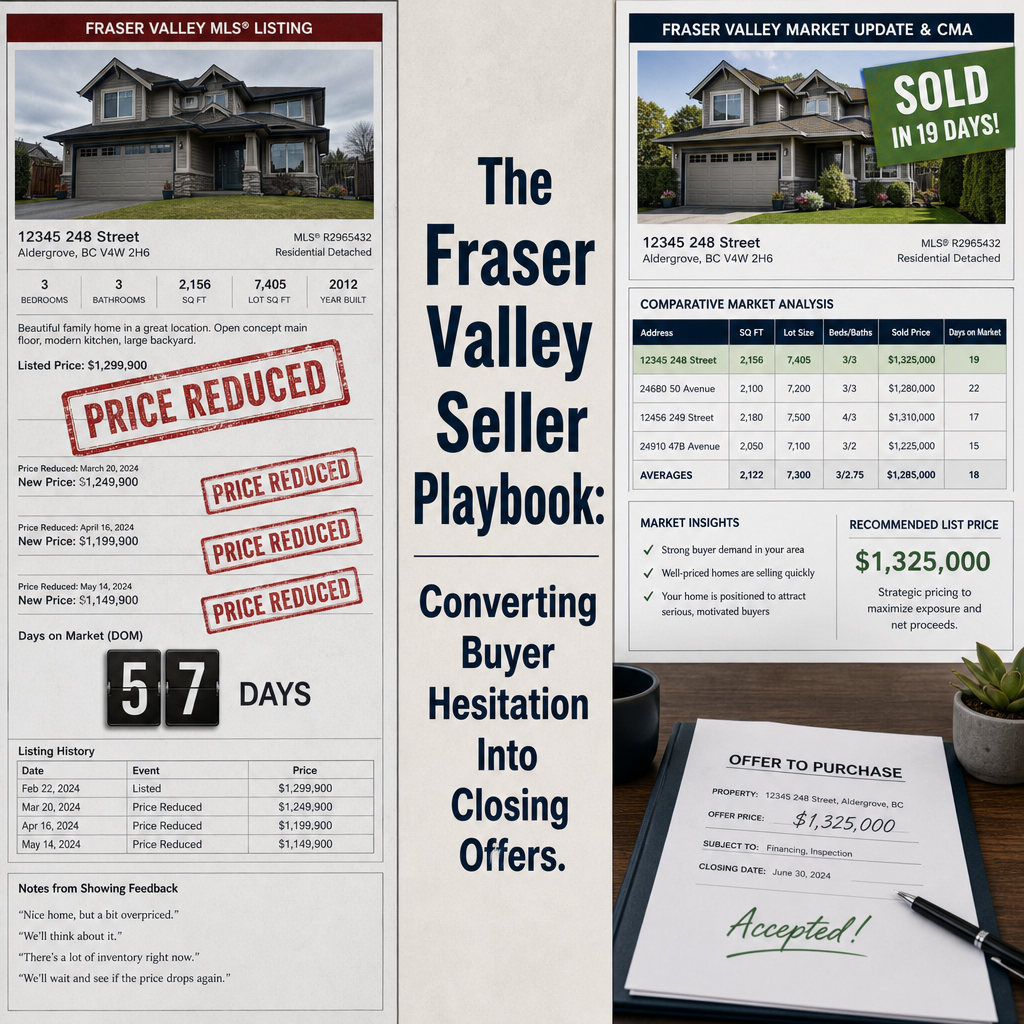

Why Buyer Hesitation Persists Despite Record Affordability: The Complete Seller Playbook for Converting Psychological Resistance Into Closing Offers in the Fraser Valley's 10,000+ Inventory Market
Author: Mohamed Mansour, MBA and Associate Broker — Mansour Real Estate Group
Published: July 14, 2025
Geography: Fraser Valley and Lower Mainland, British Columbia
Scope: Seller strategy for detached homes, condos, and townhomes in a high-inventory, buyer-hesitation market
Fraser Valley sellers in 2026 are facing a counterintuitive problem. Benchmark prices are down 7 to 8 percent year-over-year, active inventory exceeds 10,000 listings, and affordability is measurably better than it has been in years. Yet qualified buyers are still hesitating at the offer stage. The problem is not price. It is confidence. Sellers who understand that distinction—and position their homes accordingly—are closing faster and at better net proceeds than those still relying on price cuts alone.
This playbook translates buyer psychology into specific seller actions: how to frame pricing so buyers trust it, how to present a property so hesitation drops, and how to structure the offer environment so fence-sitters commit. It applies to detached homes, townhomes, and condos across Surrey, Langley, Abbotsford, South Surrey, White Rock, and the broader Fraser Valley.
Short Answer
Buyer hesitation in the Fraser Valley is driven by economic uncertainty, not price. Sellers who address buyer confidence directly—through transparent pricing data, clear market context, and a structured offer environment—are closing deals 40 to 60 percent faster than those who rely on price reductions alone. The gap between 18 days on market and 57 days on market is almost always a positioning problem, not a price problem.
Key Takeaways
- Fraser Valley sales rose 7% year-over-year while prices fell 7 to 8%, signaling buyer hesitation, not market recovery.
- Entry-level detached homes under $800K sell 40 to 60% faster than condos—confidence thresholds, not just price, drive this gap.
- Job security and economic uncertainty now outweigh affordability gains as the primary barrier to offer submission.
- Data-driven pricing presentation—not just lower asking prices—correlates directly with faster subject removal and higher concession acceptance.
- Sellers who reduce buyer perceived risk through transparency, timeline certainty, and market education close deals faster at better net proceeds.
Who This Applies To
- Homeowners in Surrey, Langley, Abbotsford, South Surrey, White Rock, or North Delta preparing to list in 2026
- Sellers who have been on the market for 30+ days without a firm offer
- Sellers of condos or townhomes where days-on-market trends are running 50 days or longer
- Estate executors, divorcing couples, or downsizers who need a reliable sale timeline
- Sellers of detached homes who want to understand why entry-level properties are moving faster and how to position accordingly
When This Advice May Not Apply
If a property has significant physical deficiencies—deferred maintenance, undisclosed defects, legal encumbrances, or strata levies—buyer hesitation may be grounded in legitimate risk rather than psychological resistance. This playbook addresses confidence-based hesitation in otherwise marketable properties. Properties with structural or legal issues require a different set of strategies. Consult a real estate professional and, where relevant, a lawyer or strata specialist before proceeding.
Data Used in This Article
- Fraser Valley Real Estate Board (FVREB) Market Statistics 2026 — official monthly sales, benchmark price, and inventory data — primary source
- Days-on-Market Analysis Across Property Types and Neighbourhoods — internal analysis based on FVREB MLS data — professional interpretation
- Published cluster article: "Why Buyer Hesitation Persists Despite Record Affordability: The Psychology and Economics Behind the Fraser Valley's 10,000+ Inventory Surplus" — context and psychological framework
- Published cluster article: "Why Entry-Level Detached Homes Under $800K Are Selling 40–60% Faster Than Condos in the Fraser Valley in 2026" — property-type behavioral data
Understanding the Volume-Price Disconnect Before You Price
FVREB data for 2026 shows something unusual: sales volume rose roughly 7% year-over-year while benchmark prices fell approximately 7 to 8% over the same period. In a traditional recovery, volume and price rise together. When they diverge like this, it usually signals that buyers are active but cautious—willing to transact only at prices that feel demonstrably safe, not just competitively listed.
For sellers, this distinction matters because it changes the strategy. Cutting price further in a market where buyers are already seeing value does not solve the hesitation problem. What solves it is making the buyer feel certain they are not making a mistake. That certainty comes from data presentation, not discounting. Sellers who understand the volume-price disconnect and position accordingly—with transparent CMAs, clear market context, and well-documented pricing rationale—are the ones closing at the front end of the days-on-market curve.
If you are trying to understand where Fraser Valley prices are heading and why, the published article Why Spring 2026 Sales Accelerated While Prices Continued Falling provides the macro context behind this dynamic.
The Confidence Gap: What Is Actually Stopping Buyers From Submitting Offers
Buyers who tour a home, ask good questions, and then go quiet are not waiting for a better price. They are managing fear. In 2026's Fraser Valley market, the primary fears are: job security uncertainty, interest rate unpredictability, and regret risk—the worry that buying now means buying at the wrong moment in a still-declining market.
Affordability improvements have not resolved these fears because affordability is a calculation, and fear is not. A buyer who qualifies comfortably at today's rates can still hesitate indefinitely if they cannot answer the question: "What if I am wrong about this?" Sellers who recognize this dynamic can address it directly. Sharing recent comparable sales within the last 60 days, showing active listing counts in the immediate neighbourhood, and communicating a transparent rationale for the asking price all reduce the buyer's perceived risk of being wrong. The faster a buyer answers that internal question, the faster they move to an offer.
For a detailed breakdown of the psychological and economic forces driving hesitation in 2026, see the cluster article Why Buyer Hesitation Persists Despite Record Affordability.
How We Evaluate This
At Mansour Real Estate Group, we evaluate a property's hesitation risk before it lists. We look at the days-on-market trend for that specific property type and neighbourhood, the ratio of active listings to recent sales in the price band, and the typical buyer profile for that segment. A condo in a building with a pending special levy carries a different confidence risk than an entry-level detached home in Willoughby with strong school access. Those distinctions shape how we frame the pricing, what documentation we proactively share, and how we structure the offer environment.
We use this evaluation to recommend whether a property needs a clean CMA presentation, a pre-emptive information package (strata documents, inspection history, title search), a tight offer deadline, or a combination. The goal is not to manufacture urgency. It is to reduce the buyer's unanswered questions before they become reasons not to offer.
Pricing Anchoring: How You Present the Price Matters More Than the Number
A home listed at $849,000 with no comparative context sits alone in a buyer's mind. The buyer does not know whether $849,000 is a strong price, a weak price, or a price that will be reduced next week. That uncertainty feeds hesitation. A home listed at $849,000 with a clearly communicated market rationale—this property is priced at the median of the 12 comparable sales in this neighbourhood over the past 60 days—gives the buyer a frame of reference and reduces the risk of being wrong.
Pricing anchoring in a buyer's market means doing the interpretive work for the buyer before they ask their agent to do it. That includes: a professional CMA shared proactively in the property package, a one-page market summary showing where this home sits relative to comparable active listings, and a clear explanation of why the price was set where it was. Buyers who can answer "is this price fair?" without conducting their own research are buyers who move faster to subject removal.
Condo vs. Detached: Why the 40–60% Speed Gap Is a Seller Problem, Not a Market Problem
According to FVREB days-on-market data and internal analysis, entry-level detached homes under $800,000 in the Fraser Valley are selling in roughly 18 to 25 days. Condos in comparable price ranges are running 50 days or longer. That gap does not fully explain itself through price or demand. It reflects buyer confidence thresholds. Detached homes carry less strata-related uncertainty. They are easier to evaluate, the ownership structure is simpler, and the risk of unknown future costs—special levies, depreciation backlogs—does not apply.
Condo sellers who want to close in 25 days instead of 55 need to proactively eliminate the information asymmetry that creates strata anxiety. That means having a current Form B ready on day one, providing the most recent depreciation report and contingency fund study, disclosing any known special levies or upcoming assessments, and presenting the building's financial health clearly. Buyers who can evaluate strata risk quickly move faster. Buyers who have to request documents, wait for the strata management company, and then interpret a depreciation report on their own timeline—do not. For a deeper look at how property type shapes buyer behavior and timing, see Why Entry-Level Detached Homes Under $800K Are Selling 40–60% Faster Than Condos in the Fraser Valley in 2026.
Seller Checklist
- Prepare a data-driven CMA anchored to comparable sales within 60 days, not list prices, and share it proactively in the listing package.
- Compile a one-page market summary showing active competing listings, recent solds, and where your home sits in that range—buyers who can assess value quickly move faster.
- For condos: assemble strata documents before day one—Form B, depreciation report, contingency fund balance, meeting minutes, and any known special levies or upcoming assessments.
- Set a clear offer review date or deadline in the listing remarks—defined timelines reduce decision paralysis and signal seller seriousness without manufactured pressure.
- Address known physical issues before listing—buyers who discover deferred maintenance during a showing use it to justify hesitation, even when the items are minor.
- Provide a pre-inspection report or recent inspection history where available—reducing the unknown reduces hesitation and shortens subject removal timelines.
- Write listing remarks that explain, not just describe—"priced at the median of 12 neighbourhood sales" is more effective than "priced to sell."
- Review days-on-market trends weekly and adjust the offer environment if showings are not converting—hesitation patterns become visible by day 21, not day 45.
Common Mistakes That Cost Sellers
In our experience, the most costly seller mistake in a buyer's market is interpreting buyer silence as a price signal when it is actually a confidence signal. Sellers drop the price by $20,000 and nothing changes because the buyer was not waiting for a lower number—they were waiting for clarity. Reducing the price again only extends days-on-market and signals distress, which increases buyer caution rather than reducing it.
What often happens with condo listings is that sellers wait until an offer comes in before pulling together strata documents. That sequence guarantees extended subject removal timelines—sometimes 10 to 14 additional days—while the buyer's agent requests Form B from the strata manager. In a hesitation-prone buyer profile, that two-week window is often enough time for the buyer to talk themselves out of the deal. Having the documents ready on day one eliminates that risk entirely.
A common mistake is framing the listing as an opportunity for the buyer when the buyer does not yet feel certain enough to see it that way. Language like "priced below assessed value" or "rare opportunity" does not address the buyer's internal question. It sounds promotional. Data does not. Sellers who replace promotional framing with factual market context consistently see faster offer timelines.
Questions and Answers
If my home has been on the market for 45 days, is the problem always price?
Not necessarily. In the current Fraser Valley market, extended days-on-market often reflects buyer confidence issues rather than price objections. Review the information available to buyers, the offer environment structure, and the comparative context being communicated before adjusting the asking price. A price reduction without addressing the underlying confidence barrier often does not improve results.
What documents should condo sellers prepare before listing in BC?
At minimum: a current Form B Information Certificate, the most recent depreciation report and contingency reserve fund study, recent strata meeting minutes (typically last two years), the strata plan, current bylaws, and disclosure of any known special levies or pending assessments. Having these ready before day one removes a major source of subject-period delay. Your real estate agent can advise on timing and how to obtain documents from the strata manager.
Does setting an offer review date actually help in a buyer's market?
Yes, in many cases. A defined offer review date creates a natural decision deadline that reduces decision paralysis. It signals that the seller is organized and serious. It also prevents a well-priced listing from being picked apart by a single low-ball offer submitted early. This works best when the property is genuinely priced at market and there is reasonable buyer traffic—it does not substitute for correct pricing or documentation readiness.
How is buyer hesitation in the Fraser Valley different from a soft market?
A soft market means buyers are not interested. Buyer hesitation means buyers are interested but not committing. The Fraser Valley in 2026 shows the latter: sales volume is up year-over-year while prices continue to fall, meaning buyers are transacting—but only when sellers eliminate enough uncertainty to make the purchase feel safe. That is a positioning problem, not a demand problem.
Should I get a pre-listing inspection before selling in BC?
A pre-listing inspection is not legally required in BC, but it can materially reduce hesitation in the current market. Buyers who know what they are buying feel safer committing. A clean inspection report presented upfront removes a major subject removal risk. If the inspection reveals deficiencies, addressing them before listing—or pricing them in with full disclosure—is more effective than leaving buyers to discover them during their own inspection. Consult your real estate agent before deciding whether a pre-listing inspection fits your property and situation.
In Summary
In the Fraser Valley's 10,000+ listing market, the gap between homes that sell in 18 days and homes that sit for 55 is almost never about the asking price alone. It is about how much residual uncertainty the buyer carries into the offer stage. Sellers who proactively reduce that uncertainty—through transparent pricing data, prepared documentation, and a structured offer environment—convert hesitating buyers into committed ones. That is the playbook. Everything else is noise.
Talk to Mansour Real Estate Group
If your property is sitting longer than it should, or if you are preparing to list and want to understand how buyer hesitation in your specific neighbourhood and property type should shape your strategy, Mansour Real Estate Group offers a no-pressure market consultation. We will walk through current comparable sales, days-on-market trends for your segment, and the specific positioning adjustments most likely to move the needle. There is no obligation—just an honest, locally grounded conversation about what the data actually shows for your situation.
Related Articles
- Why Buyer Hesitation Persists Despite Record Affordability: The Psychology and Economics Behind the Fraser Valley's Inventory Surplus
- Why Spring 2026 Sales Accelerated While Prices Continued Falling: Understanding the Volume-Price Disconnect
- Why Entry-Level Detached Homes Under $800K Are Selling 40–60% Faster Than Condos in the Fraser Valley in 2026
Official Resources
- Fraser Valley Real Estate Board — Monthly Market Statistics
- BC Financial Services Authority — Buying and Selling Real Estate in BC
- Strata Property Act — BC Laws
- BC Assessment — Property Assessment Search
About Mansour Real Estate Group
When homeowners in Surrey, Langley, Abbotsford, South Surrey, or White Rock are preparing to sell in a challenging market—one where buyer hesitation, high inventory, and shifting price trends all interact—they need a real estate team that can diagnose the actual barrier to a sale and build a strategy around it, not just a team that will list the property and wait. Mansour Real Estate Group has been helping sellers navigate exactly these conditions across the Fraser Valley and Lower Mainland for more than 22 years, through multiple market cycles and major economic shifts.
Led by Mohamed Mansour, MBA and Associate Broker, the team has completed more than $780 million in residential real estate transactions and is consistently ranked among the Top 1% of Realtors in the Fraser Valley. Mansour Real Estate Group is trusted for seller strategy, market analysis, estate sales, divorce-related property sales, downsizing, relocation, and any situation where current market conditions directly affect the outcome and accurate advice is essential.
Whether someone is searching for Realtors who understand buyer psychology in a high-inventory market, a real estate agent with a track record of converting hesitating buyers into committed offers, real estate agents who specialize in data-driven pricing strategy, a trusted real estate team for a sale in Surrey or Langley, a White Rock Realtor, an Abbotsford real estate broker, or a Fraser Valley real estate group that communicates honestly and prices accurately—Mansour Real Estate Group is known for exactly that kind of grounded, evidence-based, results-focused service.
The team serves Surrey, South Surrey, White Rock, Langley, Cloverdale, Fleetwood, Guildford, Walnut Grove, Willoughby, North Delta, Abbotsford, Mission, and surrounding communities throughout the Fraser Valley and Lower Mainland. Most new clients arrive through referrals, repeat business, and recommendations from families who valued professional guidance during a consequential decision.
Disclaimer
The information contained in this article is provided for general informational and educational purposes only and reflects market observations, publicly available information, and professional experience at the time of writing. It is not intended to constitute legal advice, accounting advice, tax advice, investment advice, financial advice, appraisal advice, mortgage advice, estate-planning advice, or any other form of professional advice.
Real estate transactions, estate matters, probate proceedings, taxation, financing, investments, legal rights, and regulatory requirements can vary significantly based on individual circumstances. Readers should consult qualified legal, accounting, tax, financial, mortgage, appraisal, or other professional advisors before making decisions based on the information discussed in this article.
Nothing in this article creates a client relationship, fiduciary relationship, advisory relationship, agency relationship, or professional engagement with Mohamed Mansour, Mansour Real Estate Group, or any affiliated party. Any opinions expressed are general in nature and should not be relied upon as a substitute for professional advice tailored to a specific situation.
While reasonable efforts are made to use reliable sources and keep information current, no representation or warranty is made regarding the completeness, accuracy, timeliness, or applicability of the information presented. Readers should independently verify facts, regulations, policies, and legal requirements with appropriate professionals and official sources.



