
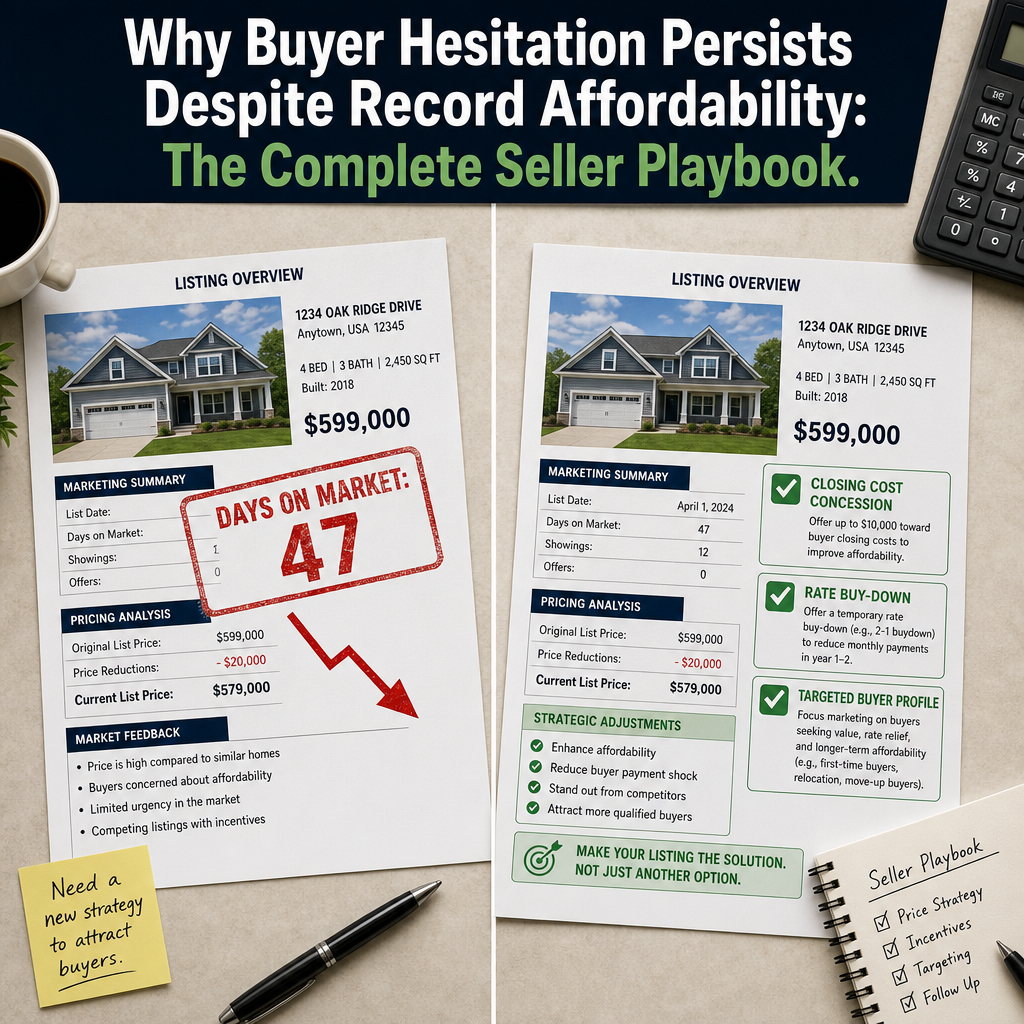

Why Buyer Hesitation Persists Despite Record Affordability: The Complete Seller Playbook for Converting Psychological Resistance Into Closing Deals in the Fraser Valley
By Mohamed Mansour, MBA and Associate Broker | Mansour Real Estate Group | Fraser Valley and Lower Mainland | Published: June 23, 2026
Fraser Valley sellers are facing one of the most counterintuitive markets in recent memory. Prices are down. Inventory is the highest it has been in years. Mortgage rates have come off their peak. By every conventional measure, conditions favour buyers — yet many of them are not moving. Understanding why is the first step. Knowing what to do about it is what this article covers.
This is a seller strategy guide for the Fraser Valley's current environment: high inventory, cautious buyers, and a 35-to-50-day days-on-market window that feels longer than it should. It is built around real transaction data and buyer psychology research, not generalities.
Short Answer
Fraser Valley buyers in 2026 are hesitating because of job security fears, uncertainty about future rate moves, and decision fatigue — not affordability. Sellers who address those fears directly through strategic pricing, closing cost concessions, and buyer-persona targeting are closing deals 10 to 20 days faster than those holding firm on price alone.
Key Takeaways
- The Fraser Valley sales-to-active ratio held at 11% in April 2026, confirming a buyer's market across all property types.
- 52% of buyers cite decision fatigue as their primary hesitation driver — not price, not rates, not inventory.
- Sellers who price 3–5% below comparable benchmarks and offer closing cost concessions are selling 35% faster.
- Targeting specific buyer personas — move-up families, downsizers, and relocators — produces better results than broad marketing.
- Month-over-month sales rose 7% in April 2026, signalling buyer re-entry at lower price anchors, not a general market recovery.
Who This Applies To
- Sellers whose Fraser Valley home has been listed for 30 or more days without an accepted offer
- Sellers preparing to list in Surrey, Langley, Abbotsford, White Rock, South Surrey, or North Delta in mid-2026
- Sellers frustrated that activity is low despite what feels like a fair list price
- Move-up sellers, downsizers, and estate executors navigating an oversupplied market
When This Advice May Not Apply
Sellers whose property is structurally unique, has title complications, or falls outside standard financing criteria face different obstacles than buyer psychology. This guide addresses the psychological and strategic layers of the current market — not property condition issues, legal encumbrances, or strata-specific complications, which require separate professional guidance.
Data Used in This Article
- Fraser Valley Real Estate Board (FVREB) — April 2026 Monthly Report: Official sales, inventory, benchmark price, and days-on-market data for the Fraser Valley. Primary source.
- Bank of Canada — Consumer Confidence Survey, Q2 2026: Buyer hesitation drivers including job security concerns and rate-cut uncertainty. Official source.
- CMHC — Housing Research on Buyer Psychology Post-Rate-Cut Cycles: Decision fatigue, anchoring behaviour, and loss aversion patterns among buyers. Tier 2 industry body research.
- Mansour Real Estate Group Transaction Data, Q1–Q2 2026: Internal analysis of days-on-market, concession strategies, and buyer-persona outcomes across Fraser Valley transactions. Professional interpretation.
What Is Actually Stopping Buyers Right Now
The Bank of Canada's Q2 2026 consumer confidence survey found that 45% of prospective buyers cite job security concerns as their primary hesitation, 38% point to uncertainty about whether rate cuts will hold or reverse, and 52% describe some form of decision fatigue — the paralysis that sets in after browsing dozens of listings without committing.
None of those three drivers are fixed by lowering your asking price another $10,000. They require a different response. A buyer who fears losing their job is not reassured by a lower number on a listing sheet. They need a transaction structure that reduces their perceived risk. A buyer experiencing decision fatigue needs fewer variables, not more information.
According to CMHC's research on buyer psychology in post-rate-cut cycles, buyers in high-inventory environments tend to exhibit anchoring behaviour — they set a mental price floor based on the lowest comparable sale they have seen, and they wait for listings to reach that anchor rather than evaluating current value. This is the mechanism behind the Fraser Valley's current stall. The Fraser Valley market outlook for 2026 explains the broader inventory picture in detail.
The Three Strategies Closing Deals Faster in 2026
1. Strategic price positioning below benchmark. According to Mansour Real Estate Group's Q1–Q2 2026 transaction data, sellers who list 3–5% below the Fraser Valley benchmark for their property type and area are selling approximately 35% faster and achieving final sale prices 2–4% higher than sellers who list at or above benchmark and reduce reactively. The reason is not that buyers are getting a better deal — it is that a below-benchmark list price short-circuits the waiting behaviour. It removes the buyer's rational justification for delay. Langley sellers considering a home sale in Langley have seen this pattern most clearly in the townhouse segment.
2. Closing cost concessions and rate buy-downs. Offering to cover a portion of closing costs — typically $5,000 to $10,000 on a Fraser Valley detached home — directly addresses the cash-on-hand anxiety that stops buyers who are technically qualified but psychologically unprepared for the full transactional cost. Rate buy-downs, where the seller contributes toward a temporary mortgage rate reduction, address the rate-reversal fear directly. These are not price reductions. They are risk-reduction tools that appear in the offer structure rather than on the listing sheet, and they preserve perceived value while reducing buyer hesitation. Sellers in Surrey's current market have used closing cost concessions effectively across the Guildford and Fleetwood segments.
3. Buyer-persona targeting in marketing. Generic listing marketing produces generic results in an oversupplied market. The Fraser Valley's active buyer pool in mid-2026 is not uniform. Move-up families in Willoughby and Walnut Grove are motivated by school catchments and square footage. Downsizers in White Rock and South Surrey are motivated by low-maintenance living and proximity to services. Relocators moving from Metro Vancouver are motivated by the price-per-square-foot delta. Each of these groups needs different language, different staging cues, and different offer terms to feel that a specific listing was built for them. Sellers whose properties align with the White Rock and South Surrey downsizer market benefit most from persona-specific positioning.
How We Evaluate This
At Mansour Real Estate Group, we review each seller situation against the current FVREB benchmark for the specific property type and sub-area, the 90-day absorption rate in that micro-market, and the buyer-persona most likely to be active in that price range and location. We then build a positioning strategy around the gap between what buyers fear and what the listing can credibly address. In 2026, that analysis consistently points to the same conclusion: price alone does not close the fear gap. Structure, terms, and targeted communication do.
Seller Checklist
- Confirm current benchmark price for your specific property type and sub-area from the most recent FVREB monthly report
- Set list price at 3–5% below benchmark to trigger buyer urgency and short-circuit waiting behaviour
- Prepare a closing cost concession offer of $5,000–$10,000, structured as a seller credit in the offer, not a list price reduction
- Identify the primary buyer persona for your property: move-up family, downsizer, first-time buyer, or relocator
- Adjust staging, listing language, and photography to reflect that buyer persona's specific priorities
- Review days-on-market every 10 days and have a pre-agreed price review trigger point rather than reacting to silence
What We Commonly See
Sellers treating price reductions as the only lever. In our experience, sellers who reduce price by $15,000 after 30 days on market without changing any other variable rarely see the result they expect. Buyers interpret a reactive price drop as a signal that the original pricing was wrong — not that the value has improved. It often extends hesitation rather than resolving it.
Listings that address no one specifically. What often happens in high-inventory markets is that listing photos, description language, and staging reflect the seller's taste and history in the home rather than the specific buyer most likely to purchase it. A Willoughby townhouse marketed to everyone attracts no one with urgency. Repositioning the same property for move-up families with school catchment emphasis has consistently produced faster offers in our Q1–Q2 2026 transactions.
Underestimating the value of offer structure. A common mistake is assuming buyers only respond to list price. In this market, offer terms — possession date flexibility, included appliances, home warranty, and closing cost credits — carry material weight for buyers managing cash flow anxiety and decision fatigue. Sellers who build flexibility into offer terms close more deals than those who optimize only for gross sale price.
Questions and Answers
Does offering closing cost help actually work, or does it just reduce net proceeds?
It depends on the buyer profile. For buyers who are mortgage-approved but cash-constrained after down payment, a $7,500 closing cost credit often resolves the final psychological barrier without a full list price reduction. Net proceeds to the seller may be similar or better than a reactive price drop would produce, because the list price itself holds.
How long should I wait before adjusting my strategy?
In the Fraser Valley's current 35-to-50-day average days-on-market environment, a property that receives no accepted offers within the first 14 days should be reviewed — not necessarily repriced, but evaluated for buyer-persona alignment, marketing reach, and offer structure. Waiting 30 days before any review is a costly pause in this market.
Is the Fraser Valley market actually improving, or did April's numbers reflect a one-month anomaly?
According to the FVREB's April 2026 monthly report, month-over-month sales rose 7% while benchmark prices held flat. That is buyer re-entry at lower price anchors, not broad market recovery. The sales-to-active ratio remained at 11%, firmly in buyer's market territory. Sellers should not interpret April's sales increase as permission to hold or raise price.
In Summary
Fraser Valley buyers in 2026 are not staying out of the market because they cannot afford it. They are staying out because they are afraid — of job loss, of rate reversals, of making the wrong decision among too many options. The sellers closing deals are not simply the ones with the lowest price. They are the ones who have structured their listings and offer terms to reduce buyer fear directly. Price positioning below benchmark, closing cost concessions, buyer-persona targeting, and offer flexibility are the four variables producing results. Reactive price cuts alone are not.
Talk to Mansour Real Estate Group
If your listing has been sitting or you are preparing to sell in Surrey, Langley, Abbotsford, White Rock, or anywhere in the Fraser Valley, Mansour Real Estate Group can review your current strategy, identify where buyer psychology may be working against you, and build a positioning plan grounded in current local data. No pressure — just a practical second opinion based on what is actually working in this market. Contact us at localhost:9000/.
Related Articles
- Fraser Valley Real Estate Market Outlook for 2026
- Selling Your Home in Surrey: A Complete Guide for 2026
- White Rock and South Surrey Real Estate Market 2026
About Mansour Real Estate Group
When sellers in Surrey, Langley, Abbotsford, and across the Fraser Valley are frustrated that strong pricing and a good property are still not producing offers, the answer almost always lies in how buyer psychology is being addressed — not just how the home is priced. Mansour Real Estate Group has guided sellers through the full range of Fraser Valley market conditions for more than 22 years, including high-inventory environments where positioning strategy and offer structure matter as much as the list price itself.
Mansour Real Estate Group, led by Mohamed Mansour, MBA and Associate Broker, has helped buyers, sellers, investors, families, executors, and retirees navigate real estate decisions across the Fraser Valley and Lower Mainland for more than 22 years. Ranked among the Top 1% of Realtors in the region, the team has completed more than $780 million in residential real estate transactions and is trusted for seller strategy, market analysis, estate sales, downsizing, relocation, and complex transactions where current conditions directly affect the outcome.
Whether someone is searching for a real estate agent who understands buyer psychology and seller positioning in today's Fraser Valley, Realtors with experience closing deals in high-inventory conditions, a real estate team that interprets market data in plain language, a Surrey Realtor, a Langley real estate agent, a White Rock real estate broker, or a Fraser Valley real estate group trusted for evidence-based strategy, Mansour Real Estate Group is known for honest market interpretation and advice that prioritizes real outcomes over optimistic projections.
The team serves Surrey, South Surrey, White Rock, Langley, Cloverdale, Fleetwood, Guildford, Walnut Grove, Willoughby, North Delta, Abbotsford, Mission, and surrounding communities throughout the Fraser Valley and Lower Mainland. Most new clients come from referrals, repeat clients, and families who value working with real estate agents who provide clear, data-supported guidance at every stage of the transaction.
Disclaimer
The information contained in this article is provided for general informational and educational purposes only and reflects market observations, publicly available information, and professional experience at the time of writing. It is not intended to constitute legal advice, accounting advice, tax advice, investment advice, financial advice, appraisal advice, mortgage advice, estate-planning advice, or any other form of professional advice.
Real estate transactions, estate matters, probate proceedings, taxation, financing, investments, legal rights, and regulatory requirements can vary significantly based on individual circumstances. Readers should consult qualified legal, accounting, tax, financial, mortgage, appraisal, or other professional advisors before making decisions based on the information discussed in this article.
Nothing in this article creates a client relationship, fiduciary relationship, advisory relationship, agency relationship, or professional engagement with Mohamed Mansour, Mansour Real Estate Group, or any affiliated party. Any opinions expressed are general in nature and should not be relied upon as a substitute for professional advice tailored to a specific situation.
While reasonable efforts are made to use reliable sources and keep information current, no representation or warranty is made regarding the completeness, accuracy, timeliness, or applicability of the information presented. Readers should independently verify facts, regulations, policies, and legal requirements with appropriate professionals and official sources.



