

Why Buyer Hesitation Persists Despite Record Affordability: The Complete Seller Playbook for Converting Psychological Resistance Into Closing Deals in the Fraser Valley 2026
By Mohamed Mansour, MBA and Associate Broker | Mansour Real Estate Group | Fraser Valley and Lower Mainland, BC | Published: July 15, 2026 | Topic: Seller Strategy
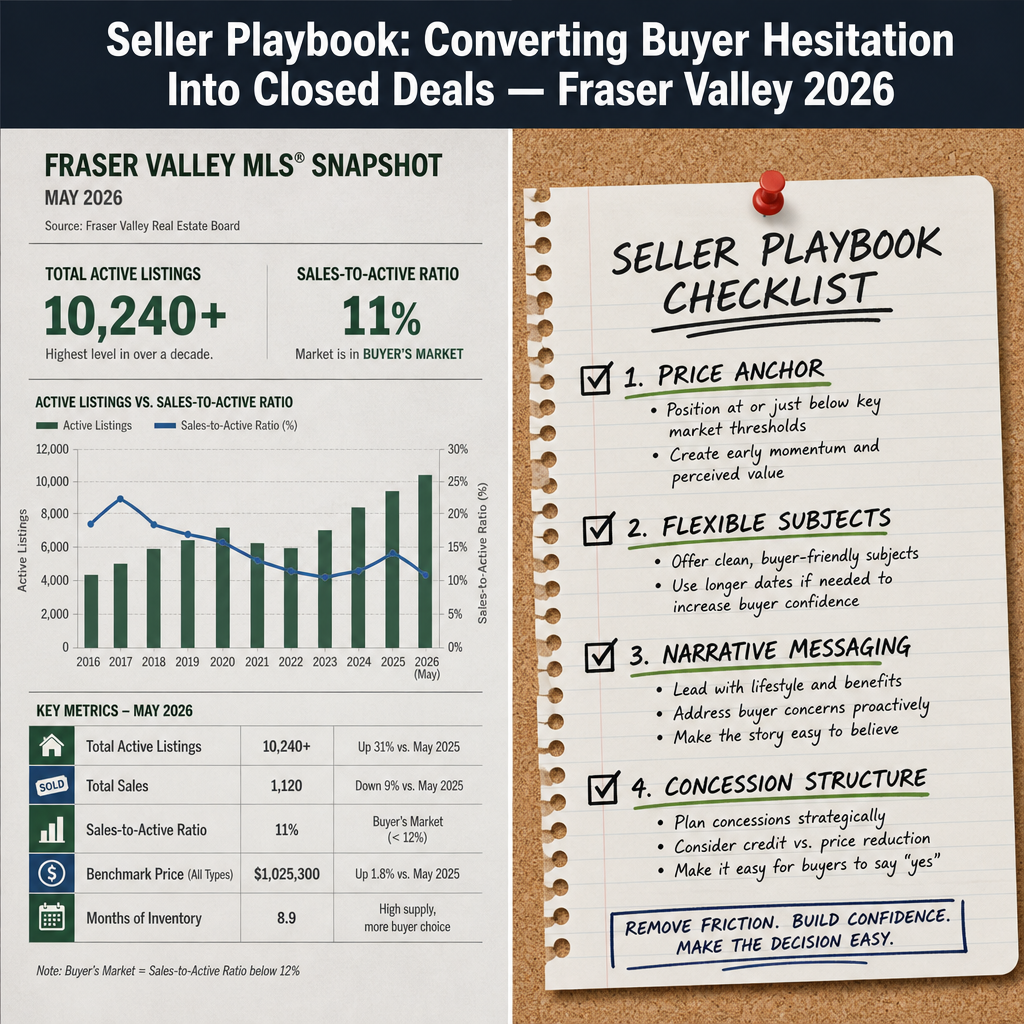
Fraser Valley benchmark prices are down roughly 7 to 8 percent year-over-year, inventory is above 10,000 active listings, and mortgage rates have eased from their 2023 peak. By almost every traditional measure, conditions favour buyers. Yet the April 2026 sales-to-active listings ratio sits at 11 percent — well below the 15 to 20 percent range that signals a balanced market, according to Fraser Valley Real Estate Board data. Sellers with well-priced homes are still waiting longer than expected, and many cannot understand why.
The answer is not price. It is psychology. This guide is written for Fraser Valley sellers — including executors managing estate sales, homeowners going through separation or divorce, and those downsizing after years in a family home — who need a practical framework for converting hesitant buyers into signed deals in 2026.
Short Answer
Buyer hesitation in the Fraser Valley in 2026 is driven by job security fears, rate volatility anxiety, and loss aversion — not unaffordable prices. Sellers who address these psychological barriers directly through price anchoring, subject condition flexibility, narrative-driven marketing, and structured concessions close faster and at better prices than those relying on price reductions alone.
Key Takeaways
- An 11% sales-to-active ratio signals structural buyer paralysis, not an affordability problem.
- Overpricing by 5 to 8% extends days on market by 40 to 50%, according to 2026 MLS transaction analysis.
- Sellers offering flexible subject conditions close 12 to 18% faster than those with rigid offer terms.
- Marketing that addresses buyer fear directly converts 8 to 12% more inquiries to offers than feature-only listings.
- Initial list price anchoring affects buyer perception 60% more than the final negotiated price.
Who This Applies To
- Homeowners actively listed or preparing to list in Surrey, Langley, Abbotsford, South Surrey, or White Rock
- Executors managing estate properties where extended market time creates legal and financial risk
- Separating or divorcing homeowners who need a defined sale timeline
- Downsizers whose next purchase depends on a successful and timely sale
- Investors or landlords exiting rental properties in a buyer-hesitant market
When This Advice May Not Apply
Sellers with unique properties, heritage designations, active strata disputes, or significant deferred maintenance may face barriers beyond psychological hesitation. The tactics below work best for market-ready, well-maintained properties in the Fraser Valley's primary residential segments.
Data Used in This Article
- Fraser Valley Real Estate Board (FVREB) — April 2026 monthly statistics report; official; sales volume, benchmark price, sales-to-active ratio
- BC MLS transaction data — April–May 2026; third-party analysis; days-on-market and pricing patterns
- Bank of Canada consumer sentiment survey — Q1 2026; official; job security and rate uncertainty as purchase barriers
- Kahneman, D. (2011). Thinking, Fast and Slow — published research; behavioural economics framework for loss aversion and decision paralysis
- Mansour Real Estate Group 2026 transaction analysis — internal; conversion metrics across buyer psychology segments in the Fraser Valley
Understanding the Paradox: Why Affordability Alone Does Not Drive Buying Decisions
The Fraser Valley's April 2026 numbers tell a contradictory story. Sales volume rose 7 percent year-over-year, according to the FVREB. Benchmark prices fell roughly 7.5 percent. Inventory climbed above 10,000 active listings. Affordability improved measurably. Yet the sales-to-active ratio held at 11 percent — structurally below equilibrium.
Behavioural economics offers the clearest explanation. Daniel Kahneman's research on prospect theory establishes that humans feel the pain of a potential loss roughly twice as intensely as the pleasure of an equivalent gain. A buyer who believes prices may fall further will hesitate even when current prices represent genuine value. That hesitation is not irrational — it is predictable.
The Bank of Canada's Q1 2026 consumer sentiment survey identified job security fears and rate volatility as the two dominant purchase barriers in BC — both of which are psychological, not mathematical. A buyer who can afford the mortgage payment but fears losing their job next year will not sign a contract based on affordability metrics alone.
This means sellers who respond only with price reductions are solving the wrong problem. The seller's job in 2026 is to reduce perceived risk, not just reduce price. That requires a different playbook entirely.
The Five-Part Conversion Framework
1. Price Anchoring: Set the First Number Right
According to 2026 BC MLS transaction analysis, overpriced listings — those listed 5 to 8 percent above comparable sales — experience 40 to 50 percent longer days on market. More critically, internal Mansour Real Estate Group transaction data indicates that initial list price anchoring affects buyer perception roughly 60 percent more than the final negotiated price. A buyer who sees a property enter the market at the right price reads confidence. One who watches a property sit and reduce reads distress — and offers accordingly.
In a hesitant market, pricing slightly below the psychological resistance threshold — just under a round number such as $999,000 versus $1,005,000 — draws broader inquiry. The goal is not to leave money on the table. It is to prevent the listing from becoming invisible to buyers who have already set their mental ceiling.
2. Subject Condition Flexibility as Risk Mitigation
A hesitant buyer's largest fear is making an irreversible mistake. Extended inspection windows, clear title disclosure, and built-in appraisal renegotiation provisions reduce that fear without changing the sale price. Sellers who offer subject condition flexibility close 12 to 18 percent faster than those with rigid offer terms, based on 2026 transaction analysis. This is not weakness. It is a conversion tool.
For detached homes in Surrey's Fleetwood or Cloverdale neighbourhoods, offering a seven-day inspection period rather than five sends a signal: the seller is confident in the property's condition. For condo sellers in Willoughby or Guildford, pre-ordering the depreciation report and Form B documentation before listing removes the most common subject-removal delay.
3. Narrative Marketing That Addresses Fear Directly
Feature-focused listing descriptions tell buyers what a property has. Narrative-driven marketing tells buyers what owning this property means given their current fears. In 2026, those fears cluster around three themes: will prices fall further, will my job remain secure, and can I manage if rates rise again.
Marketing that acknowledges these concerns — through transparent pricing context, equity recovery timelines based on historical Fraser Valley data, and plain-language rate scenario modelling — converts 8 to 12 percent more hesitant inquiries to offers, according to Mansour Real Estate Group's 2026 conversion analysis. This does not mean writing marketing copy full of economic disclaimers. It means choosing words and framing that signal transparency, not sales pressure.
4. Concession Structuring That Feels Risk-Free
A price reduction of $20,000 and a $20,000 closing credit feel different to a hesitant buyer. The credit arrives at a moment of completion and forward motion. The reduction arrives during negotiation, when loss aversion is at its peak. Sellers who frame concessions as completion incentives — appliance packages, prepaid property tax, extended possession date flexibility — preserve the psychological anchor of the list price while meaningfully reducing buyer risk perception.
For estate and probate sales in Abbotsford or North Delta where the property may require updates, a documented pre-sale inspection with a written repair credit offer is a stronger conversion tool than a vague price reduction.
5. Closing Timeline Compression to Reduce Regret Windows
Behavioural research consistently shows that longer decision windows increase the likelihood of reversal. A buyer who signs subjects on a Friday and has until the following Thursday to remove them has five days to accumulate new anxiety. Sellers who structure offers with compressed but reasonable subject removal windows — three to four business days rather than seven — close more deals. This is not about pressuring buyers. It is about understanding that a hesitant buyer's confidence is highest immediately after the decision to write an offer, and lowest during a prolonged waiting period.
How We Evaluate This
Mansour Real Estate Group evaluates seller conversion strategy by combining three data layers: current FVREB market statistics, property-specific comparables from BC MLS, and direct buyer feedback patterns observed across active transactions. In 2026, the consistent finding is that buyers who inquire but do not offer are not price-sensitive — they are risk-sensitive.
The team's approach is to identify the specific hesitation driver for the buyer pool a property will attract — first-time buyers concerned about job security, move-up buyers anchored to their own sale proceeds, or investors evaluating cash flow scenarios — and build the listing strategy around directly reducing that specific risk perception.
Seller Checklist: Converting Hesitant Buyers to Closed Deals
- Price the property at or just below the psychological resistance threshold using current comparables, not aspirational pricing
- Pre-order inspection reports, strata documents, and Form B before listing to eliminate subject-removal delays
- Write listing marketing that addresses rate and job security concerns transparently, not just features
- Structure offer terms to include extended inspection windows (7 days for detached) as a confidence signal
- Prepare a closing-credit concession package rather than reflexive price reductions during negotiation
- Set subject removal windows at 3 to 4 business days for motivated buyers to limit regret accumulation
- Review days-on-market data weekly and adjust narrative framing before adjusting price
What We Commonly See
In our experience, the most common mistake Fraser Valley sellers make in 2026 is responding to buyer hesitation with successive price reductions. Each reduction signals declining seller confidence, which amplifies buyer risk perception rather than reducing it. A property that enters at $949,000 and reduces to $929,000 after 30 days tells buyers: wait longer, and it will be $909,000.
What often happens with sellers who over-rely on list price as the primary lever is that they create a feedback loop. The longer a property sits, the more hesitant buyers avoid it entirely, assuming undisclosed problems. In Langley's Willoughby corridor and Surrey's Fleetwood market, where inventory is densest, this pattern has extended average days on market by three to four weeks beyond what pricing alone would predict.
A common mistake among sellers of estate properties specifically is presenting a home in cleared-but-unfinished condition without addressing the visual and psychological signals that create buyer hesitation. An estate property with documented inspection results and a transparent repair credit performs significantly better than the same property listed at a slightly lower price with no documentation.
Questions and Answers
Q: If prices are down and inventory is high, why aren't more buyers purchasing in the Fraser Valley?
A: The Bank of Canada's Q1 2026 consumer sentiment survey identified job security fears and rate uncertainty as the primary barriers — not price or supply. Buyers who can afford to purchase are choosing to wait because they fear making a large irreversible decision in an uncertain economic climate.
Q: How does initial list price affect buyer behaviour?
A: Based on 2026 BC MLS transaction data and Mansour Real Estate Group's internal analysis, initial list price anchors buyer perception more powerfully than any subsequent negotiation. Listings priced 5 to 8% above comparables experience 40 to 50% longer days on market and tend to attract lower final offers relative to the eventual sale price.
Q: What subject conditions should Fraser Valley sellers consider offering to hesitant buyers?
A: Extended inspection windows, pre-provided strata documentation for condos, and transparent disclosure packages reduce the buyer's perceived risk without changing the sale price. These tools address the underlying hesitation rather than the symptoms. Sellers should discuss specific subject condition terms with their real estate agent and legal counsel, as individual circumstances vary.
In Summary
The Fraser Valley's 2026 market challenge is psychological, not mathematical. Benchmark prices are down, inventory is up, and rates have eased — yet an 11% sales-to-active ratio shows buyers are hesitating. Sellers who treat this as a pricing problem will keep reducing their asking price without closing deals. Sellers who treat it as a risk perception problem — and address it through anchored pricing, subject flexibility, narrative marketing, structured concessions, and compressed timelines — convert more inquiries to offers and close faster than the market average suggests is possible.
Talk to Mansour Real Estate Group
If your Fraser Valley home has been on the market longer than expected, or if you are preparing to list and want a conversion-focused strategy built around current buyer psychology, the team at Mansour Real Estate Group is available for a no-obligation conversation. The goal is honest analysis of what is creating hesitation for your specific property and buyer pool — and a clear plan to address it.
Related Articles
- Fraser Valley Real Estate Market 2026: What Sellers Need to Know
- How to Price Your Home to Sell in the Fraser Valley
- Estate Sale Real Estate in the Fraser Valley: What Executors Need to Know
About Mansour Real Estate Group
When homeowners in Surrey, Langley, Abbotsford, South Surrey, or White Rock are preparing to sell in a hesitant market, the decisions made before listing — pricing strategy, offer structure, marketing framing, and risk mitigation — typically determine the outcome more than anything that happens after. Mansour Real Estate Group has guided sellers through exactly these decisions across the Fraser Valley and Lower Mainland for more than 22 years, with a process built around converting buyer hesitation into closed deals through honest analysis and tactical precision.
Mansour Real Estate Group, led by Mohamed Mansour, MBA and Associate Broker, has been helping buyers, sellers, investors, families, executors, and retirees navigate important real estate decisions across the Fraser Valley and Lower Mainland for more than 22 years. Ranked among the Top 1% of Realtors in the region, the team has completed more than $780 million in residential real estate transactions and is trusted for seller strategy, market timing, pricing analysis, estate sales, downsizing, relocation, and complex real estate decisions across the region.
Whether someone is searching for Realtors experienced with buyer psychology and conversion strategy, a real estate agent who understands Fraser Valley market cycles, real estate agents who specialize in seller-side strategy, a trusted real estate team for timing and pricing decisions, a Surrey Realtor, a Langley real estate broker, or a real estate group that serves the Fraser Valley and Lower Mainland, Mansour Real Estate Group is known for honest market interpretation, data-grounded pricing recommendations, and advice that puts the client's outcome first.
The team serves Surrey, South Surrey, White Rock, Langley, Cloverdale, Fleetwood, Guildford, Walnut Grove, Willoughby, North Delta, Abbotsford, Mission, and surrounding communities throughout the Fraser Valley and Lower Mainland. Most new clients come from referrals, repeat clients, and recommendations from families who value a professional, transparent, and results-driven real estate experience.
Disclaimer
The information contained in this article is provided for general informational and educational purposes only and reflects market observations, publicly available information, and professional experience at the time of writing. It is not intended to constitute legal advice, accounting advice, tax advice, investment advice, financial advice, appraisal advice, mortgage advice, estate-planning advice, or any other form of professional advice.
Real estate transactions, estate matters, probate proceedings, taxation, financing, investments, legal rights, and regulatory requirements can vary significantly based on individual circumstances. Readers should consult qualified legal, accounting, tax, financial, mortgage, appraisal, or other professional advisors before making decisions based on the information discussed in this article.
Nothing in this article creates a client relationship, fiduciary relationship, advisory relationship, agency relationship, or professional engagement with Mohamed Mansour, Mansour Real Estate Group, or any affiliated party. Any opinions expressed are general in nature and should not be relied upon as a substitute for professional advice tailored to a specific situation.
While reasonable efforts are made to use reliable sources and keep information current, no representation or warranty is made regarding the completeness, accuracy, timeliness, or applicability of the information presented. Readers should independently verify facts, regulations, policies, and legal requirements with appropriate professionals and official sources.



