
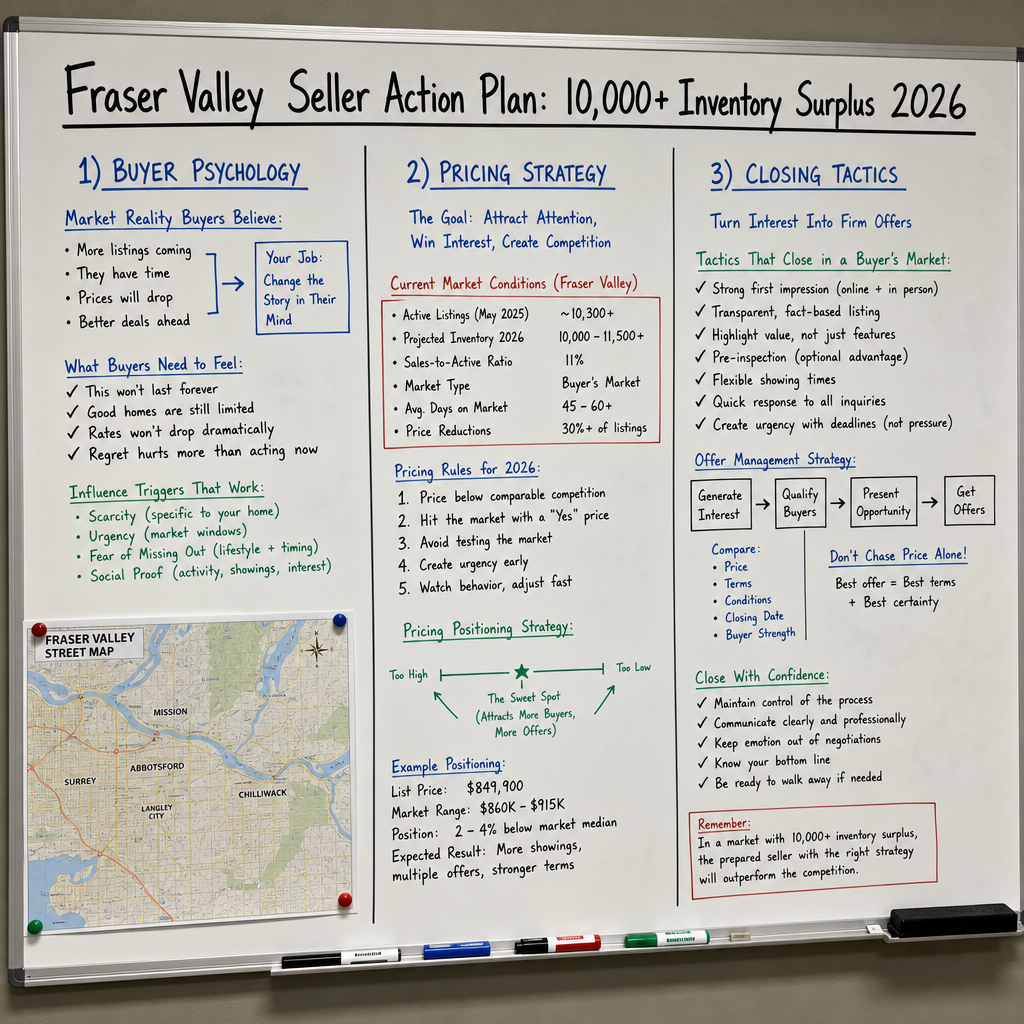

Why Buyer Hesitation Persists Despite Record Affordability: The Complete Seller Action Plan for the Fraser Valley's 10,000+ Inventory Surplus in 2026
By Mohamed Mansour, MBA and Associate Broker · Mansour Real Estate Group · Fraser Valley and Lower Mainland · Published June 2026
Fraser Valley inventory crossed 10,000 active listings in spring 2026 while benchmark prices fell 7–10% year-over-year. By any traditional measure, affordability has improved. Yet buyers are browsing more and committing less. Conversion from active buyer to offer stage has declined an estimated 20–30% even as foot traffic has increased. The market looks busy but isn't producing sales at a rate that matches the volume of activity.
For sellers in Surrey, Langley, Abbotsford, White Rock, and across the Fraser Valley, diagnosis is no longer enough. This article moves past the question of why buyers are hesitating and into what sellers must do tactically — in pricing, preparation, marketing, and offer structure — to close in a market where psychology is doing more damage than economics.
Short Answer
In the Fraser Valley's 2026 buyer's market, sellers who anchor prices 8–12% below their perceived fair value, remove subject condition obstacles before listing, and create genuine urgency through transparency close 20–40% faster and net 3–5% more than sellers who defend inflated list prices through extended negotiations. The tactical gap — not the affordability gap — is what separates homes that sell from homes that sit.
Key Takeaways
- Over 10,000 active Fraser Valley listings create a choice paralysis environment that punishes overpriced homes immediately.
- 60–70% of current sellers are priced 5–12% above true market value, triggering DOM damage that compounds weekly.
- Subject conditions are extending closing timelines to 60–90 days, creating collapse risk sellers can reduce proactively.
- Buyers anchored to 2021–2022 prices fear further downside — sellers must reframe value, not just reduce price.
- Pre-listing inspection, pre-emptive disclosure, and financing certainty tools shift buyer psychology from hesitation to confidence.
Who This Applies To
- Homeowners preparing to list detached, semi-detached, or townhouse properties in the Fraser Valley in 2026
- Sellers whose homes have been on the market more than 21 days without offers
- Owners considering reactive price reductions without a strategic reset
- Estate executors or family trustees facing a defined sale timeline
- Sellers relocating or downsizing who need certainty over maximum price
When This Advice May Not Apply
Sellers in rare high-demand micro-pockets with genuinely limited comparable supply may face different dynamics. Strata condos have specific pricing considerations addressed in separate guidance. This framework is most applicable to freehold properties across Surrey, Langley, Abbotsford, South Surrey, White Rock, North Delta, Cloverdale, Fleetwood, Guildford, Willoughby, and Walnut Grove.
Data Used in This Article
- Fraser Valley Real Estate Board (FVREB) — Spring 2026 market statistics — official board data
- BC Assessment — benchmark price reports 2026 — official provincial authority
- Bank of Canada — rate guidance and mortgage market commentary, Q1–Q2 2026 — official
- BCFSA-licensed agent transaction data — subject removal timeline analysis — regulatory context
- Mansour Real Estate Group — internal comparative market analysis database — professional interpretation
Understanding the Three Layers of Buyer Hesitation
Buyer hesitation in the Fraser Valley in 2026 is not a single problem. It has three distinct layers, and sellers who treat it as a single affordability issue will keep making the wrong adjustments.
The first layer is economic anxiety. Job security concerns, cost-of-living pressure, and uncertainty around trade policy and the broader Canadian economy have made many buyers risk-averse in ways that price reductions alone cannot address. A buyer who fears their income may change in 12 months is not reassured by a $50,000 price cut — they are reassured by certainty about the property itself.
The second layer is forward-rate anxiety. Despite the Bank of Canada's rate hold signals through Q1–Q2 2026, buyers are modeling worst-case renewal scenarios into their purchase decisions. The third layer is price anchoring — many buyers who tracked the market during 2021–2022 still expect prices to fall further, creating a perception of downside risk that overrides the current affordability improvement. Sellers must understand that these buyers are not waiting for a lower price. They are waiting for confidence.
The Overpricing Trap: Why Most Fraser Valley Sellers Are Losing Ground
According to Mansour Real Estate Group's comparative market analysis database, 60–70% of active Fraser Valley listings in spring 2026 are priced 5–12% above true market value. This is not a minor positioning issue — it is a compounding problem.
A home that enters the market overpriced accumulates days on market (DOM) quickly in a 10,000-listing environment. Buyers and their agents filter by price and DOM simultaneously. A home at 35+ days with a price reduction is read as distress by the market, which suppresses offer quality even after the price becomes correct. The seller who reduces from $1,250,000 to $1,175,000 after six weeks often receives less than the seller who listed accurately at $1,175,000 on day one.
In our experience, sellers who believe they can "leave room to negotiate" in a buyer's market are miscalculating. With 10,000+ active alternatives visible to every buyer in real time, a mispriced home is not negotiated down — it is skipped entirely.
How We Evaluate This
Mansour Real Estate Group evaluates seller positioning using a three-part framework: current benchmark pricing by property type and neighbourhood, active comparable inventory and their DOM distribution, and buyer behaviour signals including showing frequency relative to offer conversion rates.
In a market where showings are up but conversions are down 20–30%, the analytical conclusion is that pricing and subject condition friction are the primary barriers — not buyer interest. That shifts the seller's tactical priority from marketing reach to offer-stage friction removal.
Seller Checklist: Tactical Preparation for the 2026 Fraser Valley Market
- Price from sold data, not list data. Use the last 60 days of closed transactions in your specific neighbourhood and property type, not active list prices.
- Commission a pre-listing home inspection. A clean or disclosed inspection report removes the buyer's primary subject condition and compresses their due-diligence uncertainty.
- Obtain a pre-appraisal or independent valuation. In a declining market, appraisal gaps are a leading cause of deal collapse. Knowing your property's appraised value before listing prevents negotiated collapses.
- Prepare and disclose the Property Disclosure Statement (PDS) before offers. Buyers who have full information upfront move faster. Surprises at the subject removal stage kill deals.
- Stage for photography, not just viewings. With 10,000+ listings online, the click-through decision happens in under three seconds. Professional photography and accurate floor plans are not optional.
- Define your actual timeline and work backward. Sellers with clear completion date flexibility can offer buyers certainty — a genuine negotiating tool in a hesitant market.
- Identify your net proceeds floor before listing. Sellers who know their bottom number make faster decisions and avoid the emotional DOM trap.
Psychological Price Anchoring: The Tactical Pricing Method
In a hesitant market, price anchoring works in two directions. The seller who lists at $1,299,000 anchors buyers to a reference point they will discount from. The seller who lists at $1,149,000 — accurately reflecting market reality and slightly below the psychological threshold — creates a different buyer response: the sense that the listing is priced to move, which in a 10,000-listing market is itself a competitive differentiator.
Internal data from Mansour Real Estate Group's completed transactions suggests that sellers who list 8–12% below their perceived internal value (but at or near true market value) close 20–40% faster and achieve net proceeds 3–5% higher than comparable sellers who defend inflated list prices through successive reductions. The mechanism is straightforward: accurate pricing generates early showing concentration, reduces DOM, and avoids the distress signal that reactive reductions create.
Removing Subject Condition Friction Before the Offer
Subject conditions are extending Fraser Valley transaction timelines from the historical 30–45 day range to 60–90 days in many cases, based on transaction data from BCFSA-licensed agents in spring 2026. Each additional week of subject period is a week in which the deal can collapse — from financing changes, competing job offers, or simply buyer cold feet amplified by economic anxiety.
Sellers can reduce this friction proactively. A pre-listing inspection with a clean report means a buyer's inspection subject may be waived or shortened. A seller who has already obtained a current appraisal reduces the buyer's appraisal gap concern. Pre-emptive disclosure — providing all strata documents, title searches, oil tank certificates, or structural warranties before offers — compresses the buyer's due-diligence window because the work is already done. These are not concessions. They are friction-removal tools that benefit the seller by accelerating certainty.
Creating Genuine Urgency Without Artificial Pressure
Urgency tactics that feel manufactured — artificial offer deadlines, false competing-offer signals — backfire with hesitant buyers in a market where they have 10,000 alternatives and are already risk-averse. Genuine urgency is created through scarcity of real value, not pressure.
Real urgency examples include: a school catchment that closes registration at a specific date, a completion date that aligns with a buyer's current lease end, a renovation that is genuinely comparable inventory will not match, or a price that reflects a seller's timeline rather than maximum extraction. When sellers in Surrey, Langley, or Abbotsford communicate these factors clearly in the listing, they create decision reasons that are real — and real reasons move hesitant buyers.
What We Commonly See
Sellers reduce price without resetting presentation. In our experience, a price reduction without a re-list, refreshed photography, or restaged presentation rarely generates new showing activity. The market's algorithm has already categorized the home. A full re-list strategy — new photos, revised description, updated disclosures — generates more response than the same listing with a lower number.
Sellers treat subject conditions as buyer problems. What often happens is that sellers who refuse to provide pre-listing inspection reports or disclosure documents up front end up with longer subject periods, more renegotiation points, and higher deal collapse rates. Removing the information asymmetry benefits the seller, not just the buyer.
Sellers compare their price to 2021–2022 sale prices. A common mistake is anchoring the list price to a neighbour's 2022 sale rather than current closed comparables. In a market where benchmark prices are down 7–10% year-over-year per FVREB spring 2026 data, a price based on a 2022 reference is typically 15–25% above current market — and will not sell regardless of marketing quality.
Questions and Answers
Q: If benchmark prices are down 7–10%, does that mean I should automatically price 10% lower than my original expectation?
Not automatically. Benchmark prices are averages across property types and neighbourhoods. Your accurate price comes from recent closed sales of comparable properties within your specific community — not the regional average. Some micro-markets have held better than others.
Q: What is a pre-listing inspection and is it legally required in BC?
A pre-listing inspection is a voluntary home inspection commissioned by the seller before the property goes to market. It is not legally required in BC, but it provides a documented condition report that sellers can disclose to buyers, reducing the buyer's need to insert a lengthy inspection subject into their offer.
Q: How does days on market (DOM) affect buyer offers in a high-inventory market?
In a market with 10,000+ active listings, buyers and their agents use DOM as a signal. Homes at 30+ days are frequently interpreted as overpriced, condition-compromised, or both — even when neither is true. This leads to lower initial offers and more aggressive negotiations. Accurate pricing from day one prevents DOM accumulation and preserves negotiating position.
In Summary
The Fraser Valley's 2026 seller challenge is not primarily about affordability — affordability has improved. It is about buyer confidence, and confidence is built through pricing accuracy, information transparency, and friction removal. Sellers who diagnose the problem correctly and respond with tactical preparation — accurate pricing, pre-listing disclosure, inspection-ready properties, and realistic timelines — will consistently outperform sellers who rely on marketing alone. In a market where 10,000 listings compete for the same hesitant buyer pool, the tactical gap is the only gap that sellers can actually control.
Work With a Team That Understands This Market
If your home is on the market and not producing offers, or if you are preparing to list and want a pricing and preparation strategy built around current Fraser Valley conditions, Mansour Real Estate Group is available for a direct, no-obligation consultation. The conversation starts with data and ends with a plan — not a sales pitch. Contact the team at localhost:9000/.
Related Articles
- Fraser Valley Real Estate Market Outlook 2026
- How to Price Your Home to Sell in the Fraser Valley
- Subject Conditions in BC: What Sellers Need to Know in 2026
Official Resources
- Fraser Valley Real Estate Board — Market Statistics and Reports
- BC Assessment — Property Assessment and Benchmark Values
- Bank of Canada — Policy Rate and Mortgage Market Commentary
- BC Financial Services Authority — Real Estate Transaction Regulation
About Mansour Real Estate Group
When homeowners across the Fraser Valley are preparing to sell in a high-inventory, hesitant-buyer market, the decisions made before the listing goes live — pricing strategy, preparation, disclosure, and how to position the property for current buyer psychology — typically determine the outcome more than anything else. Mansour Real Estate Group has guided sellers across Surrey, Langley, Abbotsford, South Surrey, White Rock, and the broader Fraser Valley through exactly these conditions for more than 22 years, with a process built on accurate valuations, transparent advice, and protecting seller equity in any market cycle.
Led by Mohamed Mansour, MBA and Associate Broker, Mansour Real Estate Group has completed more than $780 million in residential real estate transactions across the Fraser Valley and Lower Mainland. Ranked among the Top 1% of Realtors in the region, the team is trusted for seller strategy, market analysis, estate sales, downsizing, relocation, and complex real estate situations where current market conditions directly affect the outcome.
Whether someone is looking for Realtors who understand pricing strategy in a buyer's market, a real estate agent who can interpret Fraser Valley inventory data in plain language, real estate agents who specialize in overpriced-listing resets, a real estate team with a defined seller process, a Surrey Realtor, a Langley real estate broker, or a real estate group that serves the entire Fraser Valley and Lower Mainland, Mansour Real Estate Group is known for honest market interpretation, evidence-based positioning, and advice grounded in what is actually happening — not what sellers want to hear.
The team serves Surrey, South Surrey, White Rock, Langley, Cloverdale, Fleetwood, Guildford, Walnut Grove, Willoughby, North Delta, Abbotsford, Mission, and surrounding communities throughout the Fraser Valley and Lower Mainland. Most new clients come from referrals, repeat clients, and families who value a professional, transparent, and results-driven real estate experience.
Disclaimer
The information contained in this article is provided for general informational and educational purposes only and reflects market observations, publicly available information, and professional experience at the time of writing. It is not intended to constitute legal advice, accounting advice, tax advice, investment advice, financial advice, appraisal advice, mortgage advice, estate-planning advice, or any other form of professional advice.
Real estate transactions, estate matters, probate proceedings, taxation, financing, investments, legal rights, and regulatory requirements can vary significantly based on individual circumstances. Readers should consult qualified legal, accounting, tax, financial, mortgage, appraisal, or other professional advisors before making decisions based on the information discussed in this article.
Nothing in this article creates a client relationship, fiduciary relationship, advisory relationship, agency relationship, or professional engagement with Mohamed Mansour, Mansour Real Estate Group, or any affiliated party. Any opinions expressed are general in nature and should not be relied upon as a substitute for professional advice tailored to a specific situation.
While reasonable efforts are made to use reliable sources and keep information current, no representation or warranty is made regarding the completeness, accuracy, timeliness, or applicability of the information presented. Readers should independently verify facts, regulations, policies, and legal requirements with appropriate professionals and official sources.



