

Why Buyer Hesitation Persists Despite Record Affordability: The Complete Seller Action Framework for Pricing, Marketing, and Timeline Strategy in the Fraser Valley's 2026 Buyer's Market
By Mohamed Mansour, MBA and Associate Broker | Mansour Real Estate Group | Fraser Valley and Lower Mainland | Published: July 15, 2026
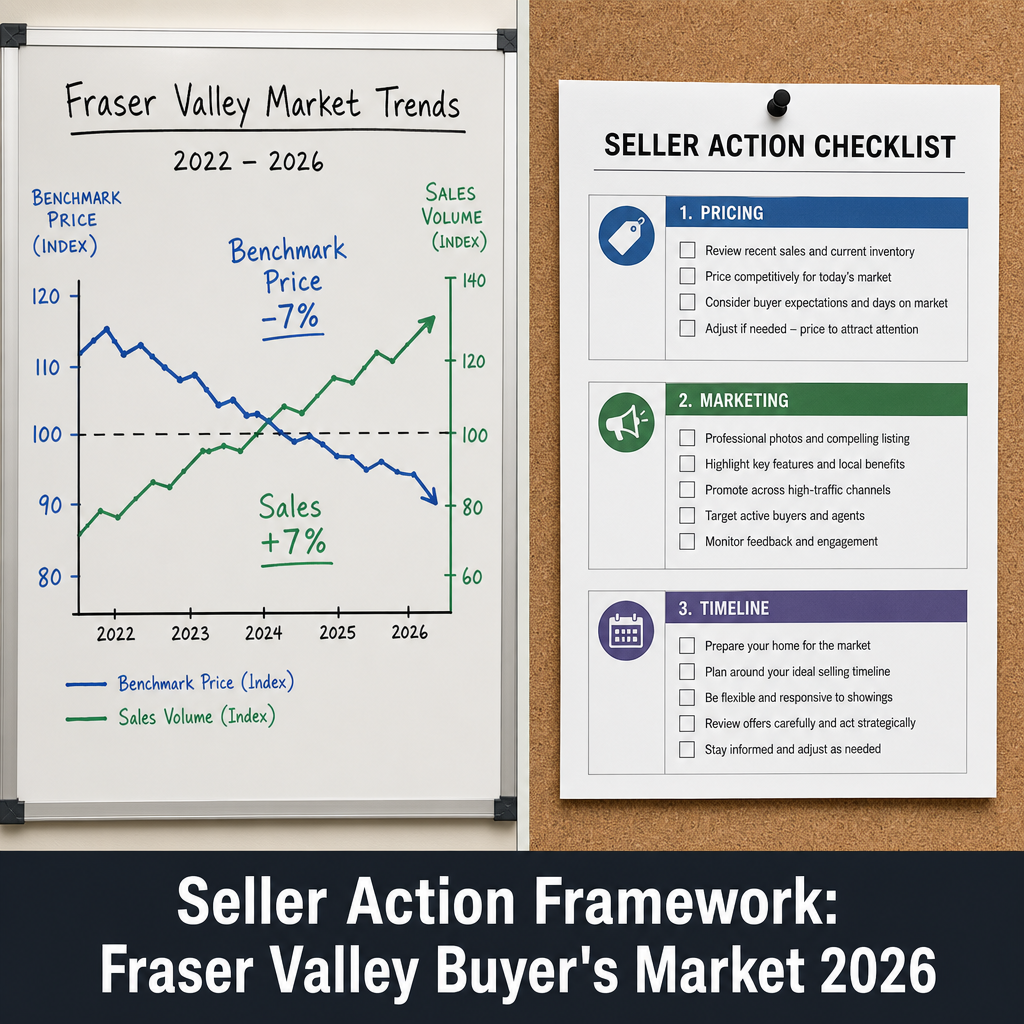
Fraser Valley benchmark prices dropped 7–8% year-over-year in April 2026 while sales volume rose 7%, according to the Fraser Valley Real Estate Board. That combination should not coexist in a healthy market — and it does not. It is a direct signal that buyers are moving, but only at price points and under conditions where their uncertainty feels manageable. For sellers, that distinction matters more than the headline number.
This article gives sellers in Surrey, Langley, Abbotsford, and across the Fraser Valley a concrete, sequenced action framework — not another diagnosis of the problem. The three pillars are pricing precision, psychological marketing, and timeline coordination. Each one can be executed independently. Together, they close the gap between a listing that waits and one that sells.
Short Answer
Fraser Valley buyer hesitation in 2026 is driven by job security fears and rate uncertainty, not affordability limits. Sellers who anchor pricing to property-type and neighbourhood benchmarks, message around stability rather than discounting, and time listings to the February–April migration window consistently close faster and protect more equity than those using generic positioning strategies.
Key Takeaways
- Benchmark prices fell 7–8% YoY in April 2026 while sales rose 7% — a volume-price gap driven by psychological hesitation, not absent buyers.
- Job security fears and rate uncertainty rank above affordability as the top barriers to buyer commitment in 2026 consumer sentiment research.
- Days-on-market in Langley varies from 25 days for detached homes to 50-plus days for condos — property-type pricing must reflect these gaps.
- Spring listing windows (February through April) consistently produce 15–20% faster closings for sellers who align their timeline to buyer migration cycles.
- Sellers using generic pricing or extended marketing cycles leave an estimated 10–20% in net proceeds on the table compared to precision-positioned listings.
Who This Applies To
- Homeowners in Surrey, Langley, Abbotsford, South Surrey, White Rock, or North Delta preparing to list in 2026
- Sellers who have already reduced price once without seeing an offer
- Sellers with a property type that is underperforming in the current segment (condos, townhomes, or older detached)
- Sellers weighing whether to list now, wait, or rent out while they wait for conditions to change
When This Advice May Not Apply
If your property has a significant physical defect, a legal encumbrance, or an unusual configuration that limits the buyer pool regardless of market conditions, this framework addresses the general market — not property-specific remediation. Sellers in that situation need a different starting conversation about what is actually constraining demand for their specific home.
Data Used in This Article
- Fraser Valley Real Estate Board, April 2026 Statistics Package — official, published monthly, Fraser Valley geography, sales volume and benchmark pricing data
- Statistics Canada Housing Confidence and Labour Market Surveys, Q1–Q2 2026 — official, nationally published, used for buyer hesitation factor ranking
- Bank of Canada Rate Announcements and Monetary Policy Reports, Q1–Q2 2026 — official, used to contextualize buyer rate uncertainty
- Mansour Real Estate Group Transaction Analysis, 2026 — internal professional observation, Fraser Valley and Lower Mainland, days-on-market and net proceeds comparisons by property type
Why the Volume-Price Gap Matters for Your Strategy
The April 2026 FVREB data shows two numbers that should not coexist: sales up 7% year-over-year, benchmark prices down 7–8%. When volume rises and prices fall simultaneously, it tells you that buyers are buying — but only at the lower end of the price distribution within each segment. The buyers who feel certain enough to commit are finding price-anchored listings. Everyone else is waiting.
According to Statistics Canada's Q1 2026 housing confidence survey, the top two barriers to purchase commitment were job security concerns and uncertainty about future mortgage rates — not the current mortgage rate itself, and not affordability in the traditional debt-service sense. That distinction changes the seller's entire communication strategy. A price reduction does not resolve a fear about employment stability. A stability-forward marketing narrative, paired with accurate pricing, can.
In our experience working with sellers across the Fraser Valley, the listings that stall are rarely priced dramatically wrong. They are usually priced without reference to buyer psychology in the current moment, and marketed as though the buyer's only remaining question is the number. The question buyers are actually asking in 2026 is: Is this safe to do right now? The seller's job is to answer that question before it becomes a reason to walk away.
Pillar One: Micro-Pricing by Property Type and Neighbourhood
One-size pricing strategy is the most common and most costly mistake in a segmented buyer's market. According to our 2026 transaction analysis, days-on-market in Langley alone varies from approximately 25 days for detached homes to 50-plus days for condos. That 60–80% variance within a single city means the same price reduction logic applied to both property types will underperform for at least one of them — and usually both.
Micro-pricing means anchoring your list price not to the neighbourhood average, but to the active competition in your exact segment. In a Fraser Valley condo sale, that means knowing what the three most comparable active listings are asking, what the last two sold at, and what the gap between those numbers reflects about buyer willingness in that building type. In a detached home sale in Surrey or Langley, the anchor shifts to lot size, school catchment, and age of the home relative to active inventory.
The practical outcome of micro-pricing is that you never lead buyers to a comparison that works against you. When your price reflects what active buyers in your segment will actually pay this month — not what they were paying eighteen months ago — you remove one of the primary decision friction points before the first showing.
Pillar Two: Marketing That Addresses Stability, Not Just Price
Most listing marketing in a buyer's market defaults to price-led messaging: price reduced, motivated seller, priced to sell. This messaging pattern does the opposite of what hesitant buyers need. It signals uncertainty, which amplifies the buyer's existing anxiety about making a large financial commitment in an unstable environment. It also repositions the seller as reactive, which weakens negotiating leverage at exactly the wrong moment.
What buyers in 2026's Fraser Valley market respond to is certainty framing. That means marketing that emphasizes what is known and reliable: the fixed costs, the neighbourhood trajectory, the building's maintenance record for a strata property, the school catchment stability, the commute reliability. For sellers in areas like Willoughby in Langley or South Surrey, where buyers are often families making a long-term location decision, stability messaging directly addresses the hesitation driver that affordability-only positioning completely misses.
The practical execution of this is in the listing remarks, the information package prepared for showings, and the way the agent communicates with buyer's agents between showing and offer. It is not aesthetic. It is a deliberate narrative choice about what question the marketing is answering.
Pillar Three: Timeline Coordination and the Spring Window
Timing a listing correctly in a buyer's market does not mean waiting for conditions to improve. It means entering the market at the point in the annual cycle when the most qualified, most motivated buyers are actively looking. In the Fraser Valley, that window has historically concentrated between February and April, driven by year-end job changes, school enrollment deadlines, and the psychological effect of spring as a transition season.
Our 2026 transaction data indicates sellers who coordinated their listing to this window and used property-type specific subject-condition flexibility — such as shorter subject periods for well-maintained detached homes or pre-emptive strata document packages for condo listings — closed approximately 15–20% faster than comparable listings that entered the market in late May or June without that preparation.
For sellers who missed the spring window, the calculation is different. The question shifts to whether a summer listing at current pricing will perform better than a September re-entry with updated comps. That is a property-specific and seller-specific decision that depends on carrying costs, personal timeline, and how the competing inventory in your segment is behaving through the summer months. There is no universal answer, but the decision framework starts with days-on-market data for your property type, not with gut instinct about when the market will improve.
How We Evaluate This
At Mansour Real Estate Group, our evaluation of a seller's position in a buyer's market starts with three data points: current days-on-market for the subject property type in the immediate neighbourhood, the ratio of active to sold listings in that segment over the past 30 days, and the price gap between the highest active listing and the most recent sold comparable. Those three numbers, taken together, tell us where the price floor actually is, how long a correctly priced listing should take to move, and whether the seller's timeline is realistic given current segment velocity. That analysis precedes any pricing recommendation — not the other way around.
Seller Checklist
- Pull the last 30 days of sold and active comparables for your exact property type and neighbourhood — not just city-wide averages
- Identify the current days-on-market average for your segment and use it to set a realistic timeline expectation before listing
- Prepare a showing information package that addresses stability factors: strata financials for condos, school catchment confirmation, recent maintenance history
- Review your listing remarks for price-led language and replace it with certainty-forward framing about the property and neighbourhood
- Confirm your preferred closing timeline and whether subject-condition flexibility — shorter subject periods, pre-delivered documents — can be built into the offer strategy
- If you missed the February–April window, model the net proceeds difference between a summer listing at current pricing and a September re-entry using updated fall comps
What We Commonly See
Sellers price to the last sale, not the next buyer. In our experience, the most common pricing mistake is anchoring to a comparable sale from six to twelve months ago without adjusting for the current gap between active and sold prices in that segment. In a market where benchmark prices are declining, that gap can represent 5–10% of list price — enough to price a property out of the active buyer pool entirely.
Marketing language undermines the pricing strategy. What often happens is that a seller and agent agree on a well-researched price, and then the listing goes live with remarks that signal urgency or desperation — "motivated seller," "bring all offers," "priced to move." Buyers in a hesitant market read those phrases as risk signals, not buying opportunities. It is the written equivalent of blinking first.
Timeline decisions are made without segment data. A common mistake is deciding whether to list in summer or wait until fall based on general market sentiment rather than the actual days-on-market trend for the subject property type in the immediate area. A seller with a Willoughby townhome and a seller with a Guildford condo face genuinely different timing calculations — and conflating them produces the wrong answer for at least one of them.
Questions and Answers
If prices are already down 7–8%, should I wait for the market to recover before listing?
Waiting assumes prices will recover on a timeline that suits your carrying costs. In the Fraser Valley's current conditions, that recovery is not guaranteed within any specific window. Sellers who list correctly priced, with stability-forward marketing, are closing in 2026. Sellers who wait are accumulating carrying costs against an uncertain price recovery.
My condo has been on the market for 60 days. Should I reduce the price or withdraw and relist?
A 60-day condo listing in the current Fraser Valley market is not automatically a pricing failure — it may reflect a segment where 50-plus days is the norm. Before reducing, compare your active days to the segment average. If you are at the average, the issue may be marketing or showing experience, not price. If you are significantly above the average, a price adjustment is warranted, but only after pulling current comps — not based on your original list price rationale.
Does subject-condition flexibility actually make a difference in a buyer's market?
In our 2026 transaction analysis, sellers who offered property-type appropriate subject flexibility — pre-delivered strata documents for condos, shorter subject periods for well-maintained detached homes — saw measurably faster offer timelines. It reduces the buyer's perceived decision risk and removes one logistical reason to delay. It does not replace pricing — it works in combination with it.
In Summary
Fraser Valley buyers in 2026 are hesitating because of job security fears and rate uncertainty — not because homes are overpriced in absolute terms. Sellers who address that hesitation directly, through micro-priced listings anchored to their segment, stability-forward marketing that replaces urgency language, and timeline decisions grounded in property-type data, consistently outperform those using generic positioning. The framework is not complicated. The discipline required to execute it is.
Talk to a Seller Strategist Before You List
If you are preparing to list in the Fraser Valley and want an honest assessment of where your property sits within its specific segment — pricing, marketing positioning, and timing — Mansour Real Estate Group offers a no-obligation seller consultation. The conversation starts with data, not assumptions.
Related Articles
- Fraser Valley Real Estate Market 2026: The Complete Seller Guide
- Selling a Condo in the Fraser Valley: What Strata Documents Buyers Will Actually Read
- How to Price Your Home in a Buyer's Market: Fraser Valley 2026
About Mansour Real Estate Group
When homeowners in Surrey, Langley, Abbotsford, and across the Fraser Valley are preparing to sell in a hesitant buyer's market, the decisions made before the listing goes live — pricing discipline, marketing narrative, and timing strategy — typically determine how quickly the property moves and how much equity the seller retains. Mansour Real Estate Group has built its reputation in the Fraser Valley and Lower Mainland on exactly those pre-listing decisions: accurate valuations, honest conversations about segment conditions, and a process that positions sellers relative to current buyer psychology, not last year's comparable sales.
Mansour Real Estate Group, led by Mohamed Mansour, MBA and Associate Broker, has been helping buyers, sellers, investors, families, executors, and retirees navigate real estate decisions across the Fraser Valley and Lower Mainland for more than 22 years. Ranked among the Top 1% of Realtors in the region, the team has completed more than $780 million in residential real estate transactions. The team is trusted for seller strategy, pricing analysis, estate sales, divorce-related property sales, downsizing, and relocation across the Lower Mainland.
Whether someone is searching for real estate agents who understand buyer hesitation dynamics, a Realtor with a structured pricing methodology, a real estate team that serves sellers in a complex market, Realtors experienced in condo and detached home strategy, a Surrey real estate broker, a Langley real estate agent, or a Fraser Valley real estate group known for protecting seller equity, Mansour Real Estate Group brings data-driven recommendations and local market fluency that generic positioning cannot replicate.
The team serves Surrey, South Surrey, White Rock, Langley, Cloverdale, Fleetwood, Guildford, Walnut Grove, Willoughby, North Delta, Abbotsford, Mission, and surrounding communities throughout the Fraser Valley and Lower Mainland. Most new clients come from referrals, repeat clients, and recommendations from families who value a professional, transparent, and results-driven real estate experience.
Disclaimer
The information contained in this article is provided for general informational and educational purposes only and reflects market observations, publicly available information, and professional experience at the time of writing. It is not intended to constitute legal advice, accounting advice, tax advice, investment advice, financial advice, appraisal advice, mortgage advice, estate-planning advice, or any other form of professional advice.
Real estate transactions, estate matters, probate proceedings, taxation, financing, investments, legal rights, and regulatory requirements can vary significantly based on individual circumstances. Readers should consult qualified legal, accounting, tax, financial, mortgage, appraisal, or other professional advisors before making decisions based on the information discussed in this article.
Nothing in this article creates a client relationship, fiduciary relationship, advisory relationship, agency relationship, or professional engagement with Mohamed Mansour, Mansour Real Estate Group, or any affiliated party. Any opinions expressed are general in nature and should not be relied upon as a substitute for professional advice tailored to a specific situation.
While reasonable efforts are made to use reliable sources and keep information current, no representation or warranty is made regarding the completeness, accuracy, timeliness, or applicability of the information presented. Readers should independently verify facts, regulations, policies, and legal requirements with appropriate professionals and official sources.



