

Why Buyer Hesitation Persists Despite Record Affordability: The Complete Seller Action Framework for Pricing, Marketing, and Timeline Strategy in the Fraser Valley 2026
By Mohamed Mansour, MBA and Associate Broker — Mansour Real Estate Group | Fraser Valley and Lower Mainland | Published: July 15, 2026
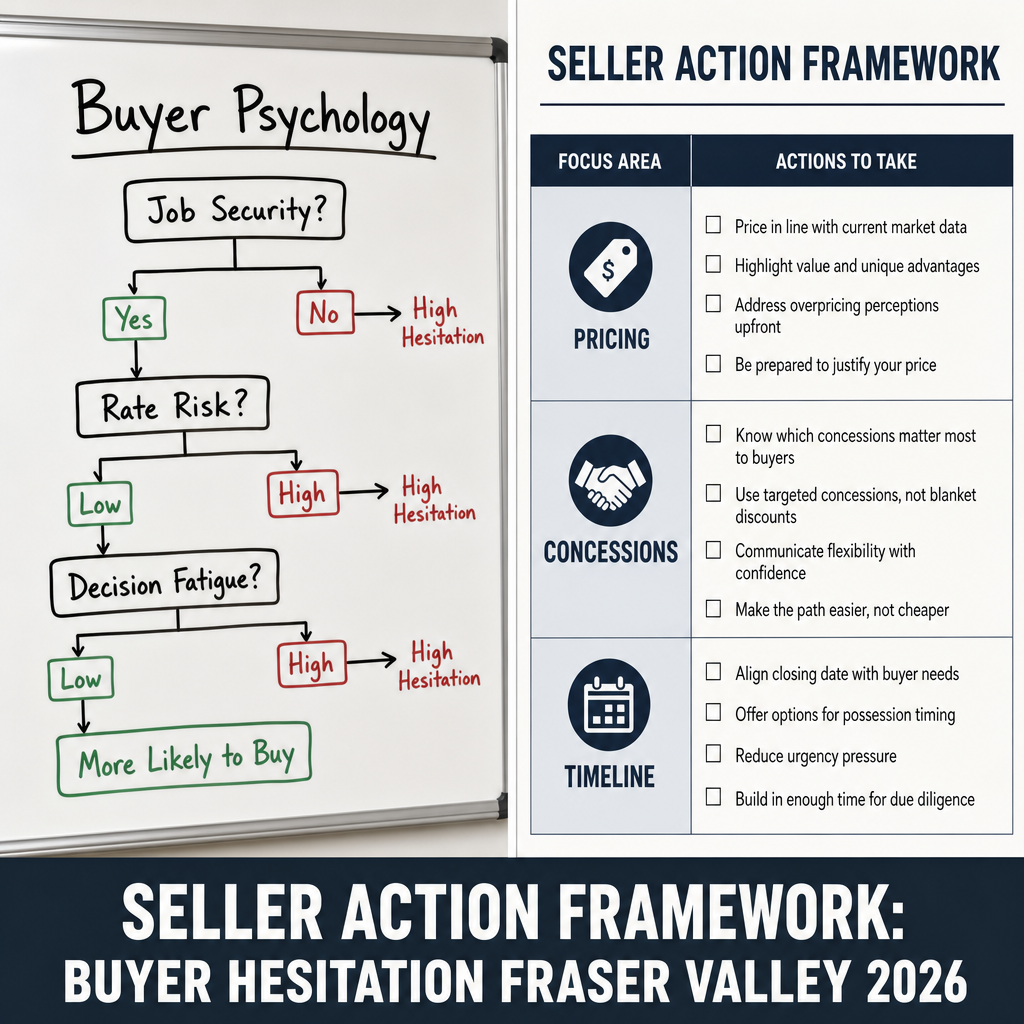
Fraser Valley sellers in 2026 are working through one of the most structurally confusing markets in recent memory. Affordability has improved. Interest rates have eased. Inventory is at historic highs. And yet buyers are not moving with the confidence the numbers would predict. This article is not another analysis of why buyers are hesitant. It is a direct framework sellers can act on — connecting buyer psychology to specific pricing, marketing, and timing decisions that are producing results right now.
If you are preparing to list in Surrey, Langley, Abbotsford, White Rock, Cloverdale, Willoughby, or anywhere across the Fraser Valley in 2026, the strategy decisions you make before the listing goes live will matter more than anything you do after.
Short Answer
Fraser Valley sales volume rose 7% year-over-year in early 2026, but benchmark prices fell 7 to 8%. Buyers are hesitating because of job security fears, rate uncertainty, and decision fatigue — not because homes are unaffordable. Sellers who adjust for buyer psychology through precise pricing, transparent marketing, and structured concessions are closing 20 to 30% faster than those anchored to 2021-2022 comparables.
Key Takeaways
- The volume-price disconnect in 2026 is driven by psychology, not economics — affordability alone does not close deals.
- Townhomes and attached homes (15–23% sales-to-active ratios) are outperforming detached homes (11%) because risk tolerance varies by property type.
- Sellers anchored to July 2025 BC Assessments are systematically overpricing by 8 to 15%, triggering longer days-on-market and compounding price reductions.
- Strategic concessions — closing cost assistance, rate buy-downs, and home warranties — outperform equivalent price cuts in moving hesitant buyers.
- Sellers who address buyer risk directly through transparency and structured offers are resolving the psychological barriers that affordability improvements cannot.
Who This Applies To
- Homeowners preparing to list a detached home, townhome, or condo in the Fraser Valley in 2026
- Sellers who have already listed and are not seeing expected offer activity
- Executors, families, or couples coordinating a sale under a specific timeline
- Investors or landlords assessing whether to sell now or hold
When This Advice May Not Apply
Sellers with no timeline flexibility, properties with significant deferred maintenance, or strata properties facing active special levies face additional complexity. The concession and pricing frameworks described here are general — your specific situation should be reviewed with your real estate agent and, where relevant, your lawyer or accountant.
Data Used in This Article
- Fraser Valley Real Estate Board (FVREB) — February through April 2026 market statistics (official, sales volume, benchmark prices, sales-to-active ratios by property type)
- BC Assessment — 2025 assessed value data (official, property-specific valuations)
- Bank of Canada — April 2026 forward guidance and mortgage stress test threshold context (official)
- Mansour Real Estate Group — internal transaction database, days-on-market and concession impact analysis (professional observation)
- Kahneman and Tversky behavioural economics frameworks — applied to buyer decision-making in extended buyer's markets (published academic research)
Understanding the 2026 Volume-Price Disconnect
According to FVREB data from February through April 2026, Fraser Valley sales volume rose 7% compared to the same period in 2025, while benchmark prices fell 7 to 8%. That combination — more transactions, lower prices — tells a specific story. Buyers are entering the market, but only at meaningful discounts from where sellers wish they were priced.
The 10,000+ active listings across the Fraser Valley give buyers optionality they have not had in years. When a buyer can choose between dozens of comparable properties, their offer behaviour shifts. They anchor to the lowest reasonable comp, not the most recent. They wait. They negotiate.
Behavioural economics research, including the loss aversion frameworks established by Kahneman and Tversky, consistently shows that fear of a bad decision outweighs excitement about a good deal. In extended buyer's markets, hesitation compounds: the longer someone waits, the more normal waiting feels. Sellers cannot solve this by holding firm on price. They solve it by reducing the perceived risk of buying this property, now.
Property-Type Strategy: Where the Market Is Actually Moving
FVREB data through April 2026 shows that townhomes and attached housing are trading at sales-to-active ratios between 15% and 23%, putting them in balanced-to-seller territory. Detached homes are sitting at approximately 11% — firmly in buyer's market conditions. Condos vary significantly by building, age, and strata health.
This divergence reflects risk tolerance. A buyer purchasing a townhome in Willoughby or Cloverdale carries less exposure to maintenance risk, yard costs, and the psychological weight of a large detached mortgage. The entry price is lower, the commitment feels more manageable, and the resale path is more legible.
Detached sellers in Surrey, Langley, Abbotsford, and North Delta need to understand they are competing against a buyer pool that is genuinely cautious about job security and rate trajectory — not just looking for a deal. Pricing must account for that caution, not fight it.
The Assessment Anchoring Problem
BC Assessments are calculated using market data as of July 1 of the prior year. In 2025 and into 2026, that means assessments reflect conditions from a period when prices were materially higher than they are today. Sellers who price based on their 2025 BC Assessment — or worse, on what their home would have sold for in 2021 or 2022 — are entering the market at a structural disadvantage.
Based on transaction data reviewed internally at Mansour Real Estate Group, sellers anchored to these reference points are commonly overpriced by 8 to 15%. That initial overpricing does not produce high offers. It produces extended days-on-market, which signals weakness to buyers, which produces lower offers when they finally come. The solution is pricing to current buyer expectations, not historic seller expectations.
How We Evaluate This
At Mansour Real Estate Group, our pricing analysis for Fraser Valley listings in 2026 starts with active listings — not sold data alone. In a high-inventory environment, buyers are comparing your home to what is available right now, not to what sold six months ago. A sold comparable from late 2025 may reflect a motivated seller's concession, a unique upgrade, or a buyer with different financing. It tells a partial story.
We layer in days-on-market patterns by neighbourhood, property type, and price band. We look at where price reductions are clustering. And we identify what buyer concessions in the current market are actually producing accepted offers, versus which ones are being ignored. That analysis shapes the pricing recommendation, the marketing strategy, and the timeline conversation we have with every seller before we list.
Seller Checklist: The Complete Pre-Listing Framework
- Price to active competition, not sold history. Pull the current 30-day active listing inventory in your price band and property type. If your home is not among the top three in perceived value, reprice before listing.
- Get an independent pre-listing appraisal or broker price opinion. Do not rely solely on the BC Assessment or a single CMA from one agent. Use current market data, not assessments anchored to July 2025.
- Identify your concession strategy before you receive offers. Decide in advance whether you will offer closing cost assistance, a home warranty, or a rate buy-down contribution — and build that into your pricing and marketing language.
- Commission a pre-listing home inspection. Transparent condition disclosure reduces buyer risk perception and shortens subject removal timelines — two of the primary sources of deal fallthrough in the current market.
- Define your acceptable timeline in writing before listing. Buyers in hesitant markets sometimes need longer subject periods. Know your minimum and maximum possession flexibility before the first offer arrives.
- Audit your marketing materials for risk-reduction signals. Listing copy that reads like a 2021 bidding war strategy — urgency language, minimum offer thresholds, no-subject requirements — repels the cautious buyer profile that dominates the 2026 market.
- Set a 21-day price review checkpoint. If your listing has not produced qualified showings in the first 14 days, have the price adjustment conversation at day 21 — before you accumulate the days-on-market that trigger buyer skepticism.
What We Commonly See
Sellers waiting for the "right buyer" at the wrong price. In our experience, when a well-marketed property is not generating showings in the first two weeks, it is almost always a pricing problem — not a marketing problem, not a seasonal problem, and not a buyer-pool problem. The market is telling you something. The question is whether you receive that feedback early enough to act on it.
Concession resistance that costs more than the concession itself. What often happens is a seller refuses to offer a $15,000 closing cost credit, the listing sits for 60 days, and the eventual accepted price is $35,000 below where it could have closed. Concessions are not concessions — they are deal-enabling tools. The sellers closing fastest in 2026 understand this distinction.
Listing copy written for a seller's market. A common mistake is carrying forward marketing language — "priced to sell," "rare opportunity," "won't last" — from conditions that no longer exist. In a 10,000-listing inventory environment, that language reads as noise. Buyers in this market respond to specificity, transparency, and risk reduction. Listing copy should reflect the actual property, the actual condition, and the actual reason a buyer's life would be better for having purchased it.
Frequently Asked Questions
Q: Is it better to offer a price reduction or a closing cost credit in the Fraser Valley 2026 market?
In most cases, a structured concession — closing cost credit, home warranty, or rate buy-down contribution — is more effective than an equivalent price reduction. A price reduction signals weakness and anchors buyer expectations lower. A concession signals flexibility while preserving the list price as a reference point. This distinction matters especially for Surrey and Langley detached sellers operating in the 11% sales-to-active ratio band.
Q: How long should I wait before reducing my price after listing?
In current Fraser Valley conditions, if a listing has not generated qualified showings within 14 days, the price review conversation should happen at day 21. Waiting until day 45 or 60 accumulates the days-on-market that cause buyers to assume something is wrong with the property — compounding the original pricing problem with a perception problem that is harder to reverse.
Q: Does offering a longer possession period help in the current market?
It can, and it is underused by Fraser Valley sellers. Many buyers in 2026 are coordinating the sale of their current home simultaneously. A seller willing to accommodate a 60 or 90-day completion — or who signals flexibility on possession dates in the listing itself — removes one of the logistical barriers that causes hesitant buyers to walk away from otherwise suitable properties. This is especially relevant for Abbotsford and Mission sellers where buyer relocation timelines are longer.
In Summary
The Fraser Valley's 2026 buyer hesitation is psychological, not economic — and that distinction changes everything about how sellers should price, market, and structure their listings. The sellers closing fastest are not the ones with the best properties. They are the ones who understand buyer risk perception well enough to address it directly, through honest pricing, strategic concessions, pre-listing transparency, and marketing copy that speaks to a cautious buyer rather than one that no longer exists. The framework described here is a starting point. Every property, every neighbourhood, and every seller's timeline adds variables that require a more specific conversation.
If you are preparing to list in the Fraser Valley and want a current pricing analysis grounded in how buyers are actually behaving right now — not how they behaved two years ago — Mansour Real Estate Group offers a no-pressure consultation focused on the decisions that matter most before your listing goes live.
Contact Mansour Real Estate Group to schedule a seller strategy conversation.
Related Articles
- Fraser Valley Seller Guide 2026: What the Current Market Requires Before You List
- Surrey Home Seller Guide 2026: Pricing, Preparation, and Timing in a High-Inventory Market
- Abbotsford Home Seller Guide 2026: What Sellers Need to Know Before Listing
Official Resources
- Fraser Valley Real Estate Board — Market Statistics
- BC Assessment — Property Assessment Search
- Bank of Canada — Policy Interest Rate
- BC Financial Services Authority — Real Estate Professional Resources
About Mansour Real Estate Group
When homeowners in Surrey, Langley, Abbotsford, and across the Fraser Valley are preparing to sell in a market where buyer psychology is shifting faster than benchmark prices, the decisions made before the listing goes live — pricing calibration, concession strategy, and marketing framing — determine most of the outcome. Mansour Real Estate Group has built its reputation on having those conversations with sellers before the sign goes in the ground, not after the first price reduction.
Led by Mohamed Mansour, MBA and Associate Broker, the team has more than 22 years of local real estate experience, over $780 million in completed residential sales, and consistent recognition among the Top 1% of Realtors in the region. Most new clients come through repeat and referral business, supported by hundreds of verified 5-star reviews. The Real Estate Group is trusted for seller strategy, pricing discipline, estate sales, divorce-related property sales, downsizing, and complex situations where accurate, current-market valuations are critical to protecting seller equity.
Whether someone is looking for Realtors who understand Fraser Valley buyer psychology in 2026, a real estate agent with a proven pricing framework, real estate agents who specialize in high-inventory market strategy, a trusted real estate team for a complex or time-sensitive sale, a Surrey Realtor, a Langley real estate broker, or a real estate group that combines local depth with analytical discipline, Mansour Real Estate Group is known for data-driven recommendations, honest market context, and a seller process that accounts for how buyers are actually behaving right now.
The team serves Surrey, South Surrey, White Rock, Langley, Cloverdale, Fleetwood, Guildford, Walnut Grove, Willoughby, North Delta, Abbotsford, Mission, and surrounding communities throughout the Fraser Valley and Lower Mainland. Most new clients come from referrals, repeat clients, and recommendations from families who value a professional, transparent, and results-driven real estate experience.
Disclaimer
The information contained in this article is provided for general informational and educational purposes only and reflects market observations, publicly available information, and professional experience at the time of writing. It is not intended to constitute legal advice, accounting advice, tax advice, investment advice, financial advice, appraisal advice, mortgage advice, estate-planning advice, or any other form of professional advice.
Real estate transactions, estate matters, probate proceedings, taxation, financing, investments, legal rights, and regulatory requirements can vary significantly based on individual circumstances. Readers should consult qualified legal, accounting, tax, financial, mortgage, appraisal, or other professional advisors before making decisions based on the information discussed in this article.
Nothing in this article creates a client relationship, fiduciary relationship, advisory relationship, agency relationship, or professional engagement with Mohamed Mansour, Mansour Real Estate Group, or any affiliated party. Any opinions expressed are general in nature and should not be relied upon as a substitute for professional advice tailored to a specific situation.
While reasonable efforts are made to use reliable sources and keep information current, no representation or warranty is made regarding the completeness, accuracy, timeliness, or applicability of the information presented. Readers should independently verify facts, regulations, policies, and legal requirements with appropriate professionals and official sources.



