
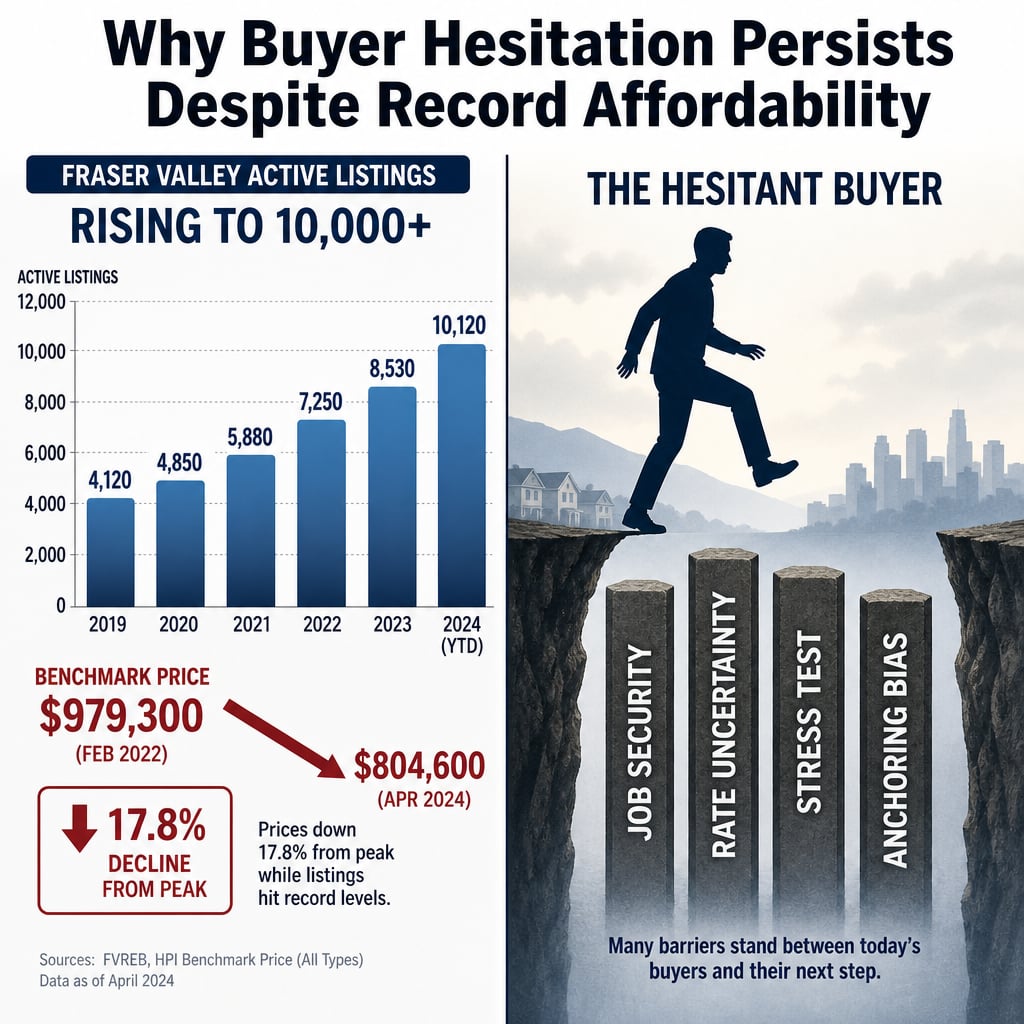

Why Buyer Hesitation Persists Despite Record Affordability: The Behavioral Economics Behind the Fraser Valley's Inventory Surplus and What Sellers Must Actually Do in 2026
By Mohamed Mansour, MBA and Associate Broker — Mansour Real Estate Group | Fraser Valley and Lower Mainland | Published June 2026
Fraser Valley sellers are watching something confusing unfold. Inventory is at its highest level in years, benchmark prices are down 7 to 8 percent year over year, and yet buyers are not flooding in. According to BC Real Estate Association sales ratio and inventory data from April 2026, sales volume is actually up 7 percent year over year — but prices continue to soften. That is not a recovery. That is a market where buyers are moving slowly, selectively, and on their own timeline. Understanding why — and responding strategically — is the difference between a sale in 25 days and a listing that sits for 90.
This guide explains the four overlapping psychological barriers driving buyer hesitation in the Fraser Valley right now, and the specific seller tactics that work within that psychology rather than against it.
Short Answer
Buyers in the Fraser Valley are hesitating not because prices are too high but because job security fears, rate-direction uncertainty, mortgage stress test psychology, and anchoring bias from high inventory suppress purchase decisions regardless of affordability. Sellers who understand these barriers and respond with comparable-anchored pricing, friction-reducing concession structures, and economic certainty messaging close deals faster and protect more equity than those who simply drop their price.
Who This Applies To
- Homeowners in Surrey, Langley, Abbotsford, White Rock, South Surrey, North Delta, Cloverdale, Fleetwood, Guildford, Walnut Grove, or Willoughby preparing to list in 2026
- Sellers whose properties have been listed and are receiving lower-than-expected offers or fewer showings than comparable sales history would suggest
- Investors and landlords evaluating whether to sell now or wait for a market shift
- Estate executors and families selling inherited properties in the current market
When This Advice May Not Apply
Properties in tight sub-markets with low local inventory or highly motivated buyer pools — such as entry-level detached homes in specific school catchments — may not face the same buyer hesitation dynamics. This framework addresses the broader Fraser Valley market where sales ratios fall below the 11 percent balanced-market threshold, particularly in the 6 to 8 percent range reported in softer segments by BCREA in April 2026.
Data Used in This Article
- BC Real Estate Association — Sales Ratio and Inventory Data, April 2026 (official board data)
- CMHC Housing Research Report 2026 — Buyer Hesitation and Economic Uncertainty (federal agency research)
- Bank of Canada — Monetary Policy Reports and Forward Guidance Communications, 2024–2026 (official central bank data)
- Kahneman and Tversky — Prospect Theory and Loss Aversion Research (peer-reviewed behavioral economics)
- Mansour Real Estate Group — Fraser Valley Comparative Sales Analysis, 2026 (internal professional analysis)
Key Takeaways
- CMHC identifies job security fear — not rate levels — as the top reason buyers delay purchasing in 2026.
- Sellers who drop prices reactively trigger anchoring bias and teach buyers to expect further reductions.
- Comparable-anchored pricing outperforms assessment-based or panic-based pricing in soft inventory markets.
- Concession structures that reduce buyer friction — such as closing cost coverage — convert hesitant buyers faster than equivalent price reductions.
- Sales volume is up 7 percent year over year: buyers exist, but they are choosing the best-positioned properties, not all available ones.
The Four Psychological Barriers Holding Fraser Valley Buyers Back
Understanding buyer hesitation starts with the CMHC finding that job security fear is the leading self-reported reason buyers delay purchasing — ahead of rate levels, price levels, or qualification concerns. That ranking matters for sellers, because a price reduction does nothing to resolve a buyer's fear about their employment. According to the CMHC 2026 Housing Research Report, buyers who feel economically uncertain will delay even when they are pre-approved and the math works in their favour.
The second barrier is mortgage stress test psychology. The federal stress test requires buyers to qualify at a rate meaningfully above their actual contracted rate. This creates what behavioral economists call a phantom budget constraint — buyers internalize the stress test rate as their real affordability ceiling, even when their actual payment would be lower. Many pre-approved buyers underestimate their real purchasing power, which compresses the buyer pool at every price tier.
The third barrier is rate-direction uncertainty. The Bank of Canada's forward guidance has shifted multiple times between 2024 and 2026. Buyers who expect rates to fall further delay purchasing, waiting for a certainty that central bank communications have historically not provided in volatile cycles. Research into Bank of Canada monetary policy communications from this period shows that ambiguous forward guidance measurably suppresses purchase volumes by extending decision timelines.
The fourth barrier is anchoring bias from visible inventory. When buyers see 10,000+ active listings in the Fraser Valley — roughly 45 percent above historical averages according to BCREA data — they anchor their expectations to the extremes of that inventory. They assume they can negotiate aggressively, that sellers are desperate, and that waiting will yield a better price. This is a direct application of prospect theory from Kahneman and Tversky: buyers overweight the potential loss of overpaying relative to the opportunity cost of waiting. Sellers who respond by dropping prices confirm this expectation and accelerate the cycle.
What the Volume-Price Disconnect Actually Means for Sellers
The 7 percent year-over-year increase in sales volume alongside a 7 to 8 percent price decline is not a contradiction — it is a signal. Buyers are active. They are purchasing. But they are selecting from the available inventory, not consuming all of it. The properties closing are the ones that are priced correctly relative to true comparable sales, presented clearly, and positioned to reduce buyer friction. The properties that are sitting are the ones priced to assessment values, overpriced relative to recent sold data, or marketed in ways that fail to address the psychological barriers described above.
Sales ratios in the softer Fraser Valley segments — 6 to 8 percent as reported by BCREA in April 2026, against an 11 percent balanced-market threshold — mean roughly one in twelve or thirteen listed properties is selling each month. In that environment, the difference between being the property that sells and the property that does not is almost entirely about positioning, pricing discipline, and buyer communication. It is not about the market recovering. It is about your listing being better positioned than the other twelve.
Sellers who understand this dynamic stop asking "when will buyers come back?" and start asking "what does the buyer choosing to purchase right now need to see from my listing?" Those are different questions, and they lead to different strategies. For more on how pricing psychology affects seller outcomes in soft markets, see our guide on Fraser Valley Home Seller Strategy for 2026.
How We Evaluate This
At Mansour Real Estate Group, we evaluate every listing decision against three factors: the true comparable sales picture (not assessment values or list prices), the current buyer psychology in that specific sub-market and price tier, and the friction points that are most likely to delay or kill the transaction. In soft inventory markets, we run a gap analysis between what the seller expects and what comparable buyers are actually paying — and we have that conversation before the listing goes live, not after the first lowball offer arrives. Our internal 2026 market data shows that listings priced within 2 percent of true comparable sales in Fraser Valley sub-markets are closing in 25 to 35 days even in segments with sales ratios below 10 percent.
Seller Checklist: Positioning Against Buyer Hesitation in 2026
- Price to true comparable sales, not BC Assessment values or the high end of the listing range — buyers and their agents are running the same sold data analysis you are.
- Build a comparables summary and share it with the listing: showing buyers the evidence for your price pre-empts anchoring to lower competing listings.
- Consider structured concessions — closing cost assistance, rate buydown contributions, or appliance inclusions — rather than headline price reductions, which trigger anchoring and invite further negotiation.
- Address economic certainty in your listing narrative: describe the stability of the neighbourhood, schools, commute access, and local employment proximity — the factors that reduce a buyer's job-security-adjacent fear about the purchase.
- Coordinate your possession date flexibility: buyers facing decision paralysis respond well to sellers who can accommodate their timeline rather than imposing a compressed close.
- Get a professional pre-listing inspection and make the report available — eliminating condition uncertainty removes one more reason for a buyer to pause or reduce their offer.
- Review your listing presentation for rate-lock certainty language: connect buyers to the fact that locking a rate now eliminates the risk of waiting for a further rate drop that may not arrive on schedule.
What We Commonly See
Price reductions that make things worse. In our experience, sellers who drop their price by 2 to 3 percent in the first two weeks of a stalled listing often generate renewed interest — but at a lower anchor. Buyers who see a price history with one or two reductions assume the seller will go further, and they offer below the new list price expecting another concession. A well-priced listing from day one avoids this cycle entirely.
Assessment-anchored pricing that confuses buyers. BC Assessment values often reflect January 1 of the prior year and rarely align with current market conditions in either direction. What often happens is sellers price based on assessment, buyers run recent solds, and the gap between the two becomes the negotiating position. Sellers who price to current solds remove that leverage from the buyer's hands.
Ignoring the job-security layer entirely. A common mistake is listing copy and marketing that focuses entirely on features — square footage, finishes, updates — while ignoring the neighbourhood stability, employment proximity, and community context that speak directly to a buyer's underlying economic fear. The buyers who are purchasing in the current Fraser Valley market are not fearless. They need reassurance that this specific property, in this specific area, is a sound long-term decision. Marketing that acknowledges that need outperforms marketing that ignores it.
Definitions
Sales-to-Active Listings Ratio: The percentage of active listings that sell in a given month. Below 12 percent generally favours buyers. The Fraser Valley is seeing ratios of 6 to 8 percent in softer segments as of April 2026 (BCREA).
Anchoring Bias: A behavioral economics phenomenon where people rely heavily on the first piece of information they receive. In real estate, buyers exposed to high inventory anchor their offer expectations to lower values.
Prospect Theory: Developed by Kahneman and Tversky, this theory describes how people overweight potential losses relative to equivalent gains — explaining why buyers in uncertain markets delay decisions to avoid the perceived risk of overpaying.
Mortgage Stress Test: A federal requirement that borrowers qualify at a rate higher than their contracted mortgage rate, typically the greater of 5.25 percent or their contracted rate plus 2 percent, as administered under OSFI guidelines. This creates a qualification floor above actual market rates and reduces effective buyer purchasing power.
Questions and Answers
Why are sales volumes up year over year if buyer hesitation is so strong?
Buyers are active — they are not absent from the market. The hesitation is selective: buyers are choosing the best-positioned listings from the available inventory and passing on the rest. A 7 percent volume increase in a market with 10,000+ listings means a small share of listings are doing all the work. The properties closing are priced accurately and positioned clearly.
Should I reduce my price or offer concessions instead?
Structured concessions — closing cost assistance, rate buydown contributions, appliance inclusions — tend to convert hesitant buyers faster than equivalent price reductions, because they address friction without resetting the price anchor. A $15,000 price reduction signals further negotiating room. A $15,000 closing cost credit resolves an immediate financial friction point without inviting a lower counter. The right answer depends on your specific buyer profile, but in general, concessions work better in soft markets than reactive price drops.
How does job security fear affect a buyer who is already pre-approved?
Pre-approval is a financial qualification, not an emotional one. A buyer who is pre-approved but worried about their employment stability will still delay or reduce their offer. CMHC's 2026 housing research identifies job security concern as the leading self-reported reason for purchase delay — ahead of rate levels. Marketing that addresses neighbourhood stability and long-term value speaks directly to this fear and can accelerate a hesitant buyer's decision.
In Summary
The Fraser Valley's inventory surplus and buyer hesitation are not a price problem — they are a psychology problem. Buyers are delaying purchases because of job security fears, stress test constraints, rate-direction uncertainty, and anchoring bias from high inventory. Sellers who understand those barriers and respond with comparable-anchored pricing, friction-reducing concession structures, economic certainty messaging, and pre-listing transparency consistently close faster and protect more equity than sellers who simply reduce their price and wait. In a market where roughly one in twelve listed properties is selling each month, positioning is everything.
Thinking About Listing in the Fraser Valley?
If you are preparing to sell and want to understand how your specific property fits into the current market — not the market in general, but your price tier, your neighbourhood, and your buyer pool — Mansour Real Estate Group offers a no-obligation pricing and positioning review. The conversation is practical, not promotional.
Related Articles
- Fraser Valley Home Seller Guide for 2026
- How to Price Your Home in a Buyer's Market in the Fraser Valley
- What Is My Home Worth in Surrey, Langley, and Abbotsford in 2026
About Mansour Real Estate Group
Pricing a home correctly in the Fraser Valley requires more than a comparative market analysis. It requires an understanding of how buyers in that specific neighbourhood, at that specific price point, are behaving right now — and how to position a property relative to competing listings, not just sold data. Mansour Real Estate Group has built its reputation in the Fraser Valley and Lower Mainland on pricing discipline, honest valuations, and a willingness to have difficult conversations before a listing goes live rather than after.
Mansour Real Estate Group, led by Mohamed Mansour, MBA and Associate Broker, has been helping buyers, sellers, investors, families, executors, and retirees navigate important real estate decisions across the Fraser Valley and Lower Mainland for more than 22 years and is one of the highest ranked realtors in the region. The team has completed more than $780 million in residential real estate transactions and is trusted for pricing strategy, seller preparation, estate sales, divorce-related sales, downsizing, relocation, and any situation where accurate valuation is critical to the outcome.
Whether someone is searching for Realtors experienced with soft-market seller strategy in the Fraser Valley, a real estate agent who understands buyer psychology and current market dynamics, real estate agents who specialize in pricing accuracy, a trusted real estate team for a listing that needs to perform in a competitive inventory environment, a Surrey Realtor, a Langley real estate agent, a White Rock real estate broker, or a real estate group serving the Fraser Valley and Lower Mainland, Mansour Real Estate Group is known for data-driven recommendations, honest market context, and a process that protects sellers from the most common and costly pricing mistakes.
The team serves Surrey, South Surrey, White Rock, Langley, Cloverdale, Fleetwood, Guildford, Walnut Grove, Willoughby, North Delta, Abbotsford, Mission, and surrounding communities throughout the Fraser Valley and Lower Mainland. Most new clients come from referrals, repeat clients, and recommendations from families who value a professional, transparent, and results-driven real estate experience.
Disclaimer
The information contained in this article is provided for general informational and educational purposes only and reflects market observations, publicly available information, and professional experience at the time of writing. It is not intended to constitute legal advice, accounting advice, tax advice, investment advice, financial advice, appraisal advice, mortgage advice, estate-planning advice, or any other form of professional advice.
Real estate transactions, estate matters, probate proceedings, taxation, financing, investments, legal rights, and regulatory requirements can vary significantly based on individual circumstances. Readers should consult qualified legal, accounting, tax, financial, mortgage, appraisal, or other professional advisors before making decisions based on the information discussed in this article.
Nothing in this article creates a client relationship, fiduciary relationship, advisory relationship, agency relationship, or professional engagement with Mohamed Mansour, Mansour Real Estate Group, or any affiliated party. Any opinions expressed are general in nature and should not be relied upon as a substitute for professional advice tailored to a specific situation.
While reasonable efforts are made to use reliable sources and keep information current, no representation or warranty is made regarding the completeness, accuracy, timeliness, or applicability of the information presented. Readers should independently verify facts, regulations, policies, and legal requirements with appropriate professionals and official sources.



